
Self-Billing in France: Autofacturation Under E-Invoicing
When a buyer may issue its supplier's invoice in France: the written billing mandate, the Autofacturation mention, type code 389 and who sends which status.

A buyer in France may issue the invoice for its supplier only under a written, prior billing mandate (mandat de facturation), and the supplier must accept each invoice. The tax code (Code général des impôts, CGI) puts it this way in article 289 I-2: the invoices may be issued by the client or a third party where the supplier gives a mandate, and each invoice is then issued in the supplier's name and on its behalf, subject to its acceptance. The invoice must carry the word « Autofacturation » (self-billing) and a self-billing type code, 389 for an ordinary invoice.
This page is for the procurement or accounts-payable lead at a marketplace, a cooperative or a transport buyer that already invoices on behalf of its suppliers. It covers the buyer-issues-the-invoice case. It does not cover sector-specific schemes. Belgium's Peppol self-billing is in a separate article. GoRoute is a certified Peppol Access Point and SMP (POP000991). It is not a plateforme agréée (approved platform); that list is published on impots.gouv.fr. Nothing here is tax advice.
When may a buyer issue the invoice?
When the supplier has authorised it in advance and in writing. The law starts from the supplier's own duty. Article 289 I-1 says every taxable person must make sure an invoice is issued, by itself or by its client or a third party on its behalf. Handing the writing of the invoice to the buyer does not remove that duty.
Annex II to the CGI, article 242 nonies, sets three conditions for a mandate:
- A written and prior mandate (un mandat écrit et préalable) must exist.
- The supplier tells the administration in writing the name and address of the client or third party, where that party regularly issues invoices in the supplier's name. The supplier files a statement with its tax office by the same deadline as its results return.
- Each invoice is issued as soon as the supply is made. The periodic summary invoice allowed by article 289 I-3 cannot be used.
The second condition is easy to miss. It is the supplier's filing, not the buyer's. If you are the buyer, ask each supplier to confirm it has made it.
What must a self-billed invoice say?
It must carry the mention « Autofacturation » and a self-billing type code. The mention comes from article 242 nonies A I 14° of annex II: where the buyer issues the invoice in the name and on behalf of the supplier, the invoice says « Autofacturation ». All the usual mentions remain, such as the identification of both parties, the date, the number and the VAT detail.
The type codes are in rule G1.01 of annex 7 of the specifications, version 3.2 of 30 April 2026:
| Code | Document |
|---|---|
| 389 | Facture auto-facturée (self-billed invoice) |
| 500 | Facture d'acompte auto-facturée (self-billed deposit invoice) |
| 261 | Avoir auto-facturé (self-billed credit note) |
| 471 | Facture rectificative auto-facturée (self-billed corrective invoice) |
| 501 | Facture auto-facturée affacturée (self-billed, factored) |
| 502 | Avoir auto-facturé affacturé (self-billed credit note, factored) |
Two details matter for numbering. The platform treats invoice number, year of issue and the supplier's SIREN together as the invoice's identity, and rejects a duplicate. For a billing mandate, rules G1.42 and G1.45 add that the invoice number must carry a root of its own for the mandated party, so that its numbers never collide with the supplier's own.
Who does what, step by step?
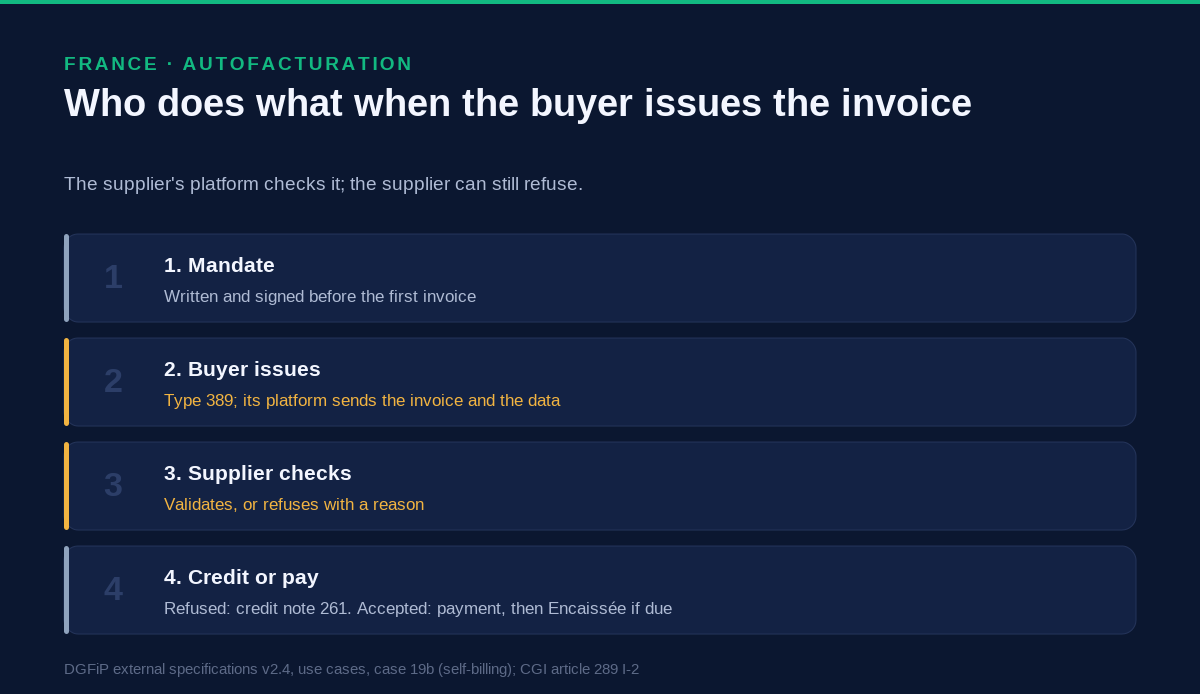
The buyer issues, the supplier's platform receives and the supplier decides. The specifications' use-case file draws this as case 19b. That file is version 2.4 of June 2024. Version 3.2 does not include a use-case file, so treat the sequence as the administration's last published drawing, and check it with your platform.
| Step | Party | What happens |
|---|---|---|
| 1 | Supplier and buyer | Sign the billing mandate. |
| 2 | Buyer or its representative | Creates the invoice. Its platform sends the invoice (flow 2) to the supplier's platform and the invoice data (flow 1) to the administration. |
| 3 | Supplier | Receives it and either validates or refuses it. |
| 4 | Supplier's platform | Sends the validation status to the buyer's platform. On a refusal it sends the status and the reason to the buyer's platform and the administration, and the refusal cancels the data flow. |
| 5 | Buyer or its representative | After a refusal, issues a credit note (261) citing the invoice. Otherwise the buyer pays. It may send the optional payment sent status. |
| 6 | Supplier | Records the payment. Its platform sends the payment received status, where payment data is due, to the administration and the buyer's platform. |
Two readings of ours. Under table 8 of the version 3.2 general file, the Déposée status is attested by the platform that issued the invoice. In self-billing that is the buyer's platform. And a credit note after a refusal is a document sent to the supplier, unlike the internal credit note the supplier writes when a normal invoice is refused; the difference is explained in credit notes in French e-invoicing.
What changes for the supplier?
The supplier gives up writing the invoice but not responsibility for it. Four duties stay with the supplier.
- Accept or refuse each invoice. The statute makes acceptance part of the mechanism.
- Report payment where VAT is due on receipt. The Encaissée status is sent by the supplier, not the buyer. See French e-invoice statuses.
- File the mandate statement with its tax office, as annex II requires.
- Choose a platform that can receive a self-billed invoice and send the refusal and payment statuses.
For a buyer, the practical consequence is a supplier file: the mandate, the supplier's SIREN and platform address, and the confirmation of its filing. The supplier's address is found through the directory.
What is still unclear?
Three things we could not settle from the sources read. Say so to your platform before go-live.
- The current drawing of the process. Version 3.2 of the specifications has no use-case file, and version 2.4 is the last that does. In version 2.4 the code for a self-billed corrective invoice was "to be determined". Version 3.2 now lists 471, which shows the file has moved on.
- Who sends Déposée in self-billing. We read it as the buyer's platform, but no sentence says so.
- Third-party billing agents. The version 2.4 file also draws a billing representative, a third party that issues for the supplier (case 19a). We do not cover it here.
What to do next
- List the suppliers you invoice for and check each one has a written mandate and has filed its statement.
- Print « Autofacturation » on every self-billed invoice and use type 389, or 261 for a credit note.
- Give your mandated invoices their own number root.
- Agree the refusal path with each supplier: the reason, the credit note 261 and who raises it.
- Read the rest of the set: credit notes, deposit and final invoices and archiving.
- To plan a self-billing flow across countries, book a demo. See also E-invoice sending and tracking, the tutorials, the developer documentation and the country page for France.
Related reading
- Self-Billing in Belgium Under E-Invoicing
- France E-Invoicing Mandate 2026
- Correcting a Self-Billed Invoice in Oman
Sources, all read on 26 November 2026: Code général des impôts, article 289 (I-1, I-2, I-3), and annex II, articles 242 nonies and 242 nonies A, text read from the droit.org copy of Légifrance data; impots.gouv.fr, Spécifications externes et normes pour la facturation électronique (page modified 2 July 2026): version 3.2 of 30 April 2026, annex 7 (rules G1.01, G1.42, G1.45) and general file (table 8); version 2.4 of 19 June 2024, use cases, case 19b (English file), now superseded. Translations from the French are ours. Passages marked as our reading are not the administration's wording.
Frequently asked questions
- Can a buyer issue invoices on behalf of its supplier in France?
- Yes, with a mandate. Article 289 I-2 of the tax code says invoices may be physically issued by the client or a third party where the taxable person gives a mandate to do so, and each invoice is then issued in the supplier's name and on its behalf, subject to the supplier's acceptance. Annex II to the code requires the mandate to be written and prior.
- What mention must a self-billed invoice carry?
- The word Autofacturation. Article 242 nonies A I 14° of annex II to the tax code requires it where the buyer issues the invoice in the name and on behalf of the taxable person.
- Which invoice type codes apply to self-billing?
- Rule G1.01 of annex 7 lists 389 for a self-billed invoice, 500 for a self-billed deposit invoice, 261 for a self-billed credit note and 471 for a self-billed corrective invoice. The factored variants are 501 and 502.
- What happens if the supplier refuses a self-billed invoice?
- In the specifications' version 2.4 use cases, the supplier's platform sends a refusal status with the reason to the buyer's platform and the administration, and refusing the invoice cancels its data flow. The buyer then issues a credit note, type 261, citing the refused invoice (BT-25).
- Who reports the payment on a self-billed invoice?
- The supplier. In the version 2.4 case, the supplier's platform sends the payment received status, where payment data is due, to the administration and to the buyer's platform. The buyer may send an optional payment sent status.
About Dr. Syed Raza
Dr. Syed Raza is an IT Enterprise Architect at ClayDesk LLC and leads the GoRoute platform. He works across Peppol Access Point and SMP infrastructure, PINT jurisdictions (Oman, AU/NZ, EU, JP, MY, SG), and national CTC regimes, translating regulatory detail into production-grade e-invoicing systems.
Building on Peppol?
GoRoute is a certified Peppol Access Point & SMP. Book a demo or read the docs to get started.