
Self-Billing in Belgium Under the E-Invoicing Mandate
Self-billing is still allowed in Belgium with a prior agreement and an acceptance step, and it runs on Peppol. Who sends what, document types and credit notes.

The short answer
Self-billing is still allowed in Belgium after the e-invoicing mandate began on 1 January 2026, on two conditions the federal e-invoicing site states: a prior agreement between both parties, and an acceptance procedure for each invoice by the supplier. It also says plainly that "self-billing is possible via Peppol". The customer raises the invoice in the supplier's name and sends it to the supplier as a Peppol BIS Self-Billing 3.0 document, not as an ordinary invoice.
This page is for the finance lead of a buyer that self-bills, and for the supplier who receives those invoices. It covers the agreement, who sends what, the document types and how credit notes work. It does not cover Oman or Australia, which use different self-billing specifications.
What is self-billing, and who is it for?
In self-billing the buyer prepares the invoice for goods or services it has consumed, based on its own records, and sends it to the supplier. The Peppol specification describes it this way: the customer issues the invoice in the supplier's name, books it as a purchase and as accounts payable, and the supplier receives it and processes it as revenue.
It suits situations where the buyer knows the quantity better than the seller does: a retailer paying a supplier for goods sold through its stock, a platform paying its sellers, a manufacturer paying for materials it has weighed in. Where the supplier knows the amount, ordinary invoicing is simpler.
Is self-billing still allowed under the Belgian mandate?
Yes. The federal FAQ answers it directly: the rules on self-billing remain unchanged. It remains authorised if:
- There is a prior agreement between both parties, and
- Each invoice is subject to an acceptance procedure by the taxable person making the supply, that is, the supplier.
The same answer says self-billing can run through Peppol. The agreement and the acceptance step are not new, but the mandate changes what must happen once you have them: the invoice itself has to be a structured e-invoice sent over Peppol. If both parties are Belgian VAT-registered businesses, a PDF of a self-billed invoice sent by email is the same kind of failure as a PDF of an ordinary one. Our penalties article covers what that costs.
The grace period is over. The federal FAQ allowed flexibility until 30 June 2026 for companies whose software provider was still building self-billing support, on condition that they could show the provider was working on it. That date has passed.
Who sends what on Peppol?
The direction is the reverse of an ordinary invoice.
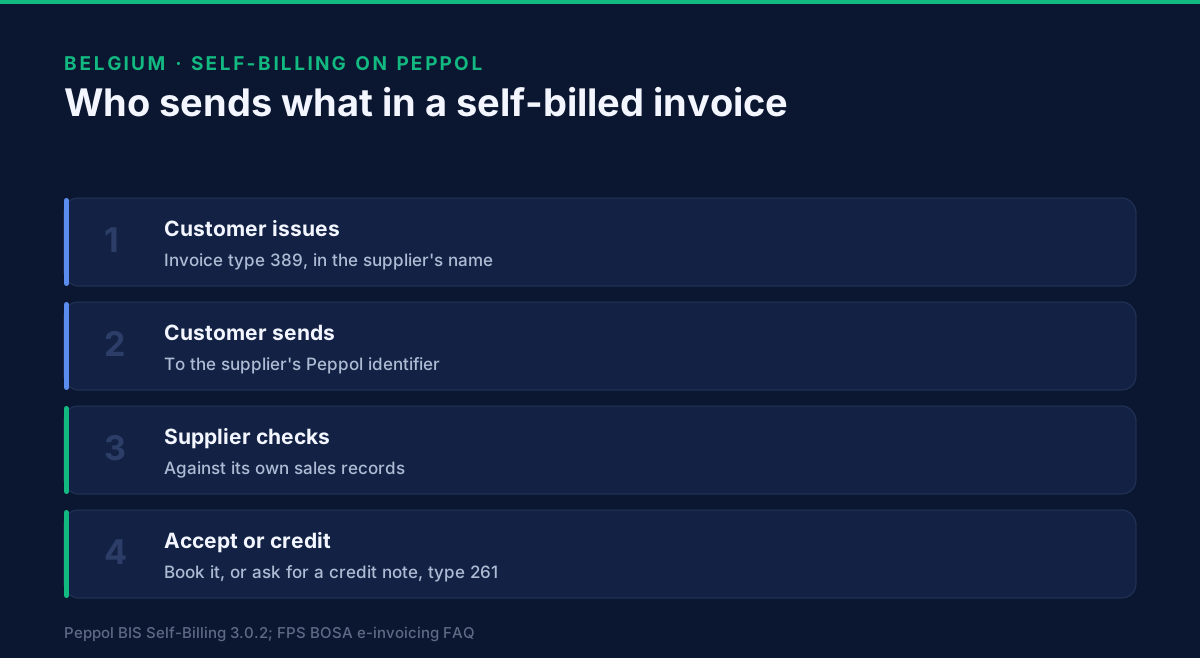
| Step | Who | What happens |
|---|---|---|
| 1 | Customer (buyer) | Issues a self-billed invoice in the supplier's name, from its own purchase and goods-received records. |
| 2 | Customer's access point | Sends the document to the supplier's Peppol identifier. |
| 3 | Supplier's access point | Receives it and hands it to the supplier. |
| 4 | Supplier | Checks it against its own sales records. This is the acceptance step. |
| 5a | Supplier | Accepts: books it as revenue and a receivable. |
| 5b | Supplier | Rejects or disputes: contacts the buyer and asks for a self-billed credit note, or a credit note plus a new invoice. |
This follows the process in the Peppol BIS Self-Billing 3.0 specification (version 3.0.2, process P12). Two consequences follow for Belgium.
The supplier must be reachable on Peppol. The buyer sends to the supplier's identifier, so a supplier that has not registered cannot receive its own self-billed invoices. For a Belgian business that identifier is the enterprise number under scheme 0208; see our guide to the number and its check digit. Since Hermes closed, a business that did not appoint a provider is not reachable by default.
The buyer needs sending capability, the supplier needs receiving capability. Many suppliers who never expected to receive invoices are now the receiving party. Our guide to receiving supplier e-invoices in Belgium covers the steps.
Which document types does it use?
Self-billing has its own Peppol specification, separate from the Billing 3.0 specification used for ordinary invoices. Under it:
- A self-billed invoice uses UNCL1001 type code 389.
- A self-billed credit note uses type code 261.
- The customization identifier is
urn:cen.eu:en16931:2017#compliant#urn:fdc:peppol.eu:2017:poacc:selfbilling:3.0, and the process profile isurn:fdc:peppol.eu:2017:poacc:selfbilling:01:1.0.
The ordinary invoice (380) and credit note (381) cannot stand in for these. Peppol identifies each document by its type and customization identifier, so our reading is that a self-billed invoice sent as an ordinary one risks being refused or misread at the other end. Test it before you rely on it.
The specification is a Core Invoice Usage Specification of EN 16931, so a self-billed invoice carries the same content as an ordinary one: parties, lines, VAT breakdown and totals. Only how it is raised and exchanged differs.
How do credit notes work?
The specification gives two ways to correct a self-billed invoice:
- A self-billed credit note (code 261). The function of crediting is carried by the document type, and the sign of the amounts is not affected.
- A negative self-billed invoice (code 389 with a negative amount). Here the sign carries the meaning, and the type code has no bearing on the crediting.
Pick one method per agreement and write it in. A supplier whose system expects code 261 will not know what to do with a negative 389. As with ordinary invoices, a correction sent as an emailed PDF fails the structured-invoice requirement.
What belongs in the prior agreement?
The Belgian rules require an agreement, but the federal FAQ does not give a template. Based on how the Peppol process works, the agreement is the right place to settle:
- Which party raises the invoice and from which records.
- How long the supplier has to accept or dispute, and how a dispute is raised.
- Whether corrections use a credit note (261) or a negative invoice (389).
- Which Peppol identifiers each side uses and who tells the other if they change.
- What happens if either side's access point is down.
This list is our suggestion drawn from the process, not a legal requirement. Have your adviser check the wording.
Does GoRoute support self-billing?
Yes, at API level. GoRoute's platform recognises Peppol BIS Self-Billing 3.0 invoices and credit notes, checks them against the official self-billing rules rather than the ordinary billing rules, and sends them from the buyer's side to the supplier's access point. That is what the code does today. We have not published a Belgium-specific self-billing walkthrough yet, so test your own document flow in the sandbox before you rely on it, and see the API integration guide.
What to do next
- List your self-billing relationships and check each has a written agreement with an acceptance step.
- Confirm both sides are registered on Peppol and can handle codes 389 and 261.
- Agree the credit method and the dispute window.
- Send a test pair: an invoice and a credit note.
For related questions, see how to invoice the Belgian government through Mercurius, whether small businesses must e-invoice and the 120% tax deduction for e-invoicing costs.
To walk a self-billing flow through our access point with the team, book a session. Recorded walkthroughs are on tutorials, the Belgian regime is on our Belgium page and the technical reference is in the developer documentation.
Sources: FPS BOSA e-invoicing site, FAQ on the B2B obligation (questions 10 and 23); Peppol BIS Self-Billing 3.0, version 3.0.2, sections 3 and 4.6. Product behaviour is from GoRoute's own platform. This is not legal or tax advice.
Frequently asked questions
- Is self-billing allowed in Belgium under the e-invoicing mandate?
- Yes. The federal e-invoicing site says the rules on self-billing are unchanged. It stays authorised if there is a prior agreement between both parties and each invoice goes through an acceptance procedure by the supplier. It also says self-billing is possible via Peppol.
- Who sends the invoice in self-billing?
- The customer. The customer issues the invoice in the supplier's name and sends it to the supplier, who receives it as a sales invoice. On Peppol the customer's access point sends and the supplier's access point receives.
- Which Peppol document type is used for a self-billed invoice?
- Peppol BIS Self-Billing 3.0. A self-billed invoice uses UNCL1001 type code 389 and a self-billed credit note uses code 261. These are different documents from an ordinary invoice, code 380, and credit note, code 381.
- Is there still a grace period for self-billing software in Belgium?
- No. The federal FAQ gave flexibility until 30 June 2026 to companies whose software provider was still building self-billing support. That date has passed, so self-billed invoices should now be structured and sent over Peppol.
About Dr. Syed Raza
Dr. Syed Raza is an IT Enterprise Architect at ClayDesk LLC and leads the GoRoute platform. He works across Peppol Access Point and SMP infrastructure, PINT jurisdictions (Oman, AU/NZ, EU, JP, MY, SG), and national CTC regimes, translating regulatory detail into production-grade e-invoicing systems.
Building on Peppol?
GoRoute is a certified Peppol Access Point & SMP. Book a demo or read the docs to get started.