
French E-Invoice Statuses: Which Ones Are Mandatory
Four lifecycle statuses are mandatory on a French e-invoice: Déposée, Rejetée, Refusée and Encaissée. Who sends each, and rejected versus refused.

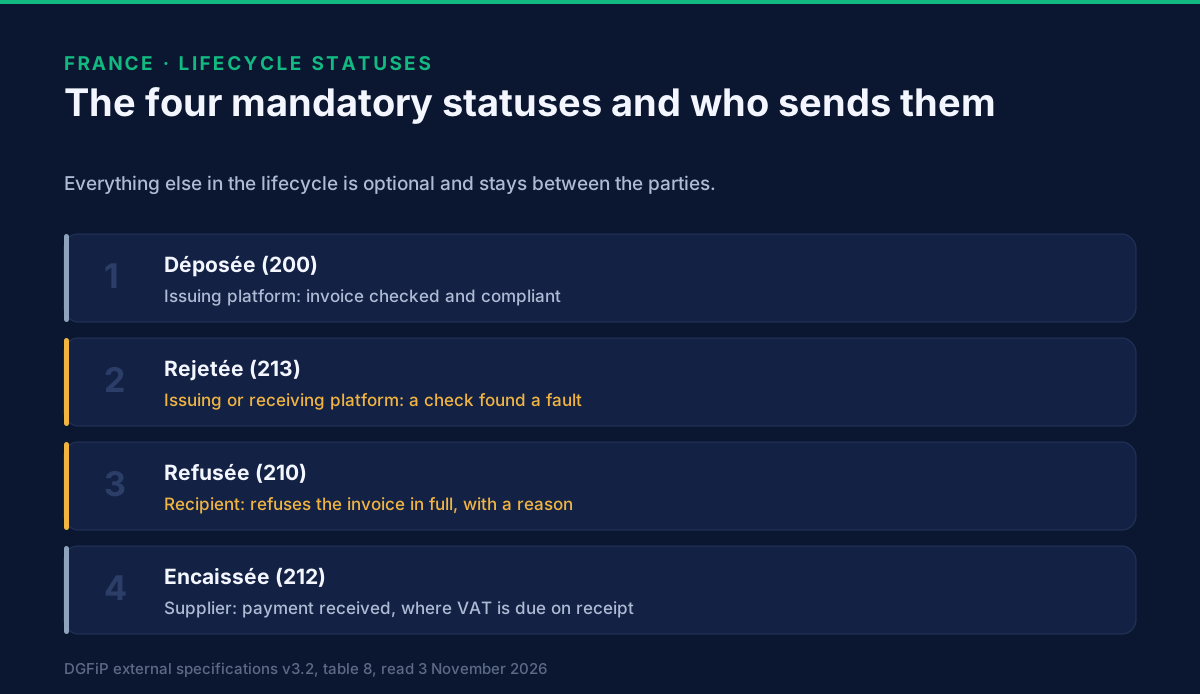
Four lifecycle statuses are mandatory on a French e-invoice: Déposée (filed), Refusée (refused), Encaissée (paid) and Rejetée (rejected). Each is sent by a different party. The platform that issued the invoice attests it as filed. Either platform may reject it after a check. The recipient may refuse it. The supplier reports payment received, and only where VAT is due on receipt. All other statuses are optional and are not sent to the tax administration.
This page is for the accounts-payable or finance lead who wants to know what comes back after an invoice is sent, and which messages their own team has to send. It uses the administration's external specifications, version 3.2 of 30 April 2026. The e-reporting calendar is in France's e-invoicing mandate and is not repeated here. GoRoute is a certified Peppol Access Point and SMP (POP000991). It is not a plateforme agréée; the list is published on impots.gouv.fr.
What is the lifecycle of a French e-invoice?
It is the chain of status messages that lets everyone involved follow an invoice from filing to payment. The specification names the parties: supplier, buyer, the approved platforms, the public invoicing portal and the tax administration. Statuses are exchanged in a structured message called CDAR, the UN/CEFACT Cross Domain Application Response. The list of statuses and their format come from the AFNOR standard XP Z12-012, which the specification refers to.
The lifecycle has two layers. A core of mandatory statuses is required by the administration and needed by every party. Optional statuses are not sent to the administration, but are recommended for the exchanges between the parties.
Which statuses are mandatory?
Four, out of fourteen in the specification's table. The table says its list is not exhaustive.
| Code | Status | Mandatory | What it means in the specification |
|---|---|---|---|
| 200 | Déposée | Yes | The supplier's invoice reached its issuing platform, which attests that it was checked and is compliant |
| 213 | Rejetée | Yes | A functional check by the issuing or receiving platform found a fault in the invoice |
| 210 | Refusée | Yes | The recipient refuses the invoice in full |
| 212 | Encaissée | Yes | Under article 290 A of the tax code, the supplier reports a partial or full payment received |
The optional ones are Émise par la plateforme (201), Reçue par la plateforme (202), Mise à disposition (203), Prise en charge (204), Approuvée (205), Approuvée partiellement (206), En litige (207), Suspendue (208), Complétée (209) and Paiement transmis (211).
Who sends each mandatory status?
The issuing platform sends Déposée, either platform may send Rejetée, the recipient sends Refusée, and the supplier sends Encaissée. The table gives the sender in its definitions rather than in a column, so this is our summary of them.
- Déposée is the issuing platform's attestation. It also starts a clock: the platform has 24 hours from the Déposée status to send the invoice's regulatory data to the public portal.
- Rejetée comes from a functional check. The checks apply the European rules (EN 16931), the French reform's own rules, field lengths and reference values.
- Refusée is the recipient's decision.
- Encaissée is the supplier's report of a payment received.
Mandatory-status flows go to the public portal within 24 hours of the status timestamp.
What is the difference between Rejetée and Refusée?
A rejection is a system's finding that the invoice is faulty. A refusal is a person's decision to turn it down. The effects on the supplier are the same, and the origin is not.
- Rejetée (213) comes from the checks run by the issuing or receiving platform, and its definition names a fault found in the invoice.
- Refusée (210) is the recipient's act. The administration's FAQ gives an example, a recipient who is not the intended one. It says the refusal needs a stated reason, is final, is done in the recipient's own interface, and that the supplier is informed.
For both, the specification tells the supplier to cancel the invoice in its accounts by an internal credit note. That cancellation must not generate a regulatory data flow to the administration.
Rejection also applies to the data itself. A separate pair of statuses reports on the regulatory data
flow: Déposée (250), accepted and taken into account by the administration, and Rejetée (251), not
integrated. For mandatory statuses, the rejection reasons include inconsistent statuses, unauthorised
statuses, business-rule failures and missing rights. One reason applies to payments, REJ_ENCAISSEMENT:
the amounts reported as received do not match the split by VAT rate.
When is Encaissée required?
Only where VAT is due when the payment is received. The FAQ says this covers, for example, services and deposits. The status is not needed if the supplier opted to pay VAT on debits, or if the customer accounts for the VAT itself.
Where the sale was invoiced electronically, the supplier completes an Encaissée status attached to the invoice with the date received and the amount received, split by VAT rate. A supplier on a monthly regime sends it monthly; one on the franchise en base sends every two months. The FAQ states those two examples. The full table of frequencies is in a separate annex that we have not reproduced.
The option on the invoice that decides this is one of the four new mentions, described in The Four New Mentions on French Invoices.
What about disputes?
They use optional statuses, and they stay between the parties. The FAQ says that where an invoice does not match the quote or contract, or carries errors, provisional statuses are provided so that the supplier learns of the dispute. The specification names En litige (207), Suspendue (208), when the recipient wants more supporting documents, and Approuvée partiellement (206). Complétée (209) is how the supplier replies with those documents.
None of these is sent to the tax administration. If your process depends on seeing them, check that your platform shows them to you. Ask this before signing: "what comes back to us, and where do we see it?"
What to do next
- Map the four mandatory statuses to your ERP, especially Encaissée, which your finance team sends.
- Decide who owns the Rejetée and Refusée queue, because each one needs an internal credit note.
- Check which optional statuses your platform exposes, and whether they appear in your system.
- Read the other pages in this set: the directory, the four new mentions and invoicing French customers from abroad.
- To discuss e-invoicing across several countries, book a demo. The tutorials, the developer documentation and the GoRoute API show how documents and responses are handled on the Peppol network.
Related reading
- E-invoicing in France, the country page.
- France E-Invoicing Mandate 2026
- Invoice validation errors you can prevent
- Peppol vs PINT, the standards background.
Sources, all read on 3 November 2026: impots.gouv.fr, Spécifications externes et normes pour la facturation électronique (page modified 2 July 2026), external specifications version 3.2 of 30 April 2026, chapter 3.6 (table 8, sections 3.6.4 to 3.6.10); impots.gouv.fr, Foire aux questions, je découvre la facturation électronique, version of 1 September 2026, questions 3.2, 10.1, 10.3 and 10.4. Translations from the French are ours. Passages marked as our summary are not the administration's wording.
Frequently asked questions
- Which lifecycle statuses are mandatory on a French e-invoice?
- Four: Déposée (code 200), Refusée (210), Encaissée (212) and Rejetée (213). The external specifications list ten others, such as Prise en charge, Approuvée and En litige, as optional. Optional statuses are not sent to the tax administration.
- What is the difference between rejected and refused?
- Rejetée means a platform's automatic check found a fault in the invoice. Refusée means the recipient decided to refuse it in full, with a reason, in its own interface. In both cases the supplier cancels the invoice in its books with an internal credit note, and this does not generate a new data flow to the administration.
- Who sends the Encaissée status?
- The supplier. It tells the platform that a partial or full payment was received, with the date and the amount per VAT rate. It is mandatory only for operations where VAT is due on receipt, not for a supplier that opted to pay VAT on debits.
- How fast must mandatory statuses reach the administration?
- The specification gives platforms 24 hours. The invoice data flow is due within 24 hours of the Déposée status. A mandatory-status flow is due within 24 hours of the status timestamp.
- Can a recipient dispute an invoice without refusing it?
- Yes. The administration's FAQ says provisional statuses let the recipient tell the supplier about a dispute, for example when the invoice does not match the quote or contract. The specification lists En litige, Suspendue and Approuvée partiellement as optional statuses.
About Dr. Syed Raza
Dr. Syed Raza is an IT Enterprise Architect at ClayDesk LLC and leads the GoRoute platform. He works across Peppol Access Point and SMP infrastructure, PINT jurisdictions (Oman, AU/NZ, EU, JP, MY, SG), and national CTC regimes, translating regulatory detail into production-grade e-invoicing systems.
Building on Peppol?
GoRoute is a certified Peppol Access Point & SMP. Book a demo or read the docs to get started.