
Deposit and Final Invoices in French E-Invoicing
How a deposit invoice (facture d'acompte, code 386) and the final invoice work as French e-invoices: VAT due on collection, the deduction, and a worked example.

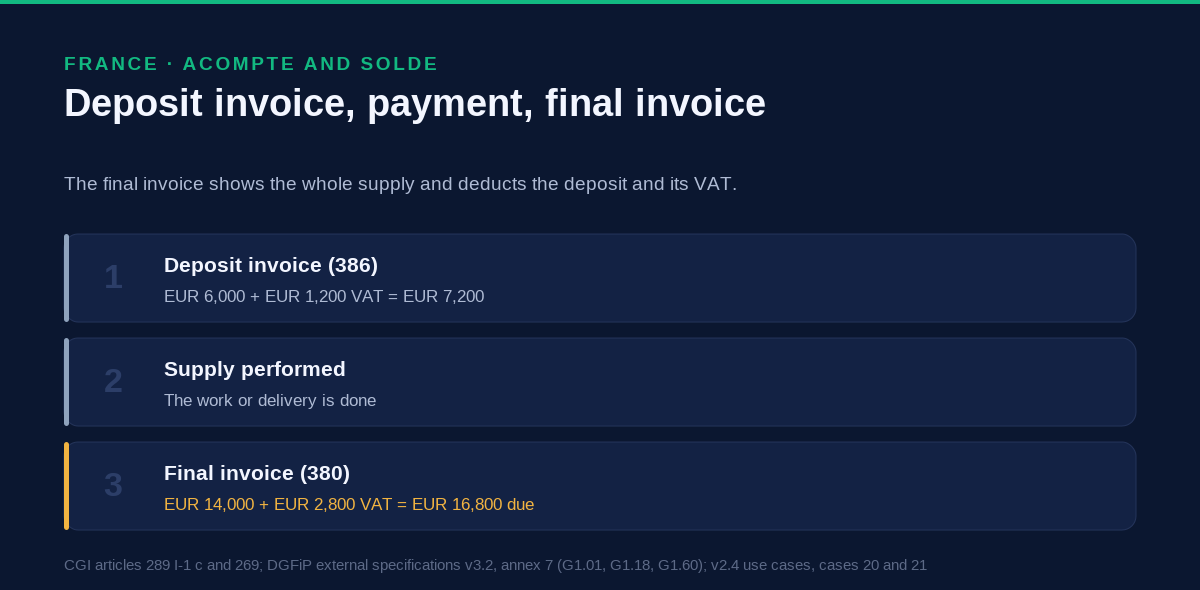
A deposit in France is invoiced when it is paid, VAT is due when you collect it, and the final invoice shows the whole supply and deducts the deposit and the VAT already charged on it. Article 289 I-1 c of the tax code (Code général des impôts, CGI) requires an invoice for a deposit (acompte). In the e-invoice formats the deposit invoice is type 386 and the final invoice (facture de solde) is an ordinary invoice, type 380, in a framework for final invoices.
This page is for the finance lead in a construction or project business that bills in stages. It covers a deposit followed by one final invoice. It does not cover progress billing under public contracts. A credit note on a deposit is in credit notes in French e-invoicing. GoRoute is a certified Peppol Access Point and SMP (POP000991). It is not a plateforme agréée (approved platform); that list is published on impots.gouv.fr. Nothing here is tax advice.
When must a deposit be invoiced, and when is VAT due?
You invoice it, and the VAT falls due when the money arrives. Two articles of the CGI answer the two halves.
Article 289 I-1 c: a taxable person must make sure an invoice is issued « pour les acomptes qui lui sont versés avant que l'une des opérations [...] ne soit effectuée » (for deposits paid to it before one of the supplies is made). The article lists exceptions for certain exempt intra-EU supplies of goods and new means of transport.
Article 269 sets the VAT date. For goods, paragraph 2 a says that where a deposit is paid first, « la taxe devient exigible au moment de son encaissement, à concurrence du montant encaissé » (VAT becomes due when it is collected, up to the amount collected). For services, paragraph 2 c makes VAT due on collection of deposits, of the price or of the fee, or, if the supplier opted for it, on debits.
The administration's FAQ for businesses says the same for payment data. It names services and deposits as examples where VAT is due on receipt (question 10.1).
How is a deposit invoice built?
With type 386, a framework for the supply and the date the deposit is paid. The annex rules in version 3.2 of the specifications (30 April 2026) say:
- Type. Rule G1.01 lists 386 for a deposit invoice, 500 for a self-billed one, and 503 for a credit note on a deposit invoice.
- Framework (BT-23). The deposit invoice uses the framework of the supply: B1 for goods, S1 for services, M1 for a double invoice. Where the deposit has already been paid when the invoice is issued, the "already paid" frameworks B2, S2 and M2 apply (rule G1.02 lists them).
- Date of the deposit. Rule G1.18 says it must be filled in if it is known and differs from the issue date. Annex II to the CGI, article 242 nonies A I 10°, is the source of that mention.
For a deposit invoice already paid, the version 2.4 use-case file adds that the amount paid (BT-113) is the whole deposit and the amount payable (BT-115) is zero. It also says you can use the standard framework and record a "payment received" status on the date of the invoice.
How does the final invoice deduct the deposit?
It is a normal invoice, type 380, in a final-invoice framework, that cites each deposit invoice and charges only what remains.
- Framework. B4 for goods, S4 for services, M4 for a double invoice. Rule G1.60 says that in these frameworks the type cannot be 386, 500 or 503.
- Reference. The block "reference to an earlier invoice" (BG-3) is meant, among other uses, for « la facture finale faisant référence à des factures de pré-paiement précédentes » (the final invoice referring to earlier prepayment invoices). It carries the number of each deposit invoice (BT-25) and, from the target stage, its date (BT-26).
- Deduction. The version 2.4 use-case file says the tax base and VAT on the final invoice should be what is still due, that is, less the deposit and its VAT, so the tax base is not increased. It advises deduction lines that reference the deposit invoices, using the block EXT-FR-FE-BG-06, which the version 3.2 annex describes as the in-line reference to an earlier invoice, notably for deposit invoices.
- A fallback. Where a system cannot do that, the same file allows the deposit plus VAT to be stated in the invoice note (BT-21, code AAI). It warns that if the deposit is not on the invoice lines, the VAT on it is taken into account twice and the pre-filled VAT return has to be corrected.
The format allows a minus sign on amounts and quantities (rules G1.14 and G1.15) but not on a unit price (rule G1.16). The sources we read do not say how a deduction line should be built. Test it with your platform before the first live final invoice.
A worked example
A EUR 20,000 services contract with a 30% deposit and VAT at 20%. The figures are ours.
| Document | Type and framework | Net | VAT | Total |
|---|---|---|---|---|
| Deposit invoice D-2026-0031 | 386, S1 | 6,000 | 1,200 | 7,200 |
| Final invoice F-2026-0577 before deduction | 380, S4 | 20,000 | 4,000 | 24,000 |
| Deduction of D-2026-0031 | cites BT-25 | −6,000 | −1,200 | −7,200 |
| Final invoice, amount due | 14,000 | 2,800 | 16,800 |
The VAT on the deposit, EUR 1,200, becomes due when the EUR 7,200 is collected. The final invoice carries the remaining VAT, EUR 2,800. Together they make the EUR 4,000 due on the whole contract.
What does the platform send?
Each invoice goes through the platform on its own, and the payment is reported by the supplier.
- Deposit invoice. Issued and sent like any invoice. The issuing platform attests it with the status Déposée and sends its data within 24 hours (specification, section 3.6.5).
- Payment received. Where VAT is due on receipt, the supplier sends the Encaissée status with the date and the amount per VAT rate. See French e-invoice statuses.
- Final invoice. Sent the same way, citing the deposit invoice. The administration's pre-filled VAT return uses the data, which is why the deduction matters.
If a deposit invoice has to be cancelled, the document is a credit note of type 503. Its rules are in credit notes in French e-invoicing.
What to do next
- Set your ERP to issue type 386 for deposits and record the date the deposit was paid.
- Use a final-invoice framework (B4, S4 or M4) and type 380 for the closing invoice.
- Make the deposit invoice number a required reference on the final invoice.
- Test the deduction line with your platform, including the VAT.
- Read the rest of the set: credit notes, self-billing and archiving.
- To talk through staged billing across countries, book a demo. See also E-invoice sending and tracking, the tutorials, the developer documentation and the country page for France.
Related reading
- Advance-Payment and Final Invoices as E-Invoices in Germany
- France E-Invoicing Mandate 2026
- Four New Mandatory Mentions on French Invoices
Sources, all read on 26 November 2026: Code général des impôts, articles 289 (I-1 c) and 269 (2 a and 2 c), and annex II, article 242 nonies A, text read from the droit.org copy of Légifrance data; impots.gouv.fr, Spécifications externes et normes pour la facturation électronique (page modified 2 July 2026): version 3.2 of 30 April 2026, annexes 1 and 7 (rules G1.01, G1.02, G1.14 to G1.16, G1.18, G1.60) and general file (section 3.6.5); version 2.4 of 19 June 2024, use cases, cases 20 and 21 (English file), now superseded; impots.gouv.fr, Foire aux questions, je découvre la facturation électronique, question 10.1. Translations from the French are ours. Passages marked as our reading are not the administration's wording.
Frequently asked questions
- Must a deposit be invoiced in France?
- Yes. Article 289 I-1 c of the tax code requires a taxable person to make sure an invoice is issued for deposits paid to it before a supply that must be invoiced, with an exception for certain exempt intra-EU and new-vehicle supplies of goods. The invoice must give the date the deposit is paid where that date is known and differs from the issue date.
- When is VAT due on a deposit?
- When the deposit is collected, up to the amount collected. Article 269 of the tax code says this for goods in paragraph 2 a, and for services paragraph 2 c makes VAT due on collection of deposits, of the price or of the fee, or, on the supplier's option, on debits.
- Which invoice type code is a deposit invoice?
- 386, deposit invoice (facture d'acompte). A self-billed deposit invoice is 500, and the credit note for a deposit invoice is 503. The final invoice is an ordinary 380 with the framework B4, S4 or M4, and may not use 386, 500 or 503 (rule G1.60).
- How does the final invoice deduct the deposit?
- It cites each deposit invoice and subtracts the deposit and its VAT, so that the tax base and VAT shown are only what is still due. The version 2.4 use-case file advises deduction lines that reference the deposit invoices, and says that if the deposit is left off the lines, the VAT on it is counted twice in the pre-filled VAT return.
- Does the supplier send a payment status for a deposit?
- Yes, where VAT is due on receipt. The administration's FAQ names deposits as an example. The supplier sends the Encaissée status with the date and the amount per VAT rate, unless it opted to pay VAT on debits.
About Dr. Syed Raza
Dr. Syed Raza is an IT Enterprise Architect at ClayDesk LLC and leads the GoRoute platform. He works across Peppol Access Point and SMP infrastructure, PINT jurisdictions (Oman, AU/NZ, EU, JP, MY, SG), and national CTC regimes, translating regulatory detail into production-grade e-invoicing systems.
Building on Peppol?
GoRoute is a certified Peppol Access Point & SMP. Book a demo or read the docs to get started.