
Credit Notes in French E-Invoicing: Avoir and Rectificative
How to correct an issued French e-invoice: the credit note (avoir, code 381) or corrective invoice (rectificative, 384), and the reference to the original.

To correct an e-invoice already issued in France, you issue a second document that points back to the first: a credit note (facture d'avoir, type code 381) or a corrective invoice (facture rectificative, type code 384). You do not edit the original. Article 289 of the tax code (Code général des impôts, CGI) says a document that modifies the initial invoice and refers to it in a specific and unequivocal way is treated as an invoice, so the correction needs all the mandatory mentions of one. It is then sent through your approved platform, like any other invoice.
This page is for the accounts-receivable lead who has to fix an invoice that has already left. It uses the administration's external specifications, version 3.2 of 30 April 2026, and the tax code. It does not cover VAT on bad debts. The status messages are in French e-invoice statuses. GoRoute is a certified Peppol Access Point and SMP (POP000991). It is not a plateforme agréée (approved platform); that list is published on impots.gouv.fr. Nothing here is tax advice.
What does French law say about correcting an invoice?
It says the correction is a document of its own, and it makes the VAT repayment depend on it. Two articles of the CGI matter here.
Article 289 I-5 reads: « Tout document ou message qui modifie la facture initiale [...] et qui fait référence à la facture initiale de façon spécifique et non équivoque est assimilé à une facture. » In English: any document or message that modifies the initial invoice, and refers to it specifically and unequivocally, is treated as an invoice. The same sentence adds that it must carry the mentions listed in the decree.
Article 272 deals with VAT. Where sales or services are later cancelled, the VAT already charged is set off or refunded, and the article adds: « L'imputation ou la restitution est subordonnée à la justification, auprès de l'administration, de la rectification préalable de la facture initiale. » In English: set-off or refund depends on showing the administration that the initial invoice was corrected first. The article also covers unpaid debts that have become definitively irrecoverable. We leave that case out.
Avoir or facture rectificative: which one?
The specification allows both and does not tell you which to use. It shows how each is built. Read the differences as technical facts, not as a rule of choice.
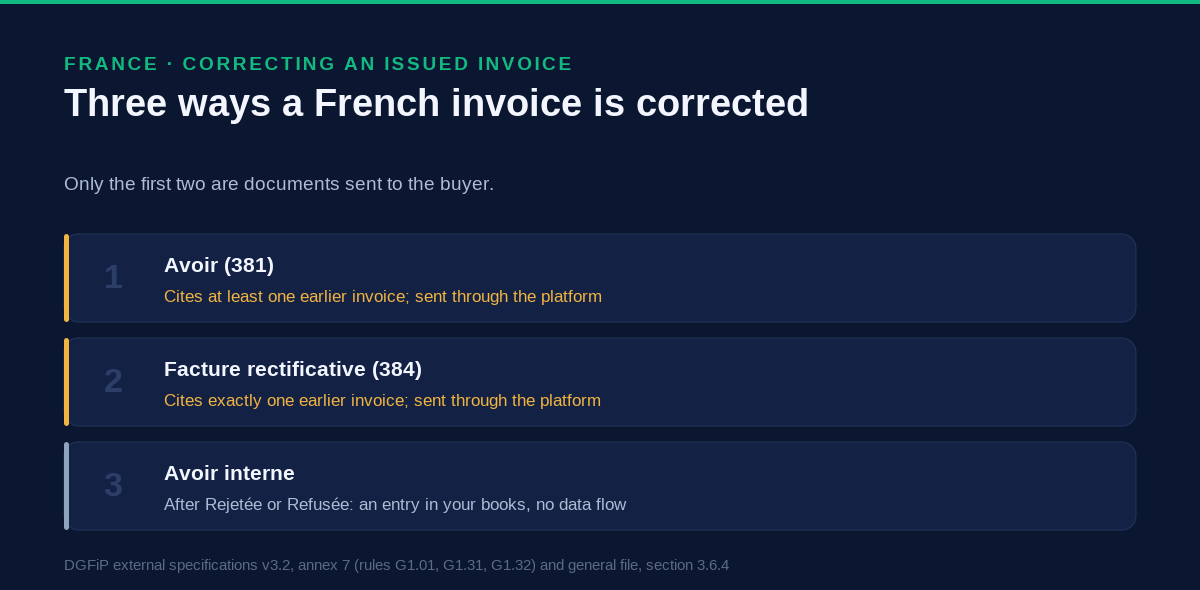
- A credit note (381) must cite at least one earlier invoice. A corrective invoice (384) must cite exactly one (rule G1.32).
- A corrective invoice may leave out the VAT exemption reason code and text that a normal invoice with exempt VAT must carry (rule G1.41).
- A credit note that is "net of tax" must use the exemption reason code
VATEX-FR-CNWVAT, and then the type must be a credit note: 261, 381 or 396 (rule G6.21).
Our reading, which you should confirm with your accountant: use a credit note when you cancel or reduce what was invoiced, such as a return or a price reduction, and a corrective invoice when you correct a mention or a figure and the invoice stands. The documents we read do not draw that line.
Which type codes can a credit note carry?
Five credit-note codes and four corrective-invoice codes are allowed, and no other code from the UN list may be used. Rule G1.01 lists them. The field is BT-3, the invoice type code. In UBL it sits in cbc:InvoiceTypeCode or cbc:CreditNoteTypeCode, in CII in ram:TypeCode.
| Code | Document |
|---|---|
| 381 | Avoir (credit note) |
| 261 | Avoir auto-facturé (self-billed credit note) |
| 396 | Avoir affacturé (factored credit note) |
| 502 | Avoir auto-facturé affacturé (self-billed, factored) |
| 503 | Avoir de facture d'acompte (credit note on a deposit invoice) |
| 384 | Facture rectificative (corrective invoice) |
| 471 | Facture rectificative auto-facturée |
| 472 | Facture rectificative affacturée |
| 473 | Facture rectificative auto-facturée affacturée |
The self-billed codes are explained in self-billing in France. The code 503 is the credit note for a deposit; see deposit and final invoices.
How do you refer to the original invoice?
By its number, in the field BT-25, in the header or on each line. This is rule G1.31, and it has three parts.
- At the start of the reform (profile BASE), the data file of a credit note must carry the number of each earlier invoice. A corrective invoice carries one number only.
- In the target profile (FULL), the date of the earlier invoice (BT-26) is also required, one date per number. Rule G6.12 makes target data compulsory from 1 September 2027, where the regulation requires it on the invoice.
- You may put numbers and dates on the invoice lines instead of the header (fields EXT-FR-FE-136 and EXT-FR-FE-138). If you fill both header and lines, the file is rejected.
An invoice number is limited to 35 characters (rule G1.05). The credit note also needs a number of its own. The platform treats the combination of number, year of issue and the supplier's SIREN as the invoice's identity, and rejects a second invoice with the same combination (rule G1.45).
How does a credit note travel through an approved platform?
Exactly as an invoice does. It is issued from your platform, which attests it as filed with the status Déposée (200). The issuing platform then has 24 hours from that status to send the credit note's regulatory data to the public invoicing portal (specification, section 3.6.5). The buyer's platform delivers the document to the buyer.
Two points follow from the rules we read.
- The unit price cannot carry a minus sign (rule G1.16). Amounts in general may (rule G1.14). We read this as a credit note being a document of its own type rather than an invoice with negative prices. Check how your system builds it.
- The type code, not the sign, tells the platform what the document is. A wrong code, or an earlier-invoice reference in both header and lines, is a reason for a Rejetée status. The checks are described in the statuses article.
Example, with our figures: an invoice F-2026-0412 for 10 units at EUR 100 net with VAT at 20% totals EUR 1,200. The buyer returns two units. Your credit note, type 381, cites F-2026-0412 in BT-25 and shows EUR 200 net, EUR 40 VAT and EUR 240 in total.
What if the invoice was refused or rejected?
Then you do not send a credit note. You cancel the invoice in your own books. This is the rule that most often confuses the two cases. After a Refusée or Rejetée status, the specification says the supplier must make an accounting cancellation, an avoir interne (internal credit note), and that this entry must not produce a regulatory data flow (specification, section 3.6.4, under table 8).
A credit note you send to the buyer is a real invoice document with its own data flow. An internal credit note stays inside your accounts. For the difference between the two statuses, see French e-invoice statuses.
What to do next
- Map your credit-note and corrective-invoice types in your ERP to codes 381 and 384, and to 261 and 471 if you invoice on behalf of a supplier.
- Make the earlier-invoice number a required field on every credit note. Plan for the date from 1 September 2027.
- Give credit notes their own numbering that never repeats an invoice number in the same year.
- Separate the two flows in your process. A refused or rejected invoice is cancelled internally. An invoice that was accepted and later changes gets a credit note or a corrective invoice.
- Read the rest of the set: self-billing, deposit and final invoices and archiving.
- To talk through French and other mandates in one flow, book a demo. See also E-invoice sending and tracking, the tutorials, the developer documentation and the country page for France.
Related reading
- France E-Invoicing Mandate 2026, the calendar and who must issue when.
- Gutschrift: German e-invoice credit notes, the German counterpart.
- Invoice validation errors you can prevent
Sources, all read on 26 November 2026: impots.gouv.fr, Spécifications externes et normes pour la facturation électronique (page modified 2 July 2026), external specifications version 3.2 of 30 April 2026: general file (section 3.6.4, table 8, and section 3.6.5) and annexes 1 and 7 (rules G1.01, G1.05, G1.14, G1.16, G1.31, G1.32, G1.41, G1.45, G6.12, G6.21); Code général des impôts, articles 289 and 272, text read from the droit.org copy of Légifrance data. Translations from the French are ours. Passages marked as our reading are not the administration's wording.
Frequently asked questions
- What is the difference between an avoir and a facture rectificative?
- The technical annex treats them as two invoice types. An avoir (credit note, code 381) must cite at least one earlier invoice. A facture rectificative (corrective invoice, code 384) must cite exactly one (rule G1.32). The documents we read do not say which to choose in a given case, so that choice is for you and your accountant.
- Can I change an e-invoice that was already sent?
- We found no rule that allows it. Article 289 I-5 of the tax code treats a document that modifies the initial invoice and refers to it as an invoice in its own right. Rule G1.45 also says an invoice with the same number, year and SIREN as one already sent is rejected, so a corrected copy under the old number would not pass.
- Does a credit note have to name the original invoice?
- Yes. For the start of the reform, the data file of a credit note must carry the number of each earlier invoice (BT-25). From 1 September 2027 the date of the earlier invoice (BT-26) is also required. The number and date go in the header or on each line, not both, or the file is rejected (rule G1.31).
- Do I issue a credit note when the buyer refuses my invoice?
- Not as a document to send. After a Refusée or Rejetée status the specification tells the supplier to cancel the invoice in its accounts with an internal credit note, and that entry must not generate a regulatory data flow to the administration.
- Is a credit note reported to the tax administration?
- Yes, as invoice data. The annex gives the credit note its own data file (the F1 flow) with the earlier invoice numbers, and the issuing platform sends it within 24 hours of the Déposée status, like any invoice.
About Dr. Syed Raza
Dr. Syed Raza is an IT Enterprise Architect at ClayDesk LLC and leads the GoRoute platform. He works across Peppol Access Point and SMP infrastructure, PINT jurisdictions (Oman, AU/NZ, EU, JP, MY, SG), and national CTC regimes, translating regulatory detail into production-grade e-invoicing systems.
Building on Peppol?
GoRoute is a certified Peppol Access Point & SMP. Book a demo or read the docs to get started.