
Archiving French E-Invoices: How Long, Where and in What Form
How long French e-invoices must be kept: six years for tax (LPF L102 B), ten for accounts (Code de commerce L123-22), in original electronic form, and where.

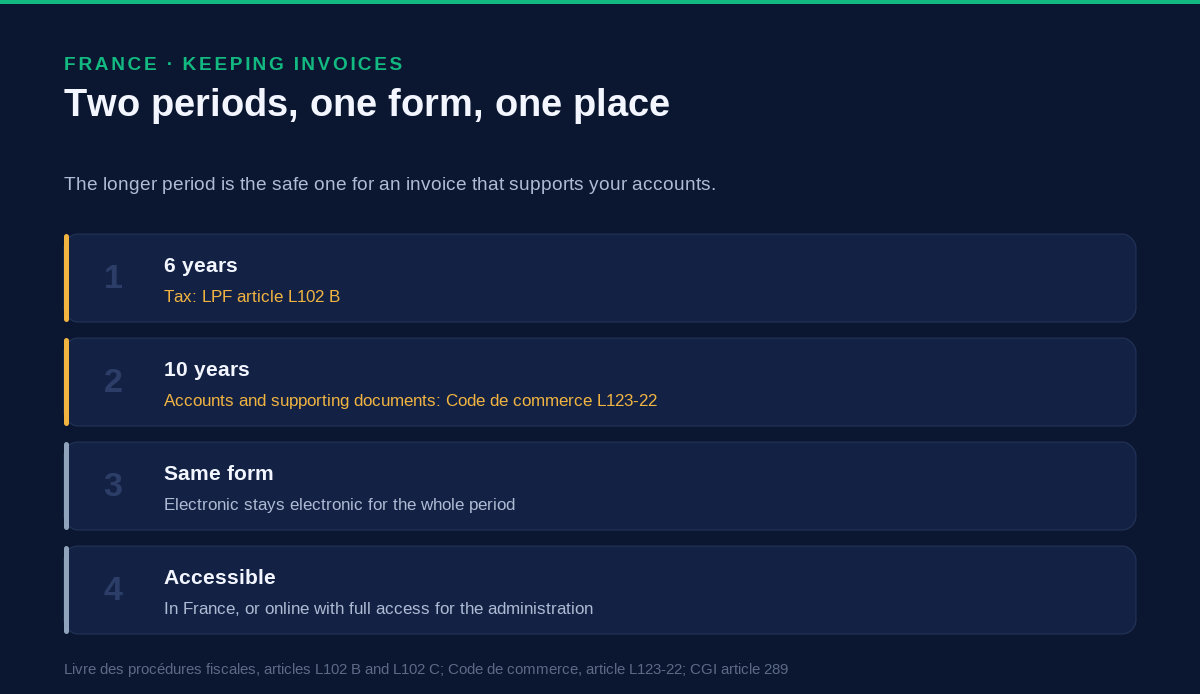
French e-invoices must be kept for six years for tax purposes and ten years as accounting supporting documents, in the electronic form in which they were issued or received, and within reach of the tax administration. The six years come from article L102 B of the Book of Tax Procedures (Livre des procédures fiscales, LPF). The ten years come from article L123-22 of the Commercial Code (Code de commerce). Neither text moves the duty to your approved platform.
This page is for the finance or IT lead deciding where invoices will live once the e-invoice duty applies. It covers the retention period, the form and the place. It does not cover the electronic signature of archives. The checklist line in France's e-invoicing mandate says "archive for the statutory period", and this page is that line in full. GoRoute is a certified Peppol Access Point and SMP (POP000991). It is not a plateforme agréée (approved platform); that list is published on impots.gouv.fr. Nothing here is tax advice.
How long must French invoices be kept?
Six years for tax and ten years for accounting. The two periods have different sources.
Article L102 B I of the LPF says books, registers, documents and supporting papers open to the administration's rights of control must be kept « pendant un délai de six ans à compter de la date de la dernière opération mentionnée sur les livres ou registres ou de la date à laquelle les documents ou pièces ont été établis » (for six years from the date of the last operation entered in the books or registers, or from the date the documents were established). Supporting documents for operations that give a right to deduct VAT are kept for the same period.
Article L123-22 of the Commercial Code says: « Les documents comptables et les pièces justificatives sont conservés pendant dix ans. » In English: accounting documents and supporting documents are kept ten years.
Our reading, which you should confirm with your accountant: an invoice supports an entry in your accounts, so the ten-year period applies to it as well. If so, six years is the minimum for the tax authority and ten years the practical period. The texts do not name invoices in the Commercial Code article.
In what form must an e-invoice be kept?
In the form in which it arrived or left. Article L102 B I says that documents established or received on an electronic medium « doivent être conservés sous cette forme » (must be kept in that form) for the whole period. A paper original may be kept on paper or on an electronic medium, and a ministerial order sets how paper invoices are digitised.
The tax code adds three duties on the e-invoice itself, in article 289:
- Original. E-invoices are issued and received in any electronic form and stand as the original invoices (VI).
- Integrity. The authenticity of origin, the integrity of content and the legibility must be assured from issue until the end of the retention period (V).
- A duplicate of every invoice issued must be kept (I-4).
Article 289 VII gives the ways to meet the integrity duty: documented and permanent controls that make a reliable audit trail between the invoice and the supply, a qualified electronic signature, a structured message in an agreed standard, or a qualified electronic seal. The audit-trail controls and the documents describing them must themselves be kept for six years (L102 B I bis).
Our reading: keep the file as received, whole. If you receive a hybrid Factur-X file, which carries both a PDF and its XML, keep that file rather than a re-exported PDF. The texts we read do not say anything about splitting or converting the file.
Where may invoices be stored?
In France, or electronically with immediate, complete online access. Article L102 C LPF covers invoices you issued, those issued for you by a client or a third party, and all you received.
- They must be stored in France unless stored electronically in a way that gives the administration immediate, complete, online access to the data.
- You may not store invoices sent electronically in a country with no mutual-assistance agreement with France, or one that does not give an immediate online right of access, with download and use of all the data.
- If the place of storage is outside France, you declare it with your results return, and declare any change.
- Where you store electronically in France, in another EU state or in a country with such an agreement, you make sure the administration can access and download the data online for control.
For an IT lead choosing a hosting region, this is the sentence to check first.
What does the approved platform keep, and what do you keep?
The texts we read make the duty to keep yours, and do not give the platform an archive role. This is the question buyers ask most, and the answer is a gap, not a rule.
| Duty | Who it falls on | Source |
|---|---|---|
| Keep invoices six years for tax | The taxable person | LPF L102 B I |
| Keep accounting supporting documents ten years | The business | Commercial Code L123-22 |
| Keep a duplicate of every invoice issued | The taxable person | CGI 289 I-4 |
| Guarantee authenticity, integrity and legibility to the end of the retention period | The taxable person (V, VII); the platform in transmission (242 nonies E 4°) | CGI 289; annex II 242 nonies E |
| Declare storage outside France | The taxable person | LPF L102 C |
| Offer an archive service for your invoices | Not stated in the texts we read | Not found |
Article 242 nonies E of annex II to the CGI lists the services an approved platform must offer. It includes transmitting invoices to the recipient's platform « dans des conditions de nature à en garantir l'authenticité de l'origine, l'intégrité du contenu et la lisibilité à compter de leur émission jusqu'à la fin de la période de conservation » (in conditions that guarantee authenticity of origin, integrity of content and legibility from issue until the end of the retention period). It does not list the long-term archive of the business's invoices. We also found nothing in the external specifications, version 3.2 of 30 April 2026, or in the administration's FAQs about how long a platform keeps an invoice.
So, before you sign, ask the platform in writing: how long it keeps your invoices, in what form, where, and how you export them if you leave.
What to do next
- Set a retention rule of ten years for issued and received e-invoices unless your accountant tells you otherwise, and six years as the floor.
- Store the file as received, unchanged, and keep its transmission statuses with it. The statuses are explained in French e-invoice statuses.
- Check the storage region against article L102 C, and declare it if it is outside France.
- Ask your platform for its archive terms and an export route.
- Read the rest of the set: credit notes, self-billing and deposit and final invoices.
- To plan archiving across several countries, book a demo. See also E-invoice sending and tracking, the tutorials, the developer documentation and the country page for France.
Related reading
- Archiving German E-Invoices: Why XML Is the Record
- How Long to Keep Invoices in Spain
- France E-Invoicing Directory (Annuaire)
Sources, all read on 26 November 2026, from the droit.org copy of Légifrance data (Livre des procédures fiscales and Code de commerce as updated to 1 October 2026): Livre des procédures fiscales, articles L102 B and L102 C; Code de commerce, article L123-22; Code général des impôts, article 289 (I-4, V, VI, VII) and annex II, article 242 nonies E (as amended by decree 2026-677 of 27 July 2026); impots.gouv.fr, Spécifications externes et normes pour la facturation électronique (page modified 2 July 2026), version 3.2 of 30 April 2026, general file. Translations from the French are ours. Passages marked as our reading are not the administration's wording.
Frequently asked questions
- How long must French invoices be kept?
- For tax, six years (article L102 B of the Book of Tax Procedures, LPF), counted from the date of the last operation entered in the books or from the date the document was established. For accounting, ten years (article L123-22 of the Commercial Code: accounting documents and supporting documents are kept ten years). We read an invoice as a supporting document, so ten years is the safe period.
- In what form must an e-invoice be kept?
- In the form in which it was issued or received. Article L102 B I says documents established or received on an electronic medium must be kept in that form for the whole period. Article 289 V of the tax code adds that authenticity of origin, integrity of content and legibility must be assured from issue to the end of the retention period.
- Does the approved platform archive my invoices?
- We found no text that says so. Article 242 nonies E of annex II to the tax code lists the services an approved platform must offer, and transmission is to keep authenticity, integrity and legibility until the end of the retention period. Archiving the business's invoices is not in the list. Ask your platform for its archive service and its term in writing.
- Can I keep invoices outside France?
- Electronically, yes, within limits. Article L102 C LPF requires invoices to be stored in France unless stored electronically with immediate, complete online access to the data. It bars storage in a country with no mutual-assistance convention with France or no online right of access, and requires a declaration of the storage location if it is outside France.
- Do I keep a copy of the invoices I issue?
- Yes. Article 289 I-4 of the tax code says the taxable person must keep a duplicate of all invoices issued. It must also keep the documentation of its audit-trail controls for six years (article L102 B I bis).
About Dr. Syed Raza
Dr. Syed Raza is an IT Enterprise Architect at ClayDesk LLC and leads the GoRoute platform. He works across Peppol Access Point and SMP infrastructure, PINT jurisdictions (Oman, AU/NZ, EU, JP, MY, SG), and national CTC regimes, translating regulatory detail into production-grade e-invoicing systems.
Building on Peppol?
GoRoute is a certified Peppol Access Point & SMP. Book a demo or read the docs to get started.