
France's E-Invoicing Directory: How an Invoice Finds Its Buyer
How a French e-invoice is routed: what the annuaire holds, the four addressing levels (SIREN, SIRET, routing code, suffix) and a buyer with no entry.

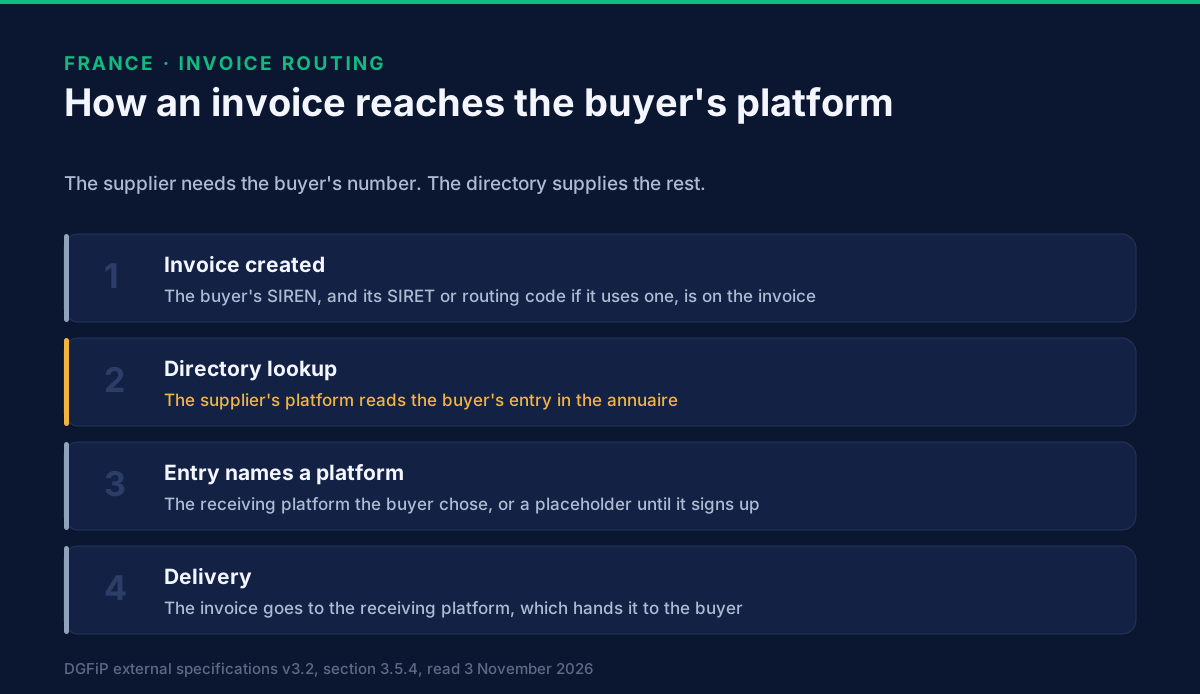
A French e-invoice is addressed to the buyer's company number and routed by looking that number up in a central directory, the annuaire, which the tax administration's public portal keeps. Each entry in it names a company and the approved platform (plateforme agréée) that receives its invoices. The supplier's own platform reads the entry and delivers the invoice there. The supplier never needs to know which platform the buyer chose, only the buyer's number.
This page is for the accounts-payable or IT lead who has to make an invoicing system produce a correctly addressed French invoice. It explains what the directory holds, the four levels at which a company can be addressed, who maintains an entry, and what the administration says about a buyer with no entry. Which platform to pick is covered in France's e-invoicing mandate. GoRoute is a certified Peppol Access Point and SMP (POP000991). It is not a plateforme agréée; the list of those is published on impots.gouv.fr.
What is the annuaire?
It is a register of invoice recipients, run by the Portail Public de Facturation (PPF), the State's own platform. Its job, in the words of the administration's external specifications (version 3.2 of 30 April 2026), is to hold everything needed to address and route an invoice.
The PPF builds it from four sources:
- the register of private companies, taken from INSEE's business directory: legal units (SIREN) and establishments (SIRET) of active companies established in France;
- the register of public bodies, from Chorus Pro: their SIRET and their services (routing codes);
- the register of businesses liable to French VAT, from the tax administration's own records;
- the register of registered approved platforms.
From these the PPF creates one entry per company at SIREN level. An entry holds three things: who the recipient is, which receiving platform the invoice goes to, and the period when that is valid. An entry has a start date, a planned end date and an effective end date. One that is past its end date can no longer be addressed or looked up.
An entry is either a définition, which carries the addressing and routing information, or a masquage, which cancels an entry set up earlier so that it never takes effect.
Which levels can a company be addressed at?
Four: the legal unit (SIREN), the establishment (SIRET), a routing code (code routage) and a suffix (suffixe). The specification gives the reason in one sentence. A company may want to receive and process its invoices centrally, for example at head office, or in a decentralised way, in each shop or in separate accounting and payroll teams.
| Level | What it addresses | Where it starts |
|---|---|---|
| SIREN | The whole legal entity | Created by default for every private company |
| SIRET | One establishment of that entity | Added by the buyer's platform |
| Routing code | A service or unit inside the organisation | Added by the buyer's platform; the default for public bodies |
| Suffix | A specific network address or addressing code | Added by the buyer's platform |
For public bodies the default is different. Their entries start at establishment (SIRET) and routing-code level, with Chorus Pro as the receiving platform.
The specification adds a practical warning about suffixes. It strongly recommends giving each one a clear meaning, so staff can tell them apart, and not naming one with a SIRET number.
How does a supplier use it?
The supplier's system, compatible solution or approved platform consults the directory twice. The specification says creating the invoice requires a lookup to confirm the buyer's addressing details, and delivering it requires a second one to find the receiving platform linked to those details.
Two consequences follow for an invoicing team.
- The buyer's SIREN has to be on the invoice anyway. It is one of the four mentions the administration made mandatory from 1 September 2026, covered in The Four New Mentions on French Invoices.
- Your platform does the lookup. The specification describes access for authorised partners who are connected and subscribed. The file route sends a daily update of changes and a full copy weekly, produced in the night between Sunday and Monday. The API route offers a search and a lookup for the legal-unit, establishment, routing-code, platform and directory-entry resources. An ordinary supplier is not one of those partners. Ask your platform how it exposes the lookup in your system.
The finer levels only matter if your buyer uses them. If a customer says "send it to our Lyon routing code", that is the level its platform created. Ask for it in writing and store it on the customer record.
Who keeps a company's entry up to date?
The company's chosen platform does, once the company has signed up. The administration's FAQ (version of 1 September 2026) says each company must sign a formal agreement with the platform it designates to receive its invoices in the directory. The choice is free, can include more than one platform, and can be changed at any time.
Until then the entry sits on a placeholder. For private companies the PPF assigns a fictitious platform to the default SIREN entry. The specification's footnote says only a platform that has formally contracted with a private client may replace that default, and may then update entries at any level to match the client's own addressing plan.
When a contract ends suddenly, the specification advises the old platform to close the entries it holds for that client and create a SIREN entry pointing back to the fictitious platform. That is how a company can revert to the placeholder.
What happens if the buyer has no entry?
The specification has two published answers, and neither is an error message. It also leaves one question open, which we flag below.
- An entity with no SIREN cannot be in the directory. The specification says it cannot be sanctioned, and that its suppliers will not be sanctioned for not e-invoicing it. They do e-reporting "as if invoicing a non-taxable person".
- An entity with a SIREN that is not yet in the directory because of the administration's validation circuits or its technical difficulties. A tolerance is to apply, and the supplier again reports as e-reporting.
Both statements concern the sanctions regime. We give no penalty figure because the guidance pages we read state none.
What we could not find is what a platform does with an invoice addressed to a company still on the placeholder. The passages we read do not say. Before you rely on a go-live date for a large customer, ask your platform in writing how it handles that case.
What to do next
- Collect each customer's SIREN, and its SIRET or routing code if it uses one, and store them on the customer record.
- Ask your platform how it looks up the directory, and what it shows you when a customer has no entry.
- Read the other pages in this set: the four new mentions, lifecycle statuses and invoicing French customers from abroad.
- To discuss e-invoicing across several countries, book a demo. The tutorials, the developer documentation and the GoRoute API show how documents are sent to customers on the Peppol network.
Related reading
- E-invoicing in France, the country page.
- France E-Invoicing Mandate 2026, the dates and the platform model.
- Belgium vs France vs Germany, three models compared.
- What a Peppol Access Point is, the other addressing model.
Sources, all read on 3 November 2026: impots.gouv.fr, Spécifications externes et normes pour la facturation électronique (page modified 2 July 2026), for the external specifications, version 3.2 of 30 April 2026, chapters 3.5 and the section on sanctions; impots.gouv.fr, Foire aux questions, je découvre la facturation électronique, version of 1 September 2026, questions 2.1 and 3.3. Translations from the French are ours.
Frequently asked questions
- What is the annuaire in French e-invoicing?
- It is the directory of invoice recipients run by the Portail Public de Facturation (PPF). Each entry, called a ligne d'annuaire, says which company it is for, which approved platform receives that company's invoices, and the period during which the entry applies. A supplier's platform reads it to route each invoice.
- Do I send an invoice to a SIREN or a SIRET?
- The directory supports four levels: the legal unit (SIREN), the establishment (SIRET), a routing code and a suffix. Every private company starts with an entry at SIREN level. Finer levels exist only if the buyer's platform has created them, so the buyer tells you which one to use.
- Who keeps a company's directory entry up to date?
- The company signs a formal agreement with the approved platform it chooses to receive its invoices. That platform can then replace the default SIREN entry and add entries at the finer levels. The administration's specification says only a platform that has contracted with a private client may do so.
- What if my customer has no entry in the directory?
- The specification says suppliers are not sanctioned for failing to e-invoice an entity that has no SIREN, or one that has a SIREN but is not yet in the directory because of the administration's own validation or technical difficulties. They report the sale as e-reporting, as if invoicing a person who is not liable to VAT.
- Can a supplier query the directory directly?
- Not as an ordinary business. The specification describes access by authorised, connected partners, through a file feed (a daily update and a weekly full copy) or an API. In practice a supplier's approved platform or compatible solution does the lookup.
About Dr. Syed Raza
Dr. Syed Raza is an IT Enterprise Architect at ClayDesk LLC and leads the GoRoute platform. He works across Peppol Access Point and SMP infrastructure, PINT jurisdictions (Oman, AU/NZ, EU, JP, MY, SG), and national CTC regimes, translating regulatory detail into production-grade e-invoicing systems.
Building on Peppol?
GoRoute is a certified Peppol Access Point & SMP. Book a demo or read the docs to get started.