
Self-Billed Invoices in Oman: How to Correct One After Clearance
When the buyer raised the invoice, the buyer issues the correction — a self-billed credit note, type code 261. What it must reference and carry to pass.

Last updated .
When the buyer raised the invoice, the buyer also issues the correction — and it is a
self-billed credit note carrying type code 261, never the 381 a supplier would use.
It travels under its own customisation identifier,
urn:peppol:pint:selfbilling-1@om-1, it must reference the self-billed invoice it corrects
by number, issue date and UUID, and its transaction type is restricted to four values by a
single fatal rule, IBR-177-OM.
This page is for a finance manager or accountant in a VAT-registered Omani business that self-bills. Every rule identifier below was read out of the PINT OM v1.0.1 self-billing rule packs GoRoute runs in production, on 8 September 2026. The general case — a supplier correcting its own invoice — is how to correct or cancel a cleared Oman e-invoice.
When does self-billing apply in Oman, and who issues the document?
Self-billing is the arrangement where the buyer raises the invoice on the supplier's behalf, usually because the buyer holds the numbers first: a contractor paid on measured work, a distributor settling on units sold, an importer accounting for a supply nobody in Oman invoiced.
In PINT OM this is not a flag on an ordinary invoice. It is a separate profile with its own
two documents — the self-billed invoice, type code 389, and the self-billed credit note,
type code 261 — sent under urn:peppol:pint:selfbilling-1@om-1 with the business process
urn:peppol:bis:selfbilling.
The parties do not swap places. The supplier remains the AccountingSupplierParty and the
buyer remains the AccountingCustomerParty; what changes is who builds and sends the file.
Because the buyer is now the author, three Oman rules read the buyer's own data harder than
they would on an ordinary invoice, and all three are fatal:
| What must be present | Term | Rule |
|---|---|---|
| Buyer VAT identification number | IBT-048 | IBR-017-OM |
| Buyer address lines 1–3, city and post code | IBT-050 to IBT-053, IBT-163 | IBR-019-OM |
Buyer country code, and it must be OM |
IBT-055 | IBR-020-OM |
IBR-020-OM is the one to check first. A self-billed document is only ever issued by an
Omani buyer — if the buyer sits outside Oman, this profile is not the answer to your problem.
Why is the correcting document a 261 and not a 381?
Because the accepted code list is a property of the rule pack, and the rule pack is chosen by the customisation identifier in the envelope before any rule reads the document.
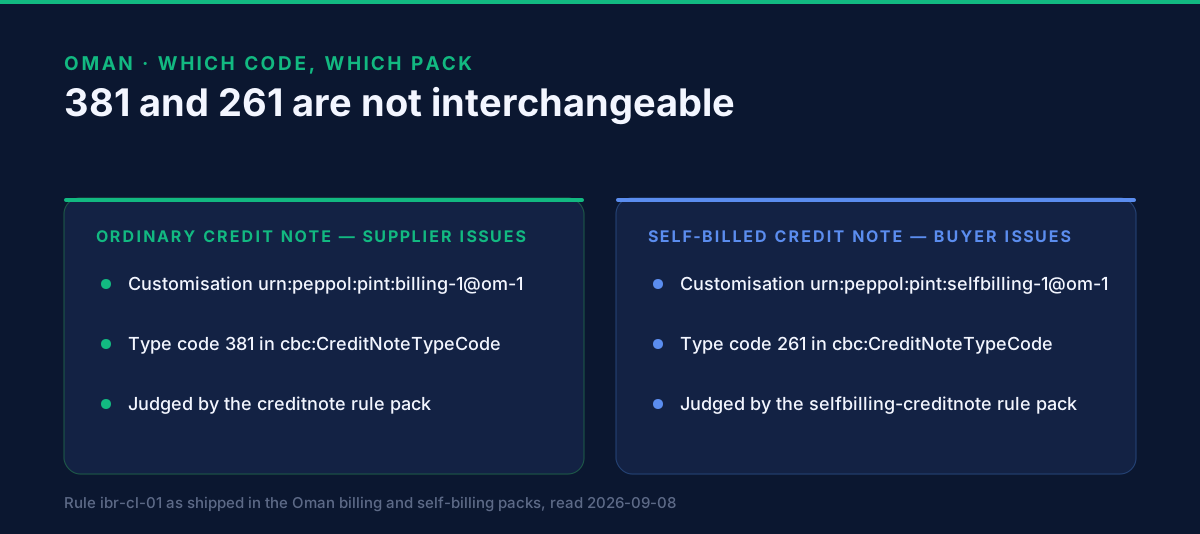
Rule ibr-cl-01 sets the list, and the lists are not the same width. The self-billing packs
accept exactly one value each — 389 for the invoice element, 261 for the credit note
element — and 381 does not appear in the self-billing list at all. So a credit note that
would validate perfectly against a supplier-issued invoice is refused the moment it is sent
under a self-billing customisation. The failure is fatal: the document is stopped at
validation and reaches neither the supplier nor the Tax Authority.
The field-by-field header for both self-billed documents, including the worked examples, is in the PINT OM CustomizationID reference.
There is no self-billed debit note: 383 has no place in either self-billing pack. Our reading
is that an upward correction is raised as a further self-billed invoice under 389. The packs
constrain which codes exist; they do not tell you how to account.
What does IBR-177-OM require of the transaction type?
That the document declares itself one of four things, and only one.
Every Oman document carries a 20-character transaction type, BTOM-001, written on the
@name attribute of the type code element — twenty positions of 1 and 0, one per
transaction characteristic. IBR-001-OM requires exactly that shape and nothing else.
IBR-177-OM then constrains it for self-billed documents:
If Invoice Type code (IBT-003) is Self billed credit note '261' or Self billed invoice '389' then Invoice transaction type (BTOM-001) MUST be either Self-billed Invoice/credit note (00100000000000000000) OR Invoice for import of services for RCM (00000000100000000000) OR Profit Margin Self-Invoice (00000000001000000000) OR Import of Goods (00000000000010000000).
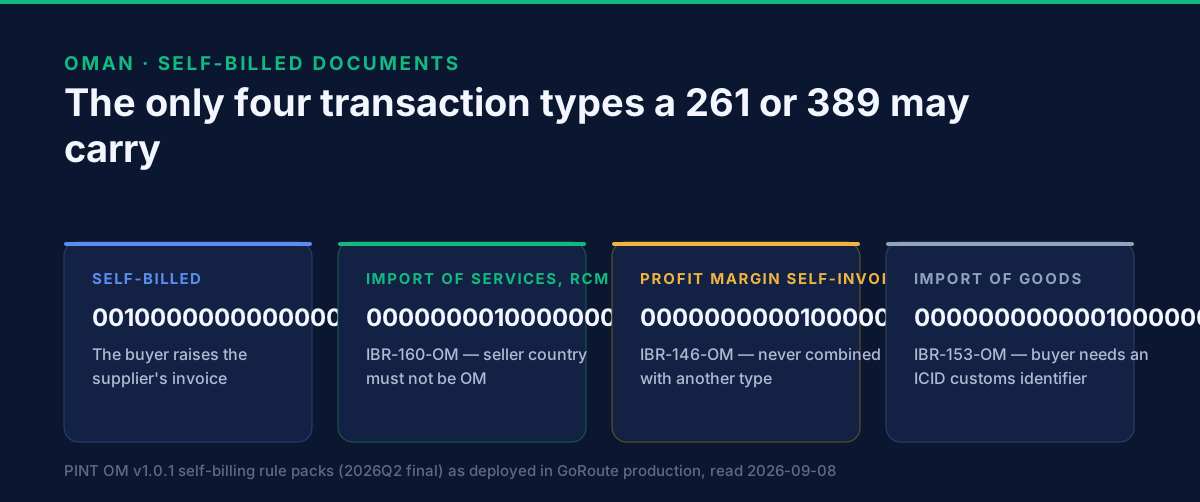
Neighbouring rules turn "either" into "exactly one". IBR-138-OM forbids the self-billed
position alongside third-party, export, import-of-services, profit-margin, profit-margin-self
or import-of-goods; IBR-146-OM and IBR-147-OM say the same from the other side.
IBR-149-OM separately forbids a simplified tax invoice from being self-billed, so the base
type on a self-billed document is the full tax invoice.
The consequence is easy to miss: a system that stamps 10000000000000000000 — full tax
invoice, no modifier — on every outgoing document produces a 261 that fails IBR-177-OM on
the first send, with a message about transaction types rather than about credit notes.
How do the import-RCM, profit-margin and import-of-goods cases differ?
They differ in what else the document must carry, and each adds its own fatal rule. Nothing in the packs requires the correction to repeat the transaction type of the document it corrects, but each rule below reads the transaction type of the document in front of it — so whichever value you set, the correction must satisfy that value's conditions in its own right.
Import of services under reverse charge (00000000100000000000). The supply came from
outside Oman, so IBR-160-OM requires the seller country code (IBT-040) not to be OM.
This is the case that makes self-billing matter to businesses that never invoice anyone: where
the seller is abroad, the receiving access point produces no Oman tax data document from the
foreign invoice, and the buyer's side raises a self-billed document for reporting instead. How
that document comes into existence, and why it is never sent to the supplier it names, is set
out in
what happens when an invoice reaches Oman from a supplier abroad.
Profit margin self-invoice (00000000001000000000). The most isolated of the four —
IBR-146-OM forbids combining it with summary, continuous supply, export, deemed supply,
import of services, profit margin, import of goods or self-billed. Note the distinction from
its neighbour: IBR-175-OM requires a preceding invoice reference and UUID on the ordinary
profit margin invoice (00000000010000000000), which is a different position in the string
and a different document.
Import of goods (00000000000010000000). IBR-153-OM requires the buyer identifier
(IBT-046) with the scheme ICID, the Importer Customs ID. That rule reads the transaction
type, not the type code, so it applies to the 261 exactly as it applied to the 389. A
correction that drops the customs identifier because "it is only a credit note" is refused.
What must the self-billed credit note reference?
The same four values an ordinary credit note carries. IBR-032-OM and IBR-023-OM name
261 alongside 381 and 383, so nothing here is relaxed for self-billing:
| What it carries | Term | Rule |
|---|---|---|
| The preceding invoice's number | IBT-025 | IBR-032-OM, ibr-055 |
| The preceding invoice's UUID | BTOM-031 | IBR-032-OM |
| The preceding invoice's issue date | IBT-026 | IBR-032-OM |
| The reason the note is issued | BTOM-032 | IBR-023-OM, CL-02-OM |
CL-02-OM restricts the reason code to five values — CAN, VAT, VAL, QTY and OTH —
and refuses anything else. The packs ship those codes without expanded labels, so the Tax
Authority's own published code list governs what each means. ibr-sr-06 allows at most one
preceding reference, so one self-billed credit note corrects one self-billed invoice.
The preceding document here is a 389, not a 380. That matters for the next section.
Whose UUID goes on it, and who computes it?
The seller's identity seeds it — even though you, the buyer, wrote the document. This is the single most expensive misunderstanding in a self-billing integration.
Oman uses a version 5 UUID, meaning a hash of fixed inputs rather than a random value, so
that the sending access point and the receiving access point derive the same identifier
independently. IBR-002-OM makes a valid version 5 UUID mandatory. The Solution Reference
Architecture fixes the recipe: a fixed namespace, and seven values joined with single spaces —
- the seller's electronic address scheme (IBT-34-1)
- the seller's electronic address (IBT-34)
- the invoice type code (IBT-003)
- the document number (IBT-001)
- the issue date (IBT-002)
- the total tax amount (IBT-110)
- the total amount including tax (IBT-112)
Amounts are the exact strings as written in the XML: 819.00 and 819.0 are different seeds
and therefore different documents.
Two traps follow for self-billing. First, fields 1 and 2 are the seller's address, not the
issuer's — a buyer that seeds the calculation with its own Peppol address produces a
well-formed UUID nobody else can reproduce, and validation will not tell you, because
IBR-002-OM checks only the shape. Second, the type code is in the seed, so the 261 and the
389 it corrects have different UUIDs even where every other value matches; the preceding
UUID you write into BTOM-031 is the one derived with 389.
One implementation detail before your first correction: our portal's Create Invoice form has no preceding-invoice fields, so a note created there falls back to its own number with the nil UUID — structurally valid, referentially meaningless. Self-billed corrections belong on the API or CSV route, where the preceding invoice is a real field.
Can the supplier even receive it?
That is a discovery question, not a validation one, and it is answered before your document is built.
Receiving capability for the PINT OM invoice and the PINT OM credit note is the mandatory minimum for every Omani taxpayer. The self-billed invoice and self-billed credit note are optional — published in the Tax Authority's central service metadata registry only where that participant has opted in. On our platform the self-billing pair is added to a participant's registration only when the record carries that opt-in.
So a 261 addressed to a supplier who never registered the document type does not fail a
rule. It fails to find a route, before any rule pack is loaded. Confirm both sides'
registrations before the first correction, not during it.
How do you confirm the correction was accepted?
By reading two statuses rather than one, because a self-billed correction travels two legs.
The delivery to the supplier answers with a Peppol message level status: AP (delivered
and confirmed), AB (delivered, no confirmation) or RE (rejected, or delivery failed). The
report to the Tax Authority answers separately, and a positive status there means the report
was well formed and accepted for processing — not that your tax treatment is right. What to do
when those two answers disagree — the supplier's side never took it, but the report went — is
when an Oman e-invoice is correct but never reaches the buyer.
Capture three identities against every self-billed correction, because they are what makes a
reconciliation possible a year later: the credit note's own version 5 UUID, the preceding
invoice UUID it carries, and the ruleset version stamped into the validation result as
BTOM-META-001.
Which mistakes get a self-billed correction refused?
Each of these is traceable to the rule that fires.
381under a self-billing customisation.ibr-cl-01, fatal. The commonest, because the document is otherwise correct.- Transaction type left as plain full tax.
IBR-177-OM, fatal. - Two of the four positions set at once — self-billed and import of goods, say.
IBR-138-OM, fatal. - Buyer country not
OM.IBR-020-OM, fatal. - Buyer VAT number missing.
IBR-017-OM, fatal — and easy to miss, since on an ordinary invoice it is the seller's that is scrutinised. - The customs identifier dropped from an import-of-goods correction.
IBR-153-OM, fatal. - A preceding UUID computed on the buyer's own address. Nothing fails. It reconciles against nothing, months later, which is worse.
Reading refusals in general — which rule set owns which identifier, and why a rule worded "should" can still stop a document — is in why Oman e-invoices get rejected.
What this page deliberately does not cover
VAT return treatment. Which period a self-billed credit note falls into, and how it is declared, is a tax question the specifications and rule packs behind this page do not answer. Ask your tax adviser or the Authority.
Penalties. No figure here for a late or wrong correction; we have no current source for one.
Prepayments. A prepayment invoice has its own referencing rules and its own exclusions —
IBR-176-OM forbids combining prepayment with a profit margin self-invoice — and it is a
separate subject from correction.
Related Oman guides
- How to correct or cancel a cleared Oman e-invoice — the same question where the supplier raised the invoice.
- The PINT OM CustomizationID reference — every customisation, profile and type code, with the self-billed headers in full.
- Why Oman e-invoices get rejected — reading a refusal, rule set by rule set.
- Advance payments and deemed supplies — two more events an ERP built for post-audit invoicing will miss.
- Correcting a cleared Oman prepayment invoice — the same problem where the document is a deposit.
- When an Oman e-invoice is correct but never reaches the buyer — the delivery and reporting legs, and the three report states.
What to do next
List every supply where your business raises the document rather than receiving it — measured work, self-billed distribution, imported services, imported goods — and for each answer three questions: which of the four transaction types it is, whether the counterparty has registered to receive self-billed documents, and whether your system can supply a preceding invoice number, date and UUID derived from the seller's address. Two of the three are usually gaps in the data model rather than settings.
The commercial and integration ground is on our Oman Fawtara e-invoicing page, the connector walkthroughs are on tutorials, and the API surface — including the preceding-invoice fields this page depends on — is in the developer documentation. To walk your own self-billing and correction flows against the Oman rules with our team, book a session.
Sources: the PINT OM v1.0.1 self-billing rule packs (2026Q2 final) as deployed in GoRoute
production — selfbilling-invoice/ and selfbilling-creditnote/, read on 8 September 2026
for every rule identifier and code list quoted here: IBR-177-OM, IBR-138-OM, IBR-146-OM,
IBR-147-OM, IBR-149-OM, IBR-153-OM, IBR-160-OM, IBR-175-OM, IBR-176-OM,
IBR-032-OM, IBR-023-OM, IBR-017-OM, IBR-019-OM, IBR-020-OM, IBR-002-OM,
IBR-001-OM, CL-02-OM, ibr-cl-01, ibr-sr-06, ibr-055, BTOM-META-001; the PINT OM
mandatory field mapping generated from the GoRoute platform code for the preceding-invoice
and transaction-type behaviour; and the Oman Solution Reference Architecture (v1.0.1 of
22 May 2026 and v1.0.3 of 27 July 2026, OpenPeppol AISBL with the Oman Tax Authority) for the
UUID derivation and the status codes. Oman's own material is published by the
Tax Authority and the
PINT Oman specification.
Frequently asked questions
- Who issues the credit note when the buyer raised the original invoice in Oman?
- The buyer. Under a self-billing arrangement the buyer raises the supplier's invoice, so the buyer also raises the document that corrects it. That document is a self-billed credit note carrying invoice type code 261, sent under the self-billing customisation urn:peppol:pint:selfbilling-1@om-1. The supplier does not issue a 381 against a document it never raised.
- Can a self-billed correction use credit note code 381?
- No. Rule ibr-cl-01 applies a different code list per rule pack. The Oman self-billing credit note pack accepts exactly one value, 261, and the self-billing invoice pack accepts exactly one value, 389. A 381 is valid in the ordinary billing credit note pack and absent from the self-billing list altogether, so it is refused as fatal.
- What transaction type must an Oman self-billed credit note carry?
- One of exactly four. Rule IBR-177-OM requires that where the invoice type code is 261 or 389, the transaction type BTOM-001 is self-billed invoice or credit note (00100000000000000000), invoice for import of services for RCM (00000000100000000000), profit margin self-invoice (00000000001000000000) or import of goods (00000000000010000000). Rule IBR-138-OM then stops you setting more than one of them.
- What must a self-billed credit note reference in Oman?
- The same four values an ordinary credit note carries, because rules IBR-032-OM and IBR-023-OM name 261 alongside 381 and 383. The preceding invoice number (IBT-025), its issue date (IBT-026), its UUID (BTOM-031) and a reason code (BTOM-032) restricted by CL-02-OM to CAN, VAT, VAL, QTY or OTH. All four are fatal if missing.
- Whose address seeds the UUID on a self-billed document?
- The seller's, not the buyer's, even though the buyer issued the document. The Oman version 5 UUID is derived from seven values beginning with the seller's electronic address and its scheme. A buyer that seeds the calculation with its own address produces a well-formed UUID that no counterparty can reproduce, and validation will not catch it — rule IBR-002-OM checks only that the value is a valid version 5 UUID.
- Does an Omani supplier have to accept a self-billed credit note?
- Not automatically. Receiving capability for the PINT OM invoice and credit note is the mandatory minimum for every Omani taxpayer; the self-billed invoice and self-billed credit note are registered only where the participant has opted in. A self-billed document addressed to a supplier who never registered those document types fails at discovery, before any rule pack is loaded.
- Is there a self-billed debit note in Oman?
- No. The self-billing packs accept 389 on an invoice and 261 on a credit note and nothing else, so the debit note code 383 has no home in this profile. Our reading is that an upward correction is therefore raised as a further self-billed invoice rather than as a debit note; the packs constrain the codes, they do not describe the accounting.
- Must the buyer be Omani on a self-billed document?
- Yes. Rule IBR-020-OM requires the buyer country code (IBT-055) to be OM on all four of the transaction types a self-billed document may carry. Rules IBR-017-OM and IBR-019-OM add the buyer's VAT identification number and a full buyer address on the same types, so the buyer side of a self-billed correction is validated harder than on an ordinary invoice.
About Dr. Syed Raza
Dr. Syed Raza is an IT Enterprise Architect at ClayDesk LLC and leads the GoRoute platform. He works across Peppol Access Point and SMP infrastructure, PINT jurisdictions (Oman, AU/NZ, EU, JP, MY, SG), and national CTC regimes, translating regulatory detail into production-grade e-invoicing systems.
Building on Peppol?
GoRoute is a certified Peppol Access Point & SMP. Book a demo or read the docs to get started.