
Can You Start E-Invoicing in Oman Before Your 2027 Date?
The Oman Tax Authority allows optional early adoption of e-invoicing. What its FAQ says, what starting early involves, and what it does not answer yet.

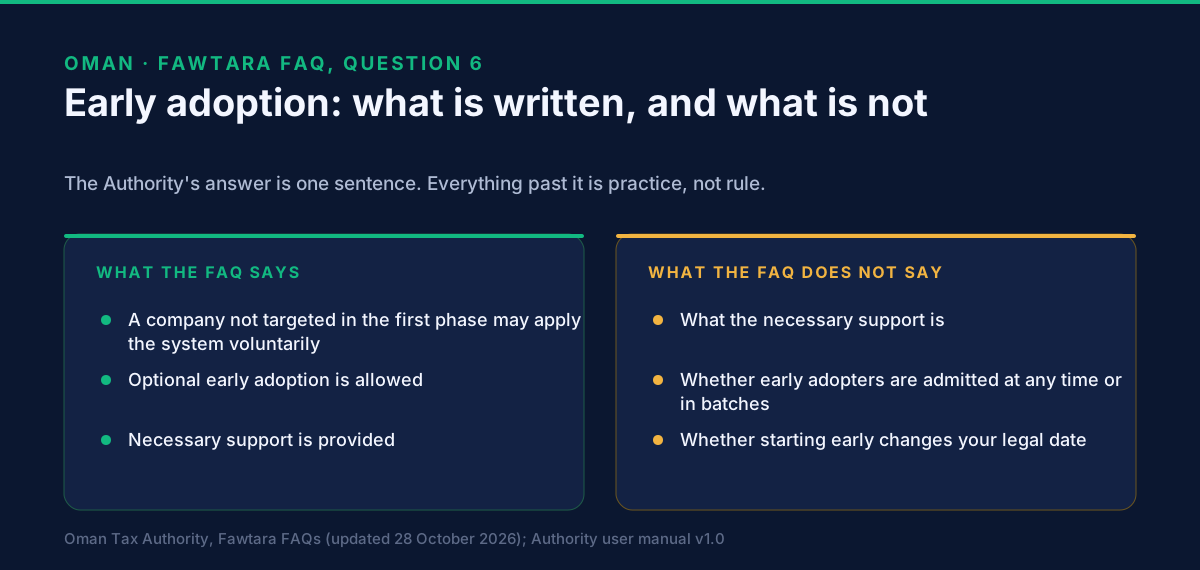
Yes. The Oman Tax Authority allows optional early adoption of e-invoicing. Its Fawtara FAQ says a company not targeted in the first phase may apply the system voluntarily, and that early adoption is allowed "with necessary support provided". The FAQ does not say what that support is, so the practical route is the one every connecting taxpayer takes: appoint an accredited service provider and test.
The wording is in question 6 of the Fawtara FAQ, which the Authority updated on 28 October 2026. This page is for a finance lead whose business has a date of 1 October 2027 and who wants to know whether starting sooner is permitted, what it involves, and whether it is a good idea. It does not cover the pilot that ran before the mandate; that history is in Oman's e-invoicing mandate for 2027.
Is early adoption of e-invoicing allowed in Oman?
Yes, in the Authority's own words. The FAQ asks: "Can a company not targeted in the first phase applies the system voluntarily?" The answer is: "Yes, optional early adoption is allowed with necessary support provided."
Three things are worth reading carefully.
- It is a permission, not a procedure. There is no application form, intake date or eligibility list in the FAQ, and the other Authority material we have read does not add one.
- The phrase is "not targeted in the first phase". The FAQ does not define the phases any more. The law sets two dates, and your own date comes from the supplies test on the threshold article. We read the sentence as covering any business that has not yet reached its date. That is our reading, not the Authority's.
- "Necessary support" is not defined. Do not plan around support you have not been promised in writing, by the Authority or by your provider.
Does starting early change your legal date?
Nothing published says it does. Decision 189/2026 fixes two dates: 1 April 2027 for taxpayers above OMR 5,000,000 of annual supplies, and 1 October 2027 for everyone else. The early-adoption answer in the FAQ mentions neither.
So the safe planning position is that your legal date is unchanged, and that early adoption is a rehearsal that happens to run on live rules. If a business needs the Authority to confirm that starting early has no effect on its date, for example because a lender or auditor asks, put the question in writing.
If you have not yet worked out your date, do that first. It matters here because a business near the line should plan for April rather than October, and then early adoption is not the question. Groups and foreign sellers have their own counting rules, set out in Oman e-invoicing for VAT groups and non-residents.
Why would a business start before its date?
To find the problems while they are cheap to fix. An e-invoice in Oman is more than a PDF with a different extension. It is a structured document checked against the PINT OM rules, and the errors that come back are almost always data errors: a missing buyer VAT number, an unmapped tax category, a unit of measure the format does not accept. The common ones are listed in why Oman e-invoices get rejected.
Starting early makes sense when:
- Your invoices come from more than one system. An ERP, a point of sale and a spreadsheet each produce different data. Each needs its own mapping and its own test.
- You have large customers on the April date. Those buyers will ask whether you can receive and send, and an answer of "we have been live since November" is a stronger one than "we are planning".
- Your finance team is stretched in the last quarter of 2027. A year-end close and a go-live in the same quarter is a risk that is avoided by moving one of them.
It makes less sense when your date is 1 April 2027. You are already inside about five months of your runway, and the work is the same whether you call it early or on time.
How do you start e-invoicing in Oman early?
The same way anyone connects. There is no separate early-adopter route that we can point to, so the steps are the ordinary ones, in this order.
- Choose an accredited provider. The accredited list is on the Fawtara portal. What to ask and what to compare is in how to choose an e-invoicing service provider in Oman.
- Settle the agreement first. The portal will not let you submit a request until you confirm that the provider has been identified and the scope, commercials and contract are done. The terms worth fixing before you sign are in what to settle with a service provider before you connect.
- Raise the connection request on the Fawtara portal. You can set a preferred effective date, which must be today or later. The full screen-by-screen path is in how to connect your Omani business to an accredited service provider, so it is not repeated here.
- Check that you are registered. After the provider accepts, it has three working days to register you on the central directory. How to confirm it is in how to check your business is registered on Oman's SMP.
- Test before you send. Validate against the PINT OM rules first. The method is in how to test an Oman e-invoice before you send it.
Our own position is stated in one place on the Oman e-invoicing page: GoRoute is an accredited Oman Tax Authority e-invoicing service provider, accredited on 29 July 2026 through Union Digital Technologies SPC, and operates a Peppol-certified Access Point (Service Provider ID POP000991). That is the name to look for on the Authority's list.
What is not answered yet?
How early adopters are admitted. As of 29 October 2026 the Authority's published material does not say:
- what the "necessary support" is;
- whether early adopters connect at any time or in batches;
- whether an early adopter's invoices are treated any differently once live;
- whether the answer in the FAQ is meant for businesses of any size.
None of these stops you preparing. They do mean that a go-live date should come from your provider's confirmation, not from this page. If any of them matters to your plan, ask the Authority in writing before you commit.
What to do next
- Work out your legal date using the threshold article.
- List your invoice sources and decide which one you would start with.
- Talk to two accredited providers and ask how they handle a business that connects before its date.
- Run a sandbox test of one real invoice. The free sandbox validates against PINT OM without any connection to the Authority.
To see how GoRoute would connect your systems and what a trial run looks like, book a working session with the Oman team. Connector walkthroughs are on tutorials and the technical detail is in the developer documentation. The full Oman picture is on the Oman e-invoicing page.
Related Oman guides
- Oman e-invoicing for VAT groups and non-residents — how the 2027 test treats a group and a foreign seller.
- Do small businesses in Oman have to e-invoice? — the obligation, the date and the lowest-effort way to comply.
- New or growing business in Oman: which e-invoicing date applies? — the forward test for a business with no history or fast growth.
- Oman e-invoicing threshold: which wave are you in? — the test, its two periods and what goes into the total.
Sources: Oman Tax Authority, Fawtara FAQs, question 6, page stamped "Last updated: 28 October 2026", read 29 October 2026, for the early-adoption wording, and question 5 for the two dates; Decision of the Chairman of the Tax Authority No. 189/2026, Article III; Oman Tax Authority, Service Provider and Taxpayer Association Management User Manual v1.0, for the connection request and the effective date; Oman Peppol Authority Specific Requirements v1.0 for registration on the central directory within three working days. Passages marked as our reading are not the Authority's.
Frequently asked questions
- Can I start e-invoicing in Oman before my official date?
- Yes, on the Tax Authority's own wording. Its Fawtara FAQ, updated on 28 October 2026, answers the question 'Can a company not targeted in the first phase applies the system voluntarily?' with 'Yes, optional early adoption is allowed with necessary support provided.' That is permission to start. It is not a process, and the FAQ does not describe one.
- Does starting early change my legal date?
- Nothing published says so. Decision 189/2026 sets 1 April 2027 for taxpayers above OMR 5,000,000 of annual supplies and 1 October 2027 for the rest. The FAQ's early-adoption answer does not mention either date. Treat your legal date as unchanged and ask the Authority in writing if you need that confirmed.
- Do I need an accredited service provider to start early?
- On the Authority's published model, yes. Invoices are issued through a model that links the taxpayer, service providers, the tax system and the recipient. You appoint one accredited provider through the Fawtara portal, as any connecting taxpayer does. The steps are in our guide to connecting to a service provider.
- Who should consider starting early?
- A business whose date is 1 October 2027 and whose invoices come from more than one system, or whose customers include large buyers already on the April date. A rehearsal on live rules finds the missing buyer VAT numbers, tax categories and unit codes while the deadline is still months away. A business on 1 April 2027 is already close to its date and has less to gain from asking for earlier.
- What does starting early cost me?
- The same things connecting later costs: a provider agreement, a portal connection and the work of mapping your invoice data to the PINT OM format. Nothing in the Authority's published material adds a fee for early adopters, and nothing waives one. Pricing is between you and your provider.
- What if my customers are not connected yet?
- An invoice can only be delivered to a buyer who is registered on Oman's central directory. Where your buyer is not yet registered, ask your provider before go-live how that invoice is handled and what the buyer will receive. Our guide to undelivered invoices explains the delivery and tax-reporting paths.
About Dr. Syed Raza
Dr. Syed Raza is an IT Enterprise Architect at ClayDesk LLC and leads the GoRoute platform. He works across Peppol Access Point and SMP infrastructure, PINT jurisdictions (Oman, AU/NZ, EU, JP, MY, SG), and national CTC regimes, translating regulatory detail into production-grade e-invoicing systems.
Building on Peppol?
GoRoute is a certified Peppol Access Point & SMP. Book a demo or read the docs to get started.