
How to Test an Oman E-Invoice Before You Send It
Check a real Oman e-invoice against the PINT OM rule packs before sending: how to run it, what each class of failure means, and why a warning is not a failure.

You can check an Oman e-invoice against the real rules today, before anything is sent: post the document to a validation call, and it is run through the same PINT Oman rule packs that would run at send time, returning every rule that fired by its identifier and its severity. Nothing goes to your buyer, nothing goes to the Tax Authority, and validation-only calls carry no per-call charge, so you can run the same document until it is clean.
This page is about that check: how to run it, what comes back, what each class of failure means, and why the answer is not a tick or a cross.
What does "testing" an Oman e-invoice actually mean?
Three different activities go by that name, and confusing them wastes weeks.
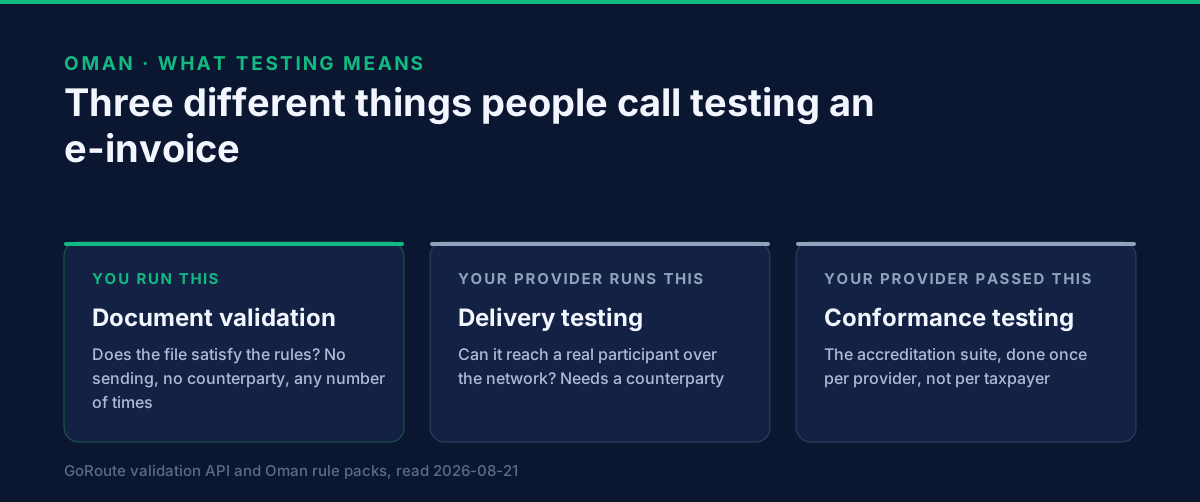
Document validation is this page. It answers one question — does this file satisfy the rules — and it needs nobody's cooperation. You can run it on a single invoice or on every invoice you issued last year.
Delivery testing answers a different question: can a document reach a real participant over the network. That needs a counterparty and a test environment, and it is the network question rather than the document question. If that is what you are looking for, the Peppol test bed is the page for it, and this one deliberately does not compete with it.
Conformance testing is the accreditation suite a service provider passes to be allowed to operate — done once per provider, against the provider's own infrastructure. It is not something a taxpayer runs, and a provider that has passed it has not thereby validated your invoices.
How do you validate a real Oman invoice today?
Four steps, and the slowest is waiting for a key.
- Get sandbox access. A developer sandbox gives you a key against the test environment. Ours is free for 14 days, applications are read by a person and usually provisioned within 24 hours on business days, and the key allows 30 requests a minute and 1,000 a day — sized for integration work and a CI pipeline rather than production traffic. Request one here.
- Send the document as data or as XML. If you already have UBL, validate the file you have. If your system produces something else, post the invoice as JSON and it is rendered into the PINT Oman document first — which is worth doing early, because a rendering that differs from your assumptions is itself the finding.
- Run the check. A quick validation returns a compliance score and human-readable errors with suggested fixes. A deep validation runs the full Schematron rule packs and returns every rule that fired. Use the deep one before you trust anything; the quick one is for a form as somebody types into it.
- Read the identifiers, not the prose. Each finding carries the rule's own identifier. That is what makes a failure a lookup instead of a hunt, and it is what you quote when you ask your provider or your ERP vendor a question about it.
The packs are chosen by the document, not by a parameter you pass. The profile identifier inside the file selects the rule set, so you cannot quietly validate an Oman invoice against another country's rules by forgetting a setting — if you named the wrong profile, the rules that run will tell you so.
What comes back, and how do you read it?
A deep validation response carries more than a verdict, and the extra parts are the ones worth wiring into your own tooling:
| Field | What it gives you |
|---|---|
| Valid or not | The gate's decision: any error or fatal finding refuses the document |
| Error count and warning count | Counted separately, because they mean different things |
| Per finding: layer | Which stage raised it — schema, shared PINT rules, or the Oman pack |
| Per finding: identifier and severity | The rule's own name, and whether it stops the document |
| Per finding: message and location | What is wrong, and where in the document it is |
| Validation time | How long the run took, in milliseconds |
| Ruleset version and pack checksum | Which rules judged this document |
That last row is the one people skip and later need. The Oman pack stamps its own version
into every result — a line reading [PINT-OM-META] Ruleset version 1.0.1 - Authority: Tax Authority Oman, which is informational rather than a failure. Keep it with the result. Rule
packs are revised, and "it validated fine in June" is only an argument if you can say what
it validated against.
Which rules run against an Oman document?
In order: well-formedness, the UBL 2.1 schema, the shared Peppol PINT rule set — 170 rules — and then Oman's own jurisdiction pack — 155 rules. Both counts are from the 2026-Q2 final packs we ship, counted on 21 August 2026 rather than recalled. The full layer-by-layer explanation, and what the file has to carry, is on what format an Oman e-invoice must be in.
One thing surprises people who have worked on European e-invoicing: a PINT document does not run the CEN EN 16931 or Peppol BIS 3.0 rule sets. That is deliberate. The PINT layer already carries the applicable EN 16931 rules adapted for the PINT context, so running both would enforce the same rule family twice and produce contradictory findings. If a tool reports EN 16931 rule failures on an Oman document, it is validating against the wrong thing.
What does each class of failure mean?
| What failed | What you see | What it means |
|---|---|---|
| The file is not well-formed XML | A parse error and no rule identifiers at all | Nothing was validated. This is a file problem, not an invoice problem |
| The document is not a UBL 2.1 invoice or credit note | BTOM-PRE-001 |
The first thing the Oman pack checks. The root element or its namespace is not one Oman accepts, so no other rule can be evaluated meaningfully |
| A shared PINT rule | A lower-case ibr- identifier with no country suffix |
The international rule set every PINT country shares — usually a missing mandatory element or a cardinality breach |
| An Oman jurisdiction rule | An identifier ending -OM |
Oman's own requirement: transaction type, item classification, currency handling, the precision rules, a VAT category needing a reason |
| An Oman code-list check | A CL-…-OM identifier |
The value is well-formed but is not on the list Oman publishes for that field — for example CL-08-OM-HS, which requires a 12-digit Oman HS code on goods |
| A rounding tolerance | An identifier ending -WARN |
Accepted, with a flag. See the next section |
Two habits make this list useful rather than intimidating. Read the identifier first and the message second, because the identifier is stable and the message is prose. And treat a failing rule as a question about your data rather than about the rule: the packs are generated from the specification, so a rule that fires is almost always describing something your system genuinely does.
The severity is in the flag, not in the wording. A rule can read like advice and still
refuse the document. IBR-174-OM says an item classification "should be provided" from the
Oman customs HS code list for goods — and in the packs we ship it is flagged fatal. Read
what the pack does, not what the sentence sounds like. There are exactly three such rules,
and they are the subject of
why Oman e-invoices get rejected.
Is Oman validation pass or fail?
No, and a tool that presents it that way is throwing information away.
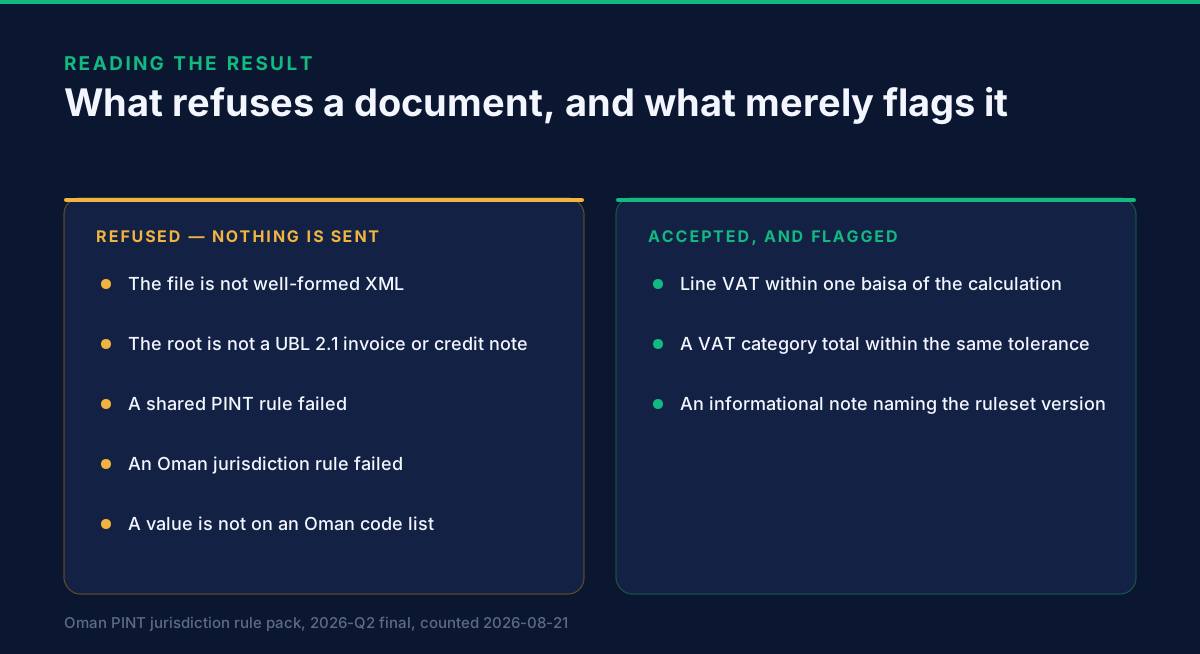
Two of the 155 rules in the Oman jurisdiction pack are warnings, and both are rounding tolerances that exist because the rial has 1,000 baisa:
IBR-168-OM-WARN— the VAT amount on a line does not exactly equal the line's net amount times the VAT rate, but the difference is within 0.001 rial per line. The pack's own message says: "ACCEPTED WITH WARNING … The invoice line is accepted; confirm the rounding is intentional."ALIGNED-IBRP-S-09-OM-WARN— the same idea at the VAT-category level: the category's tax amount does not exactly equal the sum of the line VAT amounts, adjusted for charges and allowances, but sits within the same tolerance multiplied by the number of lines. Same wording: accepted, confirm the rounding was intentional.
Everything else in the pack refuses the document, and the tax data document pack has no warning level at all — all 66 of its rules are fatal.
So the correct handling is three-way, not two-way. A fatal finding stops the document. A warning is issued, logged, and looked at by a person once: if your system is rounding to two decimal places somewhere, these two rules are how you find out before a customer does. A clean run means neither fired.
What does it cost to check a document?
Nothing per call. Charges attach to documents successfully issued, not to attempts at checking them — a validation call, a connection test, a status check, a retry of a request you already made, or a document that failed validation are all outside the meter.
That is deliberate, and it has a practical consequence: there is no commercial reason to validate less. Validate in your integration tests, validate every document before it is sent, and validate your historic invoices in bulk if you are about to be judged on them.
What validation does not tell you
Three limits, stated plainly because the gap between "valid" and "done" is where projects lose time.
It does not mean the Tax Authority has accepted anything. Validation says the document satisfies the rules. The Authority's involvement comes through the tax data document, which is a separate document derived from the invoice and filed to the Authority — it has its own rule pack, and it is covered in the Oman tax data document, field by field.
It does not mean your buyer can receive it. That is a routing question, answered by whether the buyer is registered on the network with a matching receiving capability. The registration mechanics are in the Fawtara readiness guide.
It does not judge your system. Oman also sets obligations on the software that produces the invoice — security, continuity, record-keeping — and no document-level check speaks to those. They are in Article 143 bis 1 and what it requires of your system.
What to test before you go live
A short list that catches most of what we see fail late:
- [ ] One invoice of each type you actually issue — ordinary, credit note, and the self-billed pair if you use it — each validated clean.
- [ ] An invoice with three or more lines at odd unit prices, to expose two-decimal
rounding through the two
-WARNrules. - [ ] A zero-rated or exempt line, with its reason code.
- [ ] An invoice in a currency other than the rial, and one in the rial, to check the exchange-rate rules in both directions.
- [ ] A goods line with an item classification, and a services line with its own.
- [ ] The same document validated twice, to confirm your pipeline is repeatable.
- [ ] The ruleset version from a validation result stored alongside the document.
What is not settled here
Rule packs are revised, and providers do not all run the same version at the same time. The counts and identifiers above are from the 2026-Q2 final packs as we ship them today. Severities in particular can change between a development pack and a final one, which is exactly why the version stamp in the result matters: two validators can legitimately disagree about the same document if they are running different packs. The version history we track is in PINT OM version updates and what they mean for readiness.
A rule pack is not a legal text. It is the machine-readable form of a specification. Where the two are read differently, the specification and the Authority decide, and nothing here is a statement about your own compliance position.
Related Oman guides
- What format must an Oman e-invoice be in? — UBL 2.1, the PINT OM profile, and what the file has to carry.
- Why Oman e-invoices get rejected — reading a failure: what each identifier prefix means, and why a rule worded "should" can still refuse the document.
- Peppol in Oman: a practical Fawtara readiness guide — registration, transport and the tax data document, end to end.
- GoRoute accredited as an Oman e-invoicing service provider — who is accredited, and how to check any provider's claim.
- Inside the Oman Tax Data Document (TDD) — the reporting document and its own rule pack.
- Peppol test bed — the network-level test environment, which is a different question from this one.
What to do with this
If you are integrating, the useful next hour is spent putting one real invoice through a deep validation and reading every identifier it returns — including the warnings. If you are evaluating providers, ask each of them for the rule identifiers their validator returns and the ruleset version it names; a provider that answers with a red cross is telling you something about the tooling behind it.
The commercial ground — what Oman e-invoicing with GoRoute involves, and what the integration looks like — is on our Oman e-invoicing page. A document can be validated against the full Oman rule set before you commit to anything through the free sandbox.
GoRoute is an accredited Oman Fawtara service provider and a certified Peppol Access Point, accredited on 29 July 2026 through Union Digital Technologies SPC.
Primary sources: Oman Tax Authority — the authority that publishes the Oman e-invoicing rules; Peppol technical documentation — the PINT specification the Oman profile extends; OASIS UBL 2.1 — the document syntax the rules are written against.
Frequently asked questions
- Can I check an Oman e-invoice without sending it?
- Yes. A validation call runs the document through the same Oman rule packs that run at send time and returns every rule that fired, by identifier, without transmitting anything. Nothing reaches your buyer and nothing reaches the Tax Authority, so you can run the same document as many times as you need.
- Does validating a document cost anything?
- Validation-only calls carry no per-call charge with GoRoute. What is metered is documents successfully issued, not attempts to check them — a validation call, a connection test, a status check or a document that failed validation adds nothing.
- Which rules run when an Oman invoice is validated?
- The file is checked for well-formedness, then against the UBL 2.1 schema, then against the shared Peppol PINT rule set of 170 rules, then against Oman's own jurisdiction pack of 155. PINT documents deliberately do not run the CEN EN 16931 or Peppol BIS 3.0 rule sets: the PINT layer already carries the applicable EN 16931 rules adapted for the PINT context, so running both would double-enforce the same rule family.
- Is Oman e-invoice validation pass or fail?
- Not quite. Two of the 155 rules in the Oman jurisdiction pack are warnings — both rounding tolerances — and a document that trips one is accepted with a flag rather than refused. Everything else in the pack is fatal. A tool that reports Oman validation as a red cross or a green tick is discarding information you need.
- What does IBR-168-OM-WARN mean on an Oman invoice?
- It means the VAT amount on an invoice line does not exactly equal the line's net amount times the VAT rate, but the difference is within the permitted tolerance of 0.001 rial — one baisa — per line. The pack's own wording is 'ACCEPTED WITH WARNING … confirm the rounding is intentional'. The line is accepted; someone should confirm the rounding was deliberate.
- What does a validation response tell me beyond pass or fail?
- For each rule that fired: which layer raised it, the rule identifier, the severity, a human-readable message, and where in the document it applies. The response also names the ruleset version and the checksum of the rule pack that produced it, which is what lets you prove months later which rules a document was judged against.
- How do I get access to validate Oman documents?
- Through a developer sandbox. GoRoute's is free for 14 days, applications are reviewed by a person and typically provisioned within 24 hours on business days, and sandbox keys allow 30 requests a minute and 1,000 a day — enough for integration testing and a CI pipeline.
- Does a document that passes validation mean the Tax Authority has accepted it?
- No. Validation says the document satisfies the rules. Acceptance is a separate event that happens after the document is issued and the corresponding tax data document is filed, and the tax data document has its own rule pack of 66 rules, every one of them fatal.
About Dr. Syed Raza
Dr. Syed Raza is an IT Enterprise Architect at ClayDesk LLC and leads the GoRoute platform. He works across Peppol Access Point and SMP infrastructure, PINT jurisdictions (Oman, AU/NZ, EU, JP, MY, SG), and national CTC regimes, translating regulatory detail into production-grade e-invoicing systems.
Building on Peppol?
GoRoute is a certified Peppol Access Point & SMP. Book a demo or read the docs to get started.