
How to Choose an E-Invoicing Service Provider in Oman
Before you appoint an Oman e-invoicing software vendor, put six questions in writing: what accreditation covers, who builds the Tax Data Document, how you exit.

Last updated .
The short answer
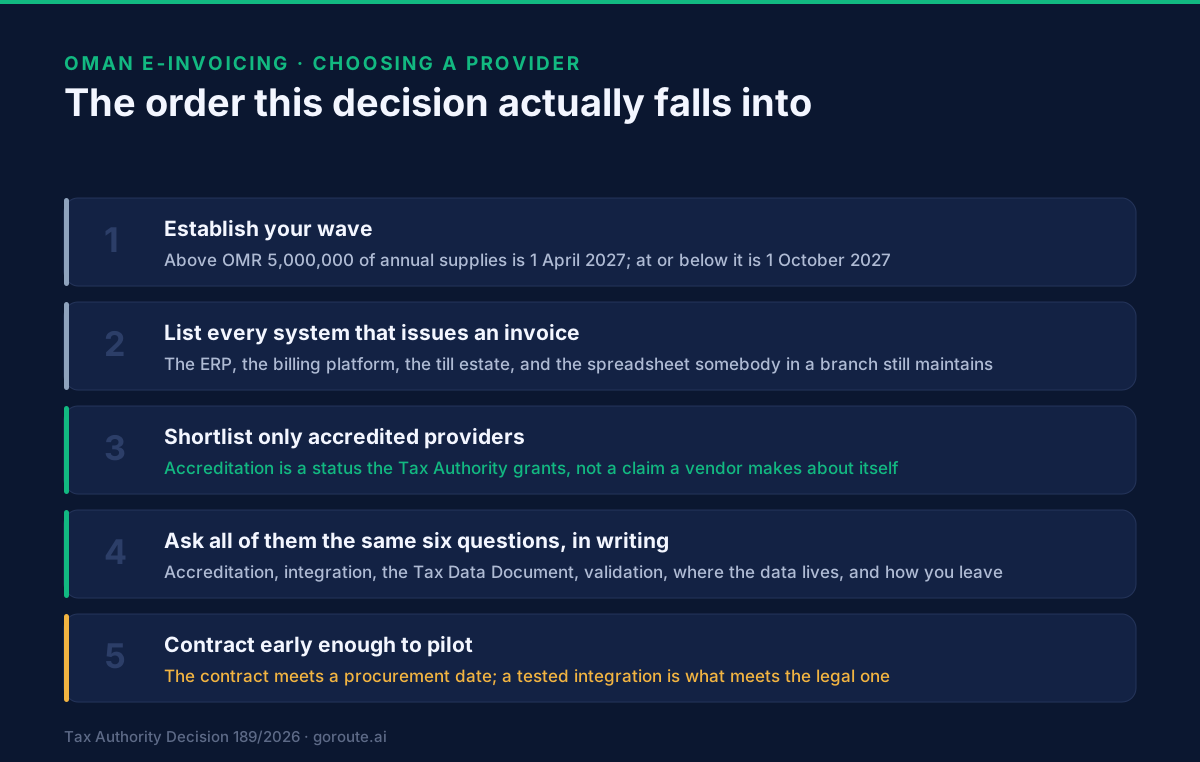
Shortlist only providers the Oman Tax Authority has accredited, then choose between them on six questions: what the accreditation covers and which legal entity holds it, how they connect to the systems that issue your invoices today, whether they produce the Tax Data Document from your invoice or hand that job back to you, which PINT OM version they validate against, where your data is stored, and what happens to your archive if you leave. The accreditation filter is quick and it is absolute. The six questions are where the decision is actually made, and the answers are worth having in writing.
| The question | Where the answer comes from |
|---|---|
| Who is allowed to do this? | The Oman Tax Authority. Article 143 bis, added by Decision 189/2026 |
| By when must invoices actually flow? | 1 April 2027 above OMR 5,000,000 of annual supplies, 1 October 2027 at or below |
| Which provider suits us? | The six questions below, asked of each shortlisted provider in writing |
| Who carries the legal duty? | You do. Article 143 bis 1 puts system security and continuity on the taxable person |
What makes an Oman e-invoicing software vendor worth shortlisting?
Two things. The Tax Authority must have accredited the entity you will contract with — that filter is absolute. Then the vendor must answer six questions in writing: accreditation scope, how it connects to your invoicing systems, who builds the Tax Data Document, which PINT OM version it validates, where your data sits, and exit terms.
Nothing else on a vendor's website settles the question. Price, ERP connector counts and roadmap slides all sit downstream of the accreditation check, and a provider who cannot evidence the accreditation is not a cheaper option — it is not an option. The rest of this page is those six questions, and what the answers should sound like.
Who is licensed to provide e-invoicing in Oman?
Providers the Tax Authority has accredited. Decision 189/2026 added Article 143 bis to the VAT Executive Regulations, and it says the Authority notifies taxpayers of the companies licensed to provide tax invoicing services in an approved electronic format.
That single sentence changes the nature of a provider list. It stops being a procurement convenience — someone's comparison table — and becomes a regulatory instrument. The Authority decides who is on it and tells taxpayers who they are.
Two practical consequences for a buyer:
- A vendor's own claim is not the evidence. Check the status against the Authority. The Fawtara portal is the Authority's own e-invoicing service, and it is a browser application — its pages are assembled when you open them, so you need to look at it yourself rather than expecting a list to appear in a search result.
- Check the legal entity, not the brand. Groups trade under several names, and the accredited one is the entity the Authority accredited. The name on your contract and the name that holds the accreditation should be the same name, not two that look related. Ours are stated further down for exactly this reason.
Oman's accreditation filter is what makes this different from choosing a provider anywhere else. If you are buying for several countries at once, the general version of the same question — certification, country coverage, validation and price, without an accreditation list to start from — is in Peppol software providers: how to choose.
Once you have chosen, appointing the provider is its own portal task with its own statuses and deadlines, and it will not start until your contract is signed: how to connect your Omani business to an accredited service provider. Before you get that far, four things have to be settled with the provider outside the portal, and one of them stops being reversible when they accept: what to settle with an Oman service provider before you connect.
Which date are you buying against?
1 April 2027 if your annual supplies exceed OMR 5,000,000. 1 October 2027 if they are at or below it. Both come from Article Three of Decision 189/2026, which was published in Official Gazette No. 1660 on 9 August 2026 and has been law since.
The threshold belongs in the same sentence as the date every time. Quoted bare, "April 2027" sends businesses that were never in the first wave shopping on a timetable that is not theirs — and it lets the second wave believe it has an extra six months of slack it may not have, because most of the work is the same work. If placing yourself is the actual question, which wave you are in covers it, including what the Decision leaves undefined.
Two more dates worth holding correctly:
- The Authority placed a voluntary pilot of 100 large VAT-registered companies in August 2026, and that month has passed. The month is the one in the Authority's own Fawtara FAQ. It is a statement by the Authority, not a phase written into the Decision, and it should not be planned around as though it were law.
- There is no published date for the Authority's production environment opening. Any provider who gives you one is quoting something we have not seen published.
There are also limited, application-based exemptions: under Article 143 bis 2 the Chairman may grant a time-limited exemption on a documented application, conditional on returns being filed and tax paid on time. It is discretionary and it is not a plan. The full reading of what the Decision changed is in Oman sets its e-invoicing dates.
What are the six questions worth asking?
Ask every shortlisted provider the same six, in writing, and compare the answers side by side. Written answers are not a formality — they are what you will be reading in a year when something behaves differently from how it was described in a meeting.
1. What does your accreditation cover, and which entity holds it?
Ask for the date and the legal entity. An accredited provider can give you both without hesitation, because both are facts about a decision someone else made.
Ask what the accreditation does not mean, too. It means the provider is cleared to serve taxpayers under the mandate. It is not a statement that any particular taxpayer is live, and it is not a claim to be the only one. A provider who presents accreditation as uniqueness is telling you something about how the rest of the answers will be phrased.
2. How do you connect to the systems that issue our invoices today?
Be specific about your own estate before you ask, because the answer is only useful against a real list. Most organisations issue invoices from more than one place: an ERP, a separate billing system, a point-of-sale estate, and at least one spreadsheet somebody maintains. The spreadsheet and the tills are where the trouble usually is — the first because nobody lists it, the second because Article 146 puts simplified invoices on the same deadlines as everything else, so every till in the country is on the same clock as the finance department.
What to listen for: whether the provider has done your exact system and version before, what the connection actually is — a supported connector, an interface your team builds, or a file drop — and what they need from your side. "We integrate with everything" is not an answer. A specific one looks like our own connector notes for Odoo, SAP S/4HANA, TallyPrime and Excel: this is the route, this is what it needs from you.
3. Do you generate the Tax Data Document, or do we?
This is the Oman-specific question, and it separates providers faster than anything else on the list.
Oman's model is not simply "send an invoice". The Tax Data Document — the TDD — is the tax-relevant view of an invoice that the Authority's platform ingests, and it sits alongside the PINT OM invoice that goes to your customer. How the five parties fit together is set out in Oman's Fawtara five-corner model.
So ask directly: is the TDD derived from the invoice we send you, or is producing it a second workflow we have to drive and reconcile? Both exist in the market. The difference is whether your team maintains one integration or two, and whether a mismatch between the two documents is your problem or the provider's.
4. Which PINT OM version do you validate against, and where do the rules come from?
Ask for the version number and its source. The authoritative rule set — the Schematron that decides whether a document passes — is published by OpenPeppol, and a provider running a homegrown approximation of it will diverge from the rules you are actually graded against. That divergence shows up late, under a deadline, on your invoices.
Ask what happens when the specification changes, too. It has already moved once and it will move again. The useful answer names who does the work and how you find out — how a version change lands on a provider and its customers is the shape of that answer.
5. Where is our data stored, and who can reach it?
Ask where invoices, keys, tax documents and audit logs physically live, and ask it as a question about location rather than about assurance.
Then read Article 143 bis 1 with your IT lead, because it is the part of the Decision most likely to be missed. It requires the taxable person to secure the issuing system against breach and unauthorised access, to have measures for emergencies and technical failures, and to be able to recover data lost for any reason. That duty sits on you and does not transfer with a contract. A provider carries most of the operational weight, but "our vendor handles it" is not an answer to the Authority unless the vendor can evidence it — so ask what evidence you would be given. The obligations are set out in full in what Article 143 bis 1 requires of your systems.
6. What happens to our invoice archive if we leave?
Ask before you sign, when you have more leverage than you will ever have again. Get four things in writing: how the archive is exported, in what format, how long the export takes and what it costs, and how long the provider retains your data after termination.
This question does more work than its subject suggests. A provider who answers it precisely and without friction is describing how they will behave for the whole contract. One who treats it as an odd thing to ask has already answered it.
What should not decide it?
Three things that feel like differentiators in a meeting and are not.
A uniqueness claim. Accreditation is a status, not a scarcity. If a provider tells you it is the only one, ask where the Authority published that. Being accredited is checkable; being the only one is a sales line.
A demonstration of the parts everyone has. Every accredited provider clears the same regulatory bar — that is what accreditation means. The demonstration worth asking for is of your own awkward case: the credit note, the advance payment, the multi-entity invoice, the till estate nobody wants to talk about. On advance payments in particular, see the two Article 143 triggers most ERPs do not produce a document for.
The lowest quoted number, read on its own. A price is only comparable once you know the unit — per document, per entity, per connection — and what sits outside it. Ask what the cost looks like at twice your volume and at half. A model you can predict at both ends is worth more than a low starting number you cannot.
Should you build it yourself instead?
It is a fair question and it deserves a straight answer rather than a sales one.
Building is a real option if you issue invoices from one system, you are comfortable owning validation rules that change with the specification, and you have somewhere for the work to live after the project ends. What you cannot build is the accreditation: Article 143 bis puts that with the Authority, so an in-house build still connects to the network through an accredited provider.
The honest test is not "can we build it" but "who maintains it in 2029". Ask any provider you shortlist what the ongoing maintenance would cost you if you did it yourself. A provider who cannot describe your side of that has not thought about it.
What is not settled, and we will not pretend otherwise
The reference period for the OMR 5,000,000 threshold. The Decision does not state which twelve months are measured, whether the test is applied once or reassessed, or what happens to a business that crosses the line before 2027. That is a real gap in the text, and it is the first thing to ask the Authority if you are anywhere near the threshold.
Penalties. No fine schedule appears in Decision 189/2026. Figures circulating in secondary coverage are not sourced to it, and this page does not repeat them.
When the Authority's production environment opens. No date has been published that we can point you to.
Your own scope position. Whether a specific entity is inside the mandate, and in which wave, is a question for the Decision text and whoever advises you on tax. An article cannot answer it about your group, and one that says it can is overreaching.
Where GoRoute stands, plainly
We publish this checklist because these are the questions finance teams in Oman ask us, and they are worth asking of any provider including us. So here are our own answers to question one, stated as facts you can check.
GoRoute is an accredited Oman Tax Authority e-invoicing service provider, accredited on 29 July 2026, through Union Digital Technologies SPC — that is the Omani entity that holds the accreditation, and it is the name to look for. We are not the only accredited provider, and you should verify any provider's status, ours included, against the Authority's own portal rather than a vendor website.
The rest, briefly: a Peppol-certified Access Point, Service Provider ID POP000991 (ClayDesk LLC). On the SMP question — the Service Metadata Publisher is the directory other access points read to find where your invoices go — Oman is centralised: the Tax Authority runs the SMP itself, and an accredited provider publishes your participant entry into it once you have selected that provider on the Fawtara portal. We do not host one for Oman and neither does anyone else; our own self-hosted SMP serves the European, Australian and New Zealand rails. If a proposal offers to build or host an SMP for your Oman operation, it is describing a different country's model — the sequence is set out in the Fawtara readiness guide. PINT OM v1.0.1 conformance re-certified with all suites passed on 30 July 2026 — PINT OM Billing and TDD 7/7, Self-Billing 7/7, Reporting 2/2, eDelivery 7/7, BIS Billing 5/5. The TDD is generated from your PINT OM invoice rather than handed back to you as a second workflow. In-country data residency for Oman on Otech's Tier III Oracle Cloud Infrastructure region, covering invoices, keys, tax documents and audit logs. ISO 27001-aligned practices on certified cloud infrastructure — the infrastructure holds the certifications; we operate to aligned practices and do not claim the certificates as ours.
The full account of how that accreditation was completed, and how to test any provider's claim about it, is in GoRoute accredited as an Oman e-invoicing service provider. The technical brief for the market is on the Oman e-invoicing page, and you can book a 30-minute scoping call if it is easier to ask the six questions out loud.
Sources
- Decision of the Chairman of the Tax Authority No. 189/2026, amending the Executive Regulations of the VAT Law (Decision 53/2021, under Royal Decree 121/2020), published in Official Gazette No. 1660 on 9 August 2026 — the source of the dates, the OMR 5,000,000 threshold, Article 143 bis and Article 143 bis 1
- Oman Tax Authority tax portal and the Fawtara portal
- OpenPeppol PINT specification — the authoritative validation rules
- Oman Observer, 9 August 2026 — the Authority's statement on the voluntary pilot of 100 companies
Each source above was fetched and answered normally on 19 August 2026, the day this page was prepared.
Frequently asked questions
- Who is allowed to provide e-invoicing services in Oman?
- Providers the Oman Tax Authority has accredited. Article 143 bis, added by Decision 189/2026, says the Authority notifies taxpayers of the companies licensed to provide tax invoicing services in an approved electronic format. So the Authority decides who is on that list, not the vendor and not the market.
- How do I choose an e-invoicing software vendor in Oman?
- Shortlist only accredited providers, then compare them on six things: what the accreditation covers and which legal entity holds it, how they connect to the systems that issue your invoices today, whether they generate the Tax Data Document from your invoice or expect you to run a second workflow, which PINT OM version they validate against, where your data is stored, and what happens to your invoice archive if you leave.
- When does a business in Oman need a provider in place?
- Decision 189/2026 makes electronic tax invoices mandatory from 1 April 2027 for taxable persons whose annual supplies exceed OMR 5,000,000, and from 1 October 2027 for those at or below that figure. Those are the dates your integration has to be working by, which is earlier than the date you sign a contract.
- Should we build our own Fawtara integration instead?
- It is a real option and the honest answer depends on how many systems issue your invoices and whether you want to own PINT OM validation rules that change. What you cannot build is the accreditation — Article 143 bis puts that with the Authority. Ask any provider what the integration would cost you to maintain yourself; a provider who cannot answer that has not thought about your side of it.
- What should I ask about leaving a provider?
- Ask before you sign, when you have the most leverage. Get four things in writing — how your invoice archive is exported, in what format, how long it takes and what it costs, and how long the provider keeps your data after termination. A provider who answers that precisely is telling you how they will behave for the whole contract.
- Is GoRoute accredited in Oman?
- Yes. GoRoute is an accredited Oman Tax Authority e-invoicing service provider, accredited on 29 July 2026 through Union Digital Technologies SPC, and operates a Peppol-certified Access Point (Service Provider ID POP000991). It is not the only accredited provider, and you should check any provider's status against the Authority's own portal rather than any vendor's website, ours included.
About Dr. Syed Raza
Dr. Syed Raza is an IT Enterprise Architect at ClayDesk LLC and leads the GoRoute platform. He works across Peppol Access Point and SMP infrastructure, PINT jurisdictions (Oman, AU/NZ, EU, JP, MY, SG), and national CTC regimes, translating regulatory detail into production-grade e-invoicing systems.
Building on Peppol?
GoRoute is a certified Peppol Access Point & SMP. Book a demo or read the docs to get started.