
Oman E-Invoicing for VAT Groups and Non-Residents: Which 2027 Date Applies?
A VAT group in Oman is tested as one business and a non-resident counts only its Oman supplies. Which 2027 date applies, and what each member sets up on Peppol.

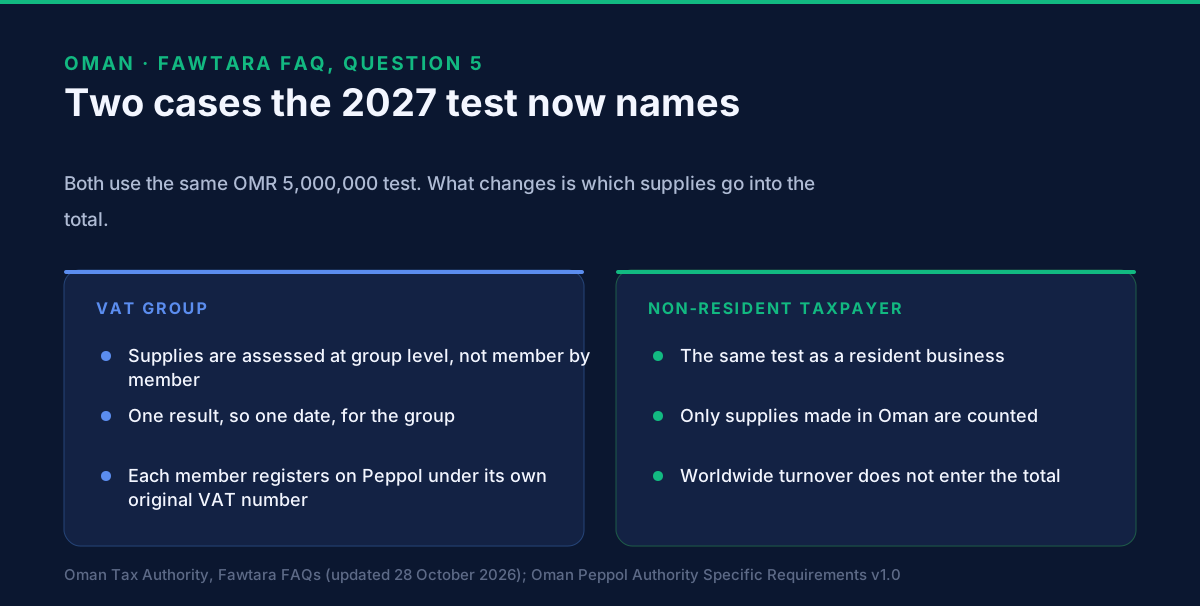
A VAT group in Oman is tested for e-invoicing as one business. If the group's combined supplies exceed OMR 5,000,000, the group starts on 1 April 2027. A non-resident counts only the supplies it makes in Oman. Each group member still registers on Peppol under its own original VAT number, not the group's.
Both rules are new in writing. The Tax Authority added them to its Fawtara FAQ on 28 October 2026, in a question headed "How should I determine whether I am required to implement e-invoicing from 1 April 2027?". The Peppol rule for group members has been in the Oman Authority Specific Requirements since they were approved in July 2026.
This page is for a tax or finance lead at a VAT group, or at a foreign business registered for VAT in Oman. The test itself, with its two periods and what goes into the total, is on the Oman e-invoicing threshold: which wave are you in?, and the decision behind both dates is on Oman's e-invoicing mandate for 2027. This page covers only what changes for a group or a non-resident.
Which date applies to a VAT group in Oman?
The group's date, worked out from the group's total. The FAQ is short on this point: "For VAT Groups, the threshold is assessed at group level and not on a per-member basis."
That has three practical consequences.
- Add up the group, not the member. The supplies the FAQ asks you to count are taxable supplies excluding capital assets, goods and services under the reverse charge, and intra-GCC supplies. For a group, that total is taken across the group.
- One result for the group. On the FAQ's wording there is no member-by-member answer. If the group exceeds OMR 5,000,000 in either test period, the group is in the 1 April 2027 wave. Otherwise it is in the 1 October 2027 wave.
- A small member inherits the group's date. A subsidiary with modest supplies of its own, inside a group that is over the line, is not judged on its own figures. Plan it for April.
The two test periods are the same as for any business: actual supplies from April 2026 to 31 March 2027, or expected supplies from 1 April 2027 to 31 March 2028. Exceeding the threshold in either one is enough.
When does a non-resident have to e-invoice in Oman?
On the same test as an Omani business, counting only what it supplies in Oman. The FAQ says the test "applies to both resident and non-resident taxpayers", and that "for non-resident taxpayers, the calculation shall be based on supplies made in the Sultanate of Oman only."
For a foreign company registered for VAT in Oman, that means:
| Question | Answer from the FAQ |
|---|---|
| Is my worldwide turnover counted? | No. Only supplies made in Oman |
| Is the threshold different for me? | No. It is OMR 5,000,000, as for a resident |
| Are the test periods different? | No. April 2026 to 31 March 2027, or the expected year from 1 April 2027 |
| What if neither test is met? | Your date is 1 October 2027 |
A large multinational with a small Omani business can therefore sit in the October wave. A foreign seller whose Oman sales alone exceed OMR 5,000,000 is in the April wave, whatever its size elsewhere.
Which VAT number does a group member use on Peppol?
Its own, as originally issued. In Oman a business is addressed on the Peppol network by its
VAT number. The Oman Peppol Authority Specific Requirements v1.0 set the identifier as
0248:OM followed by the twelve-digit VAT number, and add one sentence for groups: "In case of
VAT Groups, the End User Identifier for the members of the VAT group will be the VATIN originally
issued and not the VATIN of the VAT group."
So the group's single date does not give it a single Peppol address. In practice:
- Each member is its own participant on Oman's central SMP (the shared directory that tells other providers where to deliver an invoice).
- Each member is registered separately by its accredited service provider. The provider has three working days, from the connection being accepted on the Fawtara portal, to register it.
- Each member must be able to receive at least the PINT OM invoice and PINT OM credit note, which the same document requires for every end user.
- Consent is given on the Fawtara portal by the end user sending a request to the provider. Because each member is registered under its own identifier, our reading is that each member sends its own request. Plan the connections member by member.
A supplier sending an invoice to one of your companies will look up that company's own VAT number. Registering only the group's number would leave every member unreachable.
What VAT number goes on the invoice itself?
The PINT OM v1.0.1 rule packs require a seller VAT identifier on every invoice, except imports of goods, imports of services under the reverse charge and profit-margin self-invoices, and allow only one. They do not say whether a group member writes its own VAT number or the group's in that field. The Authority Specific Requirements settle the Peppol address, not the invoice field. Confirm this with the Tax Authority and your provider before your first live invoice.
How does a non-resident get connected?
Through an accredited Oman service provider, like any other taxpayer. The Authority Specific Requirements oblige accredited providers to register all senders and receivers in scope on the central SMP, and the identifier is the Oman VAT number. A non-resident registered for VAT in Oman has one, so it is addressed the same way as an Omani company.
Two points tend to confuse foreign businesses.
- The local-presence rules are for providers, not for you. Annex B of the same document lets a provider based outside Oman qualify through a subsidiary, a branch or a local distributor. It places no presence requirement on the taxpayer.
- Supplies you make without an Oman VAT registration are handled on the buyer's side. Where an Omani business buys services from abroad under the reverse charge, the PINT OM packs have an invoice type for it, which carries the buyer's VAT number and does not require the seller's. How that document is raised is on what happens when an invoice reaches Oman from a supplier abroad.
How to compare the providers on the accredited list is on how to choose an e-invoicing service provider in Oman.
What is still not settled?
The FAQ answers the date question. It does not answer everything a group or a foreign seller will ask next. Four points are open on the Authority's published material as of 29 October 2026:
- Supplies between group members. The FAQ does not say whether they are counted.
- The invoice VAT number for a group member, as set out above.
- A group that changes shape. Nothing says what happens if a member joins or leaves the group before 31 March 2027.
- How "expected" supplies are evidenced for the forward test. No method is given.
If any of these could move your result across OMR 5,000,000, put the question to the Tax Authority in writing now. The FAQ is the Authority's guidance; Decision 189/2026 is the law that sets the dates.
What to do next
- Work out the group total, or for a non-resident the Oman-only total, for both test periods. The method is on the threshold article.
- List every member's own VAT number. Each one is a separate Peppol registration.
- Choose one accredited provider for the group, or decide deliberately to use more than one, and plan one portal connection per member.
- Settle the invoice VAT number question with the Authority before go-live.
The full Oman picture, including how GoRoute connects to Fawtara as an accredited provider, is on our Oman e-invoicing page. Connector walkthroughs are on tutorials, and the identifier and document detail is in the developer documentation. To map a group's members, numbers and dates with our Oman team, book a session.
Related Oman guides
- Oman e-invoicing threshold: which wave are you in? — the test, its two periods and what goes into the total.
- Oman's e-invoicing mandate for 2027 — Decision 189/2026 and the two dates.
- How to choose an e-invoicing service provider in Oman — the decision a group makes once, for every member.
- How to check your Omani business is really registered on Oman's SMP — the check to run for each member after its provider accepts.
- Can you start e-invoicing in Oman before your 2027 date? — optional early adoption, for a member that wants to rehearse first.
- Do small businesses in Oman have to e-invoice? — the obligation for a business at or under the threshold.
- New or growing business in Oman: which e-invoicing date applies? — the forward test, which a growing group also faces.
Sources: Oman Tax Authority,
Fawtara FAQs, question 5, page
stamped "Last updated: 28 October 2026", read 29 October 2026, for the group-level assessment,
the non-resident rule, the three inclusions and the two test periods; Oman Peppol Authority
Specific Requirements v1.0 (approved 21 July 2026, published by OpenPeppol AISBL), section 1 for
the 0248 identifier, the VAT-group member identifier and portal consent, section 4 for
registration on the central SMP, section 5 for the three-working-day registration, section 6
for the mandatory PINT OM invoice and credit note capabilities, and Annex B for local presence;
PINT OM v1.0.1 rule packs, rules IBR-006-OM, ALIGNED-IBRP-SR-12 and IBR-017-OM for the seller and
buyer VAT identifiers. The Oman PINT specification is published at
docs.peppol.eu.
Frequently asked questions
- Is an Oman VAT group tested as one business for e-invoicing?
- Yes. The Tax Authority's Fawtara FAQ, rewritten on 28 October 2026, says that for VAT groups the threshold is assessed at group level and not on a per-member basis. The group's combined supplies are compared with OMR 5,000,000, and on that wording the group gets one result: 1 April 2027 if the total is over the threshold in either test period, 1 October 2027 if it is not.
- Does a small company inside a large VAT group start in April 2027?
- On the FAQ's wording, yes. Because the threshold is assessed at group level, a member's own turnover is not compared with OMR 5,000,000 on its own. A member with modest supplies inside a group whose total exceeds the threshold is judged by the group's total. If your group is close to the line, plan every member for April.
- Which VAT number does a group member use to register on Peppol in Oman?
- Its own. The Oman Peppol Authority Specific Requirements v1.0 say that for VAT groups the end-user identifier for each member is the VAT number originally issued to that member, not the VAT number of the group. Every member is registered on Oman's central SMP as a separate participant, in the form 0248:OM followed by its twelve-digit VAT number.
- When does a non-resident business have to start e-invoicing in Oman?
- On the same test as a resident business, using only the supplies it makes in Oman. The FAQ says the test applies to both resident and non-resident taxpayers, and that for non-residents the calculation is based on supplies made in the Sultanate only. Over OMR 5,000,000 in either test period means 1 April 2027; otherwise 1 October 2027.
- Does a non-resident need a local presence in Oman to e-invoice?
- The local-presence rules in the Authority Specific Requirements are written for service providers, not for taxpayers. Annex B sets out how a provider based outside Oman establishes a presence, through a subsidiary, a branch or a local distributor. Nothing in that document asks a non-resident taxpayer to do the same. Your provider must be accredited in Oman; that is the requirement that falls on you.
- Do supplies between members of a VAT group count towards the threshold?
- The FAQ does not say. It lists what to include, which is taxable supplies excluding capital assets, reverse-charge supplies and intra-GCC supplies, and says the group is assessed at group level. It does not address supplies made between members. If those are large enough to change your result, ask the Tax Authority in writing before you plan around either reading.
About Dr. Syed Raza
Dr. Syed Raza is an IT Enterprise Architect at ClayDesk LLC and leads the GoRoute platform. He works across Peppol Access Point and SMP infrastructure, PINT jurisdictions (Oman, AU/NZ, EU, JP, MY, SG), and national CTC regimes, translating regulatory detail into production-grade e-invoicing systems.
Building on Peppol?
GoRoute is a certified Peppol Access Point & SMP. Book a demo or read the docs to get started.