
New or Growing Business in Oman: Which E-Invoicing Date Applies?
A new or fast-growing business in Oman is tested on the supplies it expects as well as those it made. Five worked examples of the 2027 test and the open points.

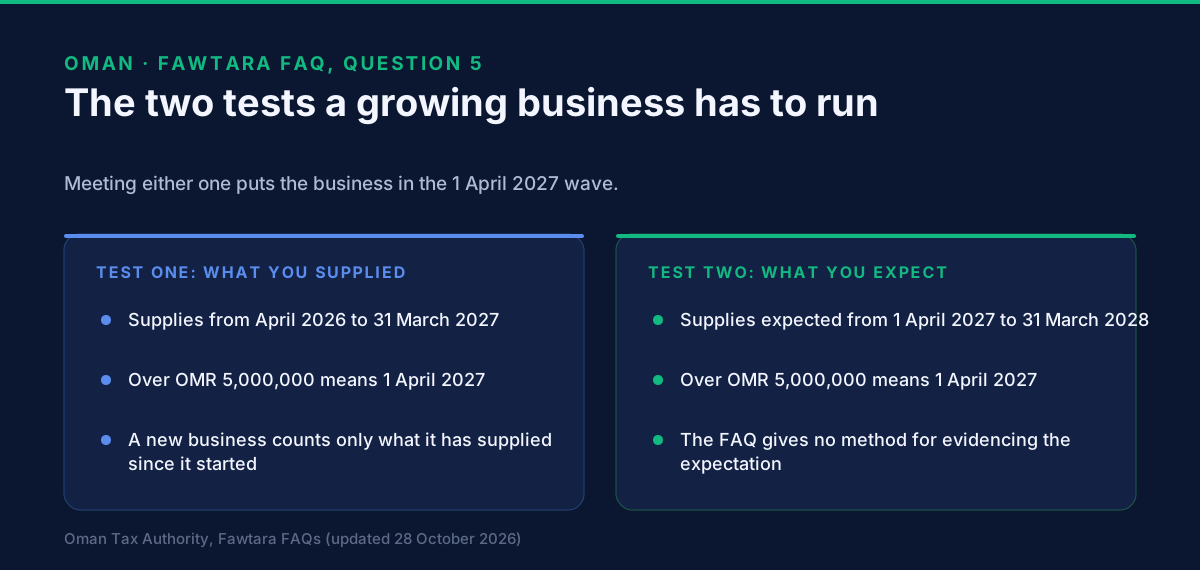
A new or growing business in Oman has two chances to land in the April wave. The Tax Authority's FAQ puts a business on 1 April 2027 if its supplies from April 2026 to 31 March 2027 exceed OMR 5,000,000, or if the supplies it expects from 1 April 2027 to 31 March 2028 exceed that figure. If neither is met, the date is 1 October 2027. For a business that is young or growing fast, the second test is the one that decides.
The rule is in question 5 of the Fawtara FAQ, updated on 28 October 2026. This page is for a founder or finance lead who cannot simply read the date off last year's accounts. It walks through five examples of the test. The basic rule, and what goes into the total, are on the threshold article, which gives this case only two bullet points. This page does not cover how to register for VAT.
How does the test work for a business with little history?
It looks forward as well as back. The FAQ calls the total value of annual supplies "as of 31 March 2027" the key reference, and then sets out the two periods.
| Test | Period | What is counted |
|---|---|---|
| One | April 2026 to 31 March 2027 | Supplies actually made |
| Two | 1 April 2027 to 31 March 2028 | Supplies expected |
Three reading points follow.
- Either test is enough. There is no need to pass both.
- The first test counts what exists. A business that started trading in January 2027 counts January to March, not a twelve-month figure.
- The second test counts what you expect. The FAQ's words are "expected to be achieved". It does not say who decides the expectation or how it is shown.
What goes into each total is the same as for any other business: taxable supplies excluding capital assets, goods and services under the reverse charge, and intra-GCC supplies of goods and services.
Five worked examples
These figures are invented to show the arithmetic. They are not drawn from any business, and none of them is advice about yours.
Example 1: a business that starts trading in February 2027. It supplies OMR 400,000 between February and March 2027, and forecasts OMR 6,200,000 for the year from April 2027. Test one is below the line. Test two is above it. Date: 1 April 2027. A short history does not protect it, because the forecast alone is enough.
Example 2: an established business that is growing. Supplies of OMR 3,200,000 in the year to 31 March 2027, and a forecast of OMR 5,400,000 for the year after. Test one is below. Test two is above. Date: 1 April 2027. Last year's accounts would have suggested October.
Example 3: a business close to the line, but under on both. OMR 4,700,000 actual and a forecast of OMR 4,900,000. Neither exceeds OMR 5,000,000. Date: 1 October 2027 on the FAQ's wording. We would still plan for April. A forecast within a few percent of the line is one a single large contract can overturn, and the threshold article's rule of thumb is that preparing early costs far less than missing the date.
Example 4: a one-off asset sale. Trading supplies of OMR 1,500,000 and a sale of a building for OMR 4,000,000. The building is a capital asset and is left out. Test one counts OMR 1,500,000. Date: 1 October 2027, subject to test two.
Example 5: growth through imported services and Gulf sales. Taxable supplies of OMR 2,800,000, supplies under the reverse charge of OMR 1,400,000 and intra-GCC supplies of OMR 1,000,000. The FAQ counts all three. The total is OMR 5,200,000. Date: 1 April 2027. A business that read only its taxable sales would have put itself in October.
How should you forecast the second test?
With a document you could show someone. The FAQ does not say how expected supplies are evidenced. That gap is the main uncertainty for a growing business. Our reading, not the Authority's, is that a sensible position is:
- A written forecast for 1 April 2027 to 31 March 2028, approved by the owners or board.
- Built from named contracts, orders and a pipeline, not a round number.
- Dated and kept. If the actual figure later differs, the file shows what you believed at the time.
- Reviewed each quarter. A forecast that crosses the line in January should change your plan in January.
If your forecast is near OMR 5,000,000, write to the Authority and ask how it expects the figure to be shown. Keep the reply.
What if you start trading after March 2027?
The FAQ does not say. Both of its test periods are defined by calendar dates, and a business that registers or begins trading after 31 March 2027 may have nothing to put in the first. The second test asks only what you expect, so its logic still reads on a new business. But the FAQ does not address a late start, and this page will not guess. Plan for the date the Authority confirms.
What does a growing business do about systems?
Plan for the earlier date and make it cheap to be right. A business that grows quickly tends to add invoice sources: a second branch, an online shop, a point-of-sale terminal. Each is a separate thing to connect and test.
- Choose a provider that fits where you are going, not only where you are. What to compare is in how to choose an e-invoicing service provider in Oman.
- Connect the steps you already know are needed. The portal path is in how to connect your Omani business to an accredited service provider.
- Start early if you are unsure. The FAQ allows it, and starting e-invoicing in Oman before your 2027 date explains what is and is not known.
- If you are small today, do small businesses in Oman have to e-invoice? covers the obligation and the lowest-effort way to meet it.
If your business is part of a group, or is a foreign company registered in Oman, the supplies are counted differently. See Oman e-invoicing for VAT groups and non-residents.
What is still open?
Three points, as of 29 October 2026.
- How expected supplies are evidenced. No method is given.
- A business that begins after 31 March 2027. Not addressed.
- Zero-rated and exempt supplies. The FAQ does not name them, and a growing business near the line should ask in writing how they are treated.
What to do next
- Write down both totals: actual supplies since 1 April 2026, and your forecast to 31 March 2028.
- If either is within about 15% of OMR 5,000,000, plan for April 2027.
- Keep the forecast on file, with the date and the people who approved it.
- Choose a provider and test one real invoice in the free sandbox.
To work through your own figures and the systems you will need to connect, book a working session with our Oman team. Connector walkthroughs are on tutorials, technical detail is in the developer documentation, and the Oman overview is on the Oman e-invoicing page.
Related Oman guides
- Oman e-invoicing threshold: which wave are you in? — the test and its inclusions.
- Oman e-invoicing for VAT groups and non-residents — how the test treats a group and a foreign seller.
- Starting e-invoicing in Oman before your 2027 date — optional early adoption.
- Do small businesses in Oman have to e-invoice? — the obligation for a business at or under the threshold.
Sources: Oman Tax Authority, Fawtara FAQs, question 5, page stamped "Last updated: 28 October 2026", read 29 October 2026; Decision of the Chairman of the Tax Authority No. 189/2026, Article III, for the two dates. All figures in the worked examples are invented for illustration. Passages marked as our reading are not the Authority's.
Frequently asked questions
- Which e-invoicing date applies to a new business in Oman?
- The one the test gives. A new business runs the same two tests as any other: actual supplies from April 2026 to 31 March 2027, and expected supplies from 1 April 2027 to 31 March 2028. If either is over OMR 5,000,000 the date is 1 April 2027. If neither is, it is 1 October 2027. The FAQ has no separate rule for new businesses.
- What counts as expected supplies?
- The FAQ says 'the total value of your supplies expected to be achieved' from 1 April 2027 to 31 March 2028, and gives no definition or method. The Authority does not say what evidence it accepts. We suggest a forecast your board or owners have approved in writing, but that is our reading, not the Authority's.
- Does a growing business start in April 2027 if it is below the line today?
- If it expects to pass OMR 5,000,000 in the year from 1 April 2027, yes. On the FAQ's wording the expected total alone is enough, even when the supplies actually made in the year to 31 March 2027 were well below the threshold.
- What if I have not started trading yet?
- Then the second test is the only one that can apply to you, because the first has nothing to count. The FAQ does not say what a business that registers after 31 March 2027 should do. Ask the Authority in writing and plan for the date it confirms.
- Should I forecast high or low?
- Honestly. Our advice is to plan for the earlier date if your forecast is close, because missing a statutory deadline is worse than preparing six months early. A forecast that is shaped to land under the line, and that your own results then contradict, would be hard to defend. This is our advice, not guidance from the Authority.
- Does the one-off sale of an asset count?
- Not if it is a capital asset. The FAQ tells you to include taxable supplies 'excluding supplies of capital assets'. Reverse-charge supplies and intra-GCC supplies of goods and services are included, so a business growing through imports of services or Gulf sales should count them.
About Dr. Syed Raza
Dr. Syed Raza is an IT Enterprise Architect at ClayDesk LLC and leads the GoRoute platform. He works across Peppol Access Point and SMP infrastructure, PINT jurisdictions (Oman, AU/NZ, EU, JP, MY, SG), and national CTC regimes, translating regulatory detail into production-grade e-invoicing systems.
Building on Peppol?
GoRoute is a certified Peppol Access Point & SMP. Book a demo or read the docs to get started.