
Oman E-Invoicing Threshold: Are You in the April or October 2027 Wave?
Oman's e-invoicing threshold is OMR 5,000,000 of annual supplies. Above it you start 1 April 2027, at or below 1 October 2027. Plus what is left undefined.

The short answer
OMR 5,000,000 of annual supplies. Above it, you are in the first wave and must issue electronic tax invoices from 1 April 2027. At or below it, 1 October 2027.
| Your annual supplies | Your date | Runway from today |
|---|---|---|
| Above OMR 5,000,000 | 1 April 2027 | about 20 months |
| OMR 5,000,000 or below | 1 October 2027 | about 26 months |
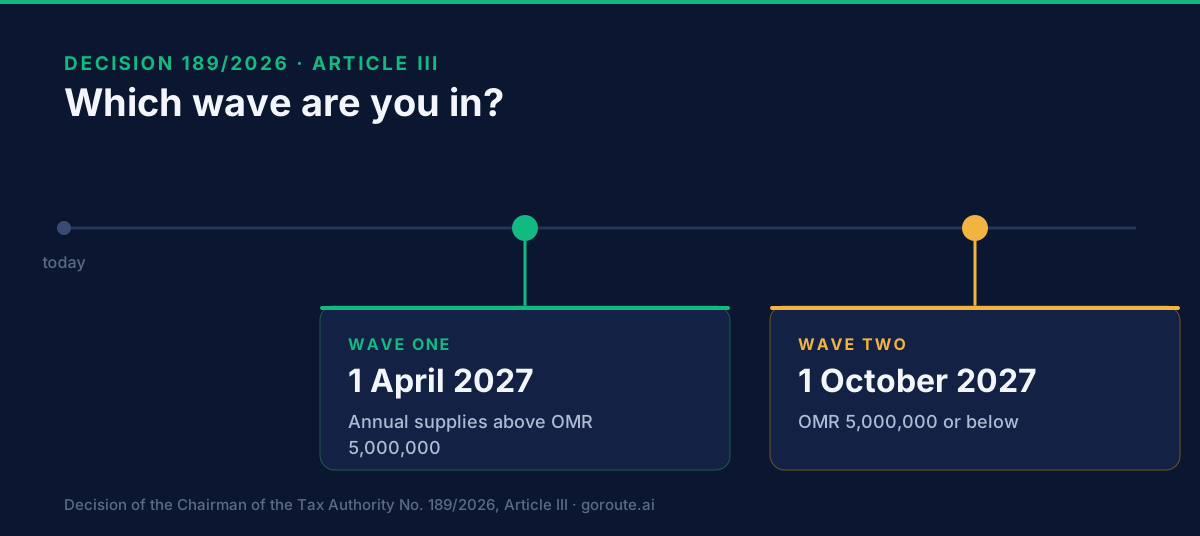
Both dates come from Article III of Decision 189/2026, the Chairman's decision amending the VAT Executive Regulations. There is no third wave and no voluntary tier below the second — every VAT-registered taxpayer is in one of these two groups.
What "annual supplies" actually means
The decision uses the phrase annual supplies value. Three things follow from that wording.
It is a supplies test, not a profit test. A business with thin margins on high volume can be in the first wave while a smaller, more profitable one is in the second. If you are reasoning from your bottom line, you are reasoning from the wrong number.
It tracks what you already report. For most VAT-registered businesses the closest existing figure is the output value on your VAT returns. That is the number to start from.
It is stated without qualification — which brings us to the part most coverage is skipping.
What the decision does not define
Being straight about this is more useful than a confident guess. Decision 189/2026 sets the threshold and does not answer:
- Which twelve months are measured. Calendar year? Trailing twelve months? The last complete financial year? The text sets no reference period.
- Whether the test is applied once or reassessed. If your supplies grow past OMR 5m during 2026, does your date move?
- Whether zero-rated and exempt supplies count. "Annual supplies" is unqualified. A business with large zero-rated exports could be above or below the line depending on the reading.
- What happens to a new business with no full year of history by the test date.
These are not edge cases. An exporter or a fast-growing business can land on either side of the line depending on how they are resolved. If you are anywhere near OMR 5m, this is the question to put to the Tax Authority in writing — and worth doing early, while the answer is still cheap to act on.
The rule of thumb if you are close
Plan for April.
The asymmetry decides it. Preparing six months early costs you readiness you were going to need anyway. Preparing six months late means missing a statutory deadline, with the invoices you cannot legally issue sitting between you and getting paid.
The same logic applies if you are unsure how the reference period will be read. Take the earlier date.
What being in a wave actually obliges you to do
The date is when you must issue tax invoices in an approved and secured electronic format, with integrity, retention and a unique number for each invoice. That obligation covers more transactions than most finance teams expect:
- supplies to non-taxable persons — so B2C is in scope, and simplified invoices run on the same clock
- deemed supplies, which often have no invoice at all in a paper process
- consideration received before the date of supply — deposits and prepayments, which is the trigger most ERPs miss
There is also an obligation on your systems rather than your documents: Article 143 bis 1 requires security, continuity and data recovery measures that sit with the taxpayer regardless of who runs the platform.
Can you be exempted?
Yes, narrowly. Article 143 bis 2 allows the Chairman, on a request with supporting documents and acceptable reasons, to grant exemption from issuing the electronic tax invoice for a period the Authority determines — conditional on filing returns within the legal deadlines in the prescribed format, and paying tax due on time.
It is discretionary, time-limited, and available only to taxpayers whose compliance record is already clean. It exists for genuine hardship. It is not a route around a wave, and building a plan on it would be unwise.
What to do now
- Pull your annual supplies figure from your VAT returns and compare it to OMR 5m.
- If you are within about 15% of the line either way, plan for April 2027 and write to the Authority about the reference period.
- Count your invoice-issuing systems — ERP, POS, billing platform, and the spreadsheet in a branch office. All of them are in scope, including Excel and TallyPrime.
- Check your numbering — one unique number per invoice, across every issuing point.
- Test in a sandbox before the queue forms. Testing is free now; capacity in late 2026 will not be.
The Oman compliance page sets out the full requirements, the Peppol API shows the integration, and you can book a working session with our Oman team. If you invoice across the Gulf, the picture is moving in Saudi Arabia, Qatar and the UAE at the same time.
Sources
- Decision of the Chairman of the Tax Authority No. 189/2026, Article III
- Oman Tax Authority and the Fawtara portal
Frequently asked questions
- What is the Oman e-invoicing threshold?
- OMR 5,000,000 of annual supplies. Taxpayers above it must issue electronic tax invoices from 1 April 2027; taxpayers at or below it from 1 October 2027. Both dates come from Article III of Decision 189/2026.
- Is the threshold based on profit or turnover?
- Neither exactly. The decision expresses it as the value of annual supplies, which is closer to the output value you already report on VAT returns than to profit. It is a supplies test, not an income test.
- Does the threshold include zero-rated and exempt supplies?
- The decision says "annual supplies value" without qualifying it, and does not state whether zero-rated or exempt supplies count toward the OMR 5,000,000. If you are near the line, this is worth confirming with the Tax Authority rather than assuming.
- Which twelve months are measured?
- The decision does not say. It sets no reference period, no test date and no rule for a business that crosses the threshold before 2027. That is a genuine gap in the published text, not an omission in this article.
- What happens if I am just below OMR 5 million?
- Plan for April 2027. The consequence of being wrong in that direction is six months of unnecessary readiness; the consequence of being wrong the other way is missing a statutory deadline.
- Can a business be exempted from the threshold?
- Article 143 bis 2 lets the Chairman grant a time-limited exemption on request with supporting documents and acceptable reasons, conditional on filing returns and paying tax on time. It is discretionary relief for hardship, not a way to opt out of a wave.
About Dr. Syed Raza
Dr. Syed Raza is an IT Enterprise Architect at ClayDesk LLC and leads the GoRoute platform. He works across Peppol Access Point and SMP infrastructure, PINT jurisdictions (Oman, AU/NZ, EU, JP, MY, SG), and national CTC regimes, translating regulatory detail into production-grade e-invoicing systems.
Building on Peppol?
GoRoute is a certified Peppol Access Point & SMP. Book a demo or read the docs to get started.