
Do Small Businesses in Oman Have to E-Invoice?
Small VAT-registered businesses in Oman are included in e-invoicing. The Authority's FAQ says so, and the law's date for them is 1 October 2027. What to do.

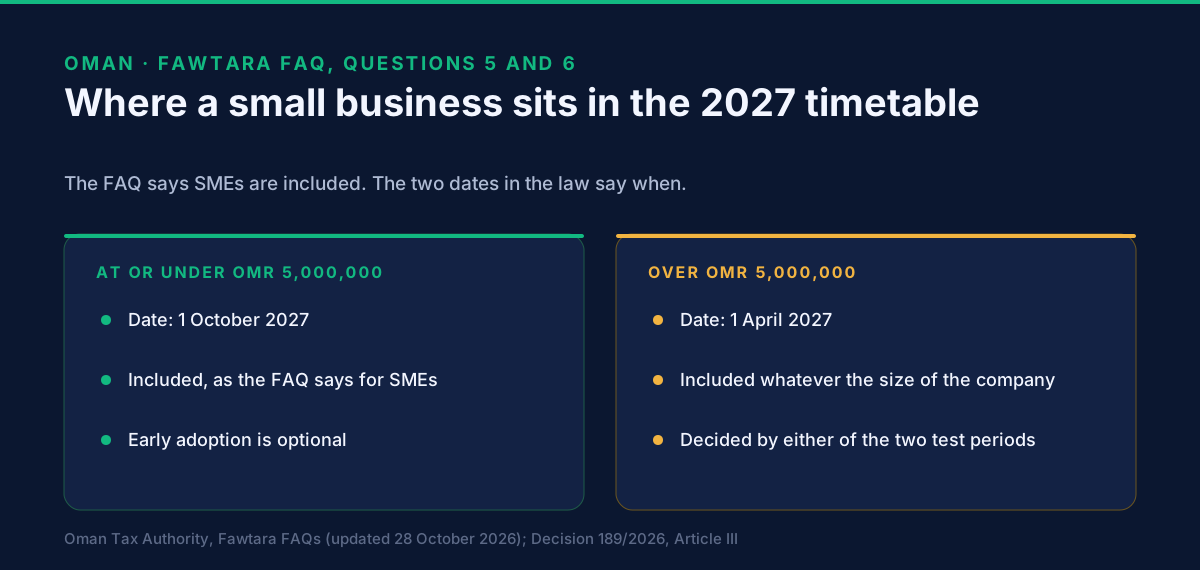
Yes. Small businesses in Oman are included in e-invoicing. The Tax Authority's FAQ answers "Will SMEs be included?" with "Yes, within the third phase of the project." Under Decision 189/2026, a VAT-registered business whose annual supplies are at or under OMR 5,000,000 must issue electronic tax invoices from 1 October 2027. Above that figure the date is 1 April 2027.
This page is for the owner of a small business, or the bookkeeper who keeps its books, who wants to know whether this applies, from when, and what the least work looks like. The test that sets your date, including the two periods it uses, is on the Oman e-invoicing threshold article. This page does not repeat it. It does not cover penalties either, because we have not seen a published penalty schedule for e-invoicing and will not guess one.
Do small businesses have to e-invoice in Oman?
Yes, if they are registered for VAT. The decision that sets the dates amends the VAT Executive Regulations. So it is addressed to taxpayers who issue tax invoices, and it sets no size below which a VAT-registered business is left out. The FAQ confirms the point for small and medium enterprises in a single sentence.
There are two things the FAQ does not do.
- It does not define "SME". No turnover band, headcount or registration category appears in the FAQ. The only dividing line in the law is OMR 5,000,000 of annual supplies.
- It no longer lists the phases. Until 28 October 2026 the FAQ described the roll-out in phases. The rewrite left the words "third phase" in this answer and removed the list they referred to. The law sets two dates, not three. We read "the third phase" as the later of the two dates, 1 October 2027. That is our reading.
Whether your business must be registered for VAT at all is a VAT question that this page does not cover. If you are not registered, ask the Tax Authority or your adviser before relying on this page.
Which date applies to a small business?
1 October 2027, unless the test says otherwise. The FAQ's test puts a business in the 1 April 2027 wave if either of these is true:
- its supplies from April 2026 to 31 March 2027 exceed OMR 5,000,000, or
- the supplies it expects from 1 April 2027 to 31 March 2028 exceed OMR 5,000,000.
If neither is true, the date is 1 October 2027. For a small business that means checking the second test as well as the first. A shop that is growing fast, or one about to win a large contract, can pass the line in the forecast year without having done so in the last one. The worked examples for that case are in the guide for a new or growing business.
A small business that belongs to a VAT group is not tested alone. The group's supplies are assessed together, so a small member of a large group takes the group's date. See Oman e-invoicing for VAT groups and non-residents.
What does a small business have to do?
Issue each tax invoice electronically, in the approved format, through an accredited service provider. The Authority describes the model in FAQ question 7: invoices go from the supplier through the supplier's service provider and the buyer's service provider to the buyer, and the Tax Authority sees each one. For a small business that comes down to four jobs:
- Appoint one accredited provider on the Fawtara portal. The steps are in how to connect your Omani business to an accredited service provider.
- Make sure the data is there. Each invoice needs a seller and buyer VAT number where the rules require one, a tax category on every line and a unit of measure the format accepts. The commonest failures are in why Oman e-invoices get rejected.
- Test before the date. Testing against the PINT OM rules is free in the sandbox, and the method is in how to test an Oman e-invoice before you send it.
- Be able to receive. Suppliers will begin sending you e-invoices too. What that needs is in what your business needs to receive a Fawtara e-invoice.
What is the lowest-effort way for a small business to comply?
Keep the software you have, and connect it. A small business rarely needs a new system. It needs the one it already uses to produce an invoice in the right format and send it. Choose the guide for the tool you use:
| If you invoice from | Start here |
|---|---|
| Excel | Send Oman e-invoices from Excel, and the longer how-to |
| QuickBooks | QuickBooks e-invoicing in Oman |
| Zoho Books | Zoho Books e-invoicing in Oman |
| Xero | Xero e-invoicing in Oman |
The Excel page describes a button inside the workbook you already use, which validates each invoice against PINT OM, sends it over Peppol and files the tax report. Each guide also lists what the tool cannot hold and what you need to add. If your accounting package is not listed, the tutorials and the developer documentation show the other ways in.
Choosing a provider is the other half of the cost. What to compare, and the terms to settle before you sign, are in how to choose an e-invoicing service provider in Oman.
Should a small business start before October 2027?
It may, and it can be sensible. The FAQ says in the same answer that optional early adoption is allowed with necessary support provided. A small business with one invoice source and a handful of customers is the easiest kind to rehearse early. The case for and against, and what the FAQ leaves unanswered, is in starting e-invoicing in Oman before your 2027 date.
What is still open for small businesses?
Three points, as of 29 October 2026.
- Whether the Authority will publish a separate definition of SME. The FAQ answer is brief and there is no guidance behind it.
- Whether zero-rated and exempt supplies count towards OMR 5,000,000. The FAQ lists what to include and does not name them. A small business near the line should ask in writing.
- What support, if any, small businesses will receive. The FAQ mentions necessary support for early adopters only.
What to do next
- Add up your supplies for April 2026 to 31 March 2027, and your forecast for the year after. If either is near OMR 5,000,000, plan for April.
- List where your invoices come from, and pick the matching guide above.
- Compare two accredited providers, and ask each whether it supports your software.
- Run a test invoice in the sandbox before the year ends.
If you want a second pair of eyes on which date you are in, and what connecting your software would look like, book a working session with our Oman team. The full picture for Oman is on the Oman e-invoicing page.
Related Oman guides
- Oman e-invoicing threshold: which wave are you in? — the test, its two periods and what goes into the total.
- Starting e-invoicing in Oman before your 2027 date — what the FAQ allows, and what is not answered.
- New or growing business in Oman: which e-invoicing date applies? — the forward test with worked examples.
- Oman e-invoicing for VAT groups and non-residents — how the test treats a group member.
Sources: Oman Tax Authority, Fawtara FAQs, questions 5, 6 and 7, page stamped "Last updated: 28 October 2026", read 29 October 2026; Decision of the Chairman of the Tax Authority No. 189/2026, Article III, for the two dates and the amendment of the VAT Executive Regulations, and Article 143 bis 2 for the exemption, as the threshold article states them; GoRoute's Excel connector page for what the Excel button does. Passages marked as our reading are not the Authority's.
Frequently asked questions
- Are small businesses included in Oman's e-invoicing?
- Yes. The Tax Authority's Fawtara FAQ asks 'Will SMEs be included?' and answers 'Yes, within the third phase of the project.' The FAQ no longer lists the phases, so read that sentence together with the law: Decision 189/2026 sets two dates, and a business at or under OMR 5,000,000 of annual supplies starts on 1 October 2027.
- What date applies to a small business in Oman?
- 1 October 2027, unless its supplies pass the threshold. The FAQ puts a business in the 1 April 2027 wave if its supplies from April 2026 to 31 March 2027, or its expected supplies from 1 April 2027 to 31 March 2028, exceed OMR 5,000,000. If neither is met, the date is 1 October 2027.
- What counts as a small business for Fawtara?
- The FAQ does not define SME, and no turnover band for it appears in the Authority's published material we have read. The only line the law draws is OMR 5,000,000 of annual supplies. We use 'small' here to mean a business at or under it. That is our shorthand, not the Authority's term.
- Can a small business get an exemption?
- Narrowly. Article 143 bis 2 lets the Chairman of the Tax Authority grant a time-limited exemption on request, with supporting documents and acceptable reasons, if returns and payments are up to date. It is discretionary relief for hardship, not a way for small businesses to opt out. The threshold article sets it out.
- Does a small business have to buy a new accounting system?
- Not necessarily. The obligation is to issue tax invoices in an approved electronic format. Many small businesses can meet it by connecting the software they already use to an accredited provider. GoRoute has connectors and guides for Excel, QuickBooks, Zoho Books and Xero. Whether your own version connects is for your provider to confirm.
- Can a small business start before 1 October 2027?
- Yes. The FAQ allows optional early adoption with necessary support provided. It does not say what that support is. Our guide on starting early explains what the FAQ says, what starting involves, and what is still not answered.
About Dr. Syed Raza
Dr. Syed Raza is an IT Enterprise Architect at ClayDesk LLC and leads the GoRoute platform. He works across Peppol Access Point and SMP infrastructure, PINT jurisdictions (Oman, AU/NZ, EU, JP, MY, SG), and national CTC regimes, translating regulatory detail into production-grade e-invoicing systems.
Building on Peppol?
GoRoute is a certified Peppol Access Point & SMP. Book a demo or read the docs to get started.