
Oman Sets E-Invoicing Dates: 1 April and 1 October 2027
E-invoicing is mandatory in Oman from 1 April 2027 above OMR 5m of annual supplies and 1 October 2027 at or below it, per Decision 189/2026. Full timeline.

Last updated .
When is e-invoicing mandatory in Oman?
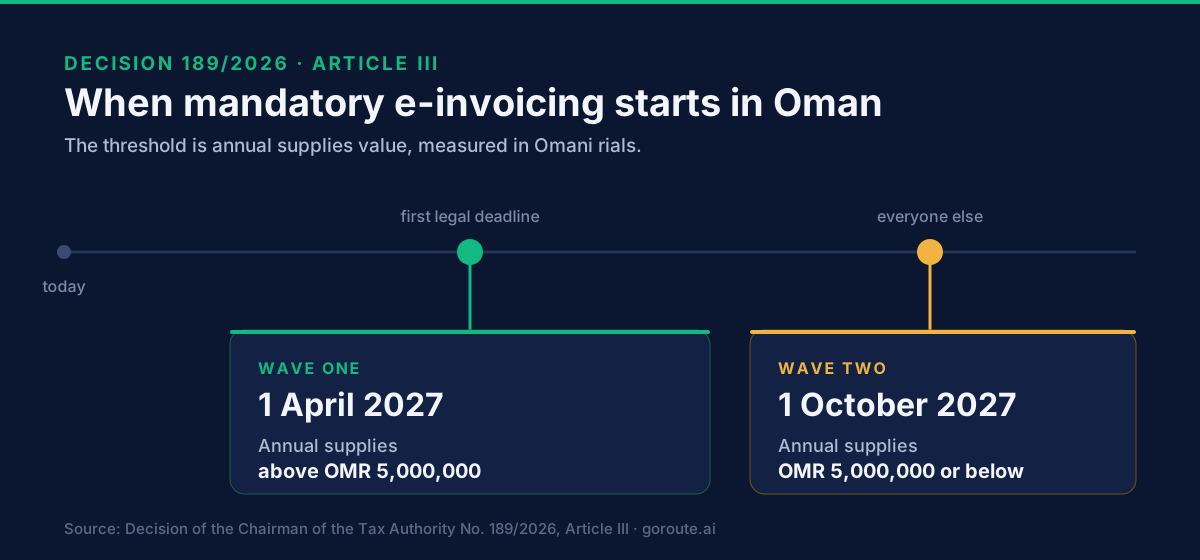
E-invoicing becomes mandatory in Oman on 1 April 2027 for taxpayers whose annual supplies exceed OMR 5,000,000, and on 1 October 2027 for everyone at or below that figure. Both dates are set by Article III of Decision No. 189/2026, which amends the Executive Regulations of the VAT Law.
The Chairman of the Tax Authority issued the decision, and these are the two waves it creates:
| Wave | From | Who |
|---|---|---|
| One | 1 April 2027 | Annual supplies above OMR 5,000,000 |
| Two | 1 October 2027 | Annual supplies OMR 5,000,000 or below |
This is the change that moves Oman from a programme with a direction to a country with a deadline. Until now the honest answer to "when do we have to be live?" was that the Tax Authority had published cohorts but not dates. That answer is now out of date.
What is the Oman e-invoicing deadline?
Oman has two deadlines, both set by Decision 189/2026. Electronic tax invoices become mandatory on 1 April 2027 for taxable persons whose annual supplies exceed OMR 5,000,000, and on 1 October 2027 for everyone at or below that figure. There is no third date and no general extension in the decision.
What is the Oman e-invoicing timeline?
Three points matter. A voluntary pilot of 100 companies was set to start in August 2026 — the month the Tax Authority's own Fawtara FAQ gives for it, and a month that has now passed; it is not written into the decision. The first mandatory wave follows on 1 April 2027, above OMR 5,000,000. The second closes it on 1 October 2027, at or below that threshold.
What happened to Oman's 2026 e-invoicing pilot?
The pilot was a voluntary first phase, and it sits outside the law that sets the deadlines. Muscat Daily reported that the Tax Authority had selected 100 companies to participate voluntarily in a pilot phase beginning at the end of August, quoting Idris bin Hamoud Al Rashdi, Director of the Electronic Invoicing Project at the Tax Authority. The Authority's own Fawtara FAQ places the same first phase — one hundred large VAT-registered companies — in August 2026, a month that has now passed.
Two things follow for a business that was not one of the hundred:
- The pilot does not change your date. Decision 189/2026 does not mention it. Your obligation starts on 1 April or 1 October 2027, depending on your wave.
- The decision does not say how the pilot and the statutory dates interact. Both statements above are reports about the rollout, not text from the decision, and we report them as that.
What is Decision 189/2026?
It is a decision of the Chairman of the Tax Authority, issued under the VAT Law promulgated by Royal Decree No. 121/2020, amending the Executive Regulations issued by Decision No. 53/2021.
Two things make it significant beyond the dates. First, it puts the electronic-invoicing obligation into the Regulations themselves rather than into programme documentation — it is now black-letter law with a repeal clause behind it. Second, it creates the statutory concept of a licensed e-invoicing service provider.
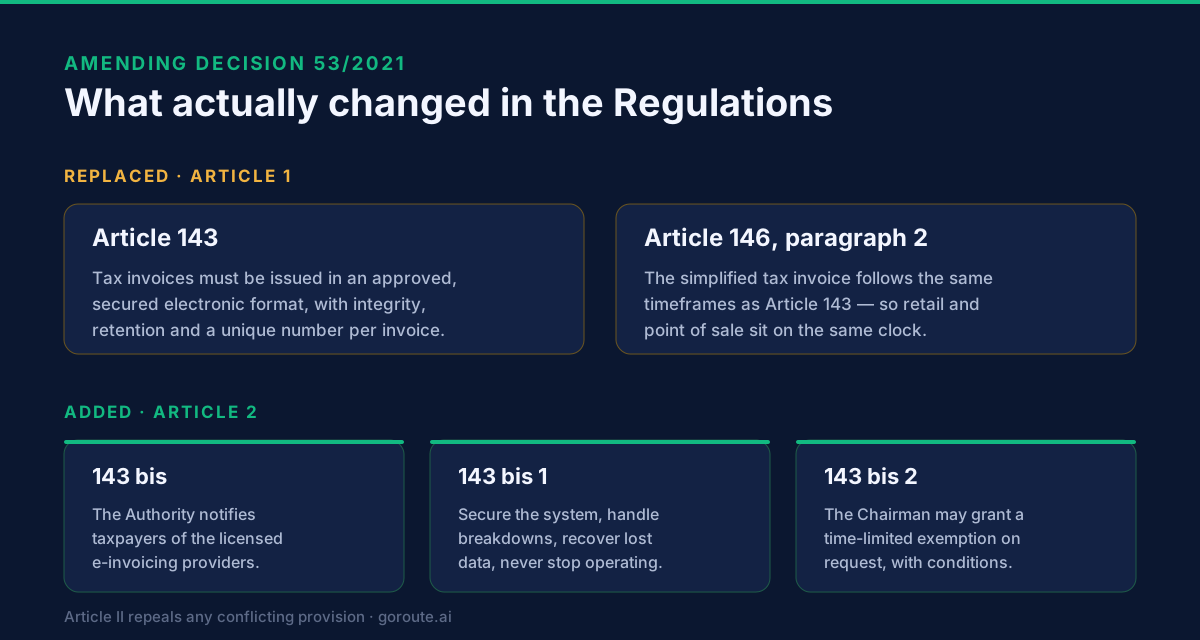
Replaced: Article 143, and Article 146 paragraph two. Added: Article 143 bis, Article 143 bis 1, and Article 143 bis 2. Repealed: anything in the Regulations that conflicts with the above.
Which wave am I in?
The dividing line is annual supplies value of OMR 5,000,000. Above it, you are in the April 2027 wave. At or below it, October 2027.
Note the wording carefully: the threshold is expressed as the value of supplies, not as taxable profit or as headcount. For most VAT-registered businesses this will track the value already reported on VAT returns.
What the decision does not settle is the reference period. It does not state which twelve months are measured, whether the test is applied once or reassessed, or what happens to a business that crosses the threshold between now and 2027. That is a real gap, not an oversight on our part in reading it, and it is the first thing worth asking the Authority if you are anywhere near OMR 5m.
What has to happen to an invoice now?
Under the new Article 143, the taxable person must issue the tax invoice in an approved and secured electronic format, ensuring its integrity and retention, with a unique number for each invoice.
Three obligations are bundled in that sentence, and they are not the same thing:
- Approved and secured format — the document must be in a form the Authority recognises, produced by a system that meets its technical requirements
- Integrity and retention — it must be demonstrably unaltered, and it must still be there later
- A unique number per invoice — no reuse, no gaps papered over, no per-branch sequences that collide
Which transactions need an electronic invoice?
Article 143 lists four triggering events, and two of them are the ones that catch people out.
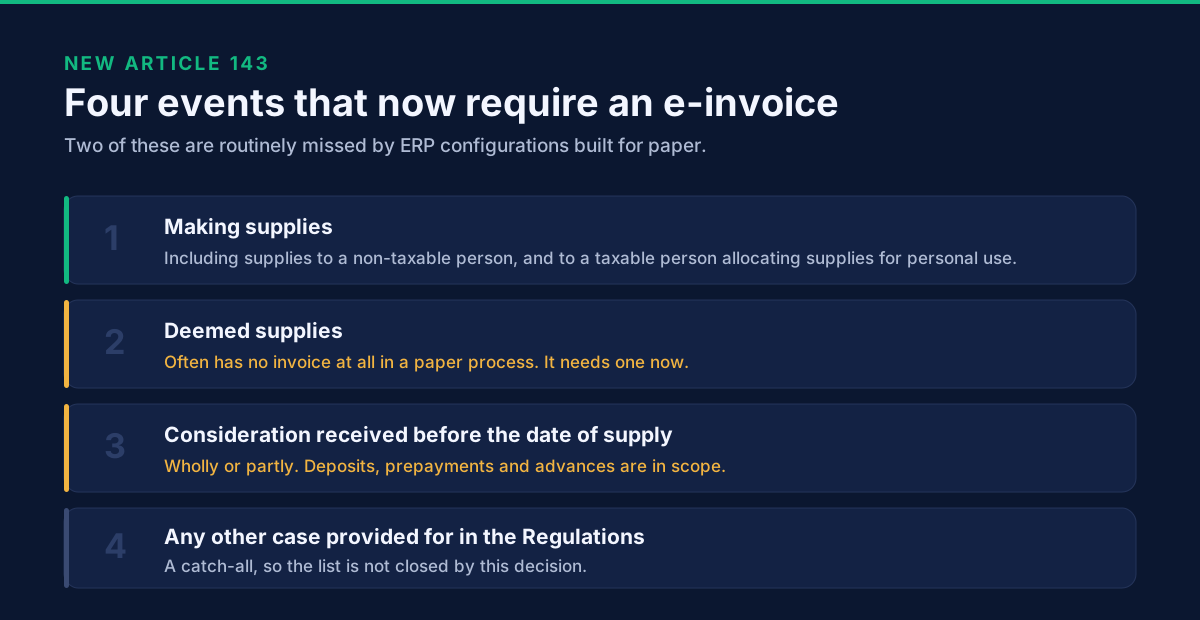
- Making supplies — including supplies to a non-taxable person, and to a taxable person allocating the supplies for personal use
- Deemed supplies
- Receiving consideration, wholly or partly, before the date of supply
- Any other case provided for in the Regulations
Items 2 and 3 deserve attention now rather than in 2027. A deemed supply frequently has no invoice at all in a paper process — it is a VAT-return adjustment. It will need a document. And advance payments are the single most common gap we see in ERP configurations: the deposit is receipted, the tax invoice is raised at delivery, and under Article 143 that is too late.
Item 1's phrasing matters too. "Including supplies to a non-taxable person" puts B2C squarely inside the mandate — which the next section confirms from the other direction.
Do B2C and point-of-sale invoices change too?
Yes, and this is the amendment most likely to be underestimated.
Article 146 paragraph two has been replaced so that the simplified tax invoice must be issued within the timeframes specified in Article 143. In plain terms: the simplified invoice is not on a slower track. Retail, fuel, exchange houses, restaurants, clinics — every till in the country is on the same clock as the finance department.
If you run high-volume counters, this is an architecture question rather than a compliance question, and it is worth starting early. We wrote up how the simplified-invoice path works in practice in the Oman Tax Data Document deep dive.
Who is allowed to provide the system?
New Article 143 bis says the Tax Authority shall notify taxpayers of the companies licensed to provide tax invoicing services in an approved electronic format.
That single sentence does real work. It means the provider list stops being a procurement convenience and becomes a regulatory instrument: the Authority publishes who is licensed, and taxpayers are formally notified of it.
For the record, and so you can weigh the source of this article: GoRoute operates in Oman through Union Digital Technologies SPC, an OTA-accredited service provider running a certified Peppol Access Point. The Service Metadata Publisher — the directory other access points read to find where your invoices go — is run centrally by the Tax Authority in Oman, and an accredited provider publishes your participant entry into it rather than hosting one of its own; our own self-hosted SMP serves the European, Australian and New Zealand rails. You can verify accredited providers directly on the Authority's own Fawtara portal rather than taking any vendor's word for it — including ours.
What does Article 143 bis 1 require of your systems?
This is the article that will surprise IT departments, because it is not really about invoices at all. It is a security and business-continuity obligation, and it sits on the taxable person.
The taxable person must comply with measures ensuring secure issuance through an electronic system, comply with the prescribed technical specifications to protect that system against breach or unauthorised access, take measures and procedures to address emergencies, breakdowns or technical malfunctions, and establish mechanisms ensuring the recovery of data in the event of loss for any reason whatsoever — so that the system does not cease operation and continues to function efficiently and effectively.
Read that as four separate programmes: access control, incident response, disaster recovery, and availability.
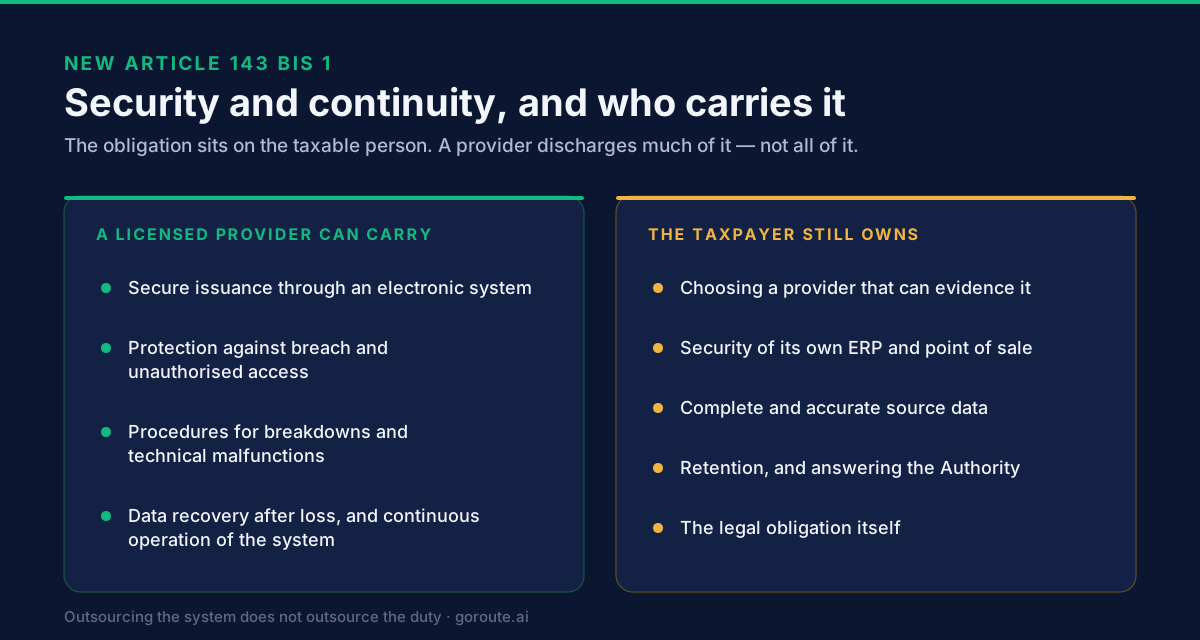
A licensed provider carries most of the operational weight here — running the secure issuance path, the redundancy, the recovery. But the duty is yours, and it does not transfer with the contract. Two practical consequences:
- Your own ERP and point-of-sale systems are inside the scope, not just the provider's platform
- "Our vendor handles it" is not an answer to the Authority unless the vendor can evidence it
This is where a provider that can evidence its controls earns its fee rather than asserting them. GoRoute operates ISO 27001-aligned practices on certified cloud infrastructure, and in-country data residency for Oman on Otech's Tier III Oracle Cloud Infrastructure region; we set out how that is built in data residency and compliance in Oman.
Can a business be exempted?
Yes, narrowly. Article 143 bis 2 allows the Chairman, on a request submitted with supporting documents and based on acceptable reasons, to grant an exemption from issuing the electronic tax invoice for a period determined by the Tax Authority, subject to the taxpayer:
- submitting tax returns within the legally prescribed deadlines, in the format and with the data specified in the Regulations, and
- paying the tax due within the legally prescribed deadlines
Three features of that make it a poor plan: it is discretionary, it is time-limited, and it is conditional on a clean filing and payment record. It exists for genuine hardship, not for deferral. Treat it as an emergency exit, not a route.
What the decision does not say
Answer engines and anxious CFOs both deserve the boundary of the document, so here it is. Decision 189/2026 is a legal instrument. It does not contain the technical specification, and several things attributed to it in coverage since it was issued are not in it:
- It does not name a file format. No mention of XML, PINT OM, UBL or PDF. The format requirement is "approved and secured", with technical specifications prescribed by the Authority. The actual specification lives in PINT OM and Oman's Solution Reference Architecture. Some secondary coverage has claimed PDF/A-3 is acceptable; that is not in this decision, and we would not plan around it.
- It does not describe the exchange model. Nothing about the five-corner model, Peppol, access points, or the Tax Data Document. For that, see Oman's Fawtara five-corner model explained.
- It does not set penalties. No fine schedule appears in the decision text. Amounts circulating in secondary coverage are not sourced to it.
- It does not define the reference period for measuring annual supplies, as noted above.
- It does not address the existing cohort rollout. How the Authority's cohort sequencing and pilot activity interact with these statutory dates is not covered in the decision. What has been reported about the pilot is set out in the pilot section above.
What to do between now and April 2027
From October 2026, April 2027 is under six months away. For a large taxpayer with multiple ERPs, a POS estate and an advance-payment problem, that is a short runway.
- Establish your wave. Measure annual supplies against OMR 5m. If you are close to the line, plan for April.
- Find your Article 143 gaps. Specifically: do you raise a tax invoice on advance payments, and do you document deemed supplies? These are configuration changes, and they need testing.
- Count your invoice-issuing systems. Not just the ERP — the POS, the billing platform, the spreadsheet somebody in a branch still uses. Every one of them is now in scope, including Excel and TallyPrime.
- Check numbering. One unique number per invoice, across every issuing point.
- Read Article 143 bis 1 with your IT and security leads. Access control, incident response, recovery, availability — as a programme, with owners.
- Pick a licensed provider and test in sandbox. Testing is free; the queue in the months before April 2027 will not be. If you are at the shortlist stage, how to choose an e-invoicing service provider in Oman sets out the six questions worth asking each candidate in writing.
If you want to see what compliant output actually looks like before committing to anything, book a working session with our Oman team. The Oman compliance page covers the requirements in detail, the Peppol API page and the developer documentation show the integration, and the video tutorials walk through sending an invoice end to end. If you are comparing providers, read how to choose an e-invoicing service provider in Oman next.
Elsewhere in the region the picture is moving at the same time — Saudi Arabia is live and expanding, Qatar has its enabling law, and the UAE programme is underway. If you invoice across the GCC, plan the estate rather than the country.
Go deeper on each part
The decision touches four things a team has to act on separately, and each has its own guide:
- Which wave are you in? — the OMR 5m threshold, and what the decision leaves undefined
- Advance payments and deemed supplies — the two Article 143 triggers most ERPs do not produce a document for
- Article 143 bis 1 system requirements — security, continuity and recovery, which sit with the taxpayer
- Simplified invoices and POS — why every till shares the same dates
- Choosing a service provider — Article 143 bis makes the provider list a regulatory instrument; this is how to buy against it
Sources
- Decision of the Chairman of the Tax Authority No. 189/2026, amending the Executive Regulations of the VAT Law (Decision 53/2021, under Royal Decree 121/2020)
- Oman Tax Authority and the Fawtara e-invoicing portal
- Oman Observer — Oman mandates electronic tax invoices from April 2027
- Muscat Daily — Oman to introduce mandatory electronic tax invoicing from April 2027
Frequently asked questions
- When does e-invoicing become mandatory in Oman?
- In two waves. From 1 April 2027 for taxpayers whose annual supplies exceed OMR 5,000,000, and from 1 October 2027 for taxpayers whose annual supplies do not exceed OMR 5,000,000. Both dates come from Article III of Decision 189/2026.
- What is Decision 189/2026?
- A decision of the Chairman of the Oman Tax Authority amending the Executive Regulations of the VAT Law. It replaces Article 143 and Article 146 paragraph two, and adds three new articles - 143 bis, 143 bis 1 and 143 bis 2. It is the legal instrument that makes electronic invoicing compulsory.
- Does the mandate apply to B2C and point-of-sale invoices?
- Yes. The amended Article 146 paragraph two puts the simplified tax invoice on the same timeframes as Article 143, so retail and point-of-sale sit on the same clock as B2B.
- Do advance payments need an electronic invoice?
- Yes. Article 143 requires an invoice when consideration is received wholly or partly before the date of supply. Deposits, prepayments and advances are in scope, and this is one of the cases a paper-era ERP configuration most often misses.
- Can a business be exempted from issuing electronic invoices?
- Article 143 bis 2 lets the Chairman grant an exemption for a period the Authority determines, on request with supporting documents and acceptable reasons. It is conditional on filing returns in the prescribed format and deadlines and paying tax due on time. It is discretionary and time-limited, not a planning option.
- Does the decision say which file format to use?
- No. Decision 189/2026 requires an approved and secured electronic format but does not name one. The technical specification lives in the PINT OM specification and Oman's Solution Reference Architecture, not in this decision.
About Dr. Syed Raza
Dr. Syed Raza is an IT Enterprise Architect at ClayDesk LLC and leads the GoRoute platform. He works across Peppol Access Point and SMP infrastructure, PINT jurisdictions (Oman, AU/NZ, EU, JP, MY, SG), and national CTC regimes, translating regulatory detail into production-grade e-invoicing systems.
Building on Peppol?
GoRoute is a certified Peppol Access Point & SMP. Book a demo or read the docs to get started.