
Advance-Payment and Final Invoices as E-Invoices in Germany
How advance-payment and final invoices work as e-invoices in Germany: section 14(5) UStG, the BMF's rule for the deduction, and the BT-113 and BT-22 fields.

An advance-payment invoice is an invoice like any other once the e-invoice duty applies to you, and the final invoice must still deduct the advances and the VAT on them. Section 14(5) of the VAT act (Umsatzsteuergesetz, UStG) applies the ordinary invoice rules to a payment received before the supply, and says a final invoice (Endrechnung, also Schlussrechnung) must deduct the part-payments received and the tax on them. In an e-invoice the Federal Ministry of Finance (BMF) says the deduction may sit in two fields until 30 June 2030: the paid amount (BT-113) and the invoice note (BT-22).
This page is for the finance lead in a construction or project business who bills in stages. It covers advance and final invoices. It does not cover continuing invoices such as rent (Dauerrechnung), and corrections are in credit notes and self-billing. It is not tax advice. GoRoute is a certified Peppol Access Point and SMP (POP000991). For German sellers it sends EN 16931 invoices, including XRechnung, over Peppol.
How does section 14(5) UStG treat advance payments?
It treats the advance like a supply for invoicing, and it puts the deduction in the final invoice. The statute has two sentences. Sentence 1: if the entrepreneur receives the price or part of it for a supply not yet made, sections 14(1) to 14(4) apply with the necessary changes. Sentence 2: if a final invoice is issued, the part-payments received before the supply and the tax on them must be deducted, where invoices under section 14(1) to 14(4) were issued for them.
Two consequences follow from the statute.
- The date changes. Section 14(4) number 6 says that in the cases of section 14(5) sentence 1, the invoice gives the date the payment, or the part of it, was received, if that date is fixed and differs from the issue date. The KoSIT mapping table, which the BMF recommends, puts that date in BT-7, the VAT point date.
- The deduction depends on an invoice. Sentence 2 applies "if" invoices were issued for the part-payments. Where no advance invoice exists, the statute does not prescribe the deduction in this form. Ask your adviser how to handle a payment that arrived without one.
A part-supply invoice (Teilrechnung) is a different case. Section 13(1) number 1 letter a sentences 2 and 3 treat a supply as a partial supply where the price is agreed separately for parts of an economically divisible service. The final-invoice deduction in section 14(5) sentence 2 covers payments received before the supply was performed.
Does an advance-payment invoice have to be an e-invoice?
Our reading is yes, from the date the duty applies to you. Section 14(2) sentence 2 number 1 requires an e-invoice for a supply from one business to another, both established in Germany. Section 14(5) sentence 1 applies sections 14(1) to 14(4) to the advance. The dates, 1 January 2027 for sellers above EUR 800,000 of prior-year turnover and 1 January 2028 for everyone else, are in Germany B2B e-invoicing 2025 to 2028, and the exceptions are in which German invoices need not be e-invoices.
The BMF's FAQ speaks to the transition. It says that advance, prepayment and instalment invoices (Anzahlungs-, Voraus- und Abschlagsrechnungen) issued before the date the duty starts need not be e-invoices, even if supply and payment come after that date. So if the duty starts for you on 1 January 2027, an advance invoice you issue in December 2026 can stay a PDF, with the buyer's agreement if it is sent electronically. The FAQ does not say what happens to one issued after the date. We read the statute as applying the ordinary rule to it.
How does the final invoice deduct the advances?
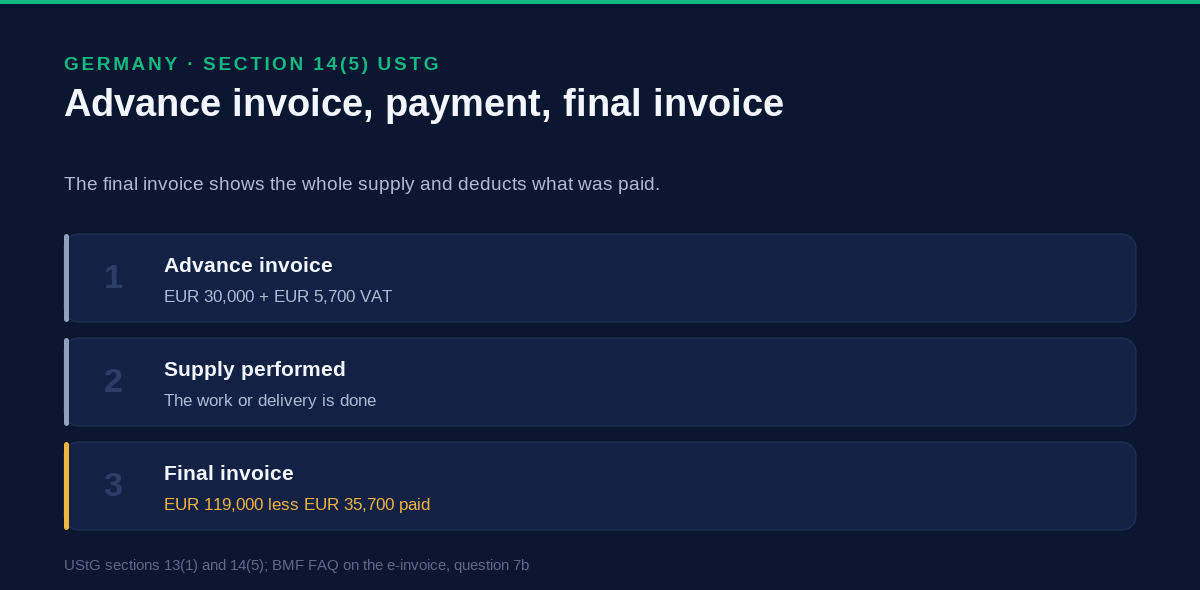
With the whole supply on the invoice, the advances deducted, and the amount still due at the bottom. The sums matter here. This example is ours, not the BMF's: a project with EUR 100,000 net, a 30 percent advance and VAT at 19 percent.
| Document | Net | VAT | Gross |
|---|---|---|---|
| Advance invoice, paid | 30,000.00 | 5,700.00 | 35,700.00 |
| Final invoice, whole supply | 100,000.00 | 19,000.00 | 119,000.00 |
| Deducted on the final invoice | 30,000.00 | 5,700.00 | 35,700.00 |
| Still due | 70,000.00 | 13,300.00 | 83,300.00 |
The statute asks for the net part-payment and its tax to be deducted. The BMF's FAQ gives the way to do it in an e-invoice: until 30 June 2030 the final invoice can show the deduction in the structured part as a sum in BT-113, the paid amount, and put the details of the part-payments in the free-text invoice note BT-22. The details are the numbers and dates of the advance invoices and the net amounts and tax. The alternative is an embedded, unstructured attachment with the deduction, if the structured part expressly refers to it. The BMF says this rule, already in its letter of 15 October 2024, can continue past 31 December 2027 until 30 June 2030.
In our example the structured part would carry 35,700.00 in BT-113 and 83,300.00 as the amount due (BT-115), and the note would name the advance invoice and give its 30,000.00 net and 5,700.00 tax. That placement is our reading of the BMF's two fields. Whether it satisfies section 14(5) sentence 2 for your case is for your adviser.
The KoSIT table lists the same fields for section 14(5) sentence 2: the invoice note (BG-1), supporting documents (BG-24) and the document totals BT-113 and BT-115. It adds that a detailed structured representation of the examples is not yet possible in the EN 16931 core model, so an attachment is needed for now.
If you prefer, the BStBK reports that the BMF recommended a remainder invoice (Restrechnung) for only the balance after the advances. That is an alternative way to bill, not a different rule.
Which type code marks an advance invoice?
The sources do not agree, so test it. Three statements, all from sources we read today:
- The KoSIT mapping table says to use code 386, prepayment invoice, for advance invoices and 326, partial invoice, for partial invoices.
- The BStBK FAQ of 3 March 2026 says 386 is not provided for in XRechnung and raises a warning there, and suggests code 380, commercial invoice, with the text Anzahlungsrechnung in BT-22.
- The German national rule DE-R-017 in Peppol BIS Billing 3.0.21 lists 326, 380, 384, 389, 381 and the construction codes 875, 876 and 877. It does not list 386. We read it in the pinned rule file; it applies when seller and buyer are both in Germany.
If your buyer's system rejects one code, use the other, and say in the note what the document is. The invoice's legal effect comes from its content under section 14(5), not from the code. That is our reading.
What is different in construction?
The BMF allows a lighter structured part, for now. Its FAQ says that for a construction supply it is currently enough if the structured part gives only the sums per trade (Gewerk), as long as an embedded human-readable attachment gives the detailed breakdown by bill of quantities (Leistungsverzeichnis) and the structured part clearly refers to it. The BStBK reports a BMF letter of 23 February 2026 that sets 30 June 2030 as the end of that relief and applies the same date to the final-invoice attachment. We did not read the letter, and the FAQ does not give the date for the trade sums.
The federal e-invoicing site adds that XRechnung already allows construction invoice types, such as instalment, partial-final and final invoices, and that its "Extension XRechnung" allows embedded XML attachments such as GAEB files. A reverse-charge construction invoice has its own wording, covered in reverse-charge invoices in Germany.
What to do next
- Mark each invoice in your system as advance, partial or final, and keep the advance invoice numbers on the project.
- Capture the date the payment was received, because it goes on the advance invoice and in BT-7.
- Build the final invoice with the whole supply, and test BT-113, BT-115 and the note on one project before January.
- Ask your buyers which type code their system accepts for an advance invoice.
- To discuss a staged-billing flow, book a demo. The Germany page, how invoices are sent and tracked, the tutorials and the developer documentation cover the rest.
Related reading
- E-invoicing in Germany, the country page.
- What a German invoice must contain
- Invoicing a German public body
- Reverse-charge invoices in Germany
- Credit notes and self-billing (Gutschrift)
Sources, all read on 25 November 2026: Umsatzsteuergesetz, section 13, section 14; Bundesministerium der Finanzen, Fragen und Antworten zur E-Rechnung (questions 7b and 11); KoSIT, Zuordnung der Pflichtangaben nach UStG zur EN 16931; Bundessteuerberaterkammer, FAQ E-Rechnung (3 March 2026, question 4.5); e-rechnung-bund.de. The BMF letters of 15 October 2024, 15 October 2025 and 23 February 2026 were not opened; where this page describes them it relies on the BMF FAQ and the BStBK. Passages marked as our reading are not the ministry's wording. Translations from the German are ours.
Primary source: VAT act, section 14 and the Federal Ministry of Finance FAQ on the e-invoice.
Frequently asked questions
- Does an advance-payment invoice have to be an e-invoice?
- Our reading is yes, once the duty applies to you. Section 14(5) sentence 1 UStG applies sections 14(1) to 14(4) to a payment received before the supply, and the e-invoice duty is in section 14(2). The BMF says that advance, prepayment and instalment invoices issued before the date the duty starts need not be e-invoices, even if supply and payment come after it. One issued after that date is not covered by that sentence.
- How does a final invoice deduct the advances?
- Section 14(5) sentence 2 UStG says the final invoice must deduct the part-payments received before the supply and the tax on them, if invoices under section 14(1) to 14(4) were issued for them. The BMF says that until 30 June 2030 an e-invoice may do this in the structured part with the sum in BT-113 (paid amount) and the details in BT-22 (invoice note), or in an embedded unstructured attachment that the structured part refers to.
- Which invoice type code do I use for an advance payment?
- The sources differ. The KoSIT mapping table names code 386, prepayment invoice, and 326 for a partial invoice. The BStBK says 386 triggers a warning in XRechnung and suggests 380 with the text Anzahlungsrechnung in BT-22. The German rule DE-R-017 of Peppol BIS Billing 3.0.21 does not list 386. Test with your validator and ask your buyer.
- Do advance invoices from 2026 have to be reissued as e-invoices?
- No. The BMF says advance, prepayment and instalment invoices issued before the date the e-invoice duty starts for the issuer need not be e-invoices, even where supply and payment fall after that date.
- When does the VAT on an advance payment arise?
- When the payment is received. Section 13(1) number 1 letter a sentence 4 UStG says that where payment is received before the supply, the tax arises at the end of the return period in which it was received.
- Can a construction final invoice carry its detail as an attachment?
- The BMF says that for a construction supply it is currently sufficient if the structured part has only the sums per trade, with a readable breakdown by bill of quantities in an embedded attachment that the structured part refers to. The BStBK reports a ministry letter of 23 February 2026 that sets 30 June 2030 as the end date; we did not read that letter.
About Dr. Syed Raza
Dr. Syed Raza is an IT Enterprise Architect at ClayDesk LLC and leads the GoRoute platform. He works across Peppol Access Point and SMP infrastructure, PINT jurisdictions (Oman, AU/NZ, EU, JP, MY, SG), and national CTC regimes, translating regulatory detail into production-grade e-invoicing systems.
Building on Peppol?
GoRoute is a certified Peppol Access Point & SMP. Book a demo or read the docs to get started.