
QuickBooks E-Invoicing in Oman: What Connects, and What QuickBooks Cannot Tell You
QuickBooks Online reaches Oman's Fawtara programme through a built connector. What it sends, the three fields QuickBooks cannot hold, and what Desktop users do.

The short answer
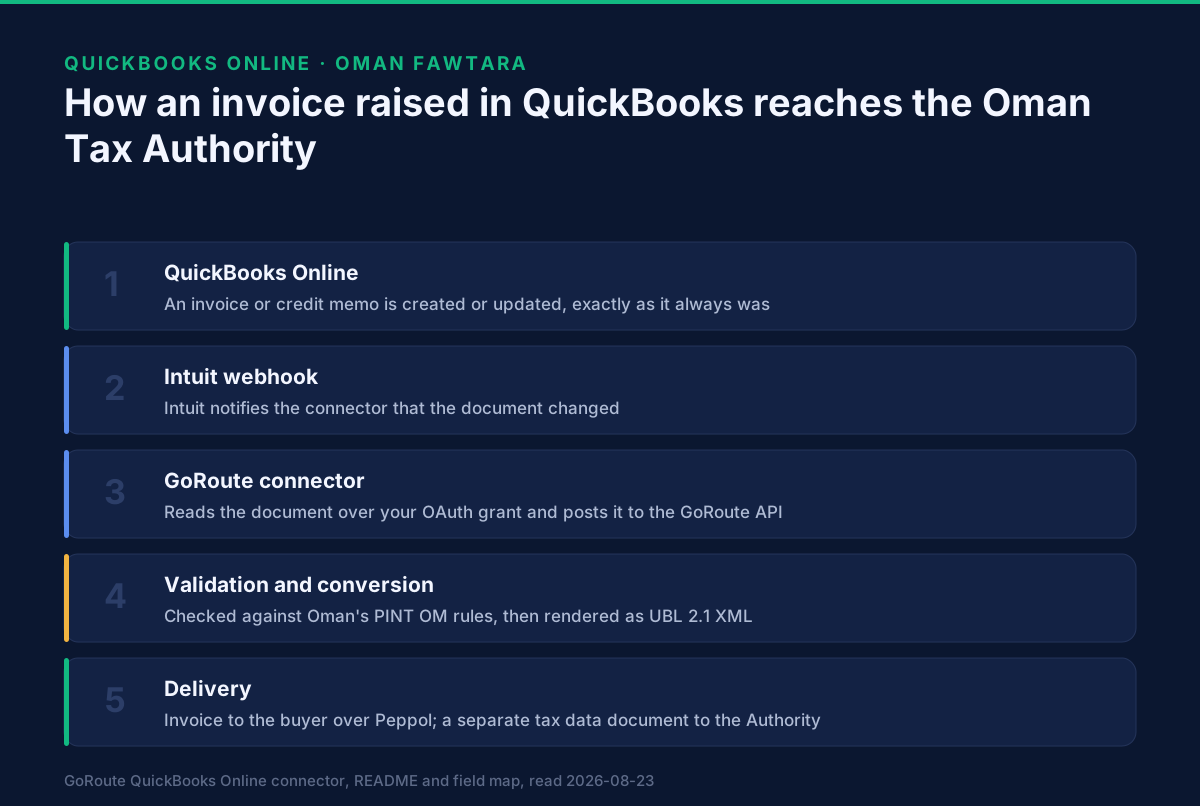
If your finance team runs QuickBooks Online, the connector already exists — and the work that decides your project is not the connection. QuickBooks Online is a built production connector in GoRoute's catalogue, reached by an Intuit OAuth grant. Your team raises an invoice exactly as they do today; Intuit's webhook tells the connector the document changed; GoRoute validates it against Oman's rules, renders it as UBL 2.1 XML, delivers it to your buyer over the Peppol network, and sends a separate tax data document to the Oman Tax Authority.
QuickBooks Desktop is a different answer: no connector, and the CSV route instead.
The real work is the other thing. QuickBooks has no field for three values Oman requires, and no amount of integration invents them. This page names them, says where they have to come from, and tells you what to check in your own books this week.
Does QuickBooks work with Oman's Fawtara e-invoicing?
QuickBooks Online, yes, through a built connector. GoRoute's connector catalogue is the single record of what each source system can actually do, and it exists because capability used to be stated in three places that drifted apart. QuickBooks Online sits in it as a production connector — built and in use — authorised by an Intuit OAuth grant, and one GoRoute can read directly once you authorise access rather than asking you for extracts.
The connector itself is webhook-driven. Intuit notifies it when an Invoice or
CreditMemo is created or updated; it converts the document and posts it to the GoRoute
API, which validates, renders UBL 2.1 XML, delivers over Peppol and generates the Oman tax
data document. Credit memos are covered, delivery status comes back over a webhook, and a
single document can be pushed by hand when someone needs to reissue one.
The field map is unremarkable, which is the point — these are ordinary QuickBooks fields:
| QuickBooks field | Becomes |
|---|---|
DocNumber |
The invoice number |
TxnDate / DueDate |
Issue date and due date |
CurrencyRef |
Document currency |
CustomerRef |
The buyer party |
TotalAmt − TotalTax |
Tax-exclusive amount |
TxnTaxDetail.TotalTax |
Tax total |
Line UnitPrice, Qty, Amount |
Price, invoiced quantity, line amount |
Line TaxCodeRef |
The tax category on the line |
Does QuickBooks Desktop work with Oman e-invoicing?
Not through the connector — Desktop editions take the CSV route. The catalogue says so in one line, and it is deliberate rather than an omission: QuickBooks Online is a cloud API with an OAuth grant, and Desktop is not.
The CSV route is a real onboarding path, not a consolation. Invoices are exported and imported using the GoRoute template, the same validation runs on the file, and a client on that route is compliant on their mandate date the same as a client on a connector. Sending Oman e-invoices from a spreadsheet covers how that works, including what the template asks for.
What does QuickBooks not hold that Oman requires?
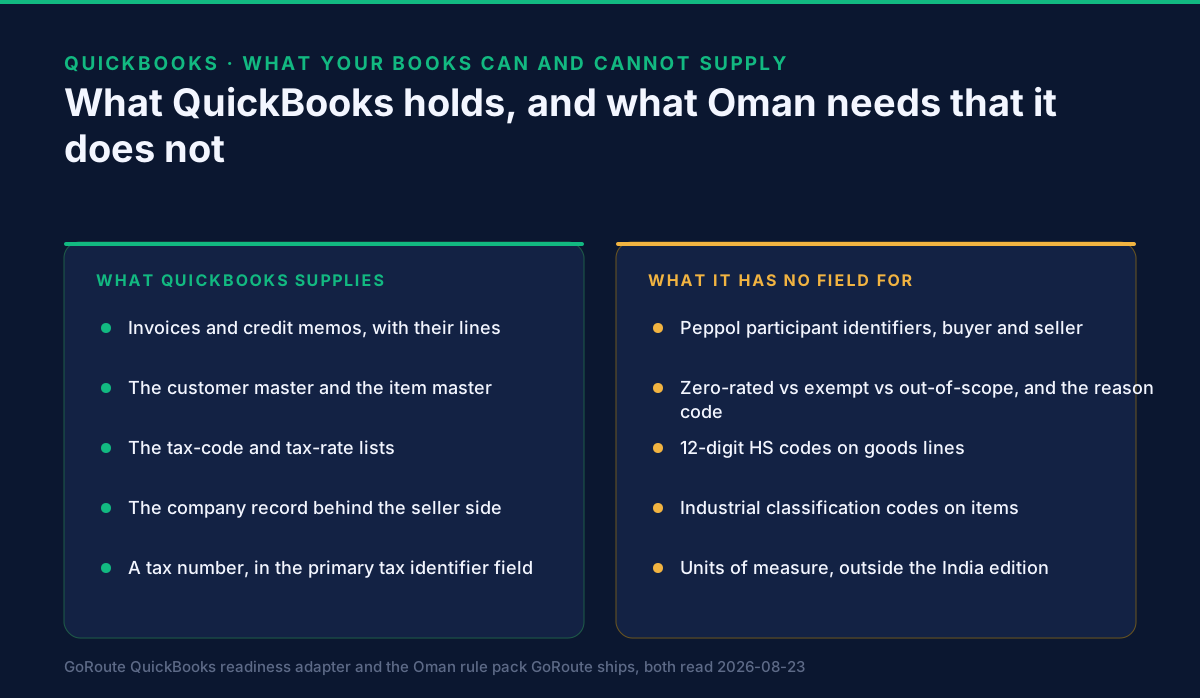
Three values, and every one of them is a decision your business makes rather than a mapping an engineer configures. This is the honest part of the answer, and it is the part that decides whether the project runs long.
Peppol participant identifiers. QuickBooks has no such field anywhere in its data model, for the buyer or for the seller. Every row of a QuickBooks extract has those columns blank. Those identifiers are established during onboarding.
The zero-rated / exempt / out-of-scope distinction, and the reason with it. This is
the expensive one. QuickBooks records a tax code and a rate. It does not record whether a
0% line is zero-rated, exempt or out of scope, and it has no exemption reason field at
all. Oman requires the distinction and the reason: rule IBR-069-OM says a VAT breakdown
with category E (exempt) or Z (zero-rated) must carry an exemption reason code, and
two further rules constrain what that code may be — CL-05-OM limits an exempt line to
the twelve codes VATEX-OM-01 to VATEX-OM-12, and CL-10-OM limits a zero-rated line
to the sixteen codes VATZR-OM-01 to VATZR-OM-16. So every 0% tax code in your
QuickBooks file has to be mapped, once, to one of those codes by someone who knows why the
line is 0%. That is a decision table your finance lead agrees before go-live, and nobody
can derive it from the books.
Item classification. Oman requires a Harmonized System code of exactly twelve digits
on a goods line under IBR-079-OM and IBR-080-OM, and an industrial classification code
on each item under IBR-081-OM. QuickBooks has no field for either.
Two smaller ones are worth knowing before someone is surprised by them. QuickBooks exposes a unit of measure only on the India edition, and never on an invoice line. And where a line uses the US automated sales tax pseudo-code, Intuit computes the rate at save time and does not expose it per line, so the rate cannot be read back — irrelevant to most Omani businesses, and worth checking if your file was set up in the United States.
What access does the QuickBooks connection ask for?
More than it uses, and you should hear that from us rather than from the consent screen. Intuit publishes a single accounting scope and that scope is read-write. When GoRoute runs a readiness assessment against your company file, the adapter only ever issues read requests — invoices, credit memos, the customer master, the item master, the tax-code and tax-rate lists, and the company record — but the grant you sign is broader than the use we make of it. That is Intuit's design, not ours, and pretending otherwise would be a poor start to a compliance engagement.
Two operational facts follow from the same grant. One grant covers one QuickBooks company, so a group with several company files authorises each one. And Intuit rotates the refresh token and expires it outright after 100 days, so a connection nobody has used for a quarter stops working and looks exactly like a withdrawn consent. Reconnecting fixes it.
What has to be right in QuickBooks before anything is sent?
Your tax registration numbers, in Oman's format. Rule IBR-003-OM requires the seller
VAT identification number, the buyer's, and any third party's to be exactly 12
characters: OM followed by ten digits. In QuickBooks the buyer's sits in the customer's
primary tax identifier field — the only field QuickBooks offers for a tax number — and your
own sits in the tax registration entry on the company record. A US resale certificate
number is not a substitute, and treating it as one produces a customer master that looks
compliant and is not.
Check your amount precision. IBR-DEC-03-OM refuses any amount carrying more than
three decimal places. Three is the Omani rial's own precision; two is what most systems
default to.
Then count the gap. How many active QuickBooks customers have no usable VAT identifier? That single number is the size of the data work, and it is far better known in week one than in week nine.
The document identifier Oman requires — a valid UUID version 5 on every invoice, under
IBR-002-OM — is not something to add in QuickBooks. It is generated in the conversion,
and it is on this list only because someone always asks where it comes from.
How do you know an invoice will be accepted?
By validating a real one, early. GoRoute checks a document against the full PINT OM 1.0.1 rule set, including its Schematron rules, and returns a compliance score with human-readable errors rather than a bare pass or fail. An error naming the field and the rule is a ticket someone can act on; a rejection code is a conversation.
Three layers can refuse the document. Counted in the packs we ship on 23 August 2026: the shared Peppol PINT layer holds 170 rules, every one fatal; Oman's own jurisdiction pack holds 154, of which exactly two are warnings; and the tax data document has its own pack of 66 rules, all fatal. Any fatal finding refuses the document before anything is sent, and the response names the rule by its own identifier.
Severity comes from the rule file, not from how the sentence reads — a message worded as advice can still refuse the document. How to read a rejection is set out in why Oman e-invoices get rejected, and how to test an Oman e-invoice before you send it covers doing this before the Authority ever sees the document.
Two things make validating properly cheap. Validation-only calls carry no per-call charge, so validating the same QuickBooks invoice forty times while a tax-code mapping is being corrected costs nothing. And you can validate long before you can send, so the technical work and the commercial work run in parallel.
For volume, batch submission takes between 1 and 1,000 invoices in a single request, with separate validate and send stages — the shape that matters at month-end.
Does the Tax Authority receive the same file?
No. Your buyer receives the invoice; a tax data document, derived from that invoice and carrying it, is what goes to the Authority. It has its own pack of 66 rules, which is why a clean validation on the invoice can still leave work to do. What an Oman e-invoice has to be, field by field, is in the Oman e-invoice format; the exchange model behind it is in Oman's Fawtara five-corner model.
Which Oman deadline applies to a QuickBooks user?
The same one that applies to everybody else — it depends on annual supplies, not on your accounting system. Decision 189/2026 makes electronic tax invoices mandatory from 1 April 2027 for taxable persons whose annual supplies exceed OMR 5,000,000, and from 1 October 2027 for those at or below that figure.
The detail of what the Decision changed is on the page that covers Oman's e-invoicing dates, and which wave am I in works through the threshold. This page states no further dates on purpose: one page should own that question.
Where do the invoices live?
For Oman, in Oman. GoRoute operates in-country data residency on Otech's Tier III Oracle Cloud Infrastructure region, covering invoices, keys, tax data documents and audit logs, and operates ISO 27001-aligned practices on certified cloud infrastructure.
Data residency is usually raised late, by a security review, at the point where changing the answer is expensive. It is a much cheaper question in week one.
What to do this week
- Establish which edition you are on. QuickBooks Online takes the connector; Desktop takes the CSV route. Everything else follows from that.
- Count your identifier gap — active customers with no usable VAT identifier in the primary tax identifier field. One number, and it sizes the data work.
- List every 0% tax code in your file. Each one needs a decision: zero-rated or exempt, and which Oman reason code. This is the task that runs long if it starts late.
- Check your amount precision. Three decimal places, not two.
- Establish which date applies to you by annual supplies, not by headcount or sector.
- Ask any shortlisted provider for their accreditation in writing.
Running a different system?
The same question, answered for the systems next to QuickBooks in Omani finance functions: Oman e-invoicing from SAP S/4HANA, Odoo e-invoicing in Oman, Microsoft Dynamics 365, Oracle Applications, TallyPrime, and, where there is no integration at all, a spreadsheet.
For the interface itself, see the API and services page and the developer documentation; for the market as a whole, the Oman page. If it is easier to talk it through against your own QuickBooks file, book a working session.
Where GoRoute stands
GoRoute is an e-invoicing service provider accredited in Oman by the Oman Tax Authority, on 29 July 2026, through Union Digital Technologies SPC. It operates a Peppol-certified Access Point (Service Provider ID POP000991, ClayDesk LLC), and re-certified PINT OM v1.0.1 conformance in July 2026 with all suites passed — Billing and tax data document 7/7, self-billing 7/7, reporting 2/2, eDelivery 7/7, and BIS Billing 5/5.
Those are checkable facts rather than adjectives, which is the point: ask any provider for the equivalent. How to check an Oman provider's claim sets out the seven questions to ask.
Sources
- PINT OM Billing Process v1.0.1 — the Oman specification the validation rules come from
- Oman Tax Authority tax portal
- Intuit Developer — the publisher of the QuickBooks Online API, its OAuth scopes and its token lifetimes
- OpenPeppol — the network the exchange runs on
Connector capability on this page was read from GoRoute's own connector catalogue and the QuickBooks Online connector on 23 August 2026. Rule identifiers, rule counts and field constraints were counted in the Oman rule packs GoRoute ships on the same day.
Frequently asked questions
- Does QuickBooks work with Oman's Fawtara e-invoicing programme?
- QuickBooks Online does, through a built connector: the connector holds an Intuit OAuth grant to your company file, is notified by an Intuit webhook when an invoice or credit memo changes, and posts the document to GoRoute for validation, conversion to UBL 2.1 XML and delivery. QuickBooks Desktop editions have no such connector and take the CSV route instead — the invoices are exported and imported using the GoRoute template.
- Does QuickBooks Desktop work with Oman e-invoicing?
- Not through the connector. GoRoute's connector catalogue covers QuickBooks Online only, and Desktop editions export to CSV instead. That is a supported onboarding path rather than a fallback: a client on the CSV route is compliant on their mandate date the same as a client on a connector, and the same validation runs on the file either way.
- What does QuickBooks not hold that Oman requires?
- Three things, and each one is a decision rather than a mapping. QuickBooks has no Peppol participant identifier field at all, so the buyer and seller identifiers come from onboarding. It does not distinguish zero-rated from exempt from out-of-scope and holds no exemption reason, while Oman's rule IBR-069-OM requires an exemption reason code on every zero-rated or exempt line, coded from a fixed list. And it has no field for a Harmonized System code, which Oman requires on goods lines at exactly twelve digits under IBR-079-OM and IBR-080-OM.
- What access does the QuickBooks connection ask for?
- More than it uses, and that is worth knowing before the consent screen appears. Intuit publishes a single accounting scope and that scope is read-write. GoRoute's readiness assessment only ever issues read requests against your company file, but the grant you sign is broader than the use. Intuit also rotates the refresh token and expires it outright after 100 days, so a connection nobody has touched for a while will need reconnecting.
- What has to be right in QuickBooks before anything is sent?
- Your tax registration numbers, in Oman's format. Rule IBR-003-OM requires the seller, buyer and third-party VAT identification numbers to be exactly twelve characters — the letters OM followed by ten digits. In QuickBooks that lives in the customer's primary tax identifier field and, for your own company, in the tax registration entry on the company record. Amounts have their own constraint: IBR-DEC-03-OM refuses any amount carrying more than three decimal places, which is the Omani rial's precision rather than the two most systems default to.
- How do we know a QuickBooks invoice will be accepted before we send it?
- By validating a real one. GoRoute checks a document against the full PINT OM 1.0.1 rule set including its Schematron rules and returns a compliance score with human-readable errors rather than a bare pass or fail. Validation-only calls carry no per-call charge, so validating the same invoice repeatedly while a mapping is corrected costs nothing.
- How many rules can refuse an Oman invoice raised in QuickBooks?
- Counted in the packs GoRoute ships on 23 August 2026: 170 rules in the shared Peppol PINT layer, all of them fatal; 154 in Oman's own jurisdiction pack, of which exactly two are warnings; and 66 in the tax data document pack, all fatal. Any fatal finding refuses the document before anything is sent, and the response names the rule that fired by its own identifier.
- Can we send a month of QuickBooks invoices in one go?
- Yes. Batch submission takes between 1 and 1,000 invoices in a single request, with separate validate and send stages. That shape matters at month-end, which is when a design that sends one invoice per call tends to fail.
- Which Oman e-invoicing date applies to a QuickBooks user?
- The same dates as everyone else, and they depend on annual supplies rather than on which system you run. Decision 189/2026 makes electronic tax invoices mandatory from 1 April 2027 for taxable persons whose annual supplies exceed OMR 5,000,000, and from 1 October 2027 for those at or below that figure.
- Where are the invoices stored?
- For Oman, in Oman. GoRoute operates in-country data residency on Otech's Tier III Oracle Cloud Infrastructure region, covering invoices, keys, tax data documents and audit logs, and operates ISO 27001-aligned practices on certified cloud infrastructure.
About Dr. Syed Raza
Dr. Syed Raza is an IT Enterprise Architect at ClayDesk LLC and leads the GoRoute platform. He works across Peppol Access Point and SMP infrastructure, PINT jurisdictions (Oman, AU/NZ, EU, JP, MY, SG), and national CTC regimes, translating regulatory detail into production-grade e-invoicing systems.
Building on Peppol?
GoRoute is a certified Peppol Access Point & SMP. Book a demo or read the docs to get started.