
Credit Notes and Self-Billing (Gutschrift) in Germany
In German e-invoicing, Gutschrift means two things: a credit note and a self-billed invoice. How each is treated and how to correct an invoice.

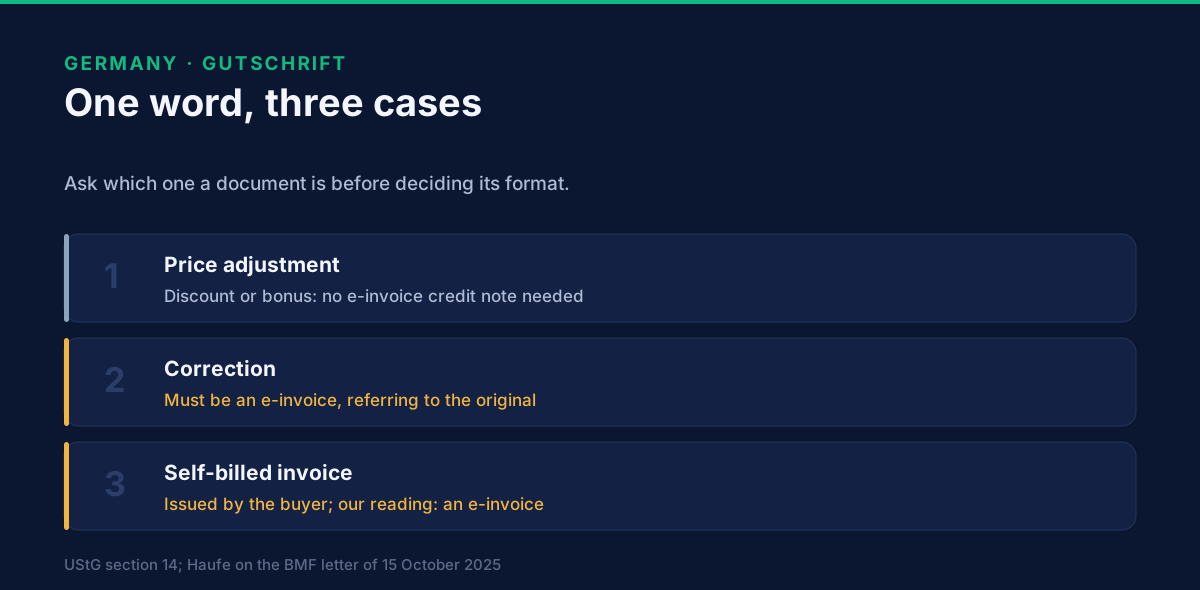
"Gutschrift" means two different things in German invoicing, and the e-invoice rules treat them differently. It can be a credit note, which reduces what the buyer owes. It can also be a self-billed invoice, which the buyer writes on behalf of the supplier. A correction of an earlier invoice must be an e-invoice that refers clearly to the original. A plain price reduction, such as a discount or a bonus, does not need a credit note in e-invoice format.
This page is for the accounts-payable or accounts-receivable lead who has to handle these in the first weeks of January 2027. It is not tax advice. The rules below come from the VAT act and from the Federal Ministry of Finance (BMF) letter of 15 October 2025, as the professional bodies summarise it, and the letter is guidance. GoRoute is a certified Peppol Access Point and SMP (POP000991). For German sellers it sends EN 16931 invoices, including XRechnung, over Peppol, and a ZUGFeRD PDF where the buyer is not on the network.
What are the two meanings of Gutschrift?
The first is the everyday one: a credit note. The supplier tells the buyer that the amount owed is lower. The cause can be a return, a pricing error, a discount or a bonus.
The second is in the VAT act. Under section 14 UStG, an invoice that the buyer issues for the supplier's supply is also called a Gutschrift: a self-billed invoice. The supplier does not write it. The buyer does. English-language systems call this self-billing, and it is common in retail, in commission arrangements and in some platform settlements.
The same word in a column heading in your ERP can mean either. Ask which one it is before you decide what format it needs.
Does a credit note have to be an e-invoice?
A credit note that corrects the original invoice must be. A credit note that adjusts the price does not have to be. Haufe's summary of the 2025 letter puts the line at section 17 UStG. Adjustments such as discounts and bonuses (Entgeltminderungen) need no e-invoice-format credit note. A correction of the original invoice does, with an unambiguous reference to it.
Examples of our own, not the letter's:
- You agreed a 3 percent year-end bonus with a customer. The credit document is an adjustment. Check with your adviser whether your process needs the structured format anyway.
- You invoiced the wrong VAT rate and issue a credit note and a new invoice to fix it. That is a correction, and both documents should be e-invoices.
If you are unsure which side a document falls on, ask your adviser. Issuing the credit note in structured format is the cautious choice, and we have read nothing that forbids it.
Does a self-billed invoice have to be an e-invoice?
Our reading is yes, between two businesses established in Germany. A Gutschrift in the tax sense is an invoice under section 14 UStG. The duty in section 14(2) sentence 2 number 1 covers an invoice issued for a supply between two businesses, both established in Germany. The statute does not exempt a self-billed invoice from it. The exceptions in which German invoices need not be e-invoices, such as the EUR 250 limit, apply to it as to any other.
We have not been able to read the ministry's letter on this point. Check the letter itself before you change a self-billing process.
Two practical points follow from the way self-billing works:
- The buyer becomes the issuer. The buyer's system must create the structured invoice, validate it and keep it. The supplier receives it and has to archive it.
- Put the arrangement in writing. This is our advice, not a rule we have read. If you run self-billing at scale, keep the agreement with each supplier where both sides can find it.
A parallel example from the other side of the world is the Omani rule on correcting a self-billed invoice, in Oman self-billed invoice corrections. The mechanics there are not the German ones, but the questions are similar: who issues, who holds the record, who corrects.
How do you correct an e-invoice?
By issuing a correction that is itself an e-invoice and refers to the original. The BStBK and Haufe both report this for an invoice that was issued in the wrong format. The reference must be clear, so that the tax authority and the buyer can see which invoice is meant. In an EN 16931 document the original invoice number goes in the preceding invoice reference.
Three habits help:
- Do not overwrite. The original stays in the archive, as described in archiving e-invoices in Germany.
- Use a new document number. The correction is its own document.
- Say what changed. A correction should be readable on its own, because the person who reads it may not have the original.
If the problem is the format and not the content, read German e-invoices with errors first. It explains which faults stop a document from counting as an e-invoice at all.
What happens to the buyer's input VAT?
It follows the corrected invoice. Haufe reports that the ministry's letter links the right to deduct input VAT to a proper invoice, and that where an e-invoice is required a document in another format is generally not one. A correction may therefore matter to your buyer as much as to you. This is why it is worth issuing corrections in the right format on the first attempt. We do not state a figure for any consequence.
What to do next
- Mark each Gutschrift in your ERP as a credit note or a self-billed invoice. The two need different handling.
- Check your self-billing agreements. They should name who issues, and in which format.
- Map corrections to the original invoice number in your accounting system, so the reference can be filled.
- Test a correction before January. Send a credit note through your process and read the validation report.
- Check invoices before they are sent, with a validator that reports faults on each document.
- To discuss a German credit note or self-billing flow, book a demo. The Germany page, the tutorials, the developer documentation and the GoRoute API cover how documents are sent and received over Peppol.
Related reading
- E-invoicing in Germany, the country page.
- Germany B2B e-invoicing 2025 to 2028: XRechnung and ZUGFeRD
- Does your German online shop have to send e-invoices?, which covers refunds from a shop.
- Invoice validation errors you can prevent
Sources, read in October and November 2026: Umsatzsteuergesetz, section 14; Bundessteuerberaterkammer, FAQ E-Rechnung (3 March 2026); Haufe, weiteres BMF-Schreiben zur E-Rechnung and BMF-Schreiben vom 15.10.2025. The Federal Ministry of Finance letter was not available to us directly; where this page describes it, it relies on these summaries. Passages marked as our reading are not the ministry's wording. Translations from the German are ours.
Primary source: Federal Ministry of Finance (BMF) and the VAT act, section 14, which set Germany's e-invoicing rules.
Frequently asked questions
- What does Gutschrift mean in German e-invoicing?
- Two things. In everyday accounting it is a credit note that reduces what a buyer owes. In German VAT law it is also an invoice issued by the buyer on behalf of the supplier, which English calls self-billing. The e-invoice rules treat these differently, so say which one you mean.
- Does a self-billed invoice have to be an e-invoice?
- Our reading is yes, where the supply is between two businesses established in Germany. A self-billed invoice is an invoice under section 14 of the VAT act (UStG), so the e-invoice duty in section 14(2) applies to it as to any other. The ministry's letter should be checked on this point.
- Does a credit note have to be an e-invoice?
- It depends on what it does. Haufe's summary of the ministry's letter of 15 October 2025 says that adjustments such as discounts and bonuses need no credit note in e-invoice format, while a correction of the original invoice does, with an unambiguous reference to it.
- How do I correct a wrong German e-invoice?
- With a correction that is itself an e-invoice and that refers clearly to the original invoice. The BStBK and Haufe summaries both say so for an invoice that was issued in the wrong format. Keep the original in the archive.
- Can I cancel an invoice with a PDF credit note?
- Not if the original had to be an e-invoice and the credit note corrects it. A PDF in that case is an other invoice and does not do the job. Issue the credit note in the structured format.
- Which EN 16931 document carries a credit note?
- The standard defines a credit note as its own document type next to the invoice. In Peppol BIS Billing 3.0 it is a separate message, with the original invoice number referenced.
About Dr. Syed Raza
Dr. Syed Raza is an IT Enterprise Architect at ClayDesk LLC and leads the GoRoute platform. He works across Peppol Access Point and SMP infrastructure, PINT jurisdictions (Oman, AU/NZ, EU, JP, MY, SG), and national CTC regimes, translating regulatory detail into production-grade e-invoicing systems.
Building on Peppol?
GoRoute is a certified Peppol Access Point & SMP. Book a demo or read the docs to get started.