
Invoicing a Portuguese Public Body: CIUS-PT, Dates and the FE-AP Route
Portuguese public bodies take structured CIUS-PT e-invoices, not PDFs. Dates by company size, the two syntaxes and the FE-AP route, per the Commission.

A Portuguese public body takes a structured e-invoice in CIUS-PT, Portugal's national version of the European standard EN 16931, and not a PDF. The European Commission's Portugal page, updated on 16 October 2026, says the duty to e-invoice government extends to micro-enterprises on 1 January 2027. This page sets out what that page says, where it disagrees with itself, and what you still have to ask the public body.
It is written for the finance lead at a supplier who sells to Portuguese ministries, hospitals, municipalities or state companies. It covers the invoice and its route, not public procurement. We link to the Commission's page throughout because we could not open Portugal's own sources for this: the ESPAP site redirected without end from our reader on 18 November 2026, and the Diário da República page needs a browser script. Every public-sector date below is therefore the Commission's, as of 16 October 2026.
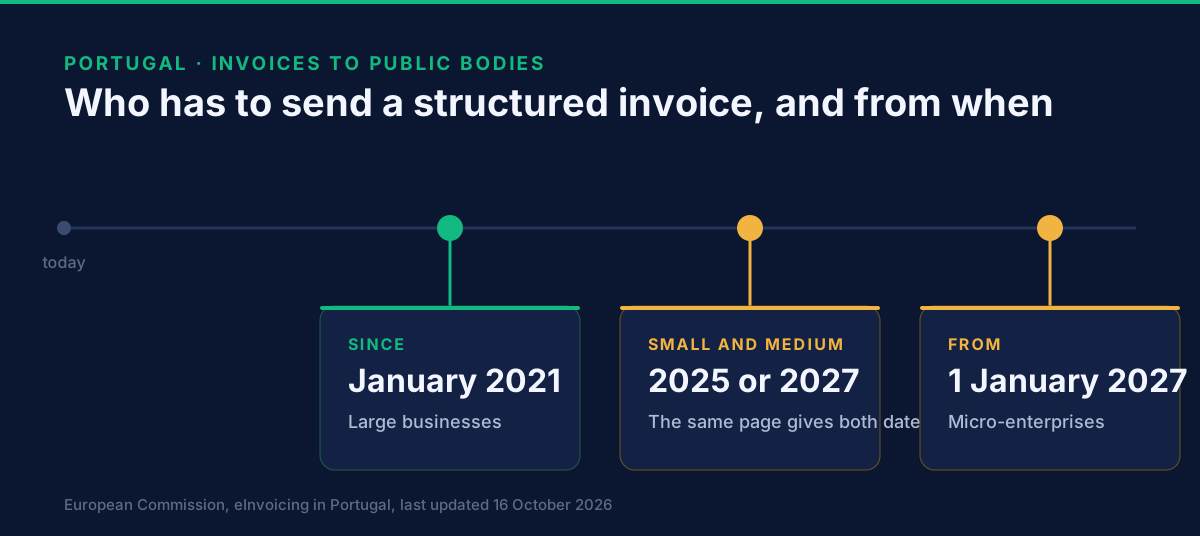
Who has to send a structured invoice to a public body, and from when?
Large businesses since January 2021, and micro-enterprises from 1 January 2027. The Commission's page puts it this way in its Legislation section: large businesses (over 250 employees, sales above EUR 50 million, or assets of EUR 43 million or more) have had to use e-invoicing with government since January 2021, under Law 111-B/2017 as amended by Law 123/2018.
For small and medium enterprises the page gives two different answers:
- Its Legislation section says the requirement extended to them from 1 January 2025, under Law 82/2023.
- Its Summary, Highlights and Next steps say it extends to medium, small and micro businesses on 1 January 2027.
We cannot settle that from the sources we could open. GoRoute's own Portugal page has said 1 January 2026 for micro, small and medium suppliers, citing Decree-Law 13-A/2025. We could not open that decree on 18 November, so we can neither confirm that date nor show it wrong, and the Commission's page does not give it. The one date on which the Commission's page is consistent is the one that matters most for a small supplier: micro-enterprises, 1 January 2027. If you are small or medium and unsure which date binds you, ask the public body and the Tax Authority in writing.
What is CIUS-PT, and which syntaxes does it use?
CIUS-PT is the Portuguese narrowing of EN 16931, the European standard that defines the data an electronic invoice carries. A CIUS (core invoice usage specification) keeps the European data model and adds a country's own rules about which fields are required and what they may hold.
The Commission names two XML syntaxes, and its page does not agree with itself on the second:
- Its Summary lists OASIS UBL CIUS-PT and CEFACT CII CIUS-PT.
- Its section on the European standard's status names UBL 2.1 or XML-GS1.
UBL appears in both. For the other, treat the public body's instructions as the answer. If you are new to the format, what a UBL invoice is is the shorter read.
The Commission adds one rule that applies whatever the syntax. All public contracting authorities must accept and process EN 16931 invoices for public procurement contracts above the EU thresholds. A public body can therefore not refuse a compliant invoice on a contract above those thresholds because of the format.
How does the invoice reach the public body?
There is no single channel. The Commission describes the model as follows.
- Portal BASE is the central public-procurement platform. It sits behind the e-procurement solutions the public authorities use.
- FE-AP is the platform built by ESPAP (Entidade de Serviços Partilhados da Administração Pública, the public administration's shared-services agency) so that public bodies can receive invoices. Its use is not mandatory. That is why practice varies between entities.
- A supplier can submit CIUS-PT invoices to FE-AP by web service or AS2, after registering with ESPAP. AS2 is a secure file-exchange protocol between systems.
- A supplier that issues fewer than 250 invoices a year can instead upload them by hand in the FE-AP Microportal.
- Public bodies may also use third-party portals, from manual upload to electronic data interchange. The Commission notes that these can cost the supplier money.
- The supplier should check the FE-AP portal for the entity's own requirements, or contact an entity that is not listed to find out how it wants invoices sent.
Decree-Law 14-A/2020 of 7 April 2020 requires public institutions of the direct State administration and public institutes to cooperate with ESPAP, according to the same page. That explains why FE-AP is the common route and not the only one.
What does the public body need on the invoice?
Everything any Portuguese invoice carries, in the format it reads. We could confirm the general rule from the Tax Authority's own text. Article 36(5) of the VAT Code requires a dated, sequentially numbered invoice with the names, addresses and tax numbers of the supplier and of a customer that is a taxable person, the quantity and description of the goods or services, the net price, the VAT rate and amount, and the reason if no VAT applies. The invoice requirements guide covers the ATCUD code, the QR code and certified software that sit beside it.
What we could not confirm is the CIUS-PT rule set itself: which extra fields a public body requires, and any entity-specific references. Neither ESPAP nor the Commission's page lists them. Ask the entity, or read the FE-AP portal's guidance for it, before the first invoice. A rejection for a missing reference is the commonest avoidable delay on any public-sector route, and we have no Portuguese evidence to say it is different here.
Is Peppol a route to a Portuguese public body?
We do not know, and we will not say it is. The Commission's Portugal page does not mention Peppol. We found no Portuguese source, in the pages we could open, that names it as a way to reach a public body. Our own Portugal page describes CIUS-PT as a Peppol specialisation; we have not found a source for that wording either, and it should not be read as saying a public body receives from the Peppol network.
What GoRoute does is narrower. It is a certified Peppol access point (POP000991) that sends structured e-invoices over Peppol. It does not deliver to FE-AP or to ESPAP, and it does not produce Portuguese SAF-T files, ATCUD codes or invoice signatures. Those stay with your certified billing program.
Does the monthly report to the Tax Authority still apply?
Yes. The Commission says resident taxpayers report invoice data to the tax administration every month, and that this covers business-to-business, consumer and government invoices, and credit notes. A structured invoice to a public body therefore still has to be reported. How, and by when, is in reporting invoices to the AT. Correcting an invoice you already sent is in Portuguese credit notes, and how long to keep it is in archiving e-invoices in Portugal.
A supplier based outside Portugal should first check whether the Portuguese rules reach its invoice at all. Invoicing Portuguese customers from outside Portugal explains the test in Article 35-A of the VAT Code.
What we could not confirm
Four points, as of 18 November 2026.
- The small and medium date. The Commission's page gives 2025 and 2027. Our own page gives 2026 under a decree we could not open.
- The second syntax. CII in one paragraph, XML-GS1 in another.
- The CIUS-PT field rules and entity references. Not in any source we could open.
- Peppol. Not named as a route in any source we could open.
What to do next
- Find out which public bodies you invoice, and ask each how it receives invoices: FE-AP, a third-party portal, or another way.
- Check your size and date with the public body and the Tax Authority, using the Commission's page as the starting point.
- Check your billing system can produce CIUS-PT in the syntax the entity reads.
- Book a working session if you want to see how a structured invoice is produced and sent. Book a demo and bring one invoice. The tutorials show the sending flow, and the developer documentation shows how a system connects.
Related Portugal guides
- Reporting invoices to the Portuguese Tax Authority — the monthly deadline and the three ways to report.
- Portuguese credit notes — when one is required and what it must cite.
- Archiving e-invoices in Portugal — what to keep, for how long, and where.
- Portugal E-Invoicing 2027: what changes on 1 January — the PDF rule for business customers.
- E-invoicing in Portugal — the whole country picture.
Sources: European Commission, eInvoicing in Portugal, last updated 16 October 2026, read 18 November 2026, for every date, the syntaxes, FE-AP, Portal BASE and the monthly reporting statement; VAT Code Article 36 as published on the Tax Authority's site (Portal das Finanças), read 18 November 2026. ESPAP and the Diário da República could not be opened, so Decree-Law 13-A/2025 and Decree-Law 14-A/2020 were not read; the latter is cited as the Commission cites it. Translations from the Portuguese are ours. Passages marked as our reading are not the authority's.
Frequently asked questions
- What is CIUS-PT?
- CIUS-PT is Portugal's national version of the European e-invoice standard EN 16931. A CIUS, a core invoice usage specification, narrows the European standard for one country. The European Commission lists two XML forms of it: a UBL form and a UN/CEFACT CII form.
- Do micro-enterprises have to e-invoice Portuguese public bodies from 1 January 2027?
- According to the European Commission's Portugal page, updated 16 October 2026, yes. It says the duty to issue e-invoices for transactions with government extends to micro, small and medium businesses on 1 January 2027. We could not open the Portuguese law itself on the day, so check the date with the public body or the Tax Authority before it carries weight in a contract.
- Can I still send a PDF to a Portuguese public body?
- Not as the invoice, where the mandate applies to you. The Commission's page describes the B2G duty as one to issue structured e-invoices, and says public contracting authorities must accept and process invoices that follow EN 16931 for contracts above the EU procurement thresholds.
- Do I have to use FE-AP?
- No. The Commission says the FE-AP platform, built by ESPAP, lets public administrations receive invoices, but its use is not mandatory. Entities differ: some use FE-AP, others use third-party portals or other channels. Check the entity's own instructions.
- Does a public body accept an invoice over Peppol?
- We do not know. The Commission's page does not list Peppol among the ways to reach Portuguese public bodies, and we found no Portuguese source that does. Ask the public body which route it reads before you send.
About Dr. Syed Raza
Dr. Syed Raza is an IT Enterprise Architect at ClayDesk LLC and leads the GoRoute platform. He works across Peppol Access Point and SMP infrastructure, PINT jurisdictions (Oman, AU/NZ, EU, JP, MY, SG), and national CTC regimes, translating regulatory detail into production-grade e-invoicing systems.
Building on Peppol?
GoRoute is a certified Peppol Access Point & SMP. Book a demo or read the docs to get started.