
Reporting Invoices to the Portuguese Tax Authority: By the 5th, Three Ways
Portuguese businesses report their invoices to the Tax Authority by the 5th of the following month. The three ways to do it, and how to correct a report.

Every Portuguese business that issues invoices reports their data to the Tax Authority (Autoridade Tributária e Aduaneira, the AT) by the 5th of the month after the invoice is issued. It can do so in three ways: by web service from its billing software, by sending a file based on SAF-T (PT), or by entering the data in the Tax Portal. The 5th is the date the Authority's own document gives, from 1 January 2023.
This page is for a bookkeeper or finance lead who has to get the report out, or who has inherited one. It covers the monthly report of invoice data under the e-Fatura system, the three ways to send it, and how to correct a report. It does not cover the annual accounting SAF-T file, penalties, or which taxpayers are exempt, because we did not read those rules for this page. The Portugal page explains what SAF-T (PT) is.
By when must invoices be reported?
By the 5th of the following month. The Tax Authority's document Sistema e-Fatura: alinhamento das funcionalidades disponíveis nos diversos canais (June 2022) lists, among the changes taking effect on 1 January 2023 after the 2022 State Budget amended Decree-Law 198/2012, the reporting deadline: "…até ao dia 5 do mês seguinte ao da sua emissão", meaning up to the 5th of the month after issue.
Two older dates still circulate, so check which you are reading:
- The 10th is in Article 41 of Decree-Law 28/2019, which amended Article 3 of Decree-Law 198/2012. That is the 2019 text. The Authority's 2022 document supersedes it.
- The 12th appears in one paragraph of the European Commission's Portugal page, updated 16 October 2026, which also says the SAF-T deadline moved to the 5th from 1 January 2023. The page contradicts itself, and the Authority's own document is the better source.
We have not opened the current consolidated text of Decree-Law 198/2012, so we rely on the Authority's June 2022 document for the 5th. If a date matters for a penalty or a contract, read the law's current text and confirm with the Authority.
What has to be reported?
The elements of the invoices you issue, and of related documents. Article 3 of Decree-Law 198/2012, in the version amended by Decree-Law 28/2019, requires anyone with a seat, permanent establishment or tax domicile in Portugal who carries out VAT-able operations to report, by electronic data transmission, the elements of the invoices issued under the VAT Code. It also covers documents that let goods or services be checked, and receipts.
The data model the Authority publishes lists elements per document. One of them is the document type, in the SAF-T (PT) definition, and another is the identification of the corrected document. That second element is what ties a credit note to the invoice it corrects. The Commission's page says the monthly report covers business-to-business, consumer and government invoices, domestic and cross-border, and every type including simplified invoices, debit notes and credit notes.
What are the three ways to report?
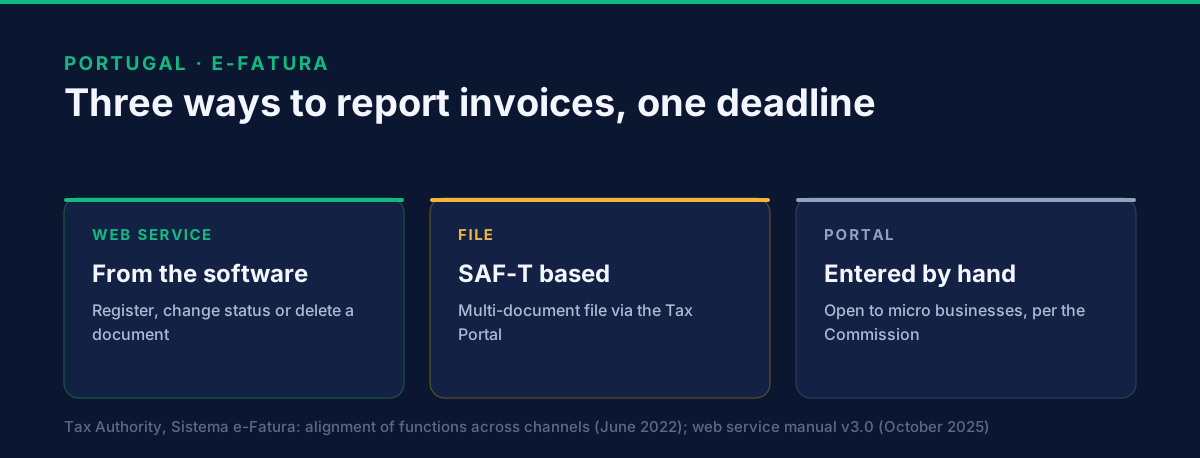
A web service, a file, or the portal. All three reach the e-Fatura system.
- Web service. The billing software sends the data. The Authority's web service manual, version 3.0 of October 2025, describes three actions for an invoice, a supporting document or a receipt: register it, change its status, delete it. It also describes a query: software can retrieve the invoices registered in e-Fatura in which the taxpayer's tax number appears as seller or as buyer, after authenticating with the taxpayer's Tax Portal credentials.
- A file. A structured file based on SAF-T (PT). The 2022 document says this file is now called the Ficheiro Multidocumento, can be submitted through the browser without the earlier applet, and that a command-line application also exists. The e-Fatura page on the Authority's site lists that application.
- The portal. Data entered directly in the Tax Portal. The Commission says micro businesses can enter invoice data there. The 2022 document says the portal can also communicate the "annulled" status and show what was communicated.
One line of the 2022 timeline is unclear to us. It says that from January 2023 documents can be submitted through the web service channel only in its new version. We do not know how that fits with the file and portal channels, which the same document describes as continuing. Read the document before you choose a channel for a new system. The choice is usually made by your billing software, which is why a certified program matters. What certification asks of it is covered in the invoice requirements guide.
What if there is nothing to report?
A nil report is made in the portal. The same June 2022 document lists, from 1 January 2023, a monthly communication for the absence of invoicing, through the Tax Portal, with the web service "in future improvements". It also lists the withdrawal of the portal's "global information" option. We do not know whether the web service now supports nil reports. Check before you automate it.
How is a report corrected?
By removing the error in e-Fatura, or by changing a document's status, and by a credit note where the invoice itself is wrong. The two are different:
- A wrong report. The Authority's document says errors in a report can be removed through any channel, for any class of document and whatever its date of issue. The web service manual covers deletion and status changes, including the status "annulled".
- A wrong invoice. An invoice already issued is not edited. Portuguese VAT law requires a corrective document. When a credit note is required, and what it must cite is the next page to read. The credit note is a new document, and it is reported in its turn.
What does the buyer see?
Only what the Authority's channels expose. We can confirm one thing: the web service manual says the invoices registered in e-Fatura in which a tax number appears as buyer can be retrieved by software, with that taxpayer's credentials. We did not read the portal's buyer-side screens, so we say nothing about how a buyer confirms or disputes an invoice.
Does this change when invoices are structured?
No. Reporting is separate from the invoice format. A business that moves to structured invoices, or sends them over Peppol, still reports to the AT. Peppol is a delivery route to a customer's system; it is not a filing channel to a tax authority. That holds for a Portuguese public body as well, where the Commission says government invoices are reported too. How long to keep what you reported is in archiving e-invoices in Portugal.
GoRoute does not produce SAF-T files or report to the AT for a Portuguese business. It is a certified Peppol access point (POP000991) that sends structured e-invoices.
What we could not confirm
- The current statutory text of the 5th. We rely on the Authority's June 2022 document.
- Whether the web service supports nil reports today.
- Penalties and exemptions. Not read.
- What a buyer sees in the portal. Only the web service query is documented above.
What to do next
- Ask your billing software vendor which channel it uses and what it sends, and by what day.
- Put the 5th in the calendar and check that your last three months were reported.
- Decide who removes an error and how credit notes are reported in your process.
- Book a demo to see structured sending alongside your reporting. Book a demo, try the tutorials, or read the developer documentation.
Related Portugal guides
- Invoicing a Portuguese public body — CIUS-PT, the dates by company size, and the FE-AP route.
- Portuguese credit notes — correcting an invoice.
- Archiving e-invoices in Portugal — what to keep and for how long.
- Portugal invoice requirements: ATCUD, QR code and certified software — what every invoice carries.
- E-invoicing in Portugal — the whole country picture.
Sources: Tax Authority, Sistema e-Fatura: alinhamento das funcionalidades, June 2022; Tax Authority, web service manual, specific aspects, version 3.0, October 2025; Decree-Law 28/2019, Article 41, amending Article 3 of Decree-Law 198/2012; the Tax Authority's e-Fatura page; European Commission, eInvoicing in Portugal, updated 16 October 2026. All read 18 November 2026. Translations from the Portuguese are ours.
Frequently asked questions
- By when must invoices be reported to the Tax Authority in Portugal?
- By the 5th of the month after the invoice is issued. The Tax Authority's June 2022 document on the e-Fatura system gives this deadline, from 1 January 2023, after the 2022 State Budget changed Decree-Law 198/2012. The text of Decree-Law 28/2019 still reads the 10th. The Commission's country page still reads the 12th in one paragraph. Use the 5th.
- What are the ways to report invoices to the AT?
- Three: by web service from the billing software, by sending a structured file based on SAF-T (PT), which the Tax Authority now calls the multi-document file, or by entering the data in the Tax Portal. The Commission says micro businesses can enter invoice data directly in the portal.
- What if I issued no invoices in a month?
- The Tax Authority's June 2022 document lists a monthly communication for the absence of invoicing, made in the Tax Portal, from 1 January 2023. The web service route was described as a future improvement. Check the portal for the current position.
- Can I correct an invoice I already reported?
- Yes. The Tax Authority's document says errors in a report can be removed through any channel, for any class of document and whatever the issue date. The web service manual describes registering, changing the status of, and deleting a document. A credit note is a different thing: it is a new document that corrects the invoice, and it is reported too.
- Is the monthly invoice report the same as the annual SAF-T accounting file?
- No. The monthly invoice report carries data about each invoice. The accounting SAF-T file is a separate obligation and this page does not cover it.
About Dr. Syed Raza
Dr. Syed Raza is an IT Enterprise Architect at ClayDesk LLC and leads the GoRoute platform. He works across Peppol Access Point and SMP infrastructure, PINT jurisdictions (Oman, AU/NZ, EU, JP, MY, SG), and national CTC regimes, translating regulatory detail into production-grade e-invoicing systems.
Building on Peppol?
GoRoute is a certified Peppol Access Point & SMP. Book a demo or read the docs to get started.