
Portuguese Credit Notes (Nota de Crédito): When One Is Required and What It Must Cite
When a Portuguese invoice changes, the VAT Code requires a corrective document. What it must cite, and the VAT adjustment deadlines for supplier and buyer.

When the value of an invoice or its VAT changes after you have issued it, the Portuguese VAT Code requires a corrective document, and a credit note is that document. The correction carries its own date and number and cites the invoice it changes. The supplier and the buyer each then adjust their VAT within a deadline that the Code sets. This page reads those rules from the Code itself.
It is written for the accounts receivable lead who issues, or has to issue, a correction against a Portuguese invoice. It covers the corrective document and the VAT adjustment rules in Articles 29, 36 and 78 of the VAT Code (Código do IVA, CIVA). It does not cover corrections for bad debts, which Article 78 treats separately from paragraph 7 onward, and it is not tax advice. Where the answer depends on your facts, ask the Tax Authority or an adviser.
When is a credit note required?
Whenever the taxable value of an operation or its VAT changes after the invoice. Article 29(7) of the VAT Code says: when the taxable value of an operation or the corresponding tax is changed for any reason, including inaccuracy, a corrective document of the invoice must be issued. Article 78(1) repeats the point: the provisions of Article 36 and following apply whenever, once the invoice has been issued, the taxable value or the tax is rectified for any reason.
The Code's phrase is documento retificativo, a corrective document. The Code does not define a
"credit note" as such. The Tax Authority's e-Fatura web service manual, version 3.0 of October 2025,
does list the document types it accepts, and they include NC for Nota de Crédito and ND for
Nota de Débito, next to FT for an invoice. So the Authority's own reporting treats a credit note
as a document type. Which type fits a given correction, a credit or a debit note, follows from
which way the value moves. The Code's rules are the same for a corrective document of either kind.
There is one named variant for returns. Article 36(3) says that when goods previously traded between the same parties are returned, the invoice is replaced by a delivery or return note (guia ou nota de devolução), issued by the fifth working day after the return.
What must a Portuguese credit note cite?
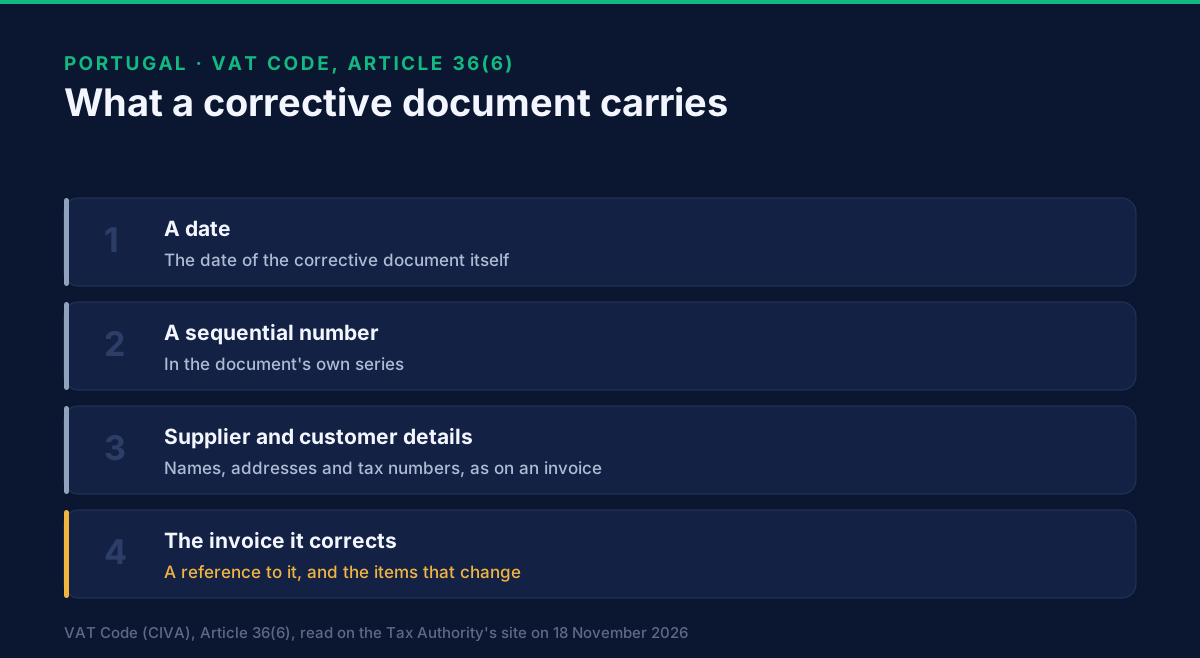
The invoice it corrects, and the items that change. Article 36(6) says return notes and other corrective documents must carry, besides the date and sequential number, the elements in Article 36(5)(a): the names, firm or company names, registered office or address, and tax numbers of both the supplier and the customer, where the customer is a taxable person. They must also carry the reference to the invoice they relate to, and the items of that invoice that are being changed.
Article 36(4) adds that documents of this kind are produced in duplicate, the original for the customer and the copy for the supplier's archive.
For a business that issues from certified billing software, the program handles the numbering and the series. What certification asks of the program is in the invoice requirements guide. The correction is then reported like any invoice: reporting invoices to the AT says by when, and the Authority's reporting data includes the identification of the corrected document, which is how the Authority links a credit note to its invoice.
How does the supplier adjust VAT?
By the end of the tax period after the one in which the reason arose, for a cancellation or reduction. Article 78(2) applies after the transaction has been recorded under Article 45. If the operation is cancelled, or its taxable value reduced, because of invalidity, termination, rescission or reduction of the contract, return of goods, or an allowance or discount, the supplier may deduct the corresponding tax up to the end of the tax period following the one in which those circumstances arose.
Article 78(5) sets a condition on a downward correction. The adjustment in the supplier's favour may be made only when the supplier holds proof that the buyer was told of the correction or was reimbursed the tax. Without that proof the deduction is regarded as undue. Keep the proof with the credit note.
What if an invoice was wrong, not cancelled?
The rule depends on which way the error ran. Article 78(3) covers inaccurate invoices already recorded:
- Too little tax charged. Correction is mandatory, and can be made without penalty until the end of the period following the one the invoice belongs to.
- Too much tax charged. Correction is optional, and can be made only within two years.
Article 78(6) applies the same two-year limit to correcting material or calculation errors in the VAT records and returns, where the result is tax in the taxpayer's favour. It is mandatory where the result is tax owed to the State.
What does the buyer do?
The buyer corrects its deduction. Under Article 78(4), a buyer that is a taxable person and has already recorded the original transaction corrects the deduction it made, by the end of the tax period following the one in which it receives the corrective document. That applies to a cancellation, a reduction, or a correction downward of the amount invoiced.
For the buyer, the credit note is therefore a trigger for a deadline. A supplier that sends it late or to the wrong address puts the buyer's adjustment at risk, which is a reason to confirm delivery.
How does a structured invoice change this?
It does not change the rule, and it makes the link explicit. A structured e-invoice can carry a reference to the document it corrects as a data field. Whether the public-sector route has its own rules for corrections is a separate question. We did not find them; see invoicing a Portuguese public body for what we could and could not read. How long to keep both the invoice and its credit note is in archiving e-invoices in Portugal.
GoRoute does not issue credit notes, report them, or adjust VAT for a Portuguese business. It is a certified Peppol access point (POP000991) that sends structured e-invoices, and a credit note travels as one more document.
What we could not confirm
- Whether a credit note, as a name, is mandatory for any given correction. The Code requires a
corrective document, and the Authority's document types include
NCandND. - Bad debts. Article 78(7) onward is not covered.
- Penalties for a missed correction. Not read.
- Anything specific to public bodies. Not found.
What to do next
- Check how your billing program issues corrections: its own series, a reference to the original invoice, and the changed items.
- Keep proof the buyer was told of every downward correction.
- Diarise the end of the following tax period for the supplier's and the buyer's adjustments.
- See structured sending working. Book a demo, try the tutorials, or read the developer documentation.
Related Portugal guides
- Invoicing a Portuguese public body — CIUS-PT and the FE-AP route.
- Reporting invoices to the Portuguese Tax Authority — the monthly deadline.
- Archiving e-invoices in Portugal — what to keep, and for how long.
- Portugal invoice requirements: ATCUD, QR code and certified software — what every invoice carries.
- E-invoicing in Portugal — the whole country picture.
Sources: VAT Code (CIVA), as published on the Tax Authority's site, Articles 29, 36 and 78; Tax Authority, e-Fatura web service manual, specific aspects, version 3.0, October 2025, for the document types; Decree-Law 28/2019, Articles 2 and 41. All read 18 November 2026. Translations from the Portuguese are ours.
Frequently asked questions
- When is a credit note required in Portugal?
- When the taxable value of a transaction or its VAT changes after the invoice is issued, for any reason, including an error. Article 29(7) of the VAT Code says a corrective document must be issued. The Code uses the term corrective document, documento retificativo. A credit note is one.
- What must a Portuguese credit note cite?
- Article 36(6) of the VAT Code says corrective documents carry a date, a sequential number, the names, addresses and tax numbers of supplier and customer, a reference to the invoice they correct, and the items of that invoice that change. The Tax Authority's e-Fatura reporting data also asks for the identification of the corrected document.
- Can I edit an invoice instead of issuing a credit note?
- Not under the rules we read. Article 29(7) requires a corrective document when the value or the tax changes, and Article 78(1) says the invoice rules in Articles 36 and following apply to the correction.
- How long does the supplier have to adjust VAT after a credit note?
- Where a transaction is cancelled or its value reduced, Article 78(2) lets the supplier deduct the tax by the end of the tax period following the one in which the circumstances arose. Article 78(5) adds a condition: proof that the buyer knew of the correction, or was reimbursed the tax. We cover nothing beyond these paragraphs.
- What does the buyer have to do?
- A buyer that is a taxable person and has already recorded the transaction corrects its VAT deduction by the end of the tax period following the one in which it receives the corrective document, under Article 78(4).
About Dr. Syed Raza
Dr. Syed Raza is an IT Enterprise Architect at ClayDesk LLC and leads the GoRoute platform. He works across Peppol Access Point and SMP infrastructure, PINT jurisdictions (Oman, AU/NZ, EU, JP, MY, SG), and national CTC regimes, translating regulatory detail into production-grade e-invoicing systems.
Building on Peppol?
GoRoute is a certified Peppol Access Point & SMP. Book a demo or read the docs to get started.