
UBL 2.1 and UBL 2.0: What the Universal Business Language Defines in an Invoice
UBL 2.1 is the schema Peppol billing runs on and UBL 2.0 still validates under it. What the Universal Business Language defines, and the six elements 2.1 added.

Last updated .
The short answer
UBL 2.1 is the version of the OASIS Universal Business Language that Peppol billing runs on, released on 4 November 2013 and also published by ISO and IEC as ISO/IEC 19845. UBL 2.0 came before it and is still schema-valid under 2.1, because OASIS designed 2.1 as a minor, backward-compatible release — but a modern invoice will not fit inside 2.0, since six of the Invoice elements a Peppol or PINT document routinely carries were added in 2.1.
An invoice in either version is one XML document whose root element is Invoice, and every
field inside it comes from two shared vocabularies UBL defines: basic components like an
issue date or a line amount, and aggregate components like a party, an address or a tax
subtotal.
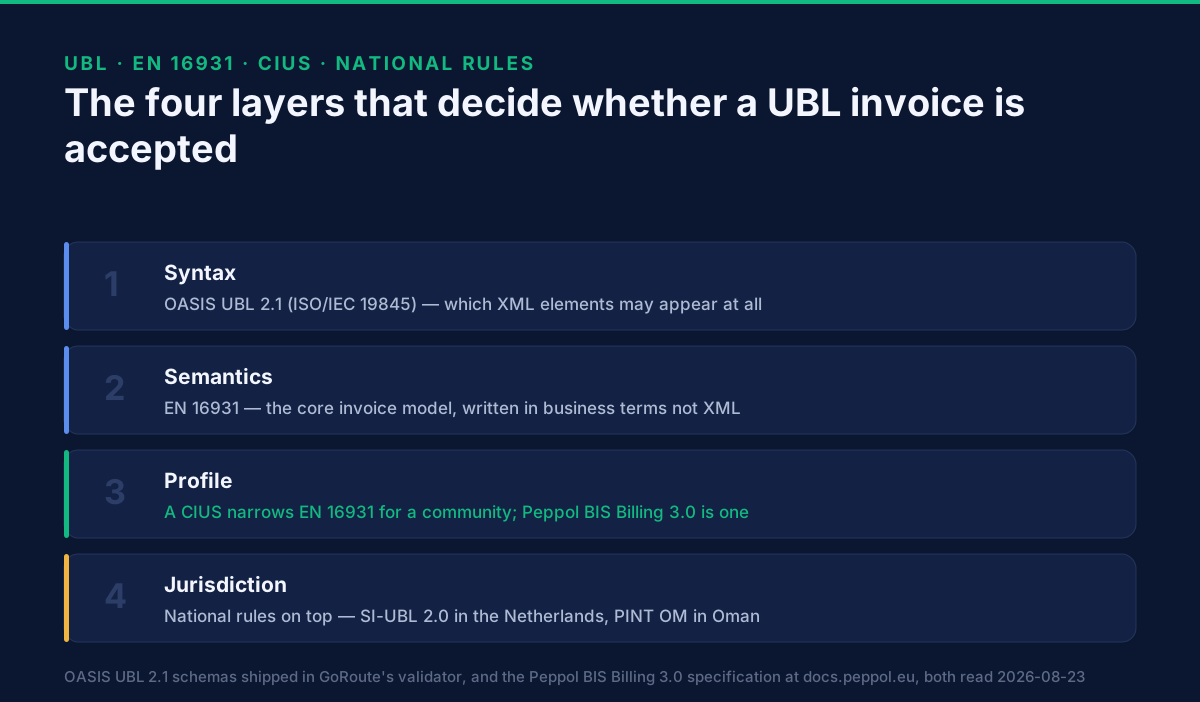
That is the whole of what UBL is, and it is less than most people assume. UBL says which elements may appear. It does not say which ones anybody will insist on. A file can be flawless UBL 2.1 and still be rejected the moment it arrives, because the rules that decide acceptance live in three layers above the syntax.
This page answers three things in order: what the Universal Business Language actually is, what changed between UBL 2.0 and UBL 2.1 for an invoice, and which layer above the schema decides whether a document is accepted.
What does "Universal Business Language" actually mean?
Universal Business Language is what UBL stands for: an OASIS standard that defines a shared library of XML business documents and a single vocabulary of components used across all of them. The invoice is one document type in that library, not the whole of it.
"Universal" is doing precise work in that name, and it is the part worth understanding:
- One vocabulary, many documents. UBL defines its fields once and reuses them everywhere.
A postal address in an invoice is the same
cac:PostalAddressstructure as a postal address in a despatch advice or a catalogue. A system that can read one UBL document already knows most of the next one. - A library, not a form. UBL 2.1 carries 65 business document types — orders, despatch advices, catalogues, credit notes, application responses, transport documents and more. UBL 2.0 had 31 of them.
- Two vocabularies underneath. Every field comes from one of two libraries — Common Basic Components for single values and Common Aggregate Components for structures that nest. The next section shows both in an actual file.
In billing, two of those 65 document types do nearly all the work: Invoice and CreditNote.
Everything else in the library exists, and most invoicing projects never touch it.
What the name does not tell you is anything about rules. UBL is a vocabulary. It says a
DueDate element may appear on an invoice; it says nothing about whether your buyer, your
access point or your tax authority requires one. That question belongs to the three layers
above, which the rest of this page walks.
What does a UBL invoice actually look like inside?
A UBL invoice is one XML document with a single root element:
<Invoice xmlns="urn:oasis:names:specification:ubl:schema:xsd:Invoice-2"
         xmlns:cac="urn:oasis:names:specification:ubl:schema:xsd:CommonAggregateComponents-2"
         xmlns:cbc="urn:oasis:names:specification:ubl:schema:xsd:CommonBasicComponents-2">
  <cbc:CustomizationID>…</cbc:CustomizationID>
  <cbc:ProfileID>…</cbc:ProfileID>
  <cbc:ID>INV-2026-0001</cbc:ID>
  <cbc:IssueDate>2026-08-23</cbc:IssueDate>
  …
</Invoice>
Three namespaces do all the work, and recognising them makes any UBL file readable:
- The document namespace identifies the kind of document.
…xsd:Invoice-2is an invoice; a credit note has its own. cbc:— CommonBasicComponents — holds the simple values. An identifier, a date, an amount, a code.cac:— CommonAggregateComponents — holds the structures. A party, a postal address, an invoice line, a tax subtotal. Aggregates nest, which is how a line contains an item which contains a classification code.
One element in that skeleton is about the version rather than the invoice. cbc:UBLVersionID
is optional, and the schema shipped in our own validator defines it as identifying "the
earliest version of the UBL 2 schema for this document type that defines all of the elements
that might be encountered in the current instance". It is a floor, not a badge — it says how
far back a reader could go and still understand the file.
What changed between UBL 2.0 and UBL 2.1 for an invoice?
UBL 2.1 added six elements to the Invoice document — ProfileExecutionID, DueDate,
BuyerReference, StatementDocumentReference, ProjectReference and WithholdingTaxTotal —
and left everything UBL 2.0 defined in place. OASIS calls 2.1 a minor release for exactly
that reason: "Because it preserves backward compatibility with UBL 2.0, UBL 2.1 is technically
a minor release, not a major one."
The compatibility statement is unusually plain, and it is worth quoting rather than paraphrasing: "All changes in 2.1 schemas are backward-compatible with valid UBL 2.0 instances." So the direction matters. A UBL 2.0 invoice passes UBL 2.1 schema validation unchanged. A UBL 2.1 invoice using any of the six new elements does not pass UBL 2.0, because 2.0 does not define them.
Four kinds of change appear across the 2.0-to-2.1 tables, and recognising them explains almost every difference you will meet:
| Kind of change | What it means in practice | Example on the invoice side |
|---|---|---|
| New element added | A field that simply did not exist before | BuyerReference on Invoice |
| Cardinality 1 → 0..1 | A formerly required element became optional | Widely applied across the library |
| Cardinality 0..1 → 0..n | One occurrence became unlimited | Note on InvoiceLine; AllowanceChargeReason |
| Dictionary entry name corrected | The element is unchanged; its formal name was fixed | Several Order fields |
On the invoice line, UBL 2.1 added PaymentPurposeCode, InvoicePeriod,
WithholdingTaxTotal, SubInvoiceLine and ItemPriceExtension, and let Note repeat instead
of appearing once. SubInvoiceLine is the one that changes a data model rather than a field
list: an invoice line can now contain invoice lines, which is how a bundled or itemised charge
gets expressed without inventing a convention.
Why this matters if you are on 2.0 today. Two of the six additions are ordinary parts of a
current e-invoice. BuyerReference carries the buyer's own reference — the value a Peppol
document uses to tell the receiving finance system which purchase this belongs to — and
DueDate carries the payment due date. Both appear in the Oman PINT example invoices that ship
inside GoRoute's own validator, and neither exists in UBL 2.0's Invoice.
So "we support UBL" and "we support UBL 2.0" are different statements. The first is vague; the second is a specific gap, because the profiles in use today — Peppol BIS Billing 3.0, SI-UBL 2.0 in the Netherlands, PINT Oman for Fawtara — are all written against UBL 2.1 and expect fields 2.0 never had.
Why is valid UBL not enough?
Because UBL is a vocabulary, not a rulebook. It is permissive by design: it has to serve industries and countries that disagree about what an invoice needs, so it allows far more than any one of them wants.
EN 16931 is the layer that fixes that for Europe. It is a semantic standard — a list of
business terms a core invoice must be able to carry, each with a definition and a cardinality,
written in business language rather than XML. "Seller VAT identifier" is a business term;
whether it appears as cac:PartyTaxScheme/cbc:CompanyID is a syntax question EN 16931 leaves
to the binding.
So the two standards answer different questions, and a document has to satisfy both:
| UBL 2.1 | EN 16931 | |
|---|---|---|
| What it is | A syntax — XML elements and nesting | A semantic model — business terms |
| Published by | OASIS; also ISO/IEC 19845 | CEN |
| Answers | "May this element appear here?" | "Must this information be present?" |
| Checked by | XML schema (XSD) validation | Business rules, usually Schematron |
An invoice can pass the UBL schema and fail EN 16931 outright, because the schema will happily accept a document missing something the European standard requires.
What is a CIUS, and what is it allowed to change?
A Core Invoice Usage Specification is a profile that narrows EN 16931 for a particular community without changing what anything means. The mechanism is defined in EN 16931 itself, in chapter 7.
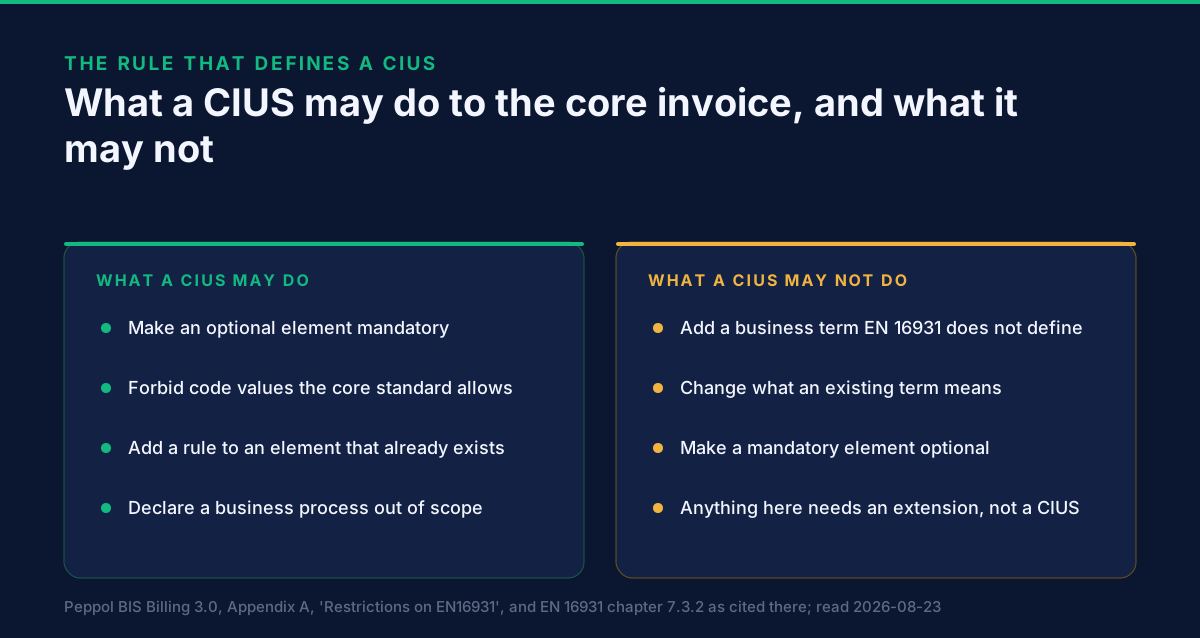
The restriction is the point. Because a CIUS may only narrow, a document valid against a CIUS is automatically valid against EN 16931 — you get community-specific strictness without losing interoperability with everyone else who follows the core standard.
Anything that cannot be expressed as a narrowing is an extension, not a CIUS, and a document using one has left plain EN 16931 behind.
Where does Peppol BIS Billing 3.0 sit?
It is a CIUS, and it says so in its own opening paragraph — that it is a Core Invoice Usage Specification of EN 16931, following the guidance given in chapter 7 of EN 16931, and that any instance document compliant with it will be compliant with the European standard.
Its Appendix A lists the restrictions it applies, and reading that list is the fastest way to understand what a CIUS does in practice. They fall into recognisable shapes: marking values in a code list as not allowed, adding a rule to an element that already exists, and — more sweepingly — removing whole business processes. Two of EN 16931's processes are declared out of scope rather than supported: corrective invoicing, on the grounds that the distinction between a corrective invoice and a credit note was unclear, and partial and final invoicing.
If you have ever wondered why a UBL invoice that looked reasonable was refused by a Peppol access point, this is usually the answer. The refusal came from the profile, not from UBL.
What is Simpler Invoicing (SI-UBL)?
Simpler Invoicing is the Dutch e-invoicing profile now published as SI-UBL 2.0, the Netherlands CIUS of EN 16931. The foundation that built it closed on 31 December 2020; the Netherlands Peppol Authority maintains the profile today, and SI-UBL invoices are ordinary UBL 2.1 XML files.
That answer has two halves, and both matter if you are searching for Simpler Invoicing UBL.
The organisation no longer exists. Stichting Simplerinvoicing — the Dutch foundation that built the profile — ceased to exist on 31 December 2020. Its website says so in both Dutch and English and redirects visitors to the Netherlands Peppol Authority, which took over the role. OpenPeppol's own register of Peppol Authorities lists the Netherlands under the Netherlands Peppol Authority (NPa), which operates on behalf of the Dutch Ministry of the Interior and Kingdom Relations.
The profile did not go anywhere. What Simplerinvoicing built lives on as SI-UBL 2.0, the Dutch CIUS of EN 16931, written in the Authority's own publications as SI-UBL 2 (NLCIUS). It is still maintained and still released on the ordinary Peppol schedule — the Authority published its most recent validation artefacts for SI-UBL 2 and Peppol BIS 3 in the May 2026 release, dated 22 May 2026, with the release before it in November 2025.
So if you are searching for Simpler Invoicing, SI-UBL 2.0 is the thing you are looking for, and the Netherlands Peppol Authority is who maintains it.
What the Netherlands asks for on top
The Authority names two mandatory document-level standards — SI-UBL 2.0 and Peppol BIS
Billing 3.0 — carried over the Peppol AS4 profile at transport level. It also names which
identifiers may be used for Dutch parties: a Chamber of Commerce number (NL:KVK, scheme
0106), a VAT identifier (NL:VAT, scheme 9944), or an NL:OIN (scheme 0190). The OIN
is required for central government, provinces and municipalities; other organisations may choose
between the KVK and VAT forms.
Peppol's national rules for Dutch suppliers then apply on top, and they are fatal rather than advisory. Among them:
| Rule | What it requires of a Dutch supplier |
|---|---|
| NL-R-001 | A credit note must reference the invoice it corrects |
| NL-R-002 | The supplier's address must carry street name, city and post code |
| NL-R-003 | The supplier's legal entity identifier must be a KVK or OIN number |
| NL-R-004 | A Dutch customer's address must carry street name, city and post code |
| NL-R-005 | A Dutch customer's legal entity identifier must be a KVK or OIN number |
| NL-R-007 | A means of payment must be given where payment runs customer to supplier |
| NL-R-008 | Between Dutch parties, the payment means code must be 30, 48, 49, 57, 58 or 59 |
| NL-R-009 | An order line reference requires an order reference at document level |
A further set of Peppol common rules checks the shape of those identifiers rather than their
presence — that a KVK number is eight digits, that a Dutch VAT identifier reads NL123456789B12
— and these are raised as warnings rather than fatal findings.
None of this changes UBL. Every one of these rules is a constraint on a document that was already valid UBL 2.1.
And PINT?
PINT is the same idea applied outside Europe: a Peppol billing model with a shared core and jurisdiction-specific profiles, used where EN 16931 is not the governing standard — PINT Oman for the Fawtara programme, PINT A-NZ, PINT Japan. It is UBL too, and it travels the same network, but it is a different base with different rule sets. We have written that comparison separately in Peppol vs PINT: the difference explained rather than repeat it here.
How do you tell which profile a UBL invoice follows?
Read its CustomizationID. That one element declares which specialisation the document
claims to follow, and the receiving system uses it to decide which rule set to run against the
file. A second element, ProfileID, says which business process the document belongs to.
This is why "is my invoice valid UBL?" is rarely the useful question. A document announces its own profile, and it is then judged against that profile's rules. Validating against UBL alone tells you the XML is well shaped and almost nothing about whether it will be accepted.
What this means if you are building or buying
Three things follow from the four layers, and they are worth stating plainly:
- Ask which profile, not which format. "We support UBL" is close to meaningless on its own. The question that matters is which CustomizationID a system emits, and whether that is the one your counterparty or your tax authority expects.
- Validate against the profile, not the schema. Schema validation catches malformed XML. Every other class of rejection — a missing business term, a forbidden code value, a national rule — is caught only by running the profile's own rules.
- Expect the jurisdiction layer to be where the work is. Moving from a domestic profile to another country's is rarely a syntax change. It is a data change, and it usually lands on whoever maintains the customer master rather than on whoever maintains the integration.
GoRoute validates documents against the profile they declare rather than against UBL alone, which is why a validation response names the rule that fired by its own identifier instead of returning a bare pass or fail. You can read the underlying terms in our e-invoicing glossary, or start from what Peppol is and how the network fits together.
Sources
- OASIS UBL 2.1, the standard itself and its XML schemas — also published as ISO/IEC 19845. The schemas quoted here are the OASIS release of 4 November 2013. The UBL 2.0 comparison, the document-type counts and the backward-compatibility statement come from its revision history, Appendix B — specifically B.3.1 for the 34 new document types, and Tables B.1 and B.2 for the element and cardinality changes.
- The UBL 2.1 schemas shipped inside GoRoute's own validator, for the definition of
cbc:UBLVersionID, and the PINT Oman example invoices in the same directory, for theBuyerReferenceandDueDateusage described here. - Peppol BIS Billing 3.0 — its statement that it is a CIUS of EN 16931, its Appendix A list of restrictions, and its national rules for the Netherlands.
- Netherlands Peppol Authority — the mandatory standards, the Dutch Peppol identifier schemes, and the SI-UBL 2 (NLCIUS) release notices.
- Simplerinvoicing — the foundation's own notice that it ceased to exist on 31 December 2020.
- OpenPeppol's register of Peppol Authorities — the Netherlands entry.
All read on 23 August 2026, and the OASIS revision history re-read on 6 September 2026.
Frequently asked questions
- What is a UBL invoice?
- A UBL invoice is an invoice expressed as an XML document following the OASIS Universal Business Language, version 2.1 — the same standard published by ISO and IEC as ISO/IEC 19845. Its root element is Invoice, in the namespace urn:oasis:names:specification:ubl:schema:xsd:Invoice-2, and every field inside it is drawn from two shared vocabularies that UBL defines: basic components such as an issue date or a line amount, and aggregate components such as a party, an address or a tax subtotal. UBL is a vocabulary rather than a rulebook: it says which elements may appear, not which ones your buyer or your tax authority will insist on.
- What does UBL stand for?
- Universal Business Language. It is an OASIS standard covering a library of business documents, not only invoices — orders, despatch advices, catalogues, credit notes and application responses among them. In billing, two of those documents do nearly all the work: Invoice and CreditNote.
- Which version of UBL does Peppol use?
- UBL 2.1. Peppol BIS Billing 3.0, the billing specification used across the Peppol network in Europe, is carried in UBL 2.1 syntax. UBL 2.1 was released by OASIS on 4 November 2013 and remains the version Peppol billing is built on.
- What is the difference between UBL 2.0 and UBL 2.1?
- UBL 2.1 is a minor release that preserves backward compatibility with UBL 2.0, in the specification's own words, and every schema change in 2.1 is backward-compatible with valid UBL 2.0 instances. It adds 34 document types, taking UBL from 31 business documents to 65, and it widens documents that already existed. On the Invoice itself, UBL 2.1 adds six elements at document level: ProfileExecutionID, DueDate, BuyerReference, StatementDocumentReference, ProjectReference and WithholdingTaxTotal. A UBL 2.0 invoice therefore still validates against the 2.1 schemas; a 2.1 invoice using any of those six does not validate against 2.0, because 2.0 does not define them.
- Is UBL 2.0 still valid?
- Yes, as a schema. OASIS states that all changes in the 2.1 schemas are backward-compatible with valid UBL 2.0 instances, so a document written against UBL 2.0 passes UBL 2.1 schema validation unchanged. Whether anyone will accept it is a separate question, and usually the answer is no: Peppol BIS Billing 3.0 and the PINT profiles are written against UBL 2.1, and they expect elements UBL 2.0 never defined. Schema validity and acceptance are decided at different layers.
- What is the difference between UBL and EN 16931?
- They describe different things. UBL is a syntax — the XML elements and how they nest. EN 16931 is a semantic model — the list of business terms a core invoice must be able to carry, described in business language and independent of any file format. An invoice can be valid UBL and still fail EN 16931, because UBL will happily accept a document that omits something the European standard requires.
- What is a CIUS?
- A Core Invoice Usage Specification: a profile that narrows EN 16931 for a particular community without changing its meaning. A CIUS may make an optional element mandatory, forbid code values the core standard allows, or add a rule to an element that already exists. It may not add a new business term or make a mandatory one optional — that requires an extension. The consequence is the useful part: a document valid against a CIUS is automatically valid against EN 16931. Peppol's own specification states this directly, saying that any instance document compliant with Peppol BIS Billing 3.0 will be compliant with the European standard.
- Is Peppol BIS Billing 3.0 itself a CIUS?
- Yes, and it says so in its own first paragraph: it is a Core Invoice Usage Specification of EN 16931, following the guidance in chapter 7 of that standard. Its Appendix A lists exactly which restrictions it applies. Two whole business processes are among them — corrective invoicing and partial and final invoicing are declared out of scope rather than supported.
- Is Simpler Invoicing still a thing, and what is SI-UBL?
- The organisation is gone; the profile name survives. Stichting Simplerinvoicing ceased to exist on 31 December 2020, and its website now redirects to the Netherlands Peppol Authority. What lives on is SI-UBL 2.0, the Dutch profile it created, which is the Dutch CIUS of EN 16931 and is usually written SI-UBL 2 (NLCIUS). The Netherlands Peppol Authority still publishes its validation artefacts on the ordinary Peppol release schedule — the most recent at the time of writing being the May 2026 release, published 22 May 2026. So if you are searching for Simpler Invoicing, SI-UBL 2.0 is what you are looking for and the Netherlands Peppol Authority is who maintains it.
- What does the Netherlands require on a UBL invoice?
- The Netherlands Peppol Authority names two mandatory document-level standards, SI-UBL 2.0 and Peppol BIS Billing 3.0, over the Peppol AS4 profile at transport level. On top of those, Peppol's national rules for Dutch suppliers are strict about identity and payment: the supplier's legal entity identifier must be a Chamber of Commerce number or an OIN, the supplier's address must carry street name, city and post code, a credit note must reference the invoice it corrects, and where payment runs from customer to supplier a payment means must be given. Each of those is fatal, not advisory.
- How do I tell which profile a UBL invoice follows?
- Read its CustomizationID. That single element declares which specialisation the document claims to follow, and the receiving system uses it to choose which rule set to run. A second element, ProfileID, says which business process the document belongs to. Get either wrong and the document is rejected by rule rather than by opinion — the file can be perfectly well-formed UBL and still go nowhere.
- Does a valid UBL file mean the invoice will be accepted?
- No, and this is the most expensive misunderstanding in the subject. Passing the UBL schema only proves the XML is shaped correctly. Acceptance is decided by the layers above it: the semantic model, the profile your counterparty expects, and any national rules that apply. Almost every real rejection happens in those layers, which is why validation is done against the specific profile a document claims rather than against UBL alone.
About Dr. Syed Raza
Dr. Syed Raza is an IT Enterprise Architect at ClayDesk LLC and leads the GoRoute platform. He works across Peppol Access Point and SMP infrastructure, PINT jurisdictions (Oman, AU/NZ, EU, JP, MY, SG), and national CTC regimes, translating regulatory detail into production-grade e-invoicing systems.
Building on Peppol?
GoRoute is a certified Peppol Access Point & SMP. Book a demo or read the docs to get started.