
Archiving E-Invoices in Portugal: 10 Years, Where They May Be Kept and How
Decree-Law 28/2019 sets 10 years for keeping Portuguese invoices, electronic ones in electronic form only, in any EU state. What else the decree asks.

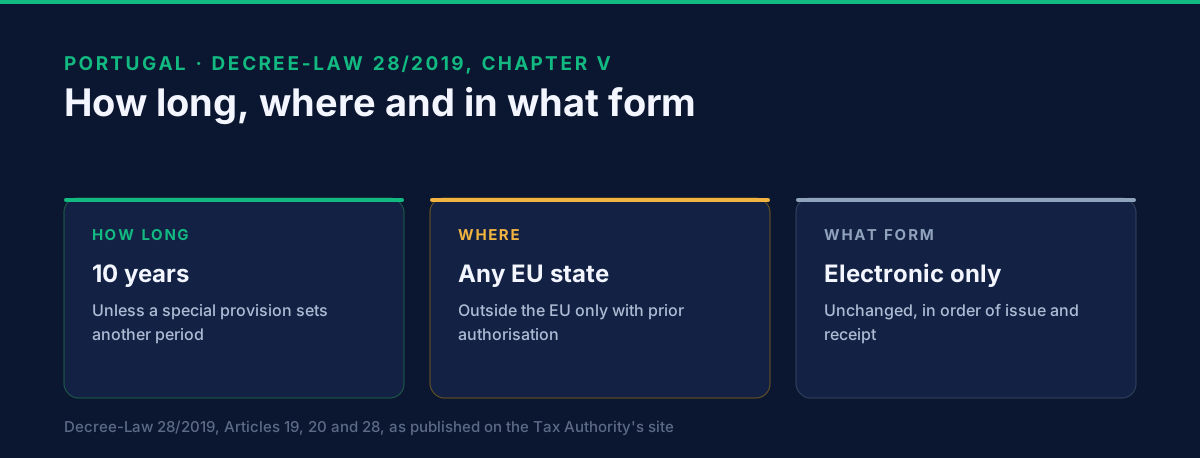
Portuguese invoices must be kept for 10 years, unless a special provision sets another period, and invoices issued and received electronically must be kept in electronic form only. That is Decree-Law 28/2019, Articles 19 and 28. The records may sit in any EU Member State. Keeping them outside the EU needs the Tax Authority's prior authorisation.
This page is for the finance or IT lead who has to say where invoices live and for how long. It reads Chapter V of the decree, Obrigação de arquivo (the duty to keep records). It does not cover storage products or any provider's service, and it does not cover other special periods, because we did not read them. The text we read is the Tax Authority's published copy, marked "vigente" (in force), with amendments by Decree-Laws 48/2020 and 49/2025 listed. The Authority notes that the copy does not replace the text in the Diário da República.
How long must invoices be kept?
Ten years, with two qualifications. Article 19(1) obliges taxpayers to file and keep, in good order, all books, records and supporting documents for 10 years, "if another period does not result from a special provision". Article 19(2) adds that where the taxpayer exercises a right with a longer period, the duty continues until the limitation period for assessing the relevant taxes ends.
The first qualification is the one to chase. The decree itself points to special provisions, and we have not read them all. The VAT Code, for example, has its own article on keeping records, which we did not open. If your sector or a particular tax has a longer period, the longer one governs.
The duty reaches beyond the invoice. Article 19(4) extends it to the documentation about the analysis, programming and execution of the computer processing, and to backups of the data that support the invoicing and accounting programs.
Where may invoices be kept?
Paper in Portugal, electronic records in any EU Member State. Article 20(1) applies to a taxpayer with a seat, permanent establishment or domicile in Portugal, and covers operations carried out abroad too. Paper records are kept in an establishment or installation in Portugal. Electronic records, including backups of the processed data, may be kept in any Member State.
Outside the EU needs authorisation. Articles 20(2) and (4) say that a taxpayer wishing to keep electronically issued and received invoices outside the EU must ask the Authority first. That includes a taxpayer with no seat or domicile in Portugal. Article 21 sets the conditions the taxpayer takes responsibility for:
- the invoicing and accounting system meets the decree's requirements;
- a certified billing program is used; and
- the Authority gets online access, download and use of the data from terminals in Portugal.
The Authority grants it only if all three of these hold: the third country has a mechanism for exchanging tax information or administrative cooperation with Portugal; the taxpayer is not in default on VAT and corporate or personal income tax declarations and payments; and the taxpayer has not been convicted of tax crimes. The Authority may cancel it at any time (Article 21(3)).
A taxpayer also has to say where the archive is. Article 20(5) says to indicate it in the declaration of start of activity under the VAT Code.
In what form must e-invoices be kept?
Electronic, unchanged, in order. Article 28(1) says invoices and other relevant documents issued and received electronically must be kept without alteration, in chronological order of issue and receipt, exclusively in electronic format. A printout is therefore not the archive of an e-invoice.
Four further rules shape the archive:
- Integrity. Article 29 says electronic messages must not contain executable code or macros that could change the records or trigger functions that do.
- Controls. Article 30 asks for integrity, accuracy and reliability controls; functions that prevent improper creation and detect any alteration, destruction or deterioration; recovery of data after an incident; and the reproduction of legible, intelligible copies.
- Documentation. Article 28(3) says the documentation on architecture, functional and organisational analysis, operation of the system, archiving devices, software and algorithms stays accessible for the whole retention period, so that the Authority can reach the records without restriction.
- Order and completeness. Article 22 says documents are stored sequentially and without interruption, following the archive plan and keeping each financial year separate, covering all documents.
What does the Authority get to see?
Online access to the data, if the taxpayer is in scope. Article 32(1) gives the Authority the right of online access, download and use of the data in electronically issued and received invoices of taxpayers with a seat, permanent establishment or domicile in Portugal, and of those in another Member State where the VAT is due in Portugal. Article 32(2) gives the competent authority of another Member State the same right over Portuguese taxpayers' invoices on which the VAT is due in that state. Article 19(3) also asks that, for computer-based invoicing, records stay accessible and legible to the Authority through controlled-access functions, independent of the system version, and exportable as exact copies.
Can paper be scanned, and can a third party keep it?
Yes to both, with controls. Article 23 allows paper documents to be scanned and archived electronically, with imaging precise enough to reproduce legible originals without loss of resolution or information. Paper originals may be destroyed only after the controls are in place and, for purchase invoices, after the right to deduct has been exercised and the record under Article 44(4) of the VAT Code has been made. Full paper reproductions from the electronic archive have the evidential value of the originals.
Article 24 lets a third party do this in the taxpayer's name. The third party adds a checksum to each record or group of records to certify the process, does not destroy paper originals before the taxpayer confirms, and must transfer the archive when the contract ends. Article 25 adds that formats may be migrated when media become obsolete or readability is at risk, provided no information or image is lost, and that readability is checked regularly. Article 27 asks for backup copies stored in a different place from the originals.
What goes in the archive plan?
A file listing the documents archived. Article 26 says the archive plan contains a file with the list of the documents. A taxpayer with an invoicing or accounting system may generate it in the format of the SAF-T structure under Portaria 321-A/2007. Image files are named or organised sequentially, so a document can be found by its identification, and the medium identifies the taxpayer by name and tax number. How invoices reach the Authority each month is a separate duty: reporting invoices to the AT.
What about credit notes and public bodies?
They are invoices for this purpose. Article 2(c)(ii) of the decree defines an invoice to include a corrective document, so the rules above apply to a credit note as well. For invoices to a public body, the decree's rules apply the same way; what the public-sector route asks beyond them is in invoicing a Portuguese public body. The 2027 PDF signature rule is in a different chapter of the same decree and is about issuing, not keeping.
GoRoute is a certified Peppol access point (POP000991) and sends structured e-invoices. It does not provide the Portuguese archive, and nothing on this page describes a storage service.
What we could not confirm
- Other special periods. The decree defers to them; we did not read the VAT Code's own article on record-keeping or any sector rule.
- Whether later amendments changed these articles. We read the Authority's copy, which lists amendments; it says it does not replace the Diário da República.
- Whether a PDF issued under the 2027 rule counts as "electronically issued" for Article 28.
What to do next
- Write down the location of every archive and check each sits in an EU Member State.
- Check retention is at least 10 years for invoices, credit notes and the program backups.
- Check the archive is unaltered, in order, and electronic for e-invoices.
- See structured sending working. Book a demo, try the tutorials, or read the developer documentation.
Related Portugal guides
- Invoicing a Portuguese public body — CIUS-PT and the FE-AP route.
- Reporting invoices to the Portuguese Tax Authority — the monthly deadline.
- Portuguese credit notes — correcting an invoice.
- Portugal E-Invoicing 2027: what changes on 1 January — the PDF signature rule.
- E-invoicing in Portugal — the whole country picture.
Sources: Decree-Law 28/2019 of 15 February, Articles 2, 19 to 30 and 32, as published on the Tax Authority's site (Portal das Finanças), state "vigente", amendments by Decree-Laws 48/2020 and 49/2025 listed, read 18 November 2026. Translations from the Portuguese are ours.
Frequently asked questions
- How long must invoices be kept in Portugal?
- Ten years, under Article 19(1) of Decree-Law 28/2019, unless a special provision sets another period. If the taxpayer exercises a right whose period is longer, the obligation runs until the limitation period for assessing the relevant taxes ends.
- Where may electronic invoices be stored?
- A taxpayer with a seat, permanent establishment or domicile in Portugal may keep electronic records, including backups, in any EU Member State (Article 20(1)(b)). Keeping them outside the EU needs the Tax Authority's prior authorisation (Article 20(2) and (4)).
- Can I keep an e-invoice as a paper printout?
- No. Article 28(1) says invoices issued and received electronically are kept unchanged, in chronological order, exclusively in electronic form.
- Can I scan paper invoices and destroy the originals?
- Yes, once the controls in Article 23 are in place. For purchase invoices, the originals may be destroyed only after the right to deduct has been exercised and the VAT Code Article 44(4) record has been made. A full paper reproduction of an electronic archive has the same evidential value as the original.
- Can a third party keep the archive for me?
- Yes. Article 24 allows a third party to scan and archive in the taxpayer's name. The third party adds a checksum to the records, must not destroy paper originals before the taxpayer confirms, and must hand the archive over when the contract ends.
About Dr. Syed Raza
Dr. Syed Raza is an IT Enterprise Architect at ClayDesk LLC and leads the GoRoute platform. He works across Peppol Access Point and SMP infrastructure, PINT jurisdictions (Oman, AU/NZ, EU, JP, MY, SG), and national CTC regimes, translating regulatory detail into production-grade e-invoicing systems.
Building on Peppol?
GoRoute is a certified Peppol Access Point & SMP. Book a demo or read the docs to get started.