
Portugal E-Invoicing 2027: What Changes on 1 January
From 1 January 2027 a PDF invoice to a Portuguese business needs a qualified electronic signature or seal. PDFs stay valid to 31 December 2026. What to do.

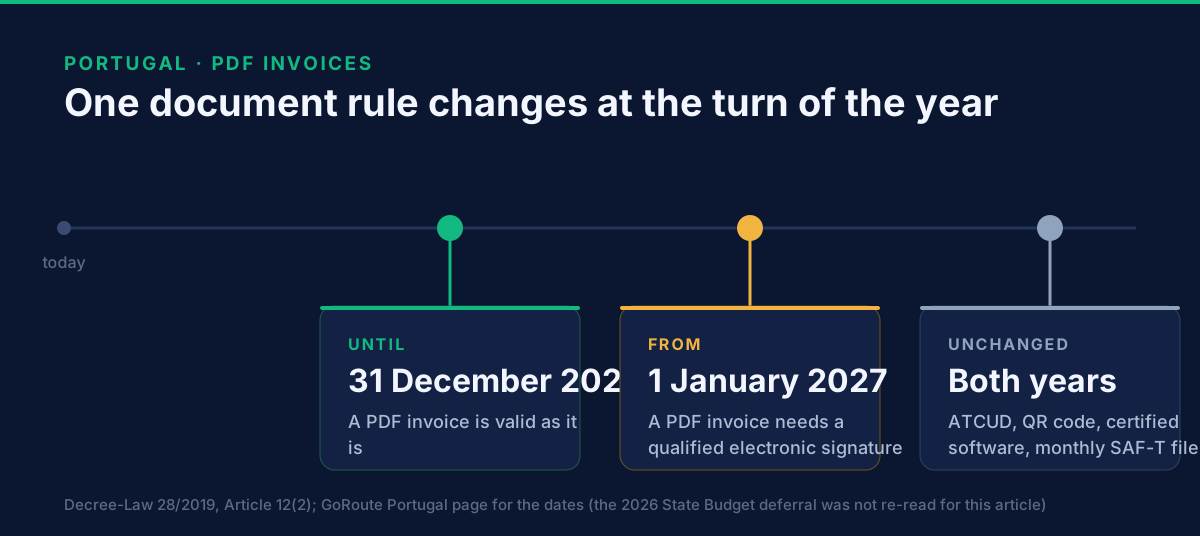
From 1 January 2027, a PDF invoice sent to a Portuguese business needs a qualified electronic signature or seal. Until 31 December 2026, a PDF is a valid invoice exactly as it is. The same file sent one day later is not, unless it has been signed or sealed. Nothing else on the invoice changes on that date.
This page is for the finance lead who invoices Portuguese customers and wants to know what stops working at the turn of the year, and what replaces it. It sets out what the law says, what we could not confirm, and the choices open to you in the nine weeks that remain. It does not cover penalties for a missed requirement, because we have not seen a published schedule, and it does not cover the monthly SAF-T file, which is a reporting duty and not a feature of the invoice.
What exactly stops being valid on 31 December 2026?
A PDF invoice with no qualified signature or seal. Electronic invoices in Portugal fall under Decree-Law 28/2019. Article 12(2) says the authenticity of origin and the integrity of content of an invoice issued electronically are considered guaranteed if the issuer adopts, in the decree's words, one of the following (our translation):
- the application of a qualified electronic signature, as the law provides;
- the application of a qualified electronic seal, under Regulation (EU) 910/2014; or
- the use of an electronic data interchange system, provided sender and receiver sign an agreement that follows the legal conditions of the European model EDI agreement.
The decree also contained a transitional rule. Until 31 December 2020, an advanced signature or seal could continue to be used in place of a qualified one (Article 43, paragraph 10). That date has since been moved by later law. The Tax Authority's published copy of the decree still shows 2020 and does not write the later dates into the text, so the current date sits in other legislation. GoRoute's Portugal page and the 2026 mandates tracker attribute the deferral to the 2026 State Budget and give 1 January 2027 as the new date. We have not opened the budget law while writing this article. The date is the one we publish; check it against the law before it carries weight in a contract.
Is Portugal making e-invoicing mandatory in 2027?
No, not between businesses. The 2027 rule is a condition on one kind of document, the PDF. It is not an order to move to structured invoices. That is the commonest error in how this change is reported, and it matters because it changes the project. If you read "mandatory e-invoicing in 2027", you plan a system migration. If you read the rule as written, the smallest project is to sign what you already send.
There is one place where a structured invoice is mandatory. Suppliers to the Portuguese public sector have been required to send structured invoices through ESPAP since 1 January 2026 for micro, small and medium enterprises, under Decree-Law 13-A/2025, according to our Portugal page. That is a different route with a different date. It applies when the customer is a public body, and the rest of this page is about customers that are businesses.
What is a qualified electronic signature or seal?
A signature or seal made with a qualified certificate, under the EU's eIDAS Regulation. The regulation, number 910/2014, is the one the decree names. In plain terms:
- A qualified signature is a person's. Someone signs, as an individual, with a certificate issued to them by a qualified trust service provider.
- A qualified seal is a company's. The company applies it, with a certificate issued to the company, to show who a document came from and that it has not changed since.
For invoicing, the seal is usually the closer fit. Nobody wants a named employee to sign every invoice a system produces. A seal lets the system apply the company's mark as each PDF is created. This is a description of the two instruments, not advice on which to buy. The regulation itself is on EUR-Lex, and the list of qualified trust service providers is kept by the European Commission.
What does not change on 1 January 2027?
Everything else on the invoice. The Authority's separate rules continue as they are:
- The ATCUD code, the unique document code, stays on every invoice. It is required in any format, PDF included, and the signature does not replace it. See Portugal invoice requirements: ATCUD, QR code and certified software.
- The QR code stays on documents issued by certified software.
- The billing program still has to be certified by the Tax Authority where the decree requires it.
- The monthly SAF-T (PT) file is still owed to the Authority. Our Portugal page explains how it differs from the invoice itself.
A signature or seal on the PDF is therefore an addition. A PDF invoice in 2027 carries the signature or seal and everything it carried in 2026.
Does a Peppol invoice count?
We do not know, and the sources we have read do not say. Article 12(2)(c) accepts an electronic data interchange system when the two parties sign an agreement that follows the European model EDI agreement. Whether an exchange over Peppol is that route, with or without a bilateral agreement, is a question the decree does not answer and the Authority's FAQ, as we read it, does not address.
We mark this as an open question rather than an assumption. If you are planning to move your Portuguese customers to Peppol so you do not have to sign PDFs, put that question to the Authority in writing first. Public bodies are different: they are on a mandatory route of their own, as described above.
Can another method replace the signature or seal?
Possibly, but do not plan around it. The decree says authenticity and integrity are considered guaranteed if the issuer adopts "nomeadamente", meaning "in particular" or "namely", one of the three listed procedures. In a 2019 FAQ on this decree, the Authority was asked whether, from the end of 2020, only a qualified signature or the EDI agreement could be used. It answered that the law's reference to these procedures does not prevent other technologies, as long as they assure the authenticity of origin and the integrity of the content of the invoices.
That answer was given for the 2020 date, and it is five years old. We have not found a current statement from the Authority that repeats it for 2027. Treat it as a reason to ask, not as permission.
What are your options before 1 January?
There are two projects, and your document mix decides which is smaller. Both are open to a finance team that starts now. Neither is comfortable if it starts in December.
- Sign the PDFs you already send. The PDF flow stays as it is. A step is added that applies a qualified seal or signature as each invoice is produced. Check, first, whether your billing system can do this, or whether you need a separate signing service. Then check that the signing step happens after the final numbered invoice is produced, so what you sign is what the customer receives.
- Move the flow to a structured exchange. This is a larger change. It makes sense if you are already exchanging structured invoices with some customers, or if a customer is a public body. It comes with the open question above until the Authority says how it fits Article 12.
A third step applies to both: list your Portuguese customers and sort them. Public bodies are on the ESPAP route already. Businesses are on the PDF calendar. A customer that is neither, such as a branch of a foreign company, is one to ask about case by case.
Timeline: what to do each week
Nine weeks from 29 October 2026 to 1 January 2027. A sensible order:
- Weeks 1 to 2. List every system that produces an invoice for a Portuguese customer. Confirm with the Tax Authority, or your adviser, the date and the methods that meet Article 12.
- Weeks 3 to 5. Choose the route. If it is signing, obtain the certificate and test on copies. If it is structured exchange, start with one customer.
- Weeks 6 to 8. Run both calendars side by side. Keep sending valid PDFs under the 2026 rule, and send a signed test set to a cooperative customer.
- Week 9. Freeze changes to the invoice template. Switch on signing for the first invoices dated 1 January 2027.
If you are a supplier outside Portugal, whether the Portuguese invoicing rules reach your invoices at all depends on who accounts for the VAT. That is covered in Invoicing Portuguese customers from outside Portugal.
What we could not confirm
Three points, as of 29 October 2026.
- The budget law text. We give 1 January 2027 as the Portuguese State Budget's date, as our other pages do. We did not read the law for this page.
- Whether a Peppol exchange meets Article 12(2)(c). Not answered in anything we have read.
- Whether other technologies are accepted for 2027. The Authority's 2019 answer exists. A current one does not appear in the sources we read.
What to do next
- Check the date and the methods against the Authority's own pages, linked below.
- Count the PDFs you send to Portuguese businesses each month, and which system produces them.
- Pick signing or structured exchange for each customer group.
- Book a working session if you want a second view on the Peppol route. Book a demo and bring your invoice volumes. GoRoute is a certified Peppol access point (POP000991), and our Peppol API integration page and the developer documentation show how a system connects. The tutorials show it working.
Related Portugal guides
- Portugal invoice requirements: ATCUD, QR code and certified software — what every Portuguese invoice must carry, and who must use certified software.
- Invoicing Portuguese customers from outside Portugal — which Portuguese rules reach a foreign supplier.
- E-invoicing in Portugal — the whole country picture, including SAF-T and the public sector.
- E-invoicing mandates 2026: a country-by-country tracker — Portugal beside every other mandate landing this year.
Sources: Decree-Law 28/2019 of 15 February, as published on the Tax Authority's site (Portal das Finanças), Article 12(2) and Article 43(10), read 29 October 2026; the Authority's FAQ on Decree-Law 28/2019, October 2019, on electronic invoicing; Regulation (EU) 910/2014 (EUR-Lex); GoRoute's Portugal page for the 1 January 2027 date, the State Budget attribution and Decree-Law 13-A/2025. Translations from the Portuguese are ours. Passages marked as our reading, and the three points under "What we could not confirm", are not the Authority's.
Frequently asked questions
- Is e-invoicing mandatory between businesses in Portugal in 2027?
- Not as a structured-invoice mandate. The change on 1 January 2027 is about what a PDF invoice must carry: a qualified electronic signature or seal. A business that sends a PDF has to add one. A business that does not want to sign PDFs has other ways to exchange invoices, which the Portuguese decree lists. Reports that say Portugal is mandating e-invoicing in 2027 overstate the rule.
- Until when is a PDF invoice valid in Portugal?
- Until 31 December 2026, exactly as it is. From 1 January 2027 it needs a qualified electronic signature or seal. GoRoute's country page and tracker give these dates and attribute the deferral to the 2026 State Budget. We have not opened the budget law for this article, so confirm the date with the Tax Authority before relying on it for a contract.
- What is the difference between a qualified signature and a qualified seal?
- A qualified electronic signature belongs to a natural person. A qualified electronic seal belongs to a legal person, such as the company issuing the invoice. Both are defined in the EU's eIDAS Regulation, number 910/2014, and both are named in Article 12(2) of Decree-Law 28/2019. For an invoicing system the seal is usually the closer fit, because the issuer is the company.
- Does the 2027 change replace ATCUD or certified billing software?
- No. The Authority's rules on the ATCUD code, the QR code and certified billing software are separate and stay in force. An invoice sent in 2027 needs the signature or seal and those items as well. The invoice requirements article lists them one by one.
- Does a Peppol invoice meet the 2027 rule?
- We cannot say. Article 12(2)(c) accepts an electronic data interchange system where sender and receiver sign an agreement following the European model EDI agreement. Neither the decree nor the Authority's published FAQ says whether a Peppol exchange counts as that route. Ask the Tax Authority in writing before you rely on it.
- Can I use another method than a signature or seal?
- The decree says authenticity and integrity are considered guaranteed if one of three listed procedures is adopted, 'namely' (nomeadamente) those. The Authority's 2019 FAQ said the law's reference to these procedures does not prevent other technologies that assure authenticity of origin and integrity of content. That answer concerned an earlier date. Do not plan around it without a current answer from the Authority.
About Dr. Syed Raza
Dr. Syed Raza is an IT Enterprise Architect at ClayDesk LLC and leads the GoRoute platform. He works across Peppol Access Point and SMP infrastructure, PINT jurisdictions (Oman, AU/NZ, EU, JP, MY, SG), and national CTC regimes, translating regulatory detail into production-grade e-invoicing systems.
Building on Peppol?
GoRoute is a certified Peppol Access Point & SMP. Book a demo or read the docs to get started.