
Invoicing Portuguese Customers From Outside Portugal
Which Portuguese invoicing rules reach a supplier outside Portugal? Article 35-A of the VAT Code decides, by who accounts for the VAT. Read from the source.

Whether Portuguese invoicing rules reach a supplier outside Portugal is decided by Article 35-A of the Portuguese VAT Code, and in practice by who has to account for the VAT. For supplies made in Portugal the rules apply. For a supplier with no Portuguese base whose customer accounts for the tax, the Code says they do not. That is the text. Applying it to your own sales is a VAT question, and this page does not answer it for you.
This page is for the finance lead of a company in the United States, Germany or elsewhere that invoices Portuguese customers and has read that Portugal is changing its invoice rules. It sets out the test the law uses, what follows if the Portuguese rules do apply, and what to ask the Authority. It does not give VAT registration advice, and it does not say where any particular supply is made.
Which law decides?
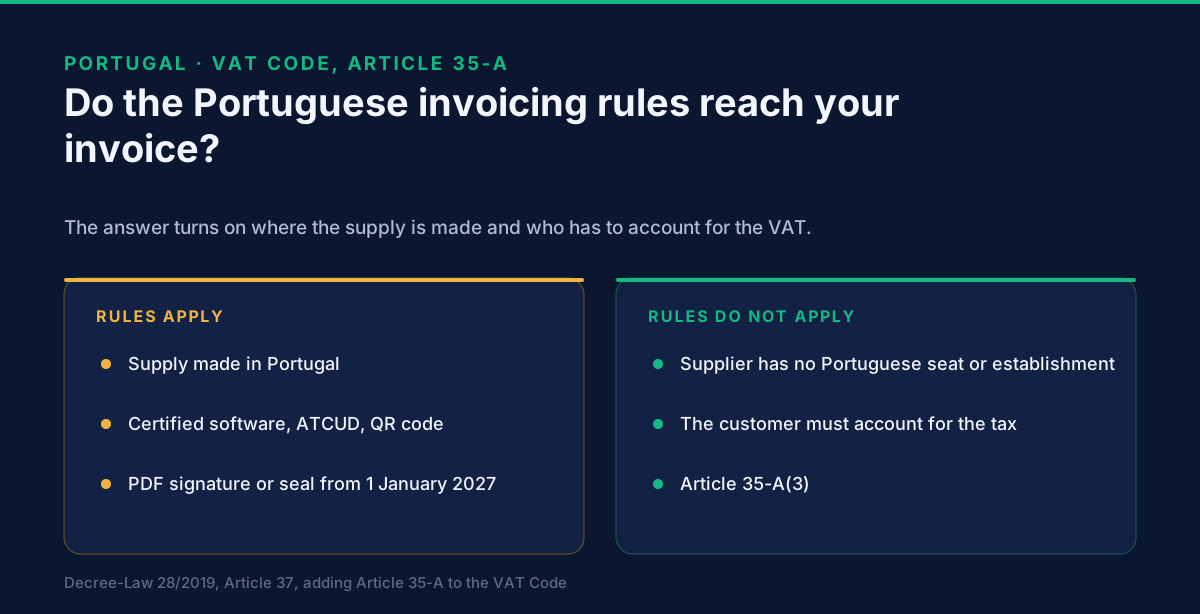
Article 35-A of the VAT Code, which Decree-Law 28/2019 added. Its title is "delimitation of competence in matters of invoicing". Read in sequence, with our translation of its terms:
- Invoices for supplies of goods and services made in Portuguese territory follow the Code's rules (paragraph 1).
- They also follow the Code when the supplier has its seat, permanent establishment or, failing that, its domicile in Portugal, from which the supply is made, and the supply is located in another Member State with the customer accounting for the tax, or is not made in the EU (paragraph 2).
- An invoice from a supplier without a Portuguese seat, establishment or domicile is not subject to the Code's rules when the customer is the one who must account for the tax (paragraph 3).
- The Code's rules apply to an invoice that a Portuguese customer draws up for itself, where the supply is made in Portugal and the customer must account for the tax (paragraph 4).
- Operators who use Portugal as their Member State of identification for the special regime in Decree-Law 158/2014 are subject to the Code's rules (paragraph 5).
For a supplier outside Portugal, paragraphs 1 and 3 do most of the work. The first pulls an invoice in. The third takes it out.
Why does it matter who accounts for the VAT?
Because paragraph 3 turns on it. When a Portuguese business buys from a supplier abroad and the law makes the buyer account for the VAT, paragraph 3 says the Portuguese invoicing rules do not apply to the foreign supplier's invoice. When the supplier has to account for Portuguese VAT itself, because it makes supplies in Portugal and is registered there, paragraph 1 applies and the Portuguese invoicing rules come with it.
Who accounts for the VAT, and where a supply is made, are VAT-law questions that depend on what you sell, to whom and from where. Neither page of ours can settle them. Treat the rest of this page as conditional: "if the Portuguese rules apply to your invoice, then".
What follows if the Portuguese rules apply?
The invoice carries the Portuguese obligations. That means, in order:
- Certified software, if a condition is met. Decree-Law 28/2019, Article 4(1), extends the duty to use only Tax Authority-certified invoicing programs to "other taxpayers" whose invoicing falls under Article 35-A, on the same three conditions as residents: turnover above 50,000 euros in the previous year, use of invoicing software, or a duty to keep organised accounts. One is enough. The Authority's FAQ answers the question for non-established VAT-registered taxpayers directly: yes, where invoice issuing is subject to the Code, and the duty applies from 1 January 2021 (Despacho 349/2019.XXI of the Secretary of State). The conditions are in Portugal invoice requirements: ATCUD, QR code and certified software.
- The ATCUD and the QR code. These come with the certified program: a series communicated to the Authority, a validation code, and a QR code built to the Authority's specification. The same guide describes them.
- The 2027 signature or seal on PDFs. Article 12 of the same decree is where the signature rule sits. If the decree applies to your invoice, so does the date: PDFs valid to 31 December 2026, qualified signature or seal from 1 January 2027. See Portugal E-Invoicing 2027.
The reverse also follows, and it is our reading, not the Authority's: if paragraph 3 takes your invoice outside the Code's rules, the Portuguese decree is not what governs that invoice, and these three items are not Portuguese obligations for it. Your own country's invoice rules and the buyer's expectations still stand. Do not drop the work on this reading alone.
What does the customer decide?
The route the invoice takes, whatever the law says about its form. A Portuguese public body reads structured invoices through ESPAP in CIUS-PT, Portugal's Peppol specialisation. Micro, small and medium enterprises supplying the public sector have been in scope since 1 January 2026 under Decree-Law 13-A/2025, as our Portugal page sets out. We have not read ESPAP's own guidance for this article, and we do not describe the steps.
A Portuguese business customer can be sent a PDF, a signed PDF or a structured invoice. Which it will accept is partly a matter for the two of you. Two practical points apply in either case:
- The customer's tax number (NIF). It identifies the buyer, and under the QR specification it is a
field of the code (
B) on documents from certified software. A final consumer is999999990. - The delivery route. If the customer is on Peppol, a structured invoice can reach it through an access point. If it is not, a PDF is what is left.
Does a foreign supplier have to register for Portuguese VAT?
This page does not say. The sections above apply to a foreign supplier whose invoicing falls under the VAT Code. Whether a supplier has to register for Portuguese VAT is a separate question for an adviser, and we give no view on it.
What is still open?
Three points, as of 29 October 2026.
- Where your supplies are made. This decides paragraph 1 against paragraph 3, and it is the question a tax adviser can answer from your contracts.
- The 2019 FAQ date. The Authority's FAQ on non-established taxpayers is from October 2019. We have not found a more recent statement on it.
- How the 2027 date applies in a reverse-charge case. Our reading of paragraph 3 above is not confirmed by an Authority statement.
What to do next
- List your Portuguese customers and mark which are public bodies, which are businesses, and who accounts for the VAT on each sale.
- Put the three questions from the FAQ above to your adviser or to the Tax Authority, and keep the answer with the contract.
- If the Portuguese rules do reach you, start with the certified-software and series steps in the requirements guide, then the 2027 signature.
- If you want to send structured invoices over Peppol, book a demo. GoRoute is a certified Peppol access point (POP000991). The e-invoice sending page, the developer documentation and the tutorials show how.
Related Portugal guides
- Portugal E-Invoicing 2027: what changes on 1 January — the signature or seal on PDF invoices.
- Portugal invoice requirements: ATCUD, QR code and certified software — what the rules ask of an invoice.
- E-invoicing in Portugal — the whole country picture.
- Peppol e-invoicing explained — the network that delivers a structured invoice.
Sources: Decree-Law 28/2019 of 15 February, as published on the Tax Authority's site (Portal das Finanças), Article 4(1) and Article 37, which adds Article 35-A to the VAT Code, read 29 October 2026; the Authority's FAQ on Decree-Law 28/2019, October 2019, on non-established taxpayers; the Authority's technical specification for the QR code, version 1.1; GoRoute's Portugal page for Decree-Law 13-A/2025 and the ESPAP route. Translations from the Portuguese are ours. Passages marked as our reading are not the Authority's.
Frequently asked questions
- Do Portuguese invoicing rules apply to a supplier outside Portugal?
- Sometimes. Article 35-A of the Portuguese VAT Code decides. Invoices for supplies made in Portugal follow the Portuguese rules. An invoice from a supplier with no Portuguese base is not subject to them when the customer is the one who must account for the tax. Which case you are in depends on where the supply is made, which is a VAT question to confirm with an adviser.
- Does a non-resident need certified invoicing software in Portugal?
- If Portuguese invoicing rules apply to the invoice, yes. Decree-Law 28/2019 extends the certified-software rule to other taxpayers whose invoicing is subject to Article 35-A, and the Tax Authority's FAQ says non-established VAT-registered taxpayers are covered from 1 January 2021 in those cases. The same conditions as for residents then apply: turnover over 50,000 euros, use of invoicing software, or organised accounts.
- Does the 2027 signature rule reach a foreign supplier?
- Only if the Portuguese invoicing rules reach the invoice. The signature or seal is in Article 12 of Decree-Law 28/2019, which is part of those rules. If Article 35-A(3) takes your invoice outside them, the Portuguese decree is not what governs it. That is our reading of the text, not the Authority's answer, so ask before you rely on it.
- What if the customer is a Portuguese public body?
- Then the route is set by the customer. Suppliers to the Portuguese public sector send structured invoices through ESPAP, in micro, small and medium enterprise scope since 1 January 2026 under Decree-Law 13-A/2025, according to our Portugal page. We have not read ESPAP's own guidance for this article.
- What should a foreign supplier get in writing from the Tax Authority?
- Three things: whether the supply is treated as made in Portugal, who accounts for the VAT, and therefore whether the Portuguese invoice rules, including certified software, the ATCUD and the 2027 signature, apply to your invoices. Keep the answer with the contract.
About Dr. Syed Raza
Dr. Syed Raza is an IT Enterprise Architect at ClayDesk LLC and leads the GoRoute platform. He works across Peppol Access Point and SMP infrastructure, PINT jurisdictions (Oman, AU/NZ, EU, JP, MY, SG), and national CTC regimes, translating regulatory detail into production-grade e-invoicing systems.
Building on Peppol?
GoRoute is a certified Peppol Access Point & SMP. Book a demo or read the docs to get started.