
UK VAT Invoice Requirements: What a Valid Invoice Must Show
What a UK VAT invoice must show under HMRC's Notice 700, the £250 simplified invoice, the reverse-charge reference, and the Peppol field for each item.

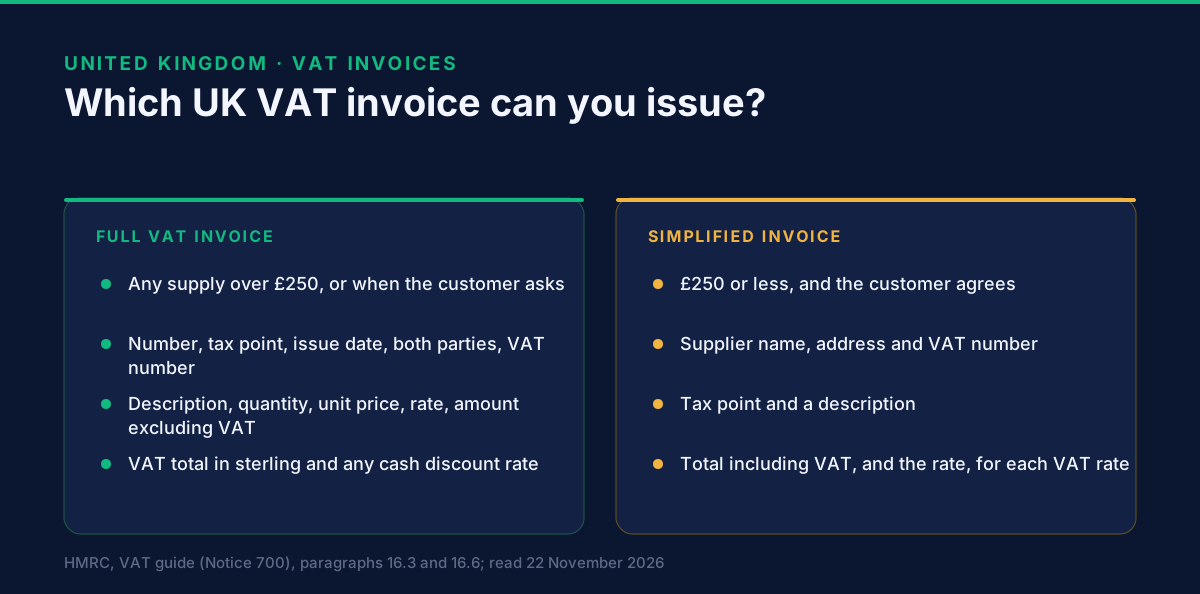
A full UK VAT invoice must show a unique sequential number, the tax point, the issue date, the supplier's name, address and VAT registration number, the customer's name and address, a description of what was supplied, and for each description the quantity, the VAT rate and the amount excluding VAT. It must also show the total excluding VAT, the total VAT in sterling, the unit price, and the rate of any cash discount. HMRC sets this out in paragraph 16.3.1 of VAT Notice 700, and the legal basis is regulation 14 of the VAT Regulations 1995.
This page lists the items, the shorter simplified invoice, the extra reference a reverse-charge invoice needs, and where each item sits in a Peppol invoice. It does not cover when VAT is due, and it is not tax advice. We quote HMRC's own text and link it, and where a statement is our reading rather than HMRC's, we say so.
What must a full UK VAT invoice show?
HMRC's guide says you must show these details on any VAT invoice you issue:
- a sequential number, based on one or more series, that uniquely identifies the document;
- the time of the supply, which is the tax point;
- the date of issue, where it differs from the time of supply;
- your name, address and VAT registration number. You may invoice under a trading name, but the name and address you are registered under must appear somewhere on the document;
- the name and address of the customer;
- a description sufficient to identify the goods or services;
- for each description, the quantity of the goods or the extent of the services, the rate of VAT and the amount payable excluding VAT. Any currency is allowed here;
- the total amount payable excluding VAT, in any currency;
- the rate of any cash discount offered;
- the total VAT chargeable, which must be in sterling;
- the unit price.
Three of these need a note. The unit price applies to countable goods or services, such as an hourly rate. HMRC says that where a supply cannot be broken into countable elements, the total price excluding VAT is the unit price, and that the unit price may not need to be shown if it is not normally provided in the business sector and the customer does not require it. An invoice may be written in a language other than English, but you must be able to give an English translation within 30 days if an HMRC officer asks. And you must keep a copy of every VAT invoice you issue, except the less detailed ones retailers use.
When can you issue a simplified invoice?
When the supply is £250 or less and your customer agrees. HMRC's guide gives these conditions in paragraph 16.6.1. A simplified invoice must show:
- your name, address and VAT registration number;
- the tax point;
- a description that identifies the goods or services;
- for each VAT rate that applies, the total amount payable including VAT, and the rate.
Retailers have a similar option. A retailers' VAT invoice is allowed for a transaction of £250 or less, and it must not include supplies that are exempt from VAT. HMRC says a retailer must issue a full VAT invoice if the transaction is above £250, or if the customer asks for one at £250 or less. The guide also notes that a card sales voucher can be adapted into a retailers' invoice. Where your business is in Northern Ireland, a further condition about EU customers applies; read paragraph 16.6 for it.
Who needs a VAT invoice, and by when?
You must give one whenever you supply standard-rated or reduced-rated goods or services to another VAT-registered person. HMRC explains why: your customer needs it as evidence for reclaiming, as input tax, the VAT you charged. You do not have to issue VAT invoices for zero-rated supplies, or for customers who are not VAT-registered. HMRC adds that in practice you will probably issue one to any customer who asks, because you usually cannot tell whether a customer is registered. You do not have to check.
The timing rule is 30 days. Unless an invoice has already created the tax point, you normally issue a VAT invoice within 30 days of the tax point arising. An invoice issued under the 30-day rule does not create a tax point on its own. Two exceptions to the duty itself are worth knowing: customers who run a self-billing arrangement, and gifts of goods. A pro-forma invoice, one that offers goods or services before they are supplied, cannot be used to reclaim input tax and should be marked "this is not a VAT invoice".
What changes for zero-rated, exempt and reverse-charge lines?
If one invoice includes zero-rated or exempt items, HMRC says each must show clearly that no VAT is payable, with a separate total for their values. Regulation 14(4) says the same in legal terms.
Where the customer, not you, must pay the tax, regulation 14(1)(o) adds one more item: the reference "reverse charge". HMRC publishes wording that meets it. The wording, and how a Peppol invoice carries it, are set out in UK reverse-charge invoices: the wording HMRC accepts.
Where does each item go in a Peppol BIS invoice?
A Peppol BIS Billing 3.0 invoice is an EN 16931 invoice, and every item has an element number. This mapping is our reading of the specification, checked against release 3.0.21 of its validation rules. Check it against your own system's field list.
| HMRC item | Peppol BIS element |
|---|---|
| Sequential number | BT-1, invoice number |
| Tax point | BT-72 actual delivery date, or the invoicing period BG-14, or BT-7 VAT point date |
| Date of issue | BT-2 |
| Supplier name, address, VAT number | BT-27, BG-5, BT-31 |
| Customer name and address | BT-44, BG-8 |
| Description | BT-153 item name, BT-154 description |
| Quantity and unit | BT-129, BT-130 |
| Unit price excluding VAT | BT-146 |
| Amount excluding VAT, per line | BT-131 |
| VAT rate | BT-152 on the line, BT-119 in the VAT breakdown |
| Total excluding VAT | BT-109 |
| Rate of any cash discount | BT-20 payment terms, free text |
| Total VAT in sterling | BT-110 on a sterling invoice; otherwise BT-6 set to GBP with BT-111 |
| "Reverse charge" reference | VAT category AE with BT-120 or BT-121 |
Three points about the table. First, the tax point is a date HMRC's rules decide, and Peppol offers three places to put one. BT-7 and BT-8 cannot both be used, under rule BR-CO-03. Second, if the invoice is not in sterling, rule BR-53 requires BT-111 whenever BT-6 is present, and that is how the VAT total in sterling is carried. Third, Peppol requires things HMRC's list does not: a buyer reference or a purchase order reference (rule PEPPOL-EN16931-R003), and an electronic address for the buyer. The one most UK suppliers miss is the buyer reference.
Is a PDF a valid VAT invoice today?
Yes, provided it carries everything a paper VAT invoice must. HMRC's guide says an electronic invoice can take many forms, the most common being a structured file such as XML sent through an EDI service, or a PDF sent by email, and that whatever the form, it must include all the information a paper invoice requires. Electronic invoices are acceptable evidence for input tax if the authenticity of origin, the integrity of the data and the legibility of the content can be ensured.
That answers today's VAT question. It does not answer what counts as an e-invoice from 1 April 2029, when the government's roadmap treats a PDF differently. Our article on PDF, EDI or Peppol covers that, and HMRC's e-invoicing roadmap covers the dates. We have not guessed at any 2029 detail that those pages do not state.
What to do next
Check one real invoice against the list above, item by item. Then check that your accounting software puts the same items in its Peppol output. If you use Sage, the Sage page shows how invoices get from a Sage export to a Peppol invoice. If you issue credit notes, UK VAT credit notes lists what they must show. If you sell from outside the UK, invoicing UK customers from abroad covers registration and what the invoice carries.
GoRoute is a certified Peppol Access Point (POP000991). It checks every invoice against the Peppol BIS Billing 3.0 rules before sending, which catches a missing buyer reference before the buyer's system does. You can see the service on the e-invoice sending page, the full position is on the UK e-invoicing page, recorded walkthroughs are on the tutorials page, the API is in the developer documentation, and a 20-minute call will test one of your invoices with you. For another country's equivalent, read Finnish VAT invoice requirements.
GoRoute is a certified Peppol Access Point (POP000991). This is not tax or legal advice; confirm your position with your accountant.
Primary sources: HMRC, VAT guide (Notice 700), paragraphs 16.2 to 16.6, 17.7 and 19.3, read 22 November 2026; The Value Added Tax Regulations 1995, regulation 14, latest revised version, read 22 November 2026; Peppol BIS Billing 3.0, validation rules release 3.0.21.
Frequently asked questions
- What must a UK VAT invoice include?
- A sequential number that identifies the document, the tax point, the issue date if it differs, the supplier's name, address and VAT registration number, the customer's name and address, a description of the goods or services, the quantity, rate of VAT and amount excluding VAT for each description, the total excluding VAT, the rate of any cash discount, the total VAT in sterling and the unit price. HMRC lists them in paragraph 16.3.1 of VAT Notice 700.
- Can I issue a simplified VAT invoice in the UK?
- Yes, if the supply is £250 or less and your customer agrees. It shows your name, address and VAT number, the tax point, a description, and for each VAT rate the total payable including VAT and the rate. A full invoice is still needed above £250, or at or below it if the customer asks for one.
- Do I have to issue a VAT invoice to every customer?
- No. HMRC says you must give a VAT invoice for standard-rated or reduced-rated supplies to another VAT-registered person. You do not have to issue one for zero-rated supplies or to customers who are not VAT-registered, though in practice you will issue one to any customer who asks.
- How long do I have to issue a VAT invoice?
- Normally within 30 days of the tax point arising. An invoice issued under that rule does not itself create a tax point. HMRC lists cases where the limit can be extended without applying, and says to apply in writing in any other case.
- Is a PDF a valid UK VAT invoice?
- Today, yes, if it carries everything a paper VAT invoice must and the buyer can rely on its origin, integrity and legibility. HMRC's guide names a PDF sent by email as a common form of electronic invoice. That is a separate question from what counts as an e-invoice under the 2029 rule, which is covered in our PDF and EDI article.
About Dr. Syed Raza
Dr. Syed Raza is an IT Enterprise Architect at ClayDesk LLC and leads the GoRoute platform. He works across Peppol Access Point and SMP infrastructure, PINT jurisdictions (Oman, AU/NZ, EU, JP, MY, SG), and national CTC regimes, translating regulatory detail into production-grade e-invoicing systems.
Building on Peppol?
GoRoute is a certified Peppol Access Point & SMP. Book a demo or read the docs to get started.