
Finnish VAT Invoice Requirements, Including Reverse Charge
What a Finnish VAT invoice must contain under the VAT Act, the simplified invoice, reverse-charge wording for a foreign seller, credit notes, and Peppol fields.

A Finnish VAT invoice must carry the items listed in section 209 e of the VAT Act: the issue date, a running identifier, the seller's VAT identifier, the buyer's identifier in reverse-charge and intra-EU goods cases, both parties' names and addresses, what was sold, the tax base by rate, and the rate and amount of tax. A foreign seller selling to a Finnish business often adds a different note instead of a rate and amount: "käännetty verovelvollisuus", in English "Reverse charge". This page sets out the content, the simplified invoice, the reverse-charge wording, credit notes, and where each item sits in a Peppol BIS invoice.
The page is about invoice content. It does not cover VAT returns or registration, and it is not tax advice. We quote the Tax Administration's guidance on invoicing requirements and link it. Whether a particular sale is taxed in Finland is for your adviser.
Whose invoice rules apply to a foreign seller?
It depends on where you are established and who writes the invoice. The Tax Administration (Verohallinto) sorts the cases in its guidance on invoicing requirements. The Finnish VAT Act rules apply to invoicing when the sale takes place in Finland under the Act's place-of-supply rules, and the guidance then names the exceptions.
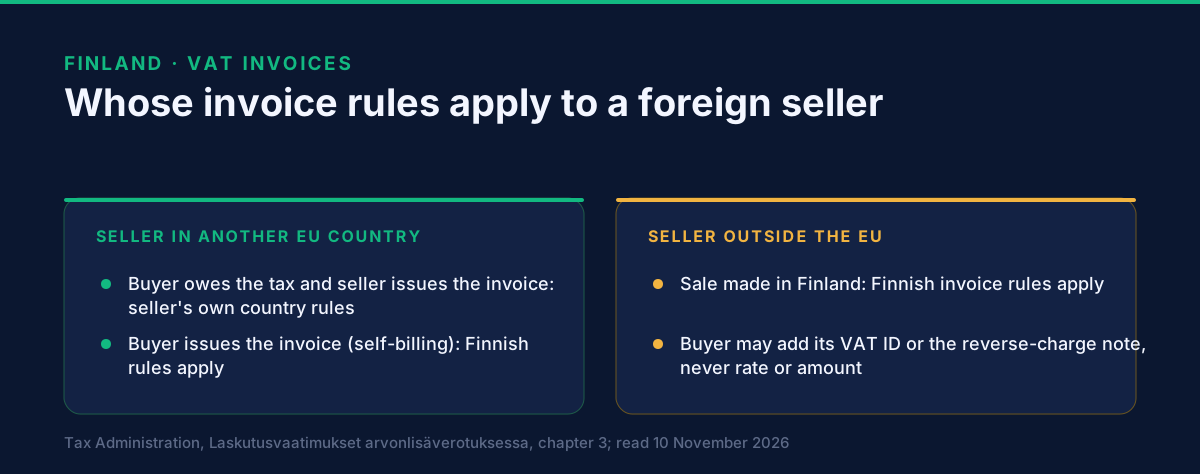
- Seller in another EU country, buyer owes the tax, seller issues the invoice: the VAT Act is not applied. Your own country's invoice rules apply.
- Seller in another EU country, and the Finnish buyer issues the invoice (self-billing): the VAT Act applies.
- Seller outside the EU, sale made in Finland: the Finnish invoice rules apply.
The Tax Administration also says the mandatory content may be in any language, and that it can ask for a translation during an audit.
What must a Finnish VAT invoice contain?
Section 209 e of the VAT Act, as the Tax Administration lists it, requires these items:
- the date the invoice was issued, and a running identifier, which must not repeat within a financial year;
- the seller's VAT identifier, and the buyer's VAT identifier in reverse-charge cases and intra-EU sales of goods;
- the names and addresses of seller and buyer;
- the quantity and type of goods, or the extent and type of services;
- the date goods were delivered or services performed, or an advance payment was made, if it can be determined and differs from the invoice date;
- the tax base by rate, the unit price without tax, and any discounts not already in the unit price;
- the VAT rate, and the amount of tax payable;
- a note that the sale is exempt, or a reference to the relevant provision;
- the note "käännetty verovelvollisuus" where the buyer owes the tax;
- the note "itselaskutus" on an invoice the buyer wrote;
- a reference to the earlier invoice, on a correcting invoice.
The Finnish VAT identifier is the country code FI and the business ID without the hyphen. The guidance also says an invoice need not be called "Lasku" to be one, and that an invoice can be made up of several documents if they refer to each other unambiguously. That rule does not apply to cross-border sales where the buyer owes the tax: those invoices must carry every required item themselves.
When can you issue a simplified invoice?
In defined cases only. Section 209 f allows reduced content when the invoice total is at most EUR 400, and for retail and similar sales almost entirely to private persons, whatever the total. It does not apply to intra-EU supplies of goods, distance sales of goods, or a sale in another EU country where the buyer owes the tax under reverse charge.
A simplified invoice carries the issue date, the seller's name and VAT identifier, the quantity and type of goods or the type of services, the tax amount or tax base by rate, and for a correcting invoice a reference to the original. Prices may be shown including tax if the tax amount is stated.
What does a foreign seller add under reverse charge?
When the buyer owes the tax, the invoice does not show a rate or a tax amount. The Tax Administration says reverse charge applies to a foreigner's sales in Finland where the foreigner has no fixed establishment in Finland and has not registered for VAT here. It does not apply when the buyer is a private person.
On such an invoice the guidance says to:
- write "käännetty verovelvollisuus", in English "Reverse charge";
- show the buyer's VAT identifier, which is FI plus the business ID without the hyphen;
- show the tax base for each type of goods or service, and leave out the rate and the tax amount.
For a Finnish seller invoicing a business in another EU country, the Tax Administration recommends the note "Reverse charge, VAT Directive art 44". That is a recommendation for Finnish sellers. If you are an EU seller invoicing a Finnish business, use the wording your own country's rules require.
If a seller outside the EU leaves out the buyer's VAT identifier or the reverse-charge note, the Tax Administration says the buyer may add them to the document. The buyer must make clear which items were original, and it may not add a rate or a tax amount.
What are the Finnish VAT rates?
Only as the Tax Administration states them, and they have changed. On 10 November 2026 the page vero.fi/en/businesses-and-corporations/taxes-and-charges/vat/rates-of-vat gives a general rate of 25.5%, a reduced rate of 13.5%, which was 14% up to 31 December 2025, and a reduced rate of 10%. Some sales are at zero rate or exempt. The detailed invoicing guidance we quote still carries a notice that it will be updated for the rate changes, so take the rate from the rates page, not from older articles.
How do you issue a credit note or correct an invoice?
With a new document that refers to the original. The Tax Administration says a correcting invoice must refer clearly to the earlier one, using its identifier, or the period if the correction covers sales in a period, as with an annual discount. A discount given after invoicing is handled with a separate invoice. For cross-border sales where the buyer owes the tax, a correcting invoice must carry all the details; a reference alone is not enough.
In a Peppol BIS invoice, a credit note or negative invoice refers to the earlier invoice in the preceding invoice reference group, BG-3, with the invoice number and, if the number is not unique, the issue date. Peppol BIS supports both a credit note document and a negative invoice, and a receiving system has to accept both.
Where does each item go in a Peppol BIS invoice?
In a Peppol BIS Billing 3.0 invoice, which is an EN 16931 invoice, each item has an element number. The table gives the mapping on our reading of the specification, with the Peppol documentation as the source; check it against your own system's field list.
| Finnish requirement | Peppol BIS element |
|---|---|
| Issue date; running identifier | BT-2; BT-1 |
| Seller VAT identifier; buyer VAT identifier | BT-31; BT-48 |
| Seller and buyer name and address | BT-27 and BG-5; BT-44 and BG-8 |
| Quantity and type of goods or services | BT-129 and BT-153 |
| Delivery or performance date | BT-72, or the invoicing period BG-14 |
| Tax base by rate; rate; tax amount | BT-116; BT-119; BT-117 (in the VAT breakdown BG-23) |
| Reverse-charge note | VAT category code AE (BT-118) with BT-120 or BT-121 |
| Exemption note | VAT category code E with BT-120 or BT-121 |
| Reference to the earlier invoice | BG-3 (BT-25 number, BT-26 date) |
| VAT amount in euros, if invoiced in another currency | BT-6 and BT-111 |
For reverse charge, the Peppol rules are strict. The category code is "Reverse charge" (AE), the rate (BT-152) must be zero, the VAT amount in the breakdown must be zero, and the invoice must carry the exemption reason, either as the code VATEX-EU-AE or as the text "Reverse charge". An invoice with that category must also carry the seller's VAT or tax registration identifier and the buyer's VAT identifier or legal registration identifier. A Peppol invoice that breaks these rules is rejected before delivery.
When the invoice carries Finnish VAT and is not in euros, the Tax Administration says the tax amount must also be stated in euros. Peppol has two elements for it: the VAT accounting currency code BT-6 and the VAT amount in that currency, BT-111.
What to do next
Decide first which of your Finnish sales fall under reverse charge, with your adviser. Then set your invoicing system to produce the right category code and note for those sales and test one invoice in the free developer sandbox.
For how the invoice is delivered, see invoicing a Finnish customer from abroad. Where the buyer is a state agency there are further references to add, which the public sector article lists, and how to find an address covers the lookup. For the file format underneath a Peppol invoice, read what a UBL invoice is. The Finland page has the rules for who can demand an e-invoice. The documentation covers the API, the tutorials show an invoice being sent, and you can book a call to have a Finnish buyer looked up with you.
GoRoute is a certified Peppol Access Point (POP000991).
Primary sources: Tax Administration, Laskutusvaatimukset arvonlisäverotuksessa (detailed guidance, sections 3 to 5, issued 1 September 2023) and Rates of VAT, read 10 November 2026; Peppol BIS Billing 3.0, rules BR-AE-01 to BR-AE-10 and section 11.4, read 10 November 2026.
Frequently asked questions
- What must a Finnish VAT invoice contain?
- Section 209 e of the VAT Act lists it: issue date, a running identifier, the seller's VAT identifier, the buyer's VAT identifier in reverse-charge and intra-EU goods cases, seller and buyer names and addresses, quantity and type of goods or extent and type of services, the delivery or performance date where it differs from the invoice date, the tax base by rate, unit price excluding tax, the rate and the tax amount. Special notes apply to reverse charge and credit notes.
- What does a foreign seller write on an invoice under reverse charge in Finland?
- The Tax Administration says the invoice carries the note käännetty verovelvollisuus, in English Reverse charge, and the buyer's VAT identifier. It shows the tax base for each type of goods or service and no VAT rate or tax amount. For a seller in another EU country, the invoice rules of the seller's own country apply when the seller issues the invoice.
- Can I issue a simplified invoice in Finland?
- Yes, in some cases. Section 209 f allows reduced content when the invoice total is at most EUR 400, and for retail and similar sales mainly to private persons. It is not available for cross-border sales where the buyer owes the tax under reverse charge.
- What are the Finnish VAT rates today?
- On 10 November 2026 vero.fi gives 25.5% as the general rate, 13.5% as the reduced rate (14% until 31 December 2025) and 10% as a second reduced rate. Check the Tax Administration's page for the current figure before you rely on this one.
- How do I credit an invoice to a Finnish customer?
- Issue a new invoice or credit note that refers unambiguously to the earlier invoice. In a Peppol invoice the reference sits in the preceding invoice reference group, BG-3. For a cross-border sale where the buyer owes the tax, the new document must carry all the invoice details, not just a reference.
About Dr. Syed Raza
Dr. Syed Raza is an IT Enterprise Architect at ClayDesk LLC and leads the GoRoute platform. He works across Peppol Access Point and SMP infrastructure, PINT jurisdictions (Oman, AU/NZ, EU, JP, MY, SG), and national CTC regimes, translating regulatory detail into production-grade e-invoicing systems.
Building on Peppol?
GoRoute is a certified Peppol Access Point & SMP. Book a demo or read the docs to get started.