
UK VAT Credit Notes: What They Must Show and How to Send One
What a UK VAT credit note must show under HMRC's Notice 700, when it is valid, and how it travels as a Peppol credit note with the invoice reference.

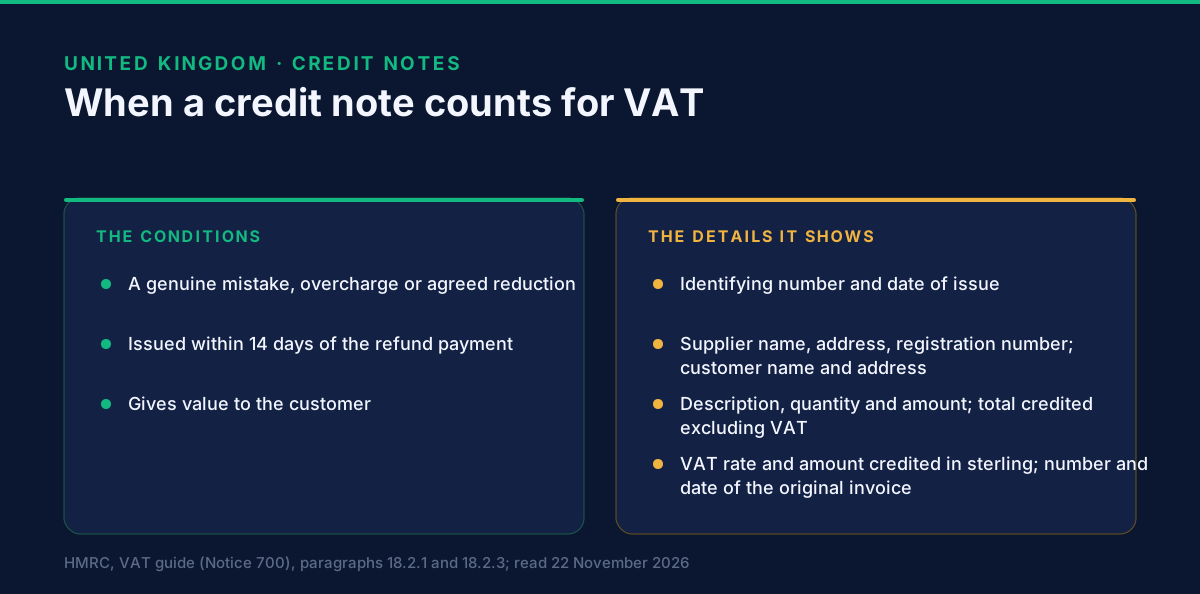
A UK VAT credit note must show an identifying number and date, the supplier's name, address and registration number, the customer's name and address, a description of what is credited, the quantity and amount for each description, the total credited excluding VAT, the rate and amount of VAT credited in sterling, and the number and date of the original VAT invoice. It is valid for VAT only if it reflects a genuine mistake, overcharge or agreed reduction, is issued within 14 days of the refund payment, and gives value to the customer. HMRC sets this out in paragraph 18.2.3 of VAT Notice 700.
This page covers what a credit note must show, when you must issue one, which rate it carries, and how it travels as a Peppol credit note. It does not cover bad-debt relief, which HMRC treats in paragraph 18.5, and it is not tax advice. The contents of an original invoice are in UK VAT invoice requirements.
When is a credit note valid for VAT?
HMRC gives three conditions in paragraph 18.2.3. To be valid for VAT purposes, a credit note must:
- reflect a genuine mistake or overcharge, or an agreed reduction in the value of the supply, and be issued within 14 days of the refund payment being made to the customer;
- give value to the customer, meaning it represents a genuine entitlement to the amount overcharged, either to be refunded or offset against future supplies;
- show clearly all the details listed in the next section.
The guide adds a consequence: HMRC will not make any repayment where a credit note does not meet these conditions. For a supplier, the credit note is what supports the reduction in output tax. For the customer, it is what supports the reduction in input tax.
What must a credit note show?
Paragraph 18.2.3 lists eight items:
- the identifying number and the date of issue;
- the name, address and registration number of the supplier;
- the name and address of the customer;
- a description that identifies the goods or services for which credit is being allowed;
- the quantity and amount for each description;
- the total amount credited, excluding VAT;
- the rate and amount of VAT credited, expressed in sterling;
- the number and date of the original VAT invoice or invoices.
If you cannot link the credit to an invoice, for example because returned goods cannot be tied to one, HMRC says you must be able to satisfy it by other means that you accounted for VAT on the original supply. Credits for zero-rated or exempt supplies must be totalled separately, and the note must show clearly that no VAT credit has been allowed for them. HMRC's guide also lists the mirror document, a debit note, with its own required details. It is used for an undercharge or an agreed increase, and it must be issued within 14 days of the increase being agreed.
Do you have to issue a credit note at all?
Not always. HMRC's paragraph 18.2.1 says that when you allow a credit or contingent discount to a customer who can reclaim all the tax on your supply as input tax, you do not have to adjust the original VAT charge, provided you and your customer both agree not to. Otherwise you should both adjust the original VAT charge, and you should issue a credit note to your customer and keep a copy.
Credit notes issued without a VAT adjustment should state "This is not a credit note for VAT". Even then you still adjust your records of outputs and inputs, to complete your VAT Return.
Prompt payment discounts have their own route. If the discount is taken up in time, you may adjust the VAT by issuing a credit note. If you choose not to, the original invoice must state the discount terms, including the time limit, and say that the customer can only recover as input tax the VAT actually paid. HMRC recommends the wording "A discount of X% of the full price applies if payment is made within Y days of the invoice date. No credit note will be issued. Following payment you must ensure you have only recovered the VAT actually paid".
Which VAT rate goes on the credit note?
The rate in force at the time of the tax point of the original supply, says paragraph 18.2.5. Section 30 of the guide covers credit notes that follow a change in the VAT rate. For a credit note that corrects an error in a VAT invoice, paragraph 19.8 says it should bear a reference to the number and date of that invoice and show clearly both the correct and incorrect amounts of VAT.
When do you account for it?
For a price decrease, in the VAT account for the period in which the refunded amount is paid to the customer, says paragraph 18.2.6. For an increase, when the supplier and customer agree it. One exception matters: if you charged an incorrect amount of VAT and have already declared it on a VAT Return, a credit note alone does not fix the declaration. HMRC says you can only correct an error in your declaration by the error correction method in VAT Notice 700/45.
How does a UK credit note travel as a Peppol credit note?
As a Peppol BIS Billing 3.0 credit note, a separate document type from an invoice. Its document type code is 381, which is in the credit note code list of the validation rules, release 3.0.21. The mapping below is our reading of those rules; check it against your own system.
| HMRC item | Peppol BIS element |
|---|---|
| Identifying number; date of issue | BT-1; BT-2 |
| Supplier and customer details | BT-27, BG-5, BT-31; BT-44, BG-8 |
| Description; quantity and amount | BT-153; BT-129 and BT-131 |
| Total credited excluding VAT | BT-109 |
| VAT rate and amount credited | BT-119 and BT-117 in the VAT breakdown; BT-110 in total |
| VAT credited in sterling, if not in sterling | BT-6 = GBP with BT-111 |
| Number and date of the original invoice | BG-3: BT-25 number, BT-26 date |
| "This is not a credit note for VAT" | The document note, BT-22 |
The row that matters most is the invoice reference. In Peppol the preceding invoice group, BG-3, is optional, and if it is present it must carry the invoice number (rule BR-55). HMRC requires the number and the date of the original invoice. A credit note that Peppol accepts can therefore still fall short of HMRC's list, so always send both BT-25 and BT-26. Peppol also bars a negative item net price (rule BR-27), so a credit is expressed with the credit note document and not by negating a price. GoRoute's platform writes a credit note with type code 381, and writes the reference group with the invoice number and, when you give it, the issue date.
A credit note for a supply that was under the reverse charge carries the reference too, and the reduction the customer must account for. That is covered in UK reverse-charge invoices. If the original sale was made from outside the UK, read invoicing UK customers from abroad first, because there may be no UK VAT to credit.
What should you keep?
HMRC says to keep a copy of the credit note (paragraph 18.2.1), and the accounts or supporting documents must make clear the nature of the adjustment and the reason for it. The record of credits you receive from suppliers must either show the details listed in paragraph 18.2, or show clearly where they can be found.
What to do next
Take your last credit note and check it against the eight items. Look especially at the original invoice date, which is the item most often missing. Then check that your system sends BT-25 and BT-26 on the Peppol credit note.
GoRoute is a certified Peppol Access Point (POP000991). You can send invoices and credit notes through the e-invoice sending service, or from your own software through the API described in the developer documentation. The UK e-invoicing page has the position on 2029, the tutorials show an invoice being sent, and a 20-minute call will test a credit note with you. For a comparison with another country, read credit notes in Portugal.
GoRoute is a certified Peppol Access Point (POP000991). This is not tax or legal advice; confirm your position with your accountant.
Primary sources: HMRC, VAT guide (Notice 700), paragraphs 18.2.1 to 18.2.6, 19.7, 19.8 and 30.7.5, read 22 November 2026; Peppol BIS Billing 3.0, validation rules release 3.0.21 (rules BR-27, BR-53, BR-55 and the credit note code list in BR-CL-01).
Frequently asked questions
- What must a UK VAT credit note show?
- The identifying number and date of issue, the supplier's name, address and registration number, the customer's name and address, a description of the goods or services credited, the quantity and amount for each description, the total credited excluding VAT, the rate and amount of VAT credited in sterling, and the number and date of the original VAT invoice. HMRC lists them in paragraph 18.2.3 of VAT Notice 700.
- When is a credit note valid for VAT purposes?
- When it reflects a genuine mistake, overcharge or agreed reduction in the value of the supply and is issued within 14 days of the refund payment being made to the customer, when it gives value to the customer, and when it shows all the required details. HMRC says it will not make any repayment where a credit note does not meet these conditions.
- Do I have to issue a credit note for a discount or refund?
- Not always. Where the customer can reclaim all the VAT on your supply as input tax, you do not have to adjust the original VAT charge if you and the customer both agree not to. Otherwise you should both adjust it, and you should issue a credit note and keep a copy. A credit note issued without a VAT adjustment should state that it is not a credit note for VAT.
- Which VAT rate goes on a UK credit note?
- The rate that was in force at the time of the tax point of the original supply. HMRC's guide has a separate section for credit notes caused by a change in the VAT rate.
- How is a UK credit note sent over Peppol?
- As a Peppol BIS Billing 3.0 credit note, with document type code 381, that refers to the original invoice in the preceding invoice reference group, BG-3. Peppol makes that group optional, but HMRC requires the original invoice number and date, so supply both. A credit note in a foreign currency also needs the VAT total in sterling, carried in BT-6 and BT-111.
About Dr. Syed Raza
Dr. Syed Raza is an IT Enterprise Architect at ClayDesk LLC and leads the GoRoute platform. He works across Peppol Access Point and SMP infrastructure, PINT jurisdictions (Oman, AU/NZ, EU, JP, MY, SG), and national CTC regimes, translating regulatory detail into production-grade e-invoicing systems.
Building on Peppol?
GoRoute is a certified Peppol Access Point & SMP. Book a demo or read the docs to get started.