
UK Reverse-Charge Invoices: The Wording HMRC Accepts
What a UK domestic reverse-charge invoice must say, the wording HMRC accepts for construction services and specified goods, and how a Peppol invoice carries it.

A UK reverse-charge invoice must show everything a normal VAT invoice shows, and it must include the reference "reverse charge". Regulation 14(1)(o) of the VAT Regulations 1995 requires that reference, and HMRC's guidance adds that the invoice should make clear the customer must account for the VAT. HMRC's examples that meet the requirement are "reverse charge: VAT Act 1994 Section 55A applies", "reverse charge: S55A VATA 94 applies" and "reverse charge: Customer to pay the VAT to HMRC". This page covers when the charge applies, what the invoice shows, and how a Peppol invoice carries it.
It does not cover Construction Industry Scheme deductions, and it is not tax advice. Whether the reverse charge applies to a particular job is for you and your adviser to decide from HMRC's guidance.
Which supplies are covered?
The domestic reverse charge is a rule that moves the VAT from the supplier to the customer for certain supplies between UK businesses. HMRC's Notice 735 lists the specified supplies:
- Goods: mobile phones and computer chips, from 1 June 2007, and wholesale gas and electricity, from 1 July 2014.
- Services: emission allowances, wholesale telecommunications, renewable energy certificates, and construction services from 1 March 2021.
The charge applies only where the customer is registered or liable to be registered for UK VAT and is buying for a business purpose. For mobile phones and computer chips there is a limit. The reverse charge applies if the VAT-exclusive value of the phones or chips on an invoice is £5,000 or more, and then to the whole of that value. If the customer is not VAT-registered, normal VAT applies, so you need the customer's VAT number and should satisfy yourself that it is genuine.
When does it apply to construction?
HMRC says the charge applies to standard-rated and reduced-rated building and construction services, for businesses registered for VAT in the UK, where the services are reported within the Construction Industry Scheme (CIS). The list matches the CIS "construction operations", except that supplies of workers by employment businesses are outside it.
Two groups of customers can opt out. An end user is a business that is VAT- and CIS-registered and does not make onward supplies of the construction services it buys. An intermediary supplier is connected to an end user through the same land or the same corporate group. In both cases the reverse charge does not apply once the customer tells its supplier in writing, by post, email or contract. If you think a customer is an end user but it has not told you in writing, HMRC says to apply the reverse charge.
If goods are supplied with construction services, HMRC treats it as a single supply and the charge covers the full value. There is a 5% disregard where the reverse-charge element is a minor part, which both sides must agree from the start of the contract. For anything borderline, read HMRC's technical guide for the exact conditions.
What must the invoice show?
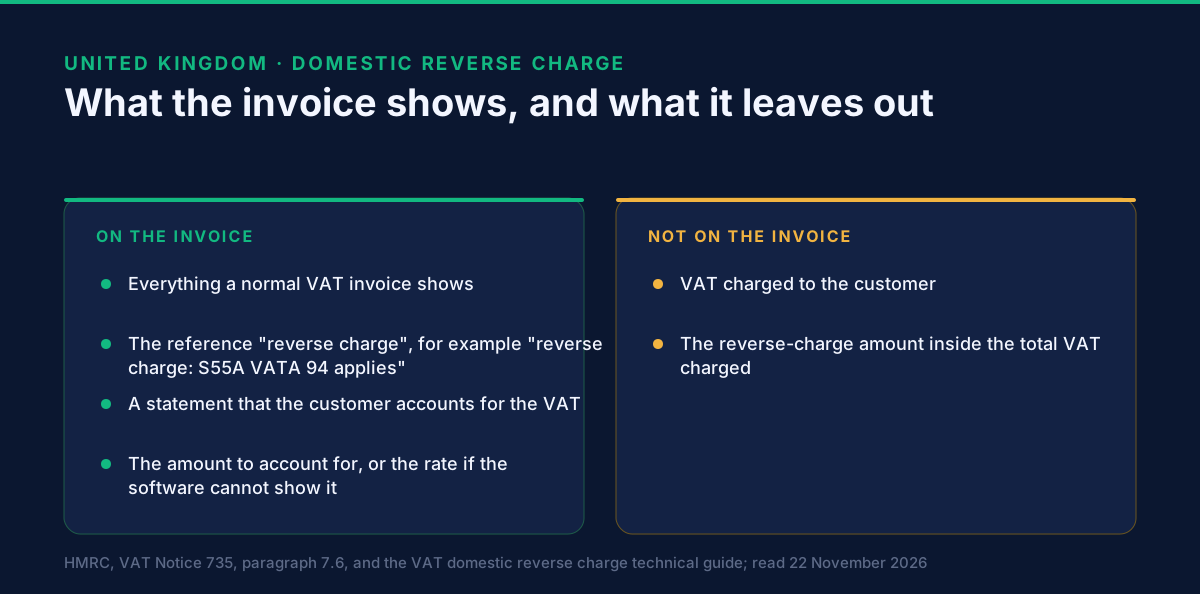
Under Notice 735 paragraph 7.6, you must:
- show all the information normally required on a VAT invoice, the list in UK VAT invoice requirements;
- include a reference that makes clear the reverse charge applies and the customer must account for the VAT;
- state the amount to be accounted for under the reverse charge clearly, without including it in the amount shown as total VAT charged.
If your invoicing system cannot show that amount, HMRC says the wording should state that VAT is to be accounted for by the customer at the standard rate, based on the VAT-exclusive selling price. The customer must be able to identify the reverse-charge items, and HMRC suggests a legend such as "customer to account to HMRC for the reverse charge output tax on the VAT-exclusive price of items marked reverse charge".
An illustration at the 20% standard rate: a sub-contractor invoices £10,000.00 for covered services. The invoice shows net £10,000.00, "reverse charge: S55A VATA 94 applies", reverse-charge VAT of £2,000.00 to be accounted for by the customer, total VAT charged £0.00, and £10,000.00 payable. The supplier puts the £10,000.00 in box 6 of its VAT Return and nothing in box 1, because the tax is the customer's.
How does a Peppol invoice carry the reverse charge?
Through the VAT category code AE, "Reverse charge". This mapping comes from release 3.0.21 of the Peppol BIS Billing 3.0 validation rules, which fail an invoice that breaks them.
| What the invoice must say | Peppol BIS element |
|---|---|
| A line under the reverse charge | BT-151 = AE, with a rate (BT-152) of zero, rule BR-AE-05 |
| The VAT breakdown for those lines | BT-118 = AE; taxable amount BT-116 is the sum of the AE lines (BR-AE-08); VAT amount BT-117 = 0 (BR-AE-09) |
| The reference "reverse charge" | BT-120 text, or BT-121 code, required by BR-AE-10 |
| Supplier and customer VAT numbers | BT-31 and BT-48 (BR-AE-02) |
| The reverse-charge VAT amount | No dedicated element that we found |
Three points follow. First, the zero VAT amount in the breakdown matches HMRC's instruction that the reverse-charge amount stays out of the VAT charged. Second, we found no element in the specification for the amount the customer will account for. Our reading is to state it in the BT-120 text, because Peppol allows only one note on a document (rule PEPPOL-EN16931-R002) and BT-120 is a field the rules already require you to fill. Third, Peppol's rule asks for the reason as the code VATEX-EU-AE or as the text "Reverse charge". We suggest writing HMRC's wording, beginning "Reverse charge", in BT-120, for example "Reverse charge: Customer to pay the VAT to HMRC. VAT to be accounted for: £2,000.00 at 20%".
HMRC's paragraph 7.6.2 allows electronic invoices that use a coded representation instead of text, if both parties agree and either can show the content to an HMRC auditor. A bare code is therefore possible by agreement. It is a weaker position than visible wording, and a customer's accounts team cannot read a code.
An invoice with category AE can only hold one AE breakdown (rule BR-AE-01), so lines at the standard rate go in their own breakdown on the same invoice. Many suppliers instead put reverse-charge supplies on a separate invoice. HMRC says so in its notice for mobile phones and computer chips, because it makes clear who accounts for the output tax.
GoRoute fills BT-121 with VATEX-EU-AE and BT-120 with "Reverse charge" when an invoice arrives with neither, and keeps anything your system sends. So send the full wording yourself.
What happens on a credit note?
The credit note carries the reference too, and shows the reduction the customer must account for. HMRC suggests "reverse charge: customer to account for the output tax adjustment of £[amount] to HMRC". The full rules are in UK VAT credit notes.
What to do next
Check your last three construction or specified-goods invoices: does each carry the reference, and does your software keep the reverse-charge amount out of the VAT total? Then check the Peppol output of one invoice against the table. If you sell to customers from outside the UK, the position differs, and invoicing UK customers from abroad covers it.
GoRoute is a certified Peppol Access Point (POP000991). You can test a reverse-charge invoice through the e-invoice sending service before a real customer sees it. The wider position is on the UK e-invoicing page, the tutorials show an invoice being sent, the developer documentation covers the API, and a 20-minute call will go through a real invoice with you. For a European comparison, read Finnish VAT invoice requirements, which sets out the same Peppol rules for a foreign seller.
GoRoute is a certified Peppol Access Point (POP000991). This is not tax or legal advice; confirm your position with your accountant.
Primary sources: HMRC, Domestic reverse charge procedure (Notice 735), paragraphs 3.1, 5, 6.1, 7.1, 7.4 to 7.7 and 10.4, read 22 November 2026; HMRC, VAT domestic reverse charge technical guide, last updated 18 September 2024, read 22 November 2026; HMRC, Check when you must use the VAT domestic reverse charge for building and construction services, last updated 24 September 2020; The Value Added Tax Regulations 1995, regulation 14; Peppol BIS Billing 3.0, validation rules release 3.0.21.
Frequently asked questions
- What must a UK reverse-charge invoice say?
- It must show everything a normal VAT invoice shows and include the reference "reverse charge", which regulation 14(1)(o) of the VAT Regulations 1995 requires. HMRC says it should also make clear that the customer must account for the VAT. Its accepted examples are "reverse charge: VAT Act 1994 Section 55A applies", "reverse charge: S55A VATA 94 applies" and "reverse charge: Customer to pay the VAT to HMRC".
- Does a reverse-charge invoice show a VAT amount?
- It shows the amount to be accounted for under the reverse charge, clearly stated, but that amount is not included in the total VAT charged. If the software cannot show the amount, HMRC says the wording should state that the customer accounts for VAT at the standard rate on the VAT-exclusive price of the items marked reverse charge.
- Which supplies does the UK domestic reverse charge cover?
- HMRC's Notice 735 lists mobile phones and computer chips, wholesale gas and electricity, emission allowances, wholesale telecommunications, renewable energy certificates and construction services. It applies between UK businesses where the customer is registered or liable to be registered for UK VAT and buys for business purposes. Mobile phones and computer chips only qualify at £5,000 or more on an invoice.
- Does the reverse charge apply to every construction invoice?
- No. HMRC says it applies to standard-rated and reduced-rated building and construction services that are reported within the Construction Industry Scheme, supplied to a VAT-registered business. It does not apply where the customer is an end user or intermediary supplier and has said so in writing, or to supplies by employment businesses.
- How does a Peppol invoice carry the UK reverse charge?
- With VAT category AE on the lines and in the VAT breakdown, a zero rate, a zero VAT amount in the breakdown, and an exemption reason in BT-120 or BT-121. The seller's VAT identifier and the buyer's VAT identifier are required. We suggest putting HMRC's wording in BT-120.
About Dr. Syed Raza
Dr. Syed Raza is an IT Enterprise Architect at ClayDesk LLC and leads the GoRoute platform. He works across Peppol Access Point and SMP infrastructure, PINT jurisdictions (Oman, AU/NZ, EU, JP, MY, SG), and national CTC regimes, translating regulatory detail into production-grade e-invoicing systems.
Building on Peppol?
GoRoute is a certified Peppol Access Point & SMP. Book a demo or read the docs to get started.