
HMRC's E-Invoicing Roadmap: What the UK Decided
The UK's e-invoicing roadmap of 28 October 2026: VAT e-invoices from 1 April 2029, Peppol as the core framework, and every date from Spring 2027 on.

What did the UK decide on 28 October 2026?
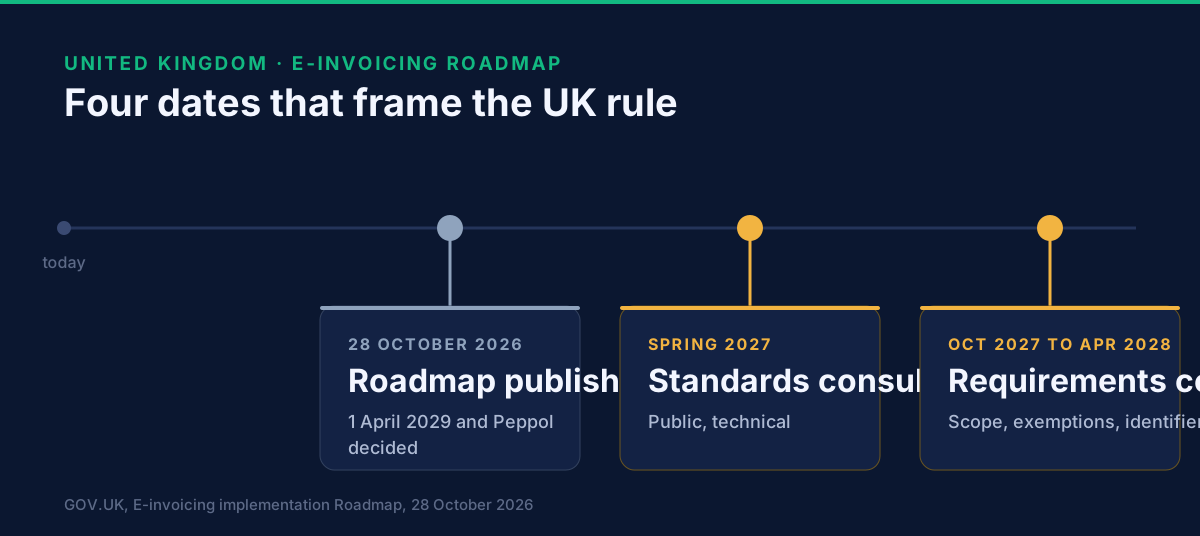
The UK government has confirmed that VAT invoices must be issued as e-invoices from 1 April 2029, that Peppol will be the core framework, and that HMRC will become the UK Peppol Authority. All three come from the e-invoicing implementation roadmap published on GOV.UK on 28 October 2026. The roadmap does not yet fix the detail. Scope, exemptions, standards and business identifiers are due between October 2027 and April 2028.
This page lists every milestone in date order and says what a UK finance or tax lead can sensibly do at each one. The legal start date and the consultation history are covered in UK e-invoicing 2029: the mandate, the consultation and Peppol. The summary for the country is on the UK e-invoicing page.
What has been decided, and what has not?
The roadmap draws the line itself. Its "at a glance" table says two things are already decided: the VAT e-invoicing requirement from 1 April 2029, and Peppol as the UK's core interoperability framework. Everything else is a plan to decide or publish by a stated date.
| Decided | Still to be decided |
|---|---|
| E-invoices required for VAT invoices from 1 April 2029 | The technical standards, after a public consultation |
| Peppol as the core interoperability framework | Whether UK-specific Peppol requirements are needed |
| HMRC becomes the UK Peppol Authority | The timing and detail of that transfer from NHS Supply Chain |
| VAT invoices are not required for sales to consumers, so those are outside the rule | Exact exemptions, including the process for digitally excluded businesses |
| Cross-border sales do not need an e-invoice, because no VAT invoice is required | Which business identifiers the UK will accept |
| No planned changes to the requirements after April 2028 | Penalties: the roadmap says it plans to use the existing VAT invoicing penalties framework as a basis |
Two further items are explicitly undecided. The government launched a consultation on digital reporting at Budget 2026, and the roadmap calls it "an early-stage, exploratory exercise" with no decision taken on whether e-invoicing digital reporting should be introduced. We keep that to one line here because nothing in it is settled.
What are the UK e-invoicing milestones, in date order?
The roadmap sorts its milestones into four types: decisions, publications, readiness steps and implementation. The dates below are the roadmap's own wording. Where it gives a season, we give the season rather than a day.
| When | What the roadmap says happens |
|---|---|
| 28 October 2026 | The roadmap is published. A consultation on e-invoicing digital reporting opens at Budget 2026. |
| Finance Bill 2026, law expected Spring 2027 | Primary legislation giving the government powers to require e-invoicing. The roadmap says it expects this to become law in Spring 2027, subject to Parliament. |
| Spring 2027 | Public technical consultation on the proposed UK e-invoicing standards, including Access Point certification requirements. |
| Autumn 2027 | Further guidance on legacy and EDI (Electronic Data Interchange) systems. |
| By the end of 2027 | Guidance for specific populations, such as those unable to use digital tools. |
| October 2027 to April 2028 | The government confirms the requirements: scope, exemptions, standards, guidance, business identifiers and software provider requirements. |
| By April 2028 | The process for applying for an exemption, the details of taxpayer obligations, and updated VAT guidance. |
| Spring 2028 | Software provider management requirements published. |
| April 2028 to April 2029 | Communications campaign; software providers and businesses prepare, test and onboard. |
| Summer 2028 | Readiness testing with software providers. |
| Autumn 2028 or early 2029 | Secondary legislation may complete. The roadmap says the formal process "may not be concluded until Autumn 2028 or early 2029". |
| Winter 2028 | Infrastructure and governance arrangements operational, so providers can finish onboarding and accreditation. |
| 1 April 2029 | VAT e-invoicing takes effect. Software providers are expected to have completed accreditation with the UK Peppol Authority. |
The roadmap also says the government intends to publish updated VAT guidance by April 2028 "even if this means publishing guidance pending secondary legislation being made". So businesses may see the rules in guidance before they see the final regulations.
What should a UK business do at each date?
The roadmap is blunt about timing: "There is no need to begin implementing e-invoicing before the detailed requirements are published." What follows is our reading of how to use the gaps. It is practical advice, not something the roadmap instructs.
Now to Spring 2027: learn what you have. The roadmap suggests examining current invoicing processes, making sure finance, tax, procurement and digital teams know the requirement is coming, talking to accountants, and researching software providers. A useful first job is a list of every system that issues or receives a VAT invoice. Many businesses find more than they expected. If your supplier sends you a PDF, that is not an e-invoice under the roadmap; see PDF, EDI or Peppol: what counts as a UK e-invoice.
Spring 2027: read the technical consultation if you build or run software. The government says the consultation is open to everyone but "largely" technical, and expects it to interest software providers most. A finance lead rarely needs to respond. It is worth asking your accounting software provider whether it will.
October 2027 to April 2028: check whether the rules include you. This is when scope and exemptions are confirmed. Our guide to who must e-invoice from 2029, and who is exempt separates what the roadmap already says from what it leaves open. If you use EDI today, the Autumn 2027 guidance will say how it sits alongside the new framework.
April 2028 onwards: choose and test. With the standards and provider requirements published, you can pick how you will connect. The roadmap expects most businesses to reach Peppol through an Access Point run by their existing software provider, and says many will not need separate software. It also expects free or low-cost products for smaller businesses. Larger organisations with ERP systems may want a bespoke integration. Test it before 2029 rather than on the day.
1 April 2029: issue and receive. Receiving matters as much as sending. The roadmap says VAT-registered persons "will need to be able to receive e-invoices from 1 April 2029".
What does Peppol mean for the UK?
The roadmap says the UK will adopt Peppol as its core interoperability framework, and that "organisations will typically access Peppol through an Access Point provided by their software provider". It adds that businesses will need a business identifier registered as part of their Peppol participant identity, and that the technical set-up will usually be handled by the provider.
Peppol is already used in the UK, particularly in the NHS. The roadmap says the UK Peppol Authority function currently sits within NHS Supply Chain, and that HMRC will take it on; timing and detailed governance are still to be worked out. What that changes for an NHS supplier, and when, is in HMRC becomes the UK Peppol Authority.
The roadmap is also clear that the UK has not yet decided whether it needs UK-specific requirements on top of the international Peppol rules. These would be set out by the Peppol Authority and cover areas such as identifiers, security, reporting and service levels. It says only that work is under way and that the government will consult. Treat any claim about a UK-specific invoice format as unconfirmed.
What does this mean for GoRoute customers?
GoRoute (POP000991) is a certified Peppol Access Point, and UK businesses can send Peppol invoices today from Sage, Xero, QuickBooks or a spreadsheet through the e-invoice sending service. That is available now and does not depend on the roadmap. It is not a statement that any product meets the UK requirements, because they have not been published. We will update this page when the Spring 2027 consultation opens.
If you want to talk through where your invoices come from and which route fits, book a short walkthrough. Recorded set-up guides are on the tutorials page, and the technical reference is in the developer documentation. For the wider picture of how GoRoute fits the network, see Peppol Access Point and SMP.
Sources: HMRC and the Department for Business and Trade, "E-invoicing implementation Roadmap", published 28 October 2026 (all dates and quotations). GOV.UK, "E-invoicing digital reporting" consultation. This is not tax or legal advice; confirm your position with your accountant.
Frequently asked questions
- When does e-invoicing become mandatory in the UK?
- On 1 April 2029. From that date VAT-registered persons, public bodies included, must issue VAT invoices as e-invoices and must be able to receive them, unless a specific exemption applies. The date comes from the government's e-invoicing implementation roadmap, published on 28 October 2026.
- When will the UK confirm the detailed e-invoicing requirements?
- Between October 2027 and April 2028. The roadmap says this covers scope, exemptions, standards, guidance, business identifiers and software provider requirements, and that it gives at least 12 months to prepare. The government does not plan to change the requirements after April 2028.
- Does the UK use Peppol for e-invoicing?
- Yes. The roadmap says the UK will adopt Peppol as its core interoperability framework, and that HMRC will become the UK Peppol Authority. Businesses will typically reach the network through an Access Point run by their software provider.
- Do UK businesses need to do anything before 2027?
- The roadmap says there is no need to begin implementing before the detailed requirements are published. It suggests examining current invoicing processes, making finance, tax, procurement and digital teams aware, speaking to accountants or advisers, and starting to research software providers.
About Dr. Syed Raza
Dr. Syed Raza is an IT Enterprise Architect at ClayDesk LLC and leads the GoRoute platform. He works across Peppol Access Point and SMP infrastructure, PINT jurisdictions (Oman, AU/NZ, EU, JP, MY, SG), and national CTC regimes, translating regulatory detail into production-grade e-invoicing systems.
Building on Peppol?
GoRoute is a certified Peppol Access Point & SMP. Book a demo or read the docs to get started.