
PDF, EDI or Peppol: What Counts as a UK E-Invoice
Is a PDF an e-invoice in the UK? The government's roadmap says no. What counts under the 2029 rule, where EDI stands, and how Peppol invoices differ.

Is a PDF an e-invoice in the UK?
No. The UK government's e-invoicing roadmap, published on 28 October 2026, says a PDF is not an e-invoice. It defines e-invoicing as "the digital exchange of invoice data directly between buyers' and suppliers' financial systems" and adds that invoices shared as digital files, but not as structured data, are not classed as e-invoices. Its list of formats that do not count is PDF, word-processed documents, image files such as JPEG, HTML invoices on a web page or email, and images sent by fax.
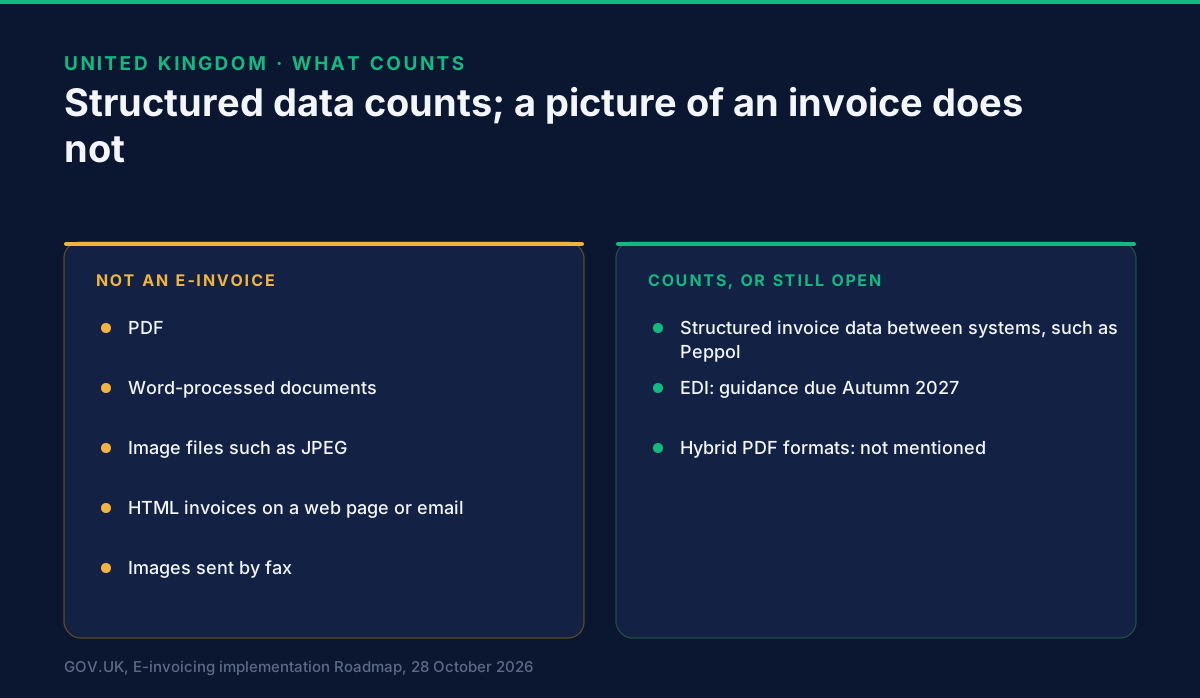
This matters because many UK suppliers believe they already send e-invoices. If your invoices go out as a PDF attached to an email, you do not, in the sense the 2029 rule uses. This page sets out what does count, where EDI sits, and what a structured invoice contains that a PDF lacks. The dates are in HMRC's e-invoicing roadmap: what the UK decided.
Can I keep sending PDFs until 2029?
Yes. The roadmap is clear that nothing changes today. Its legislation annex says the VAT Regulations 1995 already allow VAT invoices to be sent electronically, and that HMRC's current guidance is technology neutral: businesses "can use PDFs, EDI systems, structured invoice formats, or other electronic methods", provided the legal requirements are met. Those requirements are proving authenticity of origin, integrity of content and legibility, and having the customer's approval to receive invoices electronically.
The roadmap sums it up: electronic invoices "are already permitted, but only as an option for businesses". The change is that from 1 April 2029, the VAT invoice itself must be an e-invoice, unless an exemption applies. Who that covers is in who must e-invoice in the UK from 2029, and who is exempt.
What is the difference between a PDF and a structured invoice?
A PDF is a picture of an invoice. A person can read it, and software can only read it by guessing. A structured invoice is a data file in which every item has a label: this is the seller's VAT number, this is line 3's quantity, this is the VAT category and rate, this is the payment due date. The buyer's system reads the labels and posts the invoice without anyone retyping it.
| PDF invoice | Structured e-invoice | |
|---|---|---|
| What the buyer's system receives | A document to read | Labelled data to process |
| Who types it into the ledger | Usually a person, or an optical-reading tool that guesses | Nobody; the system reads the fields |
| Can it be checked against rules before sending | Only by a person | Yes, automatically, before it leaves |
| Counts under the 2029 rule | No | Yes, once the standards are set |
| Errors | Found when someone reads it | Rejected before delivery, or flagged on receipt |
The roadmap gives the reason for the change. It says invoices handled through manual processes involve "re-keying of data", which increases "the risk of inconsistencies, processing delays, avoidable errors and certain forms of invoice fraud, such as the interception and alteration of invoice details". A structured invoice sent over a network between systems is harder to alter on the way.
For an introduction to how the file travels, see how does e-invoicing work. For the errors a validator catches before sending, see invoice validation errors you can prevent.
What does the 2019 public sector definition say?
The UK already has a legal definition for one group of buyers. The Public Procurement (Electronic Invoices etc.) Regulations 2019 require a contracting authority to accept and process an electronic invoice under the contracts it awards. They define an electronic invoice as "an invoice which has been issued, transmitted and received in a structured electronic format which allows for its automatic and electronic processing".
The regulations add that the invoice must comply with the European standard on electronic invoicing and with one of the syntaxes published in Commission Implementing Decision (EU) 2017/1870, as amended. In practice those syntaxes are UBL and UN/CEFACT CII, the two file formats used by Peppol BIS Billing 3.0.
The regulations came into force on 18 April 2019, with regulation 5 following a year later. They apply to public procurement, not to ordinary business-to-business VAT invoices, so they are an older and narrower rule than the 2029 requirement. The two definitions are close. We have not seen the 2029 definition published in legislation yet, because the standards are still to be consulted on and confirmed. Read the 2019 text as a guide to the direction, not as the 2029 rule.
Where does EDI fit?
Electronic Data Interchange (EDI) is an older way of exchanging invoice and order data between systems, which the roadmap says is used across a range of sectors. It is structured, so it is closer to an e-invoice than a PDF is. The roadmap's problem with it is not that it is electronic. It says many EDI set-ups "rely on bespoke connections and sector-specific standards agreed between trading partners", so a business can need a separate arrangement with each customer.
The government's stated intention is that "businesses can continue using these arrangements alongside the future UK e-invoicing framework", but that businesses using them "will also need to be capable of exchanging e-invoices through the future framework". It says further policy, technical and implementation work will decide how this operates, and that it will publish guidance in Autumn 2027.
So we cannot yet say whether an existing EDI invoice will count as an e-invoice in 2029. The roadmap does not say. If you run EDI, the sensible plan is to wait for the Autumn 2027 guidance and keep your existing set-up until then. If a large customer is moving suppliers to Peppol, ask them what they want.
What about PDF with data inside it?
Some hybrid formats embed structured data inside a PDF, for example ZUGFeRD and Factur-X in Germany and France. The roadmap does not mention them. Whether such a file would count in the UK depends on standards the government has not yet published, so we do not claim either way.
What does a Peppol invoice look like?
A Peppol invoice is a structured file in UBL, built to the Peppol BIS Billing 3.0 specification and checked against its rules before it leaves. It travels between two certified Access Points, so the seller's system and the buyer's system do not need a direct connection. The roadmap says the UK will adopt Peppol as its core interoperability framework, and the UK summary is on the UK e-invoicing page.
The roadmap also leaves open whether the UK will add its own requirements on top of the international rules. Until it publishes them, a UK Peppol invoice today is the standard Peppol BIS Billing 3.0 invoice. A guide to the network itself is in what a Peppol Access Point is.
How do I start, without changing my accounting system?
You do not have to replace your accounting package. GoRoute takes invoice data from Sage, Xero, QuickBooks, an API or a spreadsheet, converts it to a Peppol invoice, validates it and delivers it. That is the e-invoice sending service, and it works today. It is not a statement that any product meets UK requirements that have not been published.
To check whether your invoices would pass, book a short walkthrough with a sample. Recorded guides are on the tutorials page, and the technical reference is in the developer documentation. If you supply the NHS or want to know who runs Peppol in the UK, read HMRC becomes the UK Peppol Authority.
Sources: HMRC and the Department for Business and Trade, "E-invoicing implementation Roadmap", published 28 October 2026 (background, legislation annex, EDI chapter). The Public Procurement (Electronic Invoices etc.) Regulations 2019, SI 2019/624. This is not tax or legal advice; confirm your position with your accountant.
Frequently asked questions
- Is a PDF invoice an e-invoice in the UK?
- No. The government's roadmap of 28 October 2026 says invoices shared as digital files but not as structured data are not e-invoices, and lists PDF, word-processed documents, image files such as JPEG, HTML invoices on a web page or email, and faxed images as examples that do not count.
- Does EDI count as e-invoicing in the UK?
- EDI exchanges invoice data electronically, so it is closer to an e-invoice than a PDF. The roadmap says businesses can keep EDI alongside the new framework but must also be able to exchange e-invoices through it. Detailed guidance on EDI is due in Autumn 2027.
- What is a structured e-invoice?
- An invoice whose content is held as labelled data fields that software can read and process automatically, rather than as a picture or document a person has to read. The UK's 2019 procurement regulations define an electronic invoice as one issued, transmitted and received in a structured electronic format that allows automatic and electronic processing.
- Can I keep sending PDF invoices until 2029?
- Yes. The roadmap says current VAT rules allow electronic invoices, including PDFs, provided authenticity of origin, integrity of content and legibility can be shown, and the customer has agreed to receive them electronically. The e-invoice requirement for VAT invoices starts on 1 April 2029.
About Dr. Syed Raza
Dr. Syed Raza is an IT Enterprise Architect at ClayDesk LLC and leads the GoRoute platform. He works across Peppol Access Point and SMP infrastructure, PINT jurisdictions (Oman, AU/NZ, EU, JP, MY, SG), and national CTC regimes, translating regulatory detail into production-grade e-invoicing systems.
Building on Peppol?
GoRoute is a certified Peppol Access Point & SMP. Book a demo or read the docs to get started.