
Invoicing UK Customers From Abroad: VAT Registration and the Invoice
When a business outside the UK must register for UK VAT, when its UK business customer accounts for the VAT instead, and what the invoice shows in each case.

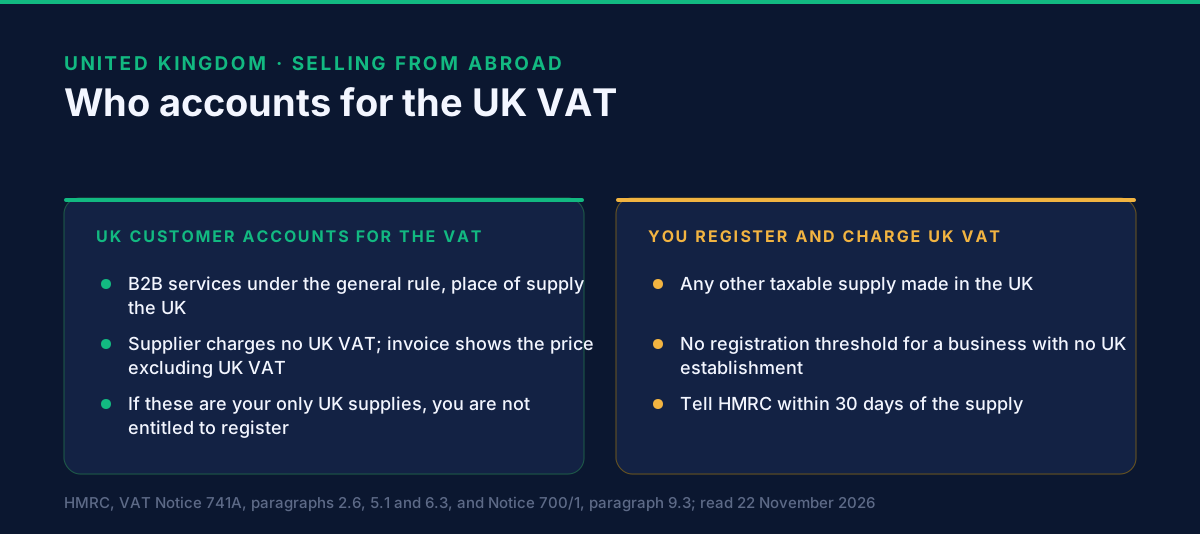
A business outside the UK must register for UK VAT if it makes any taxable supply in the UK, whatever the value, because HMRC applies no registration threshold to a business with no UK establishment. The common exception is the business-to-business service. For most of those, the place of supply is where the customer belongs, so the UK customer accounts for the VAT under the reverse charge and the overseas supplier charges no UK VAT. This page sets out the two cases, what the invoice carries in each, and how it travels as a Peppol invoice.
It is about invoicing. It does not cover customs declarations or import VAT. Goods moving to or from Northern Ireland follow different rules, which HMRC sets out in separate notices. It is not tax advice, and whether a given sale is taxed in the UK is a question for your adviser.
Does an overseas business need to register for UK VAT?
If it makes taxable supplies in the UK, yes. HMRC's Notice 700/1 says a non-established taxable person (NETP) must register if it makes any taxable sales in the UK, or expects to in the next 30 days, and must tell HMRC within 30 days of the date of the supply. A taxable sale is any transaction made in the UK that is not exempt from VAT. If all its UK sales are exempt, it cannot register.
An NETP may not need to be registered in two cases that matter here. All its UK sales may be zero-rated. Or all its sales to the UK may be to VAT-registered businesses in Great Britain that account for the VAT under the reverse charge. HMRC's services notice goes further: if you make only supplies of services in the UK to which the reverse charge applies, you are not entitled to register.
Who counts as established in the UK?
HMRC defines an NETP as any person without a UK establishment. An establishment exists if either of these is true:
- the place where essential management decisions are made and the central administration is carried out is in the UK;
- the business has a permanent physical presence with the human and technical resources to make or receive taxable supplies in the UK.
A company incorporated in the UK is normally treated as established if it can also make or receive business supplies at its registered address. A registered, serviced or virtual office on its own is not enough to create an establishment.
When does the UK customer account for the VAT?
For business-to-business services under the general rule. HMRC's Notice 741A says the B2B general rule for services is that the supply is made where the customer belongs. The reverse charge then applies where the place of supply is the UK, the supplier belongs outside the UK, the customer belongs in the UK, and the supply is not exempt. HMRC's examples include legal services from a French business and customised software from a US business.
For the customer it is simple bookkeeping. The notice says the customer credits its VAT account with output tax on the full value of the supply and debits the same amount as input tax, if it is entitled to. The amount you charge excludes UK VAT.
Three limits apply. The general rule needs business evidence: HMRC says to obtain commercial evidence that the customer is in business, and where a customer cannot show a VAT number or other evidence, the supply is treated as a business-to-consumer one. For consumer sales, the general rule is that the place of supply is where the supplier belongs. Some services have their own rules, such as those related to land and the hire of means of transport, which Notice 741A covers in sections 7 and 8. And if you belong abroad but issue a VAT invoice on a UK VAT registration, HMRC says the UK customer must still apply the reverse charge, because it is not optional, and should ask you to correct the invoice.
What does the invoice show when the customer accounts for the VAT?
The HMRC texts we read set no wording for an overseas supplier that is not registered for UK VAT, so the following is practice rather than a rule. Our advice is to show:
- a description of the service that says what it is. HMRC says invoices should avoid general or generic descriptions;
- the amount payable, with a statement that it excludes UK VAT;
- the customer's UK VAT number, which is also your evidence that it is a business;
- if you like, a note that the customer accounts for the VAT.
If you are registered for UK VAT as an NETP, the position is different. You are issuing VAT invoices, and they must carry everything on the list in UK VAT invoice requirements, including your UK VAT number, and the name and address you are registered under. HMRC registers an NETP at its principal place of business, which must be outside the UK and must not be a mail-forwarding or registered-office address. It may also direct you to appoint a UK VAT representative or to pay a security. If a supply is subject to the reverse charge, a registered supplier's invoice also needs the reference "reverse charge", covered in UK reverse-charge invoices.
How does the invoice travel as a Peppol invoice?
Peppol is cross-border, so a Peppol BIS Billing 3.0 invoice can go from an overseas access point to a UK buyer's. Three elements need care. The buyer's VAT number goes in BT-48. The seller's identifier goes in BT-31 or BT-32. And the VAT category must match the case.
On our reading of the Peppol rules, release 3.0.21, there are two distinct codings, and they pull in opposite directions. Category AE, "Reverse charge", requires both the seller's identifier and the buyer's VAT identifier or legal registration identifier (rule BR-AE-02). Category O, "Not subject to VAT", forbids the seller's VAT identifier, the seller tax representative's and the buyer's VAT identifier (rule BR-O-02). Which one fits your supply is a question for your adviser, because it depends on how you treat the supply. We name it so that a rejection is not a surprise. GoRoute checks these rules before an invoice is sent, so a wrong combination fails at your end rather than in the buyer's inbox.
If you convert prices, remember the sterling rule applies only to UK VAT: HMRC says a VAT invoice in a foreign currency must show the VAT total in sterling, which Peppol carries in BT-6 and BT-111. If you charge no UK VAT, there is no such total.
Is the UK customer reachable on Peppol?
Not necessarily today. The UK requirement begins on 1 April 2029, and until then it depends on the customer. The roadmap's position on overseas sellers is summarised in who must e-invoice in the UK, and who is exempt. In short, a business registered for UK VAT follows the same rules as a UK one for UK-to-UK supplies. For cross-border sales the roadmap says e-invoices will not be required, though one may be issued by agreement with the customer.
What to do next
Sort your UK sales into two piles: business services where the customer accounts for the VAT, and everything else. Ask your adviser about the second pile before the first invoice goes out, because registration runs from the first taxable supply. Then agree with each UK customer how it wants to receive invoices.
GoRoute is a certified Peppol Access Point (POP000991), and its e-invoice sending service delivers invoices to buyers by their Peppol identifier. The UK e-invoicing page has the position on 2029, the tutorials show an invoice being sent, the API is in the developer documentation, and you can book a call to look up a UK customer with us. If you also need to credit an invoice, read UK VAT credit notes. A similar page for another country is invoicing Swiss customers from abroad.
GoRoute is a certified Peppol Access Point (POP000991). This is not tax or legal advice; confirm your position with your accountant.
Primary sources: HMRC, Who should register for VAT (Notice 700/1), paragraphs 4.2, 9.1 to 9.4, read 22 November 2026; HMRC, Place of supply of services (Notice 741A), paragraphs 2.3, 2.6, 5.1 to 5.6, 5.17 and 6.2 to 6.3, last updated 29 September 2022, read 22 November 2026; HMRC, VAT guide (Notice 700), paragraph 16.4; Peppol BIS Billing 3.0, validation rules release 3.0.21.
Frequently asked questions
- Does a business outside the UK need to register for UK VAT to invoice a UK customer?
- It depends on the supply. HMRC says a non-established taxable person must register if it makes any taxable supplies in the UK, whatever their value, with no threshold. It does not need to register if all its sales to the UK are to VAT-registered businesses in Great Britain that account for the VAT under the reverse charge. If it makes only reverse-charge supplies of services in the UK, it is not entitled to register.
- Do I charge UK VAT to a UK business if I am based abroad?
- For most business-to-business services, no. The place of supply is where the customer belongs, so the UK customer accounts for the VAT under the reverse charge, and the amount you charge excludes UK VAT. Other supplies, such as services related to UK land, follow special rules in HMRC's Notice 741A.
- What is a non-established taxable person?
- HMRC defines it as any person who does not have a UK establishment. An establishment exists where essential management decisions are made and central administration is carried out in the UK, or where the business has a permanent physical presence with the people and technical resources to make or receive taxable supplies. A registered, serviced or virtual office alone is not enough.
- What does an invoice to a UK business customer show when the customer accounts for the VAT?
- The HMRC texts we read set no wording for a supplier that is not UK VAT-registered. The invoice should describe the service clearly rather than generically, show the amount payable excluding UK VAT, and carry the customer's UK VAT number as evidence of its business status. A note that the customer accounts for the VAT is our recommendation, not an HMRC requirement.
- Can I send a Peppol invoice to a UK customer from outside the UK?
- Yes, Peppol is cross-border by design, and the buyer is looked up by its Peppol identifier. Whether the UK customer is reachable on Peppol today is a question to settle per customer, because the UK mandate starts on 1 April 2029.
About Dr. Syed Raza
Dr. Syed Raza is an IT Enterprise Architect at ClayDesk LLC and leads the GoRoute platform. He works across Peppol Access Point and SMP infrastructure, PINT jurisdictions (Oman, AU/NZ, EU, JP, MY, SG), and national CTC regimes, translating regulatory detail into production-grade e-invoicing systems.
Building on Peppol?
GoRoute is a certified Peppol Access Point & SMP. Book a demo or read the docs to get started.