
MCP for E-Invoicing: Letting AI Agents Send Invoices Safely
How to let AI agents send e-invoices safely over MCP: sign in as the user, mark every tool that acts, keep a human approval and validate on the server.

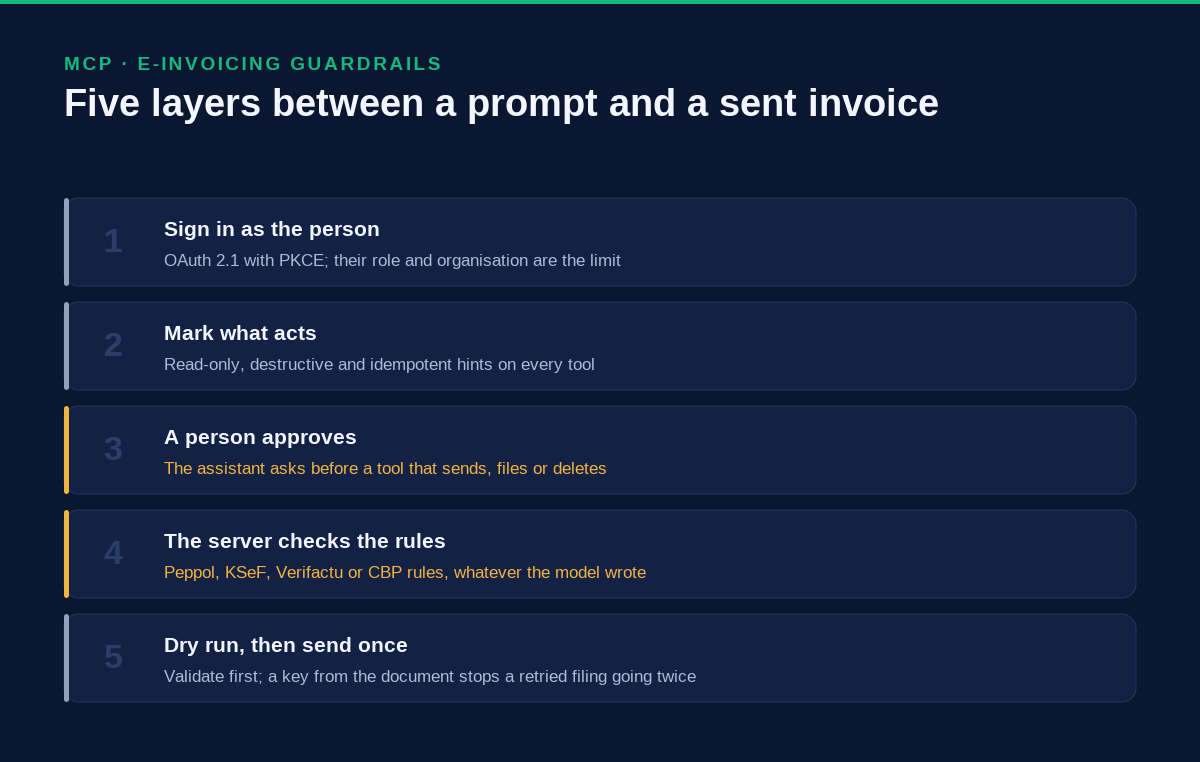
To let AI agents send e-invoices safely over MCP, the agent must act as a signed-in person with that person's limits, every tool that sends or changes data must say so, the person must approve each send, and the server must check every document against the official rules itself. Add a dry run and idempotency, and a model's mistake becomes a refusal, not a sent invoice.
This article is for engineering and finance-systems teams that are building or approving MCP connections to invoicing systems. It describes the design GoRoute uses for its ChatGPT, Claude and Copilot connectors, and why each layer is there. The Model Context Protocol is the open standard these assistants use to call tools on other systems.
Why is invoicing different from other agent tasks?
Because a sent invoice is a legal document that cannot be unsent. A summary that is wrong can be regenerated. An e-invoice delivered over Peppol, or cleared by a tax authority such as Poland's KSeF, is on record: it is corrected with a credit note or a correcting invoice, not deleted. So the design aims to catch mistakes before the send, and to make every send deliberate.
Layer 1: who is the agent acting as?
The signed-in person, never a shared service account. GoRoute's MCP server uses OAuth 2.1 with PKCE: the person signs in with their own GoRoute login and approves the connection. Every tool call then runs with that person's role, in their own organisation. A viewer cannot send; nobody reaches another organisation's data. Things that would outlive the connection or move money, such as API keys and payments, are not offered at all.
Layer 2: does each tool say what it does?
Yes: every tool carries hints. The MCP specification defines annotations such as read-only, destructive and idempotent. GoRoute marks lookups and listings as read-only, and sends, filings and deletions as acting on the world. The specification is careful here: clients MUST consider tool annotations to be untrusted unless they come from trusted servers. That is why the hints are only one layer.
Layer 3: who approves the send?
The person, every time. The MCP specification says there SHOULD always be a human in the loop with the ability to deny tool invocations. ChatGPT, Claude and Copilot ask before running a tool that acts; GoRoute's server instructions also tell the assistant to validate, show the person a summary, and send only on a clear yes. For tools that send invoices, keep the assistant's setting on "ask", not "always allow".
Layer 4: who checks the document?
The server, against the official rules. A model can map a field wrongly or add up a total wrongly. GoRoute validates every document against the rules of its network or authority (Peppol BIS Billing, PINT, KSeF FA(3), Verifactu, CBP's ISF format) and recalculates totals from the lines. A document that fails is refused with the reasons, which the assistant shows the person to fix. The checks are the same ones described in invoice validation errors you can prevent. The model's output is an input, never the last word.
Layer 5: what if the agent retries?
It must not send twice. Agents retry: a timeout, a dropped connection, a repeated instruction. GoRoute's KSeF and ISF tools derive an idempotency key from the document itself, so a retried call returns the first result instead of filing again, and the GoRoute API accepts an Idempotency-Key header on every send. Validation tools are dry runs: validate_invoice and isf_validate check everything and send nothing, so the person can see exactly what will go before it goes.
What about generic API tools?
Keep them out of public listings. A tool that can call any endpoint makes every other guardrail harder to reason about. GoRoute's full connector, used in Claude and Copilot, includes general API tools for power users inside their own account. The ChatGPT and KSeF profiles, which are listed in public directories, carry only named, purpose-built tools. Each one does a single thing and has its own description and annotations.
What to do next
- See it working: send a Peppol e-invoice from ChatGPT or connect Claude.
- Read the security posture on the trust page: ISO 27001 and ISO 22301 certified.
- Building your own agent? Start from the developer documentation, or book a technical call.
Related reading
- GoRoute brings production e-invoicing into AI workflows
- File a U.S. ISF with your AI assistant
- How to connect Claude to Peppol e-invoicing
Sources, read on 26 November 2026: Model Context Protocol specification 2025-11-25, Tools and Authorization; GoRoute, Claude and other AI apps (MCP).
Frequently asked questions
- Is it safe to let an AI agent send invoices?
- It can be, if the agent acts as a signed-in person with that person's limits, the person approves each send, and the server checks every document against the official rules itself. The model should never be the last check.
- What are MCP tool annotations?
- Hints a server attaches to each tool, such as read-only, destructive or idempotent, so the assistant can decide when to ask the person first. The MCP specification says clients must treat them as untrusted unless the server is trusted.
- Who checks that the invoice is correct?
- The server. GoRoute validates every document against the network or authority rules before it sends, and recalculates the totals; a model's arithmetic or field mapping is never trusted on its own.
- What stops an agent sending the same invoice twice?
- Idempotency. GoRoute's KSeF and ISF tools derive a key from the document itself, so a retried call returns the first result instead of filing again; the GoRoute API accepts an Idempotency-Key header on every send.
- Should an MCP server offer a generic API tool?
- Keep generic executors out of public directory listings. GoRoute's ChatGPT and KSeF profiles carry only named, purpose-built tools, each with its own description and annotations.
About Dr. Syed Raza
Dr. Syed Raza is an IT Enterprise Architect at ClayDesk LLC and leads the GoRoute platform. He works across Peppol Access Point and SMP infrastructure, PINT jurisdictions (Oman, AU/NZ, EU, JP, MY, SG), and national CTC regimes, translating regulatory detail into production-grade e-invoicing systems.
Building on Peppol?
GoRoute is a certified Peppol Access Point & SMP. Book a demo or read the docs to get started.