
File a U.S. ISF (10+2) With Your AI Assistant
How to file a U.S. Importer Security Filing (ISF 10+2) from ChatGPT or Claude: share the documents, check the dry run, approve, and GoRoute files it with CBP.

To file a U.S. Importer Security Filing (ISF, also called 10+2) with your AI assistant, connect GoRoute to ChatGPT or Claude, share the shipment's bill of lading, commercial invoice and packing list, answer any questions, check the dry run, and approve. GoRoute then transmits the ISF to U.S. Customs and Border Protection and reports CBP's status back to you.
This guide is for importers, freight forwarders and the small teams that handle U.S.-bound ocean shipments. The ISF must reach CBP no later than 24 hours before the cargo is laden aboard the vessel at the foreign port, under 19 CFR 149.2. CBP's own overview is on its Importer Security Filing page.
What does the assistant need from you?
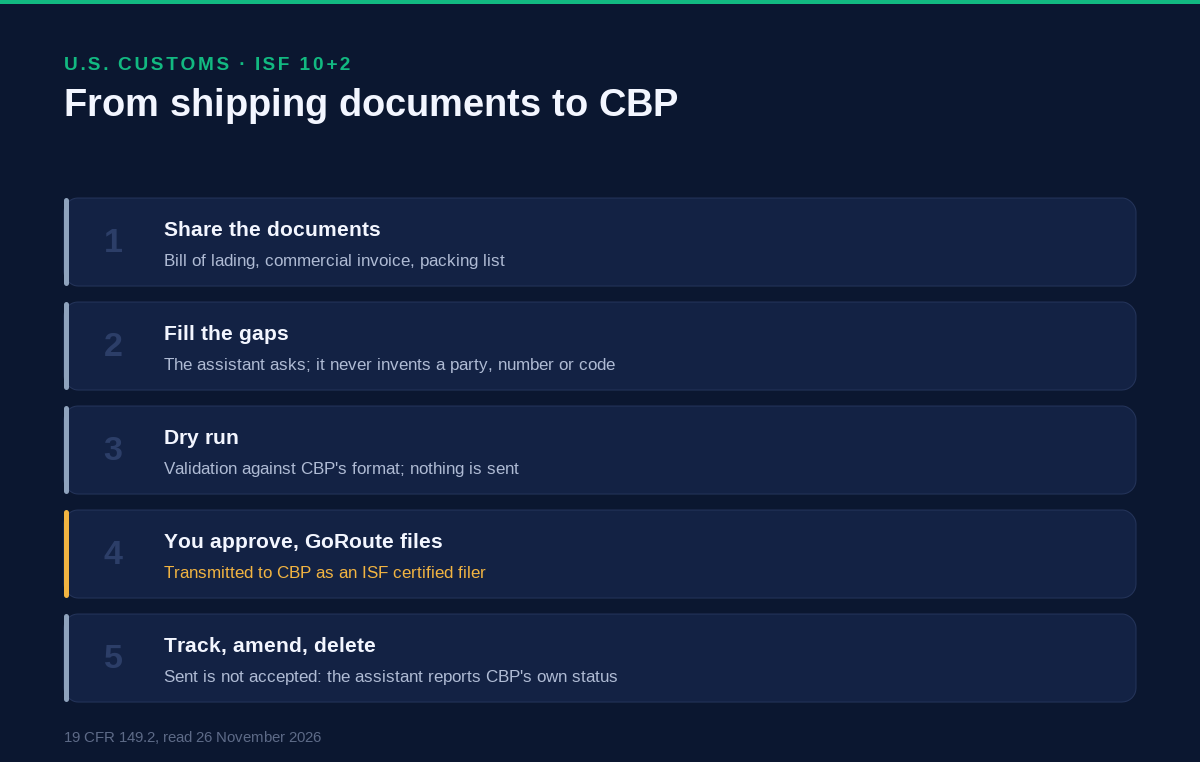
The documents you already have. The bill of lading, commercial invoice and packing list usually give the seller, buyer, manufacturer, ship-to party, the goods and their HTS codes, the container stuffing location and the consolidator. The assistant reads them and asks for anything missing. It never invents a name, address, number or code, and for HTS codes it offers the closest tariff lines for you to choose.
How does approval work?
Nothing is filed without your clear yes. The assistant first runs a dry run against CBP's format, which sends nothing. It shows you a short summary and the filing deadline. Only then, and only if you say yes, does it file. An amendment or a deletion works the same way: you see what changes, then approve.
What happens after filing?
GoRoute reports what CBP says, not what it hopes. "Sent" is not "accepted": the assistant tells you CBP's own response for the filing. If the shipment changes, for example a different container or a new HTS line, ask the assistant to amend the ISF; if the shipment is cancelled, ask it to delete the filing.
What does GoRoute not do?
Broker the entry or calculate duty. GoRoute files the Importer Security Filing only, as a CBP-certified ISF filer. It is not a customs broker and calculates no duty. Customs entry and duty stay with your broker.
What does it cost?
There is a free allowance, then pay per filing or a plan. The details are on the U.S. customs filing page. The assistant checks your allowance before filing and tells you if you are near the limit.
What to do next
- Read the overview on the U.S. customs filing page.
- Connect your assistant: ChatGPT or Claude.
- Filing many shipments? Book a demo to talk about volumes and API access.
Related reading
- GoRoute brings production e-invoicing into AI workflows
- MCP for e-invoicing: letting AI agents send invoices safely
Sources, read on 26 November 2026: eCFR, 19 CFR 149.2, time and manner of submission; U.S. Customs and Border Protection, Importer Security Filing.
Frequently asked questions
- When must an ISF be filed?
- No later than 24 hours before the cargo is laden aboard the vessel at the foreign port, for ocean shipments bound for the United States (19 CFR 149.2).
- Can ChatGPT or Claude file an ISF?
- With GoRoute connected, yes. The assistant reads your shipping documents and prepares the filing; GoRoute validates it and, after your approval, transmits it to U.S. Customs and Border Protection.
- Is GoRoute a customs broker?
- No. GoRoute files the Importer Security Filing only. It is not a customs broker and calculates no duty.
- What documents do I need?
- Usually the bill of lading, the commercial invoice and the packing list. Between them they give the parties, the goods, the HTS codes and the shipment details; the assistant asks for whatever is missing.
- Can I change an ISF after filing?
- Yes. Ask the assistant to amend or delete it; it shows you what changes and asks for your yes before it sends the update.
About Dr. Syed Raza
Dr. Syed Raza is an IT Enterprise Architect at ClayDesk LLC and leads the GoRoute platform. He works across Peppol Access Point and SMP infrastructure, PINT jurisdictions (Oman, AU/NZ, EU, JP, MY, SG), and national CTC regimes, translating regulatory detail into production-grade e-invoicing systems.
Building on Peppol?
GoRoute is a certified Peppol Access Point & SMP. Book a demo or read the docs to get started.