
Reverse-Charge Invoices in Germany: Section 13b and the Wording
When section 13b UStG makes the buyer owe the VAT, the wording a German invoice must carry under section 14a(5), and how an e-invoice codes it as AE.

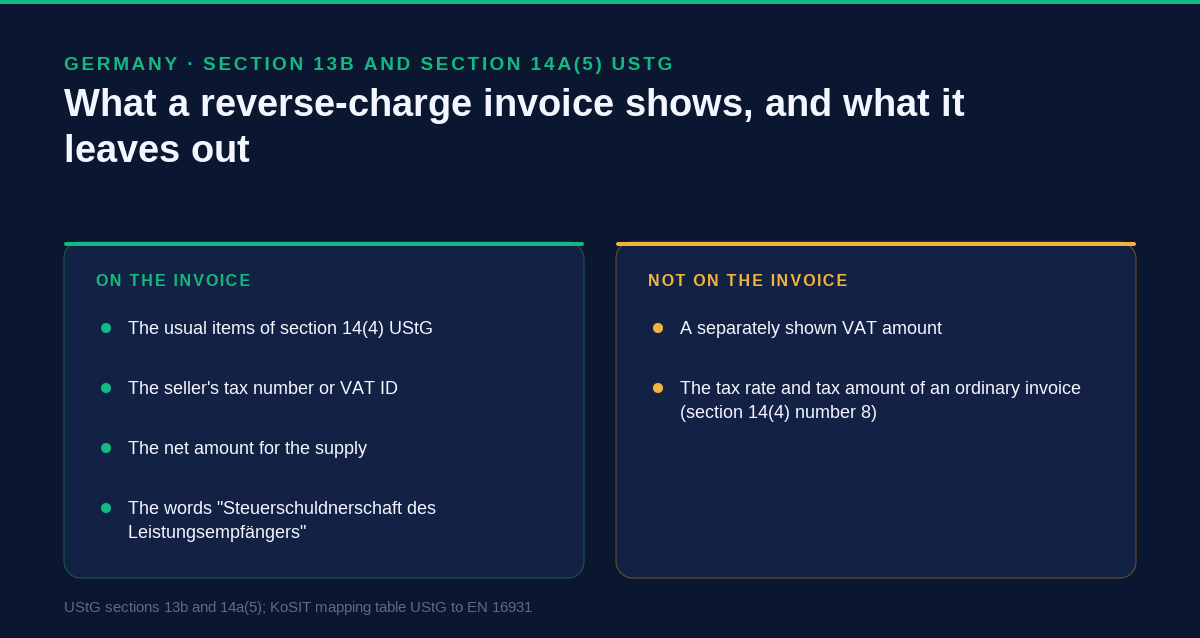
A German reverse-charge invoice must carry the words "Steuerschuldnerschaft des Leistungsempfängers", meaning that the recipient owes the VAT, and it shows no separate VAT amount. Section 14a(5) of the VAT act (Umsatzsteuergesetz, UStG) requires the words where a supplier makes one of the supplies listed in section 13b(2) and the recipient owes the tax under section 13b(5). In an e-invoice the supply is coded with VAT category AE, and the words go in the exemption text field.
This page is for the bookkeeper who has to decide whether an invoice falls under the reverse charge and what to write on it. It covers supplies between businesses in Germany and the supplies of a supplier established abroad to a German recipient. It does not cover cross-border services within the EU under section 3a. It is not tax advice, and whether section 13b applies to a particular job is for you and your adviser. GoRoute is a certified Peppol Access Point and SMP (POP000991).
When does the buyer owe the VAT instead of the seller?
When the supply is on the list in section 13b(2) and the buyer meets the condition in section 13b(5). Normally the seller owes the VAT on a supply. Section 13b moves that duty to the recipient for a list of supplies, and the tax arises when the invoice is issued, at the latest at the end of the calendar month after the supply (section 13b(2)).
The list in section 13b(2) has twelve numbered groups. The table gives our short English description. The statute is more detailed, and some groups depend on lists in annexes that we did not read.
| No. | Supply | Condition on the recipient (section 13b(5)) |
|---|---|---|
| 1 | Work supplies and other services by a supplier established abroad | A business or a legal person |
| 2 | Supply of security-transferred goods outside insolvency | A business or a legal person |
| 3 | Transactions under the real estate transfer tax act | A business or a legal person |
| 4 | Construction services, including work supplies and services connected with land that build, repair, maintain, change or remove buildings, except planning and supervision | A business that itself regularly supplies such services; presumed with a tax office certificate |
| 5 | Gas through the gas network and electricity, in certain reseller cases | A reseller, as defined in section 3g |
| 6 | Emission allowances and gas and electricity certificates | A business |
| 7 | Goods listed in annex 3 | A business |
| 8 | Cleaning of buildings and parts of buildings | A business that itself regularly supplies such cleaning; presumed with a certificate |
| 9 | Gold in raw form or semi-finished | A business |
| 10 | Mobile phones, tablets, game consoles and integrated circuits, from EUR 5,000 per economic transaction | A business |
| 11 | Goods listed in annex 4, from EUR 5,000 per economic transaction | A business |
| 12 | Telecommunications services | A business whose main activity is supplying such services and whose own use is minor |
Three points the table cannot show:
- Public bodies. Under section 13b(5) the last sentence, a public-law body does not owe the tax on groups 4, 5b and 7 to 12 if it buys the supply for its non-business sphere.
- Construction and cleaning. The recipient must itself supply such services regularly. The statute presumes this where the tax office issued a certificate that was valid on the date of supply and is limited to three years. A certificate is the easiest way to know.
- Mistakes. In doubtful cases for groups 4, 5b and 6 to 12, if seller and buyer both assumed the conditions were met although objective criteria say otherwise, the buyer is still treated as the debtor, provided no tax is lost.
Not covered by the reverse charge are the cases listed in section 13b(6), such as taxed passenger transport and tickets for trade fairs.
What must the invoice say?
The words "Steuerschuldnerschaft des Leistungsempfängers", and no separately shown tax. Section 14a(5) sentence 1 requires the words for a supply under section 13b(2) where the recipient owes the tax under section 13b(5). Sentence 2 says that section 14(4) sentence 1 number 8, which asks for the tax rate and amount or an exemption note, is not applied. The rest of the ten items in what a German invoice must contain stay.
So the invoice shows the net amount and the phrase. It does not show a rate and a VAT amount.
Section 14c UStG, on incorrectly shown tax, says that a person who shows a higher amount of tax than the law makes them owe owes the excess as well. In a reverse-charge case the supplier owes none, so any VAT amount shown would be more. That is our reading, not a ruling. Section 14c(1) sentence 2 says that a correction towards the recipient follows section 17(1). The simpler course is to leave the amount off.
Section 14a(5) does not ask for the buyer's VAT ID. Section 14a(1), which covers services to another member state, does. Keep the two apart.
What if the supplier is established abroad?
Then section 14(7) UStG usually sends the invoice rules to the supplier's own country. If a supplier without a German seat, management, or participating branch makes a supply in Germany for which the recipient owes the tax under section 13b, the invoice rules of the member state where the supplier is established apply instead of German sections 14(1) to 14(6). This does not apply where the buyer and supplier have agreed on self-billing (Gutschrift), where the buyer issues the invoice. The German buyer still accounts for the VAT under section 13b.
How is it coded in an e-invoice?
With VAT category AE, a zero rate, a zero VAT amount and the phrase in BT-120. The KoSIT, FeRD and AWV mapping table, which the Ministry of Finance (BMF) recommends, maps section 14a(5) to the seller's tax registration identifier (BT-32) and to the VAT exemption reason text (BT-120) or reason code (BT-121). Its note says the text "Steuerschuldnerschaft des Leistungsempfängers" goes in BT-120.
The Peppol BIS Billing 3.0.21 rules, which we read in the pinned rule file, fix the rest:
- the VAT category code is "Reverse charge" (AE) on each line and in the VAT breakdown (BR-AE-01);
- the line rate is zero (BR-AE-05) and the VAT amount in the breakdown is zero (BR-AE-09);
- the breakdown has either an exemption reason code or the text (BR-AE-10);
- the invoice carries a seller VAT identifier, a seller tax registration identifier or a tax representative (BR-AE-02), and the German rule DE-R-016 repeats this when seller and buyer are both in Germany.
A reverse-charge invoice between two German businesses is an e-invoice from 1 January 2027 for sellers above the turnover threshold, as set out in Germany B2B e-invoicing 2025 to 2028. Section 14(2) UStG leaves supplies exempt under section 4 numbers 8 to 29 outside the duty. A section 13b supply is a taxable supply (section 13b(2) says so), so it is not in that group.
Does the EUR 250 small-invoice rule help?
Our reading is that it does not. Section 33 of the implementing regulation (UStDV) lets a small invoice, up to EUR 250, carry fewer items. Its sentence 3 says the first two sentences do not apply to invoices for supplies under sections 3c, 6a and 13b. We read that as keeping a section 13b supply outside the small-amount relief, so a reverse-charge invoice of EUR 200 is not a small-amount invoice. The exceptions are explained in which German invoices need not be e-invoices. Check this point with your adviser before you rely on either page.
What about advance payments?
The tax arises when the advance is received. Section 13b(4) sentence 2 says that where a payment or part-payment is received before the supply, the tax arises at the end of the return period in which it was received. Advance-payment and final invoices as e-invoices explains how the advance and final invoices fit together.
What to do next
- Mark every supply that may fall under section 13b in your item master, with the group number from the table.
- Check the buyer's status for construction and cleaning: ask for the tax office certificate, and keep a copy.
- Set one tax code for it in your system that prints the phrase and suppresses the VAT line, and maps to category AE.
- Test one invoice and open the XML to see AE, the zero amounts and BT-120.
- To discuss a reverse-charge flow, book a demo. The Germany page, how invoices are sent and tracked, the tutorials and the developer documentation cover the rest.
Related reading
- E-invoicing in Germany, the country page.
- What a German invoice must contain
- Invoicing a German public body
- Advance-payment and final invoices as e-invoices
- Credit notes and self-billing (Gutschrift)
- UK reverse-charge invoices, for the different British rule.
Sources, all read on 25 November 2026: Umsatzsteuergesetz, section 13b, section 14, section 14a, section 14c; Umsatzsteuer-Durchführungsverordnung, section 33; KoSIT, Zuordnung der Pflichtangaben nach UStG zur EN 16931; Bundesministerium der Finanzen, Fragen und Antworten zur E-Rechnung. The application decree (UStAE) and the annexes 3 and 4 to the VAT act were not read. Passages marked as our reading are not the ministry's wording. Translations from the German are ours.
Primary source: VAT act, section 13b and section 14a.
Frequently asked questions
- What must a German reverse-charge invoice say?
- It must carry the words "Steuerschuldnerschaft des Leistungsempfängers" (VAT owed by the recipient). Section 14a(5) UStG requires them where the supplier makes a supply listed in section 13b(2) for which the recipient owes the tax under section 13b(5). The same subsection says the rule on separately showing the tax in section 14(4) number 8 is not applied.
- Does a reverse-charge invoice show VAT?
- No. Section 14a(5) sentence 2 disapplies the requirement to show the tax separately. The invoice shows the net amount and the phrase. If you show a VAT amount anyway, section 14c UStG, on incorrectly or wrongly shown tax, may make you owe it. That is our reading of the statute.
- Which supplies does section 13b cover?
- Section 13b(2) lists twelve groups. They include construction services, building cleaning, work supplies and other services by a supplier established abroad, real estate transfers, gas and electricity, emission allowances, gold, mobile phones, tablets, game consoles and integrated circuits from EUR 5,000, and telecommunications services. For several groups the buyer must also meet a condition.
- Does every construction invoice fall under section 13b?
- No. Section 13b(5) sentence 2 makes the recipient the debtor only if it is a business that itself regularly supplies construction services. The statute presumes that where the tax office has issued a certificate valid on the date of supply, for up to three years.
- How is the reverse charge coded in an e-invoice?
- With VAT category AE in the VAT breakdown and on the lines, a rate of zero, a VAT amount of zero, and the phrase in the exemption text field BT-120. The KoSIT mapping table puts the phrase in BT-120 and the seller's tax number in BT-32. The Peppol BIS rule BR-AE-02 requires a seller VAT identifier, tax registration identifier or tax representative.
- Does the EUR 250 small-invoice rule apply?
- Our reading is no. Section 33 UStDV says in sentence 3 that its small-amount rules do not apply to invoices for supplies under section 13b. A reverse-charge invoice of EUR 200 would then follow the ordinary rule. Check this with your adviser.
About Dr. Syed Raza
Dr. Syed Raza is an IT Enterprise Architect at ClayDesk LLC and leads the GoRoute platform. He works across Peppol Access Point and SMP infrastructure, PINT jurisdictions (Oman, AU/NZ, EU, JP, MY, SG), and national CTC regimes, translating regulatory detail into production-grade e-invoicing systems.
Building on Peppol?
GoRoute is a certified Peppol Access Point & SMP. Book a demo or read the docs to get started.