
What a German Invoice Must Contain: The Pflichtangaben
The ten items section 14(4) UStG requires on a German invoice, in German and English, and the EN 16931 field that carries each one in an e-invoice.

A German invoice must show ten items under section 14(4) of the VAT act (Umsatzsteuergesetz, UStG): the full names and addresses of seller and buyer, the seller's tax number or VAT ID, the issue date, a unique invoice number, the quantity and kind of the supply, the date of the supply, the amount by tax rate and exemption, the tax rate and tax amount or an exemption note, and two items that apply only in special cases. From 1 January 2027 larger German sellers must send these items as structured data, and the official table below shows which EN 16931 field carries each one.
This page is for the finance lead or bookkeeper who wants one list. It does not cover the dates, which are in Germany B2B e-invoicing 2025 to 2028, or invoices up to EUR 250, which are in which German invoices need not be e-invoices. It is not tax advice. GoRoute is a certified Peppol Access Point and SMP (POP000991). For German sellers it sends EN 16931 invoices, including XRechnung, over Peppol, and a ZUGFeRD PDF where the buyer is not on the network.
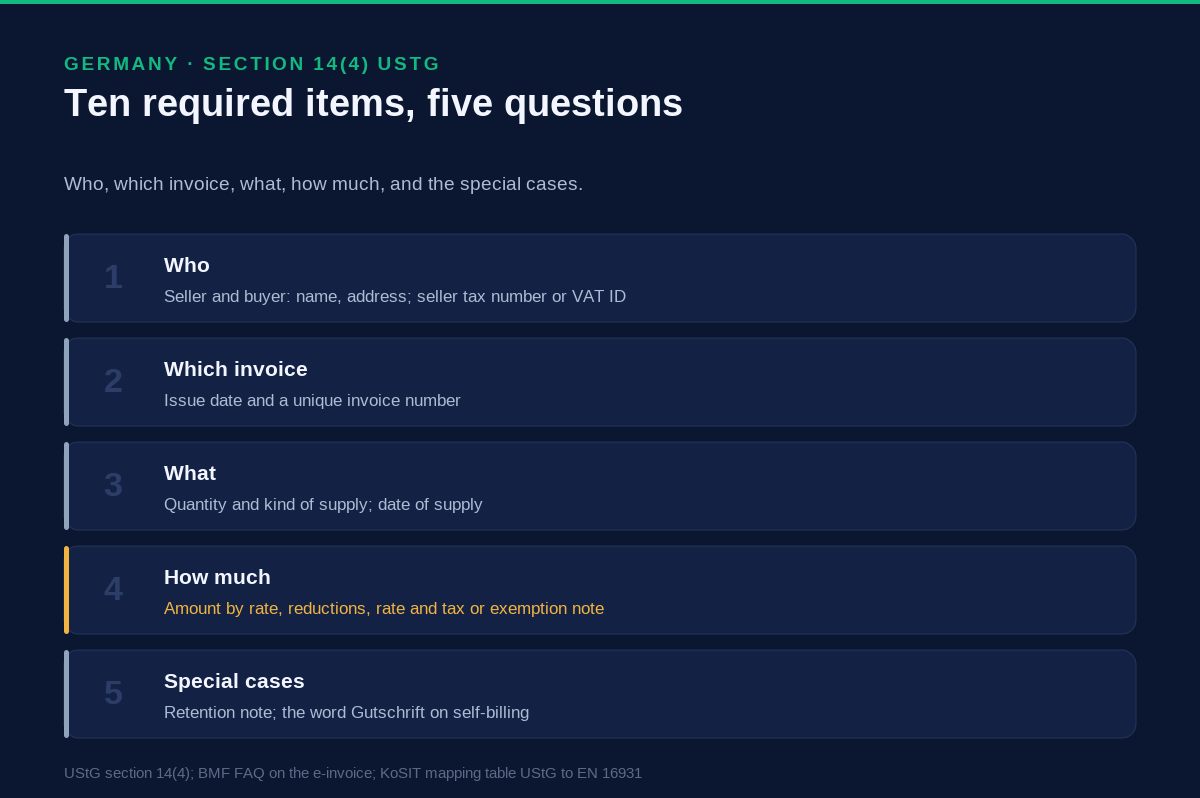
What are the ten required items?
They are the ten numbered items of section 14(4) sentence 1 UStG. The statute is written in German, so the table gives its wording in short form with our English gloss. The right-hand column is the field in the EN 16931 data model, taken from the mapping table that the KoSIT (the public sector's IT standards coordination office, which maintains XRechnung), the FeRD (the ZUGFeRD forum) and the AWV (an industry body) published on 28 July 2025. The Federal Ministry of Finance (BMF) points to that table in its own FAQ and recommends it.
| No. | Statute says | In English | EN 16931 field |
|---|---|---|---|
| 1 | vollständiger Name und vollständige Anschrift des leistenden Unternehmers und des Leistungsempfängers | Full name and address of seller and buyer | BG-4 seller (BT-27), BG-5 seller address (BT-35 to BT-40), BG-7 buyer (BT-44), BG-8 buyer address (BT-50 to BT-55) |
| 2 | Steuernummer oder Umsatzsteuer-Identifikationsnummer | Seller's tax number, or VAT ID from the federal tax office (BZSt) | BT-32 tax registration identifier, or BT-31 VAT identifier |
| 3 | Ausstellungsdatum | Issue date | BT-2 |
| 4 | fortlaufende Nummer, einmalig vergeben (Rechnungsnummer) | Sequential number, assigned once | BT-1 |
| 5 | Menge und Art der Gegenstände, Umfang und Art der Leistung | Quantity and kind of goods, or extent and kind of service | BG-25 invoice line, BT-129 quantity, BG-31 item information |
| 6 | Zeitpunkt der Lieferung oder sonstigen Leistung | Date of supply | BT-72 delivery date, or the invoicing period (BG-14) or line period (BG-26) |
| 7 | nach Steuersätzen und Steuerbefreiungen aufgeschlüsseltes Entgelt; im Voraus vereinbarte Minderung | Net amount by rate and exemption; any agreed reduction not already deducted | BT-131 line net amount, BT-116 taxable amount per category; BT-20 payment terms or BT-92 allowance for agreed reductions |
| 8 | Steuersatz und Steuerbetrag, oder Hinweis auf Steuerbefreiung | Rate and tax amount, or a statement that the supply is exempt | BT-118 category, BT-119 rate, BT-110 total VAT; BT-120 exemption text or BT-121 code |
| 9 | Hinweis auf die Aufbewahrungspflicht des Leistungsempfängers (section 14b(1) sentence 5) | Note on the buyer's duty to keep the invoice, where that section requires it | BG-1 invoice note |
| 10 | Angabe „Gutschrift" | The word Gutschrift when the buyer issues the invoice | BT-3 type code, and a note with the text |
Items 9 and 10 are the special cases. Credit notes and self-billing (Gutschrift) explains item 10. The wording of item 8 for a reverse-charge supply is in reverse-charge invoices in Germany.
Where does each item go in an e-invoice?
In the structured part, and only there. The BMF says that for an e-invoice every required item must be in the structured data so that software can process it. A reference in the structured data to an attachment that holds the items in free text does not meet the rule. Supplementary detail, such as a breakdown of hours, can sit in an embedded attachment.
In a hybrid format such as ZUGFeRD, the BMF says the order of precedence has reversed. The structured XML now leads, and if the picture differs from the XML, the XML counts. A PDF check at the end of the process is therefore not enough: check the data.
Two fields you will meet that section 14(4) does not name:
- BT-10, the buyer reference. For a public body it carries the Leitweg-ID (see invoicing a German public body). The BMF says that between businesses no Leitweg-ID is needed, and that where a format makes the field mandatory, a placeholder such as "-" is enough for tax purposes.
- The seller contact (BG-6) and payment instructions (BG-16). They are not tax items. They are required by the German rules of Peppol BIS Billing 3.0.21, which apply when seller and buyer are both in Germany. We read those rules in the pinned rule file: DE-R-001 (payment instructions), DE-R-002 and DE-R-005 to DE-R-007 (seller contact, with name, telephone and email), DE-R-014 (VAT rate) and DE-R-015 (BT-10).
The mapping is a recommendation, not a statute. According to the BMF FAQ, the tax administration recommends that the table be used as the basis for the items in an e-invoice. KoSIT says it is updated as law and standards change.
What does the statute say about names, abbreviations and the date?
Names and addresses must identify the party clearly, and the date of supply can be a month. Section 31 of the implementing regulation (Umsatzsteuer-Durchführungsverordnung, UStDV) adds four rules.
- Name and address (section 31(2)). It is enough if the wording lets the reader identify seller and buyer without doubt.
- Abbreviations (section 31(3)). Abbreviations, letters, numbers or symbols may be used for the party details and the description of the supply if their meaning is fixed in the invoice or in other documents. Both seller and buyer must hold those documents.
- Date of supply (section 31(4)). The calendar month in which the supply was made may be given. The BMF confirms that a collective invoice (Sammelrechnung) for several supplies in one month is valid as an e-invoice.
- Several documents (section 31(1)). An invoice may consist of several documents, if one of them states the net amount and tax together and names the others. For an e-invoice, read this with the BMF point above: the required items must still be in the structured part.
When must the invoice be issued, and does it need a signature?
Within six months of the supply, for a supply to another business, and no signature is needed. Section 14(2) sentence 2 UStG sets the six-month limit for supplies to another business, to a legal person that is not a business, and for taxable work deliveries or services connected with land to other recipients. It does not apply to supplies exempt under section 4 numbers 8 to 29.
Two shorter deadlines exist for special cases. Section 14a(3) UStG requires an invoice for an intra-Community supply by the 15th of the month after the supply, and section 14a(1) sets the same day for certain services to a customer in another member state who owes the VAT there.
There is no signature rule. Section 14(3) UStG requires authenticity of origin, integrity of content and legibility, and leaves it to each business to decide how to assure them, by any internal control that creates a reliable audit trail between invoice and supply. A qualified electronic signature or EDI under a suitable agreement are named as methods that count as proof, "without prejudice to other permitted procedures".
What happens if an item is missing or wrong?
The invoice can be corrected, but an e-invoice must be corrected by an e-invoice. Section 31(5) UStDV lets the issuer correct an invoice that lacks items or states them wrongly. Only the missing or wrong items need to be sent, in a document that refers specifically and clearly to the original, and with the same form and content requirements as an invoice. The BMF adds that where an e-invoice is required, the correction must itself be an e-invoice. Credit notes and self-billing covers the mechanics.
The stakes are on the buyer's side. The BMF says that if the issuer was obliged to send an e-invoice and sent another kind of invoice, the document is not a proper invoice under sections 14 and 14a, and in principle does not entitle the buyer to deduct input VAT. It describes two ways out, a later e-invoice that corrects the first or, under strict conditions, the details in the other invoice as objective evidence. The BMF presents both as available "at least for now". The simpler course is to send the structured invoice first time, and which errors cost a document its e-invoice status explains what to check.
If you also sell abroad or to the public sector, the same ten items apply, with additions: a German public body needs a Leitweg-ID, a reverse-charge supply needs a set phrase, and an advance payment needs its own invoice and a deduction later.
What to do next
- List the ten items against your invoice template. Mark each one with the field in your system that fills it.
- Check that every item reaches the structured data. Open the XML, not the PDF.
- Fill BT-10 for every German buyer, with the Leitweg-ID for a public body and a placeholder otherwise.
- Test one invoice of each kind before January: normal, reverse charge, advance payment and credit note.
- To discuss a German sending flow, book a demo. The Germany page, how invoices are sent and tracked, the tutorials and the developer documentation cover the rest.
Related reading
- E-invoicing in Germany, the country page.
- Invoicing a German public body: Leitweg-ID and XRechnung
- Reverse-charge invoices in Germany
- Advance-payment and final invoices as e-invoices
- Credit notes and self-billing (Gutschrift)
Sources, all read on 25 November 2026: Umsatzsteuergesetz, section 14, section 14a; Umsatzsteuer-Durchführungsverordnung, section 31; Bundesministerium der Finanzen, Fragen und Antworten zur E-Rechnung (questions 6, 7a, 7b, 11, 12a, 12b); KoSIT, Zuordnung der Pflichtangaben nach UStG zur EN 16931. The Peppol rule references are from Peppol BIS Billing 3.0.21. The BMF letters themselves were not opened; the FAQ is the ministry's own text. Translations from the German are ours, and the English gloss is not the statute.
Primary source: VAT act, section 14 and the Federal Ministry of Finance FAQ on the e-invoice.
Frequently asked questions
- What must a German invoice contain?
- Section 14(4) of the VAT act (UStG) lists ten items: full names and addresses of seller and buyer, the seller's tax number or VAT ID, the issue date, a unique invoice number, the quantity and kind of the supply, the date of the supply, the amount by tax rate and exemption together with any agreed reduction, the tax rate and tax amount or an exemption note, a retention note where section 14b requires one, and the word Gutschrift on a self-billed invoice.
- Does a German invoice need to be signed?
- No signature is required. Section 14(3) UStG asks for authenticity of origin, integrity of content and legibility, and lets each business decide how it assures them, for example through internal controls that create a reliable audit trail between invoice and supply. A qualified electronic signature or EDI are named as ways that count as sufficient, not as the only ways.
- Does the invoice number have to be consecutive?
- The statute asks for a sequential number in one or more series that the issuer assigns once to identify the invoice (section 14(4) number 4). It does not use the word gapless. If your process may skip numbers, ask your adviser how to document the gaps.
- Can I write the month instead of the day of supply?
- Yes. Section 31(4) of the implementing regulation (UStDV) allows the calendar month in which the supply was made. The BMF confirms that this also holds in an e-invoice, so several supplies in one month can go on one invoice.
- What if only a PDF shows an item?
- For an e-invoice that is not enough. The BMF says all required items must be in the structured part, and a bare reference in the structured data to an attachment that holds them in unstructured form does not suffice. In a hybrid file such as ZUGFeRD, the structured part now prevails over the picture.
- Which EN 16931 field holds the invoice number?
- BT-1. The issue date is BT-2, the seller VAT ID BT-31 and the seller's tax number BT-32. The KoSIT mapping table lists the field for every item.
About Dr. Syed Raza
Dr. Syed Raza is an IT Enterprise Architect at ClayDesk LLC and leads the GoRoute platform. He works across Peppol Access Point and SMP infrastructure, PINT jurisdictions (Oman, AU/NZ, EU, JP, MY, SG), and national CTC regimes, translating regulatory detail into production-grade e-invoicing systems.
Building on Peppol?
GoRoute is a certified Peppol Access Point & SMP. Book a demo or read the docs to get started.