
Which German Invoices Need Not Be E-Invoices in 2027?
Which German invoices stay outside the e-invoice duty: amounts up to EUR 250, tickets, consumers, exempt supplies, foreign buyers and small businesses.

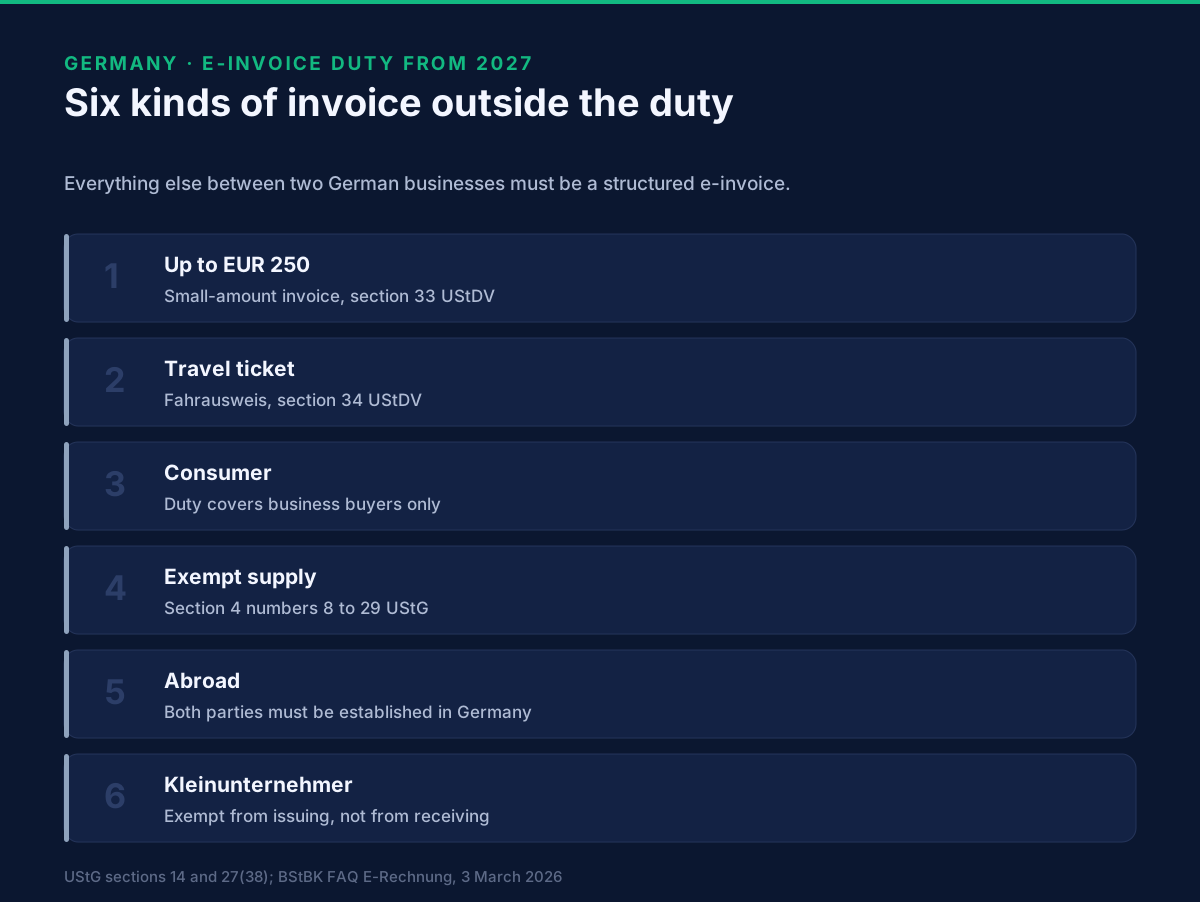
Six kinds of German invoice sit outside the e-invoice duty that starts for larger sellers on 1 January 2027: invoices up to EUR 250, travel tickets, invoices to consumers, invoices for VAT-exempt supplies, invoices to or from a party not established in Germany, and invoices from small businesses (Kleinunternehmer). Everything else sent from one German business to another must be a structured e-invoice once the transition ends. A PDF, a Word file or a scan is then an "other invoice" (sonstige Rechnung).
This page is for the finance lead who wants to know which invoices can stay as they are. It does not cover the dates themselves, which are in Germany B2B e-invoicing 2025 to 2028. It is not tax advice. The ministry's letters are guidance, and your tax adviser decides how they apply to you. GoRoute is a certified Peppol Access Point and SMP (POP000991). For German sellers it sends EN 16931 invoices, including XRechnung, over Peppol, and a ZUGFeRD PDF where the buyer is not on the network.
What is the starting rule?
An invoice for a supply from one business to another is an e-invoice if both are established in Germany. Section 14(2) sentence 2 number 1 of the VAT act (Umsatzsteuergesetz, UStG) says so. Since 1 January 2025 the rule applies, but section 27(38) UStG lets issuers keep using paper or other electronic formats while the transition lasts.
The transition has two steps, as the statute reads:
- until 31 December 2026 for everyone;
- until 31 December 2027 if the issuer's total turnover in the previous calendar year was not more than EUR 800,000. The same extra year covers EDI formats that do not meet the e-invoice standard.
So 2027 is the first year the duty applies to a seller whose 2026 turnover was over EUR 800,000. The exceptions below apply on top of this. They do not depend on the date.
Which invoices are outside the duty?
The exceptions come from the VAT act and its implementing regulation (UStDV), as summarised by the Bundessteuerberaterkammer (BStBK). The BStBK's FAQ of 3 March 2026 lists them.
| Invoice | Rule | Where it comes from |
|---|---|---|
| Total up to EUR 250 | Small-amount invoice; may be paper or PDF | Section 33 UStDV |
| Travel ticket | Ticket as invoice; may be paper or PDF | Section 34 UStDV |
| Consumer (B2C) | Outside the duty | Section 14(2) UStG applies to business buyers only |
| Supply exempt under section 4 numbers 8 to 29 | No invoice duty at all | Section 14(2) UStG |
| Seller or buyer not established in Germany | Outside the German duty | Section 14(2) UStG |
| Kleinunternehmer as issuer | Not required to issue e-invoices | Section 34a UStDV |
The next sections take each in turn.
Is a small-amount invoice up to EUR 250 an e-invoice?
No, it does not have to be. The limit is EUR 250 in total (the BStBK cites section 33 sentence 4 UStDV). Haufe's summary of the ministry's second letter, dated 15 October 2025, adds two points. A small-amount invoice may still be issued as an e-invoice without the buyer's consent. And if the total is over EUR 250, an e-invoice is required, even where only part of the invoice would be in scope.
In practice, a till receipt for EUR 180 is outside the duty. An invoice for EUR 300 that includes EUR 100 of exempt services is not.
Are tickets and travel documents outside the duty?
Yes, a Fahrausweis (travel ticket) that serves as an invoice is. The BStBK gives section 34(1) sentence 2 UStDV as the source. Haufe's summary of the 2025 letter says tickets, like small-amount invoices, may be e-invoices without consent, but need not be.
Do invoices to consumers have to be e-invoices?
No. The duty covers supplies to another business (Unternehmer). A sale to a private person is outside it, and IHK Munich notes that a structured electronic invoice to a consumer needs their consent.
If you sell to both, the line is the buyer, not the product. The shop case is worked through in does your German online shop have to send e-invoices?, including the refund and the buyer who gives a company name at checkout. For a WooCommerce shop, see WooCommerce e-invoicing in Germany. For a Wix shop, see Wix e-invoicing.
Do invoices for VAT-exempt supplies need to be e-invoices?
Not under section 14(2) UStG, which sets no invoice duty at all for supplies exempt under section 4 numbers 8 to 29. If no invoice is required, the e-invoice duty has nothing to attach to. The numbers cover a range of exempt activities, for example many financial and insurance services and some medical care. Check your own activity against the statute text.
One caution from the BStBK: the exemption from issuing does not remove the duty to receive. Since 1 January 2025 every business must be able to receive and archive e-invoices, including one that only makes exempt supplies.
What about a buyer or seller outside Germany?
The German duty applies only where the supplier and the recipient are both established in Germany. Section 14(2) sentence 3 UStG describes "established": a seat, a place of management or a permanent establishment. IHK Munich and Haufe add that without a seat, a domicile or habitual abode is enough, and that a German company's foreign branch making a taxable domestic supply counts as domestic.
So a German seller invoicing a customer in another country is outside the German duty. That is a statement about Germany only. The buyer's country may require its own format or platform. For one example, see France.
The reverse also holds. A seller that is only VAT-registered in Germany, with no seat, management or permanent establishment, is outside the issuing duty. Its German customers still have to be able to receive e-invoices, and they may ask for one anyway. This reading follows from the statute text. It is our inference, not a statement from the ministry.
Are small businesses (Kleinunternehmer) exempt?
From issuing, yes. From receiving, no. The BStBK cites section 34a sentence 3 UStDV. The ministry's first letter, of 15 October 2024, had said that Kleinunternehmer must issue e-invoices. Haufe reports that the second letter, of 15 October 2025, withdrew that statement. A Kleinunternehmer may issue an e-invoice without the buyer's consent, and must be able to receive one.
What does the 2027 transition change for these cases?
Nothing for the exceptions, and a lot for everything else. An exempt invoice stays exempt in 2028. What ends after 2027 is the transition cover for invoices that are in scope. If an invoice is in scope and you send a PDF in 2028, it is an "other invoice". The buyer's right to deduct input VAT then depends on what the tax office can verify, and the second letter treats that as an exception. Our article on German e-invoices with errors covers it.
What to do next
- List what you send, by buyer type. Split business customers in Germany, consumers, and buyers abroad.
- Check the EUR 250 and exempt-supply cases invoice by invoice. A mixed invoice follows the whole total.
- Decide whether to issue e-invoices everywhere anyway. One process is often simpler than two. The rules above say you may, not that you must.
- Plan the archive. Exempt invoices still arrive as e-invoices; see archiving e-invoices in Germany.
- Plan corrections. Credit notes and self-billing (Gutschrift) follow their own rules.
- To talk to us about the rest of your German invoices, book a demo. The Germany page, the tutorials and the developer documentation show how XRechnung and ZUGFeRD documents are sent over Peppol.
Related reading
- E-invoicing in Germany, the country page.
- Germany B2B e-invoicing 2025 to 2028: XRechnung and ZUGFeRD
- Does your German online shop have to send e-invoices?
- Invoice validation errors you can prevent
- GoRoute API
Sources, read in October and November 2026: Umsatzsteuergesetz, section 14 and section 27; Bundessteuerberaterkammer, FAQ E-Rechnung (3 March 2026); Haufe, weiteres BMF-Schreiben zur E-Rechnung and BMF-Schreiben vom 15.10.2025; IHK München, elektronische Rechnungen. The Federal Ministry of Finance (BMF) letters of 15 October 2024 and 15 October 2025 were not available to us directly; where this page describes them it relies on these summaries. Translations from the German are ours.
Primary source: Federal Ministry of Finance (BMF) and the VAT act, section 14, which set Germany's e-invoicing rules.
Frequently asked questions
- Does a small-amount invoice up to EUR 250 have to be an e-invoice?
- No. The Bundessteuerberaterkammer (BStBK) lists small-amount invoices up to EUR 250 (section 33 sentence 4 of the VAT implementing regulation, UStDV) among the exceptions. Reading the ministry's letter of 15 October 2025 through Haufe's summary, such an invoice may still be issued as an e-invoice without the buyer's consent, but it does not have to be.
- Do invoices to consumers have to be e-invoices?
- No. The duty covers supplies from one business to another, both established in Germany. A consumer is outside it. If you do send a consumer an electronic invoice in a structured format, IHK Munich says the consumer must agree to receive it.
- Does a German seller have to send an e-invoice to a buyer abroad?
- Not under the German duty. Section 14(2) of the VAT act (UStG) requires an e-invoice only where both the supplier and the recipient are established in Germany. A buyer established elsewhere is outside it. The buyer's own country may have its own rules.
- Are small businesses (Kleinunternehmer) exempt?
- From issuing e-invoices, yes. The BStBK says a Kleinunternehmer must still be able to receive them. Haufe reports that the ministry's second letter withdrew the statement in its first letter that Kleinunternehmer had to issue e-invoices.
- Does an invoice for a VAT-exempt supply need to be an e-invoice?
- Not under section 14(2) UStG, which sets out no invoice duty at all for supplies exempt under section 4 numbers 8 to 29. That list includes, for example, many financial and insurance services and some medical care.
- What if an invoice mixes an exempt part with a taxable part?
- Haufe reports that the ministry's letter of 15 October 2025 says an e-invoice is required where the total is over EUR 250, even if only part of the invoice is in scope. Check the invoice as a whole, not line by line.
About Dr. Syed Raza
Dr. Syed Raza is an IT Enterprise Architect at ClayDesk LLC and leads the GoRoute platform. He works across Peppol Access Point and SMP infrastructure, PINT jurisdictions (Oman, AU/NZ, EU, JP, MY, SG), and national CTC regimes, translating regulatory detail into production-grade e-invoicing systems.
Building on Peppol?
GoRoute is a certified Peppol Access Point & SMP. Book a demo or read the docs to get started.