
Invoicing a German Public Body: Leitweg-ID and XRechnung
To invoice a German public body you need the Leitweg-ID from the order, an XRechnung and a registration at the federal platform OZG-RE. The steps.

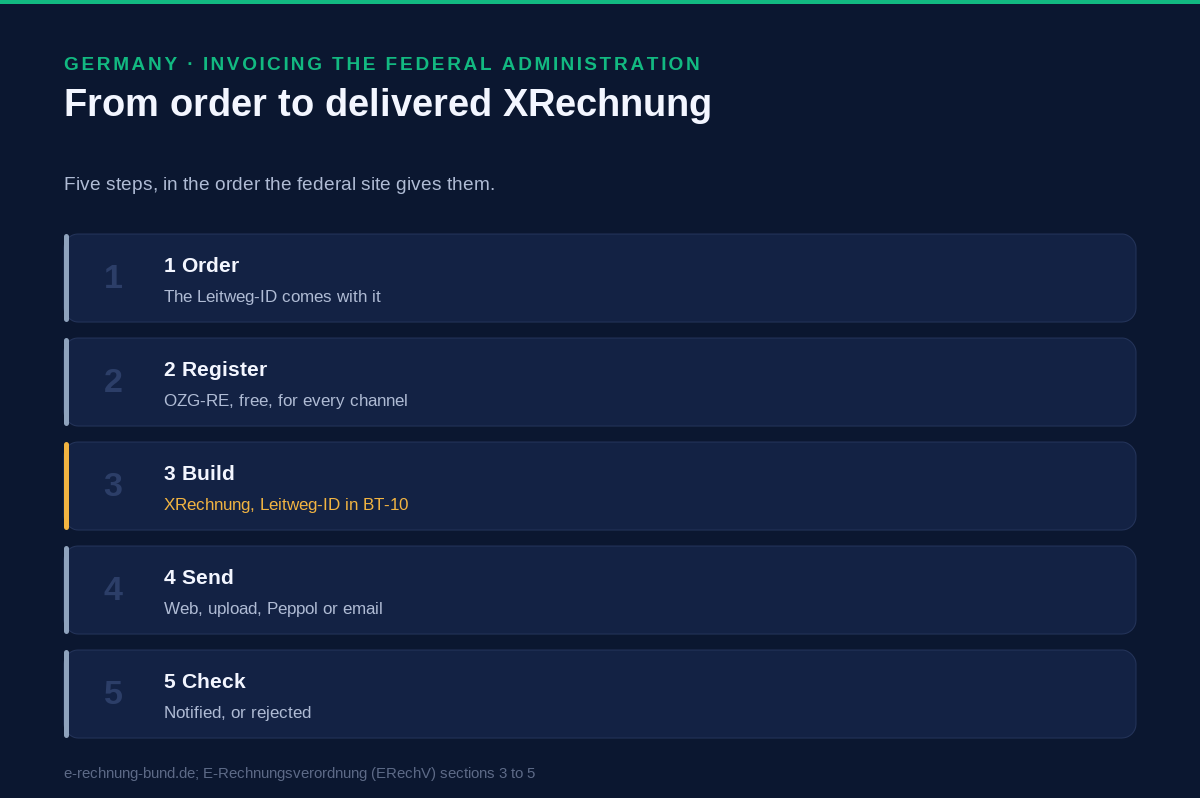
To invoice a German public body you need three things: the Leitweg-ID that the contracting authority gave you with the order, an e-invoice in the XRechnung format, and, for a federal buyer, a registration at the federal invoice platform OZG-RE. The Leitweg-ID (Leitweg-Identifikationsnummer, the buyer's routing code) goes into the buyer reference field of the invoice, BT-10. Without it the platform rejects the invoice. Federal suppliers have had to invoice this way since 27 November 2020.
This page is for the accounts-receivable lead of a company with a public contract. It covers the federal rules and names the state portals. It does not cover each state's own rules. It is not legal advice. GoRoute is a certified Peppol Access Point and SMP (POP000991). We describe the federal route as the federal site does. This page does not say that GoRoute delivers invoices to the federal platform.
What is a Leitweg-ID, and where do you get it?
It is the public recipient's routing code, and you get it from the buyer. The federal site says a public recipient must be identified and addressable by a Leitweg-ID so that the platform can forward the e-invoice to the downstream processing system. The code has three parts: a coarse address (Grobadressierung), a fine address (Feinadressierung) and a check digit (Prüfziffer).
The first part tells you who receives the invoice:
| Starts with | Recipient | Received through |
|---|---|---|
| 991 | Direct federal administration, or a constitutional body | OZG-RE |
| 992 | Indirect federal administration | OZG-RE |
| 993 | Indirect federal administration with its own solution | Not OZG-RE |
A supplier does not need its own Leitweg-ID. The federal site says so twice, and the Ministry of Finance (BMF) adds that businesses invoicing each other need none. The authority tells you its code in the order, or you ask for it.
Use the code from the order and no other. The federal site explains that one authority can hold several Leitweg-IDs so that invoices reach the right department. Its platform also shows a directory of codes in the web entry screen, but the federal FAQ says to use only the one named in the order for that invoice.
Which law makes the invoice electronic?
For federal contracts, the E-Rechnungsverordnung (ERechV). Its section 3(1) says issuers must issue and send invoices to recipients in electronic form. Section 3(3) lists the exceptions, including a direct award of up to EUR 1,000 and the cases covered by sections 8 and 9 (secret data, the foreign service and procurement abroad). The regulation covers invoices issued after public contracts and concessions are fulfilled (section 1).
Section 4(1) names the format: XRechnung in its current version, or another data exchange standard that meets the European standard (EN 16931). The federal site adds that ZUGFeRD 2.2.0 in the XRechnung profile also works, but only as a pure structured XML file without a picture. A ZUGFeRD file that carries a readable picture is not accepted in that profile.
The states are separate. The federal site says the states implement e-invoicing in their own competence, so requirements can differ, sometimes a great deal. Check the state's rules and the contract.
What must the invoice contain besides the tax items?
Section 5 ERechV adds four items to the tax items, and two more if you were given them. The tax items are the same as for any German invoice, listed in what a German invoice must contain. The federal site gives the XRechnung field for each of the extras:
| Item | Field | Condition |
|---|---|---|
| Leitweg-ID | BT-10, buyer reference | Always |
| Bank details | BG-17 (BT-84 to BT-86) for a transfer, BG-19 (BT-89 to BT-91) for a direct debit | Always |
| Payment terms | BT-9 due date, or BT-20 payment terms | Always |
| Email address of the issuer | BT-43 | Always |
| Supplier number and order number | The federal FAQ page names no field for them | Only if the buyer gave them at the order |
For a buyer in the federal administration, put the Leitweg-ID in BT-10. The federal FAQ says the field is a mandatory item under German law and that XRechnung makes it a mandatory element.
How does the invoice reach the buyer?
Through a federal platform, and you register there first. Section 4(3) ERechV requires issuers to use a federal administration portal and to register a user account before sending. The platform checks each invoice automatically for formal errors, tells you when it has accepted one, and rejects a formally defective one.
Section 4(4) adds a second rejection: a recipient who receives an e-invoice that cannot be linked to a user account must reject it, and in that case the sender receives no information about the rejection. A supplier who has not registered can therefore be rejected without being told.
Since September 2025 the federal administration receives invoices on one platform, OZG-RE. It replaced the earlier ZRE, which was merged into it. The federal site publishes a test environment where you can register and try before invoicing for real. Registration is free.
You can send in four ways. Web entry types the invoice into the portal. Upload sends a file you made elsewhere. Peppol sends it from your system through a Peppol Access Point. Email sends a file to the platform. The federal site recommends Peppol and email for high volumes, and says Peppol is the only channel that allows machine-to-machine sending and bulk export. Whichever channel you choose, the terms of use currently require the registration.
Direct federal bodies (991) receive only through OZG-RE. Indirect bodies (992) can too. A 993 buyer has its own solution, so ask it how.
How does Peppol fit in?
Peppol is one of the four channels, and the address is built from the Leitweg-ID. The federal Peppol page says the receiver's Peppol participant ID is the prefix 0204, a colon and the Leitweg-ID. An example is 0204: followed by the code. The federal page gives the issuer's ID as 9930 with its VAT ID, or 0088 with its Global Location Number.
Two points need care.
- The code must be in the invoice as well. The federal page says you address the Peppol document with the receiver ID, but the Leitweg-ID must also be in the e-invoice itself, or OZG-RE rejects it.
- The issuer's identifier is changing. KoSIT, the public sector's IT standards coordination office, announced on 11 November 2026 that the German Electronic Business Address (GEBA, scheme 0246) has been the default identifier for German companies on Peppol since 17 August 2026. The federal page we read today still names 9930 and 0088. We do not know whether the federal platform treats the sender's identifier as significant. Ask your Access Point which one it uses.
We also could not confirm from the sources we read whether OZG-RE accepts a Peppol BIS Billing 3.0 document or only XRechnung. The federal site says the standard to use is XRechnung, and that another standard may be used if it meets EN 16931, the regulation and the platform's terms of use. Ask your Access Point which profile it will send, and ask the platform's support line if the answer matters.
What happens after you send?
You are notified of acceptance or rejection, and you keep the record yourself. The federal FAQ says that OZG-RE deletes invoices completely 28 days after they were made available or after their last status change, for data protection reasons. You can download them before then. The statutory retention duty is yours, as described in archiving e-invoices in Germany.
If an invoice is rejected, read the rejection, correct the data and send a new one. Which faults stop a document counting at all is explained in German e-invoices with errors.
What to do next
- Ask the contracting authority for its Leitweg-ID at the order, and note the first three digits.
- Register at OZG-RE's test environment, then at production, if the buyer is federal.
- Put the Leitweg-ID in BT-10, with bank details, payment terms and an email address, and the supplier and order numbers if you have them.
- Pick a channel. For a few invoices a month, web entry or upload is enough. For volume, ask about Peppol or email.
- Check the state portal if the buyer is a state or municipal body. The federal site's state page links each state's information.
- To discuss a German public-sector flow, book a demo. The Germany page, how invoices are sent and tracked, the tutorials and the developer documentation cover how documents are sent over Peppol.
Related reading
- E-invoicing in Germany, the country page.
- What a German invoice must contain
- Reverse-charge invoices in Germany
- Advance-payment and final invoices as e-invoices
- Credit notes and self-billing (Gutschrift)
Sources, all read on 25 November 2026: Beschaffungsamt des BMI, E-Rechnung in der Bundesverwaltung, its Peppol page, FAQ and state overview; E-Rechnungsverordnung sections 1, 3, 4, 5 and 8; Bundesministerium der Finanzen, Fragen und Antworten zur E-Rechnung (question 6); KoSIT, GEBA als Default Identifier (11 November 2026). The KoSIT Leitweg-ID specification itself was not read; the structure above is the federal FAQ's. Translations from the German are ours.
Primary source: e-rechnung-bund.de, the federal e-invoicing site and the E-Rechnungsverordnung.
Frequently asked questions
- What is a Leitweg-ID?
- The routing code of a public invoice recipient. The federal site says the recipient must be identified and addressable by it so that the e-invoice can be forwarded to the right processing system. It goes into the buyer reference field (BT-10) of the XRechnung and must be on every e-invoice to the federal administration.
- Does a supplier need its own Leitweg-ID?
- No. The federal site says issuers need none. The contracting authority gives you its own Leitweg-ID with the order, or you ask for it. Use the one named in the order, because an authority can have several.
- Where do I get the Leitweg-ID of a state or municipal buyer?
- From the buyer. The states set their own rules. Some have a central office that allocates the codes, such as Berlin's finance administration, and some do not: Hessen allocates none centrally, and Niedersachsen, Rheinland-Pfalz and the Saarland pass them on with the order. The federal site lists each state's contact page.
- Can I still send a PDF to a federal authority?
- No. The federal site says that since 27 November 2020 suppliers may send neither paper nor PDF invoices to federal contracting authorities. An invoice must be an e-invoice, normally in XRechnung.
- What do the digits 991, 992 and 993 mean at the start?
- They say who receives the invoice. 991 is the direct federal administration or a constitutional body, receiving through OZG-RE. 992 is the indirect federal administration, also through OZG-RE. 993 is the indirect federal administration with its own solution and not OZG-RE.
- Can I send a public-sector e-invoice over Peppol?
- Yes, for buyers connected to the federal platform. Peppol is one of four channels. The receiver address is 0204: followed by the Leitweg-ID. The Leitweg-ID must also be in the invoice itself, or OZG-RE rejects it. You still register at OZG-RE first.
About Dr. Syed Raza
Dr. Syed Raza is an IT Enterprise Architect at ClayDesk LLC and leads the GoRoute platform. He works across Peppol Access Point and SMP infrastructure, PINT jurisdictions (Oman, AU/NZ, EU, JP, MY, SG), and national CTC regimes, translating regulatory detail into production-grade e-invoicing systems.
Building on Peppol?
GoRoute is a certified Peppol Access Point & SMP. Book a demo or read the docs to get started.