
German E-Invoices With Errors: Is It Still an E-Invoice?
A German e-invoice with a format error is only an other invoice; a content error is corrected as before. How the classes differ and what they do to input VAT.

A German e-invoice with a format error is not an e-invoice at all. It is only an "other invoice" (sonstige Rechnung). A content error, such as a wrong tax rate, leaves it an e-invoice but is corrected as before. The Federal Ministry of Finance (BMF) letter of 15 October 2025 draws that line, as the Bundessteuerberaterkammer (BStBK) and Haufe summarise it. The line matters because a buyer's right to deduct input VAT can depend on which side an error is on.
This page is for the IT or finance lead who sees validation errors from a Peppol or XRechnung check and wants to know what they cost. It explains the principle. It does not list individual business-rule codes, because we have not read the ministry's table of them. It is not tax advice, and the letter is guidance, not law. GoRoute is a certified Peppol Access Point and SMP (POP000991). For German sellers it sends EN 16931 invoices, including XRechnung, over Peppol, and a ZUGFeRD PDF where the buyer is not on the network.
What is the difference between a format error and a content error?
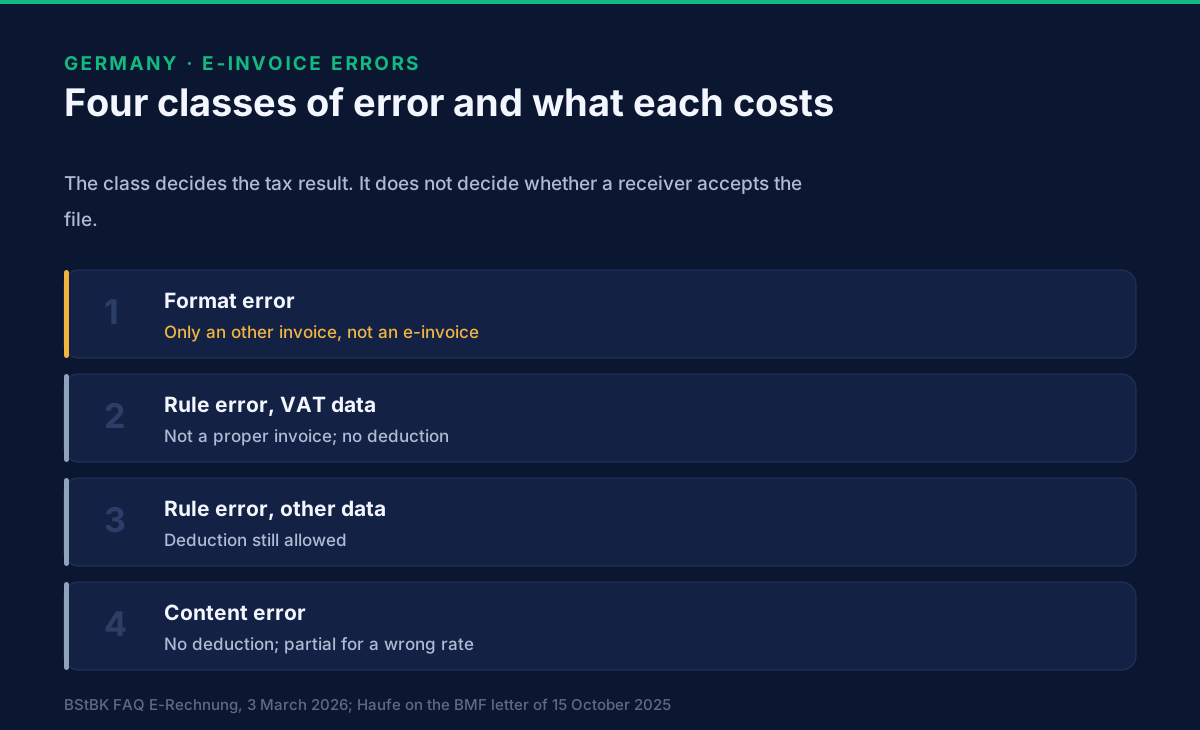
A format error is about the file. A content error is about what the invoice says. The BStBK's FAQ of 3 March 2026 describes the letter's classes as follows:
| Class | What it is | What it does to the document |
|---|---|---|
| Format error (Formatfehler) | The file breaches the EN 16931 syntax, or the data cannot be extracted completely | The document is only an other invoice |
| Business-rule error (Geschäftsregelfehler) in the VAT data | A rule fails on data the VAT act requires, such as the supply date or the quantity | Not a proper invoice; no input VAT deduction |
| Business-rule error outside the VAT data | A rule fails on other data, such as a bank account or a missing buyer reference (BT-10) | Input VAT deduction still allowed |
| Content error (Inhaltsfehler) | The invoice is wrong in substance, for example a wrong tax rate or an insufficient description | No deduction; for a wrong rate, a partial deduction up to the tax actually owed |
The table is the BStBK's summary, not the letter's wording. We have not named any rule numbers, since we have not read them. Check any case against the letter.
What does a format error do to the document?
It takes away its status as an e-invoice. If the file breaches the EN 16931 syntax, or the data cannot be extracted completely, the document is treated as an other invoice. Where the VAT act requires an e-invoice, an other invoice is generally not a proper invoice.
The transition rules in section 27(38) UStG soften this for now. During the periods in which a PDF or paper invoice is still allowed, an other invoice still supports the deduction. The BStBK says so for format errors. When the transition for a given issuer ends, the cover ends with it. Which invoices are in scope is the subject of which German invoices need not be e-invoices in 2027.
What happens to the buyer's input VAT?
The buyer's deduction follows the class of error. Haufe's summary of the letter says that where an e-invoice is mandatory, only a proper e-invoice supports the deduction. A document in another format is generally not proper. The deduction may still be allowed if the tax office has all the information it needs to verify the claim, if the invoice is correct and complete, and if no correction as an e-invoice was issued.
For the buyer, then, a rejection from a validator is not a formality. It changes whether a company can reclaim the VAT on a purchase. It can also change what the supplier has to send next. We state no penalty amounts here, because the consequence in the letter is on the deduction, not on a fine.
Which errors leave the deduction intact?
Per the BStBK, business-rule errors outside the VAT data. Its examples are a wrong bank account number and a missing buyer reference (BT-10). The deduction is still allowed. The same rule would be unhelpful if it meant such errors could be ignored. They still fail validation, and a receiving system may reject the document. The class says what the error costs in tax. It does not say whether the file will be accepted.
Can I rely on a validator?
The summaries say yes, with due care. According to the BStBK and Haufe, a merchant who exercises due care may rely on the technical result of a suitable validator. Keeping the validation report is recommended.
A validator for German invoices runs the EN 16931 rules and the German XRechnung rules from KoSIT, the body that maintains the XRechnung standard. KoSIT publishes the validator and its configuration. Which version you run matters: the rules change from release to release, and a result is only as current as the configuration that produced it. The report from an old version is weaker evidence than one from the current one.
How do you fix an invoice that failed?
Correct it with an e-invoice that refers to the original. That is how the summaries describe the correction of an invoice that was issued in the wrong format. In practice:
- Do not edit the file in place. The original stays in the archive. See archiving e-invoices in Germany.
- Issue the correction as a structured document. The mechanics are in credit notes and self-billing (Gutschrift).
- Keep the validation report of the original and the correction, for the reason given above.
Why check before sending?
Because the class of an error is decided after you send, and you can only fix it before. A check at the point of creation costs nothing in tax. A check at the buyer's end can cost the buyer its deduction and leave you to correct, resend and explain. The kinds of fault that fail checks in practice are in invoice validation errors you can prevent.
GoRoute validates documents before transmission over Peppol, so a fault reaches the sender first. Book a demo to see the report for a German invoice.
What to do next
- Run a sample of your own invoices through a validator today, and sort the faults into the four classes above.
- Block sending on format errors, and decide in advance who fixes each class.
- Keep the validation report with the invoice.
- Check which invoices are in scope with the exemptions page.
- Read the tutorials and the documentation for how validation fits a sending flow: the tutorials, the developer documentation and the Germany page.
Related reading
- E-invoicing in Germany, the country page.
- Germany B2B e-invoicing 2025 to 2028: XRechnung and ZUGFeRD
- Does your German online shop have to send e-invoices?
- GoRoute API
Sources, read in October and November 2026: Bundessteuerberaterkammer, FAQ E-Rechnung (3 March 2026); Haufe, BMF-Schreiben vom 15.10.2025 and weiteres BMF-Schreiben zur E-Rechnung; Umsatzsteuergesetz, section 27; KoSIT, XRechnung. The Federal Ministry of Finance letter was not available to us directly; where this page describes it, it relies on these summaries. Translations from the German are ours.
Primary source: Federal Ministry of Finance (BMF) and the VAT act, section 27, which set Germany's e-invoicing rules.
Frequently asked questions
- When does a German e-invoice stop being an e-invoice?
- When it breaches the EN 16931 syntax or the data cannot be extracted completely. The BStBK's summary of the ministry's letter of 15 October 2025 calls this a format error (Formatfehler). The document is then only an other invoice (sonstige Rechnung), not an e-invoice.
- What is the difference between a format error and a content error?
- A format error is about the structure of the file. A content error (Inhaltsfehler) is about what the invoice says, such as a wrong tax rate or a description that is not specific enough. A format error costs the document its status as an e-invoice. A content error is dealt with as before, by correcting the invoice.
- Can the buyer still deduct input VAT on a faulty e-invoice?
- It depends on the class of error and the year. The summaries say that where an e-invoice is required, only a proper one supports the deduction. A document with a format error is only an other invoice, which supports the deduction during the transition periods. A business-rule error touching VAT data means no proper invoice.
- Does a failed validation check mean the invoice is wrong?
- Not always. The summaries say business-rule errors outside the VAT data, such as a wrong bank account number or a missing buyer reference (BT-10), still leave the deduction intact. The report tells you where the fault is. The class decides what it costs.
- Can I rely on a validator?
- The summaries say a merchant who exercises due care may rely on the technical result of a suitable validator, and recommend keeping the validation report. We have not read the letter's wording on this point.
- How do I fix a format error?
- Issue a correction that is itself an e-invoice and refers to the original. Do not overwrite the original. The credit notes page explains the mechanics.
About Dr. Syed Raza
Dr. Syed Raza is an IT Enterprise Architect at ClayDesk LLC and leads the GoRoute platform. He works across Peppol Access Point and SMP infrastructure, PINT jurisdictions (Oman, AU/NZ, EU, JP, MY, SG), and national CTC regimes, translating regulatory detail into production-grade e-invoicing systems.
Building on Peppol?
GoRoute is a certified Peppol Access Point & SMP. Book a demo or read the docs to get started.