
Small Businesses and the Belgian E-Invoicing Mandate
Belgium's e-invoicing mandate covers businesses under the 25,000 euro VAT exemption, sending and receiving. The few exceptions, and free or low-cost options.

The short answer
Yes: a Belgian business under the small-business VAT exemption is still covered by the e-invoicing mandate. The federal e-invoicing site says the obligation "also applies if you make use of the exemption scheme for small businesses", meaning annual turnover of no more than EUR 25,000. The test is simple: if you hold an active VAT number, the mandate applies to you. It covers sending structured invoices to other Belgian VAT-registered businesses and receiving them from your suppliers.
The exceptions are short and specific, and being small is not one of them. This page is for sole traders, micro-businesses and the accountants who look after them. It sets out who is exempt from what, what the mandate means for a business that only invoices consumers, and the cheapest ways to comply.
Who has to send, and who has to receive?
The federal guidance splits the obligation in two. Sending and receiving have different exceptions.
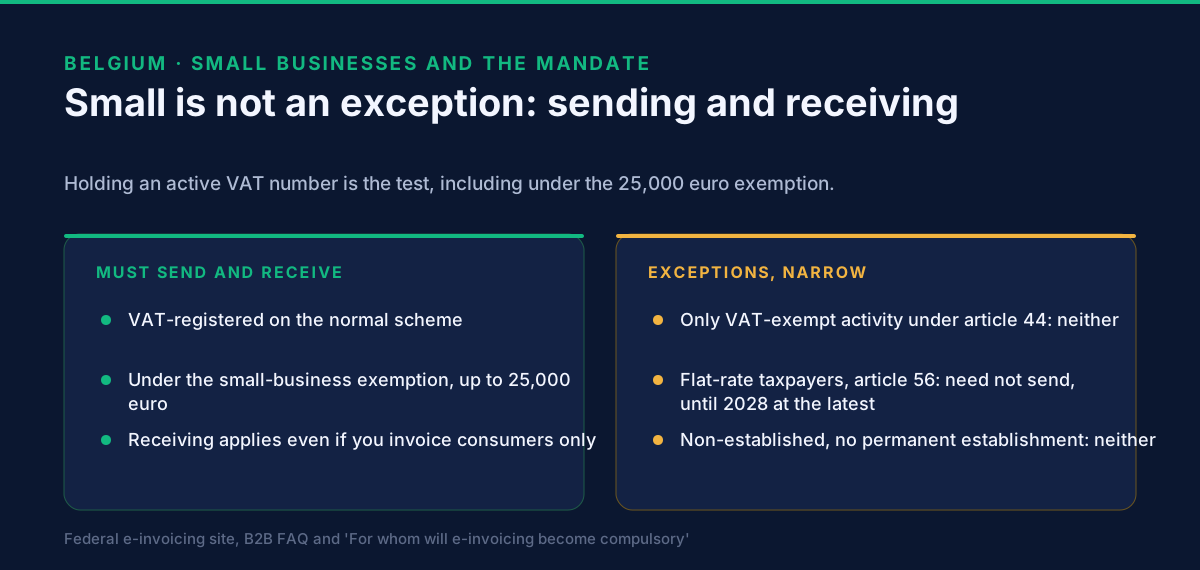
| Situation | Must send structured e-invoices? | Must be able to receive them? |
|---|---|---|
| VAT-registered, normal scheme | Yes | Yes |
| Small-business exemption (turnover up to EUR 25,000) | Yes | Yes |
| Special agricultural scheme | Not stated (see note) | Yes |
| Only VAT-exempt activity under article 44 | No | No |
| Flat-rate taxpayer (article 56) | No, until the scheme ends (by 1 January 2028 at the latest) | Yes |
| Non-established, no permanent establishment in Belgium | No | No |
| Bankrupt taxpayer | No | Yes |
| Serving private customers only | Not for those invoices | Yes |
The note on agriculture: the FAQ says the obligation applies under the special agricultural scheme "at least for receiving B2B invoices", and does not say more about sending. If you are a farmer on that scheme, ask your accountant about the sending side.
The table is built from two federal pages, the B2B FAQ and the French-language article Pour qui la facturation électronique deviendra-t-elle obligatoire ?. The English FAQ answers the small-business question and points to the longer article for the rest.
What if I only invoice private customers?
You do not have to send structured invoices to consumers, because B2C is outside the mandate. The federal guidance is blunt about the other half: you must still be able to receive structured e-invoices from your suppliers, and it told businesses to have their systems updated by January 2026. The obligation also needs both sides to be VAT-liable. If one party to a transaction is not a VAT taxable person, the obligation does not apply to that transaction.
In practice this means a hairdresser or a tradesperson with a VAT number and consumer customers still needs a way to receive the supplier invoices that now arrive as XML files over Peppol. A PDF in the inbox no longer meets the supplier's obligation, although your supplier may keep sending one as a courtesy.
Is there still a transitional period for the smallest businesses?
Not in the sense of a general grace period. Two separate things have been called that, and they are easy to confuse:
- The tolerance period. Belgium allowed a tolerance for the first three months of 2026. It ended on 31 March 2026, so the rules have been fully enforced since 1 April 2026. See our penalties article.
- The flat-rate scheme. Taxpayers under the article 56 flat-rate scheme do not have to send e-invoices, and the scheme ends by 1 January 2028 at the latest. This is the only size-related relief for sending that the federal guidance lists.
If a supplier or adviser tells you your business is too small to be covered, ask which of the listed exceptions they mean.
What are the free and low-cost options?
The government does not provide a free central tool for small businesses. Its own FAQ explains that it chose to have businesses connect their existing invoicing software to the Peppol network instead. What it offers is a list of compliant software, which it says has more than 250 applications. It does not list prices, because they change and because functions differ. It adds that the cost of meeting the legal obligation "may be zero euro" where it is included in the base price of other software you choose, such as accounting or a bank account.
So the first step costs nothing: ask your accounting or invoicing software supplier whether it already sends and receives over Peppol. If it does, you may have nothing to buy.
If it does not, the options are:
- Switch to a package from the government list that covers both sending and receiving.
- Use a standalone Peppol connection. GoRoute offers Peppol registration so you can be reached and can send; see the registration page, priced at $29 a month at the time of writing.
- Run it from your shop. If you sell on WooCommerce, the Belgium plugin page describes the free plugin, and our article on e-invoicing for a Belgian online shop covers checkout and refunds.
The government list notes that some packages only send. Check that yours also receives, since receiving is the half small businesses forget. Our guide to receiving supplier e-invoices walks through it.
Can I claim a tax break?
Possibly. For taxable periods 2024 to 2027 the federal site describes an increased deduction of 120% for e-invoicing subscription and advice costs, for SMEs and the self-employed. The conditions are specific, so read the 120% deduction explained and ask your accountant.
What happens if I do nothing?
Fines run from EUR 1,500 for a first offence to EUR 5,000 for a third within three months, as set out in our penalties article. The larger cost is usually commercial: a business customer who must receive structured invoices may refuse your PDF, and an invoice the buyer cannot book is paid late. If your customers are Belgian VAT-registered businesses, that is the immediate risk.
If you are a foreign company, whether you are covered at all depends on having a Belgian permanent establishment. See Belgium e-invoicing for foreign companies.
What to do this week
- Confirm you hold an active VAT number. The federal site says you can check any Belgian business in the Crossroads Bank for Enterprises, where a VAT-liable business shows the quality "Assujettie à la TVA".
- Ask your software supplier whether it sends and receives over Peppol, and since when.
- Look up your enterprise number and make sure you can be found on the network. Our guide to scheme 0208 shows the check.
- Tell your accountant which route you chose.
If you sell to public bodies, the rules differ; see how to invoice the Belgian government through Mercurius. If a customer self-bills you, see self-billing in Belgium.
For a shop, start with the Belgium WooCommerce plugin page. For everyone else, book a short session and we will check your set-up with you. Recorded walkthroughs are on tutorials and the technical reference is in the developer documentation.
Sources: FPS BOSA e-invoicing site, FAQ on the B2B obligation; Pour qui la facturation électronique deviendra-t-elle obligatoire ? (9 October 2024, French); The list of solutions is long, I do not know where to start (23 May 2025). This is not tax or legal advice; confirm your position with your accountant.
Frequently asked questions
- Does a Belgian business under the 25,000 euro VAT exemption have to send e-invoices?
- Yes. The federal e-invoicing site says the obligation also applies if you use the exemption scheme for small businesses, where annual turnover does not exceed 25,000 euro. If you have an active VAT number, the obligation applies to you, with a short list of exceptions.
- Does a Belgian sole trader have to receive e-invoices from suppliers?
- Yes, if they hold an active VAT number. Even a business that invoices only private customers does not have to send structured invoices to them, but it must be able to receive structured e-invoices from its suppliers.
- Which small businesses are not required to send e-invoices?
- Bankrupt taxpayers, businesses with only VAT-exempt activity under article 44 of the VAT Code, non-established taxpayers with no permanent establishment, and flat-rate taxpayers under article 56, a scheme that ends by 1 January 2028 at the latest.
- Is there a free way for a small Belgian business to e-invoice?
- The government does not provide a free central application. It publishes a list of more than 250 compliant software applications and notes the cost of meeting the obligation may be zero where it comes with other software you already pay for, such as accounting.
About Dr. Syed Raza
Dr. Syed Raza is an IT Enterprise Architect at ClayDesk LLC and leads the GoRoute platform. He works across Peppol Access Point and SMP infrastructure, PINT jurisdictions (Oman, AU/NZ, EU, JP, MY, SG), and national CTC regimes, translating regulatory detail into production-grade e-invoicing systems.
Building on Peppol?
GoRoute is a certified Peppol Access Point & SMP. Book a demo or read the docs to get started.