
Does Your Belgian Shop Have to Receive E-Invoices Too?
Belgium's B2B e-invoicing rule cuts both ways: your suppliers must send your shop structured invoices. What it takes to be reachable, and to read what arrives.

If your Belgian shop has to send structured e-invoices, its suppliers have to send them to
you. Belgium's business-to-business e-invoicing obligation has applied since 1 January 2026 and
it is symmetrical — it describes invoices between businesses, not invoices leaving your business.
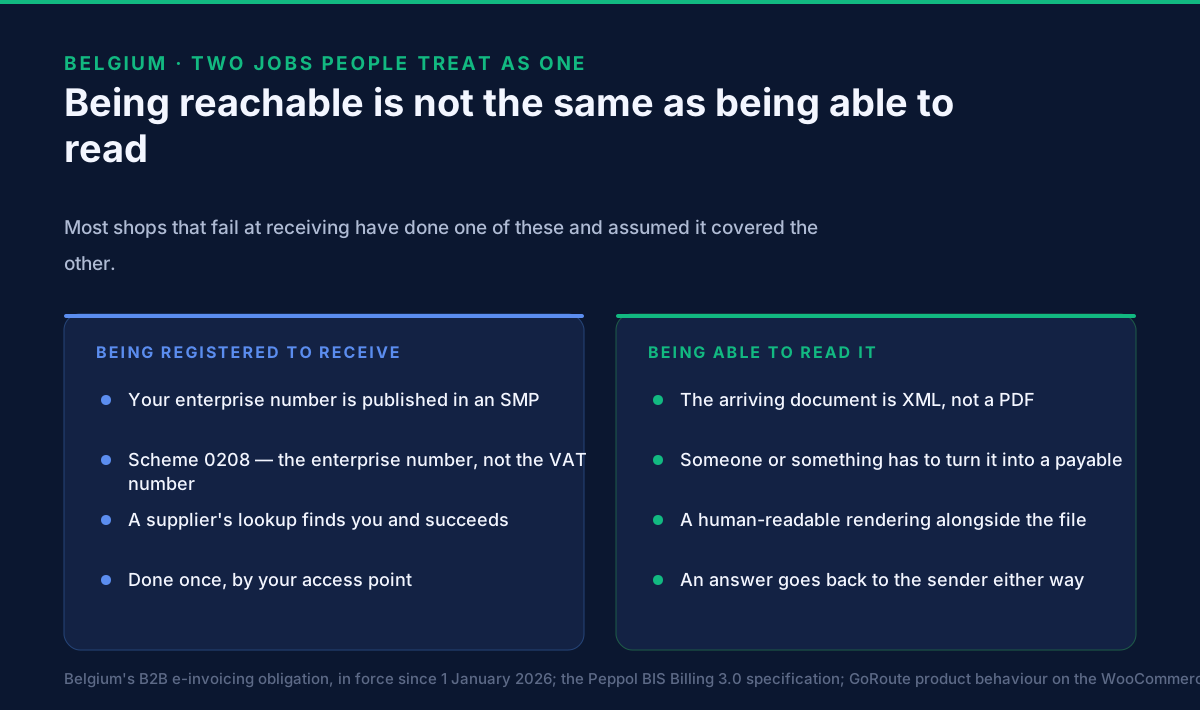
So the shop needs two things: to be reachable on the Peppol network, which means its
enterprise number published under identifier scheme 0208, and to be able to handle what
arrives, which means a structured XML document rather than a PDF. Those are different jobs, and
doing one does not do the other.
This page is for the owner or store manager of a Belgian shop that already understands the sending side. If you have not settled that yet, whether your Belgian shop has to send e-invoices at all is the page to read first; this one is its other half.
Does my Belgian business have to receive e-invoices?
In practice, yes — and the reason is worth understanding rather than memorising.
The Belgian obligation is written about supplies between businesses. Every invoice has two parties, so the same rule that makes you issue a structured invoice to a business customer makes your suppliers issue structured invoices to you. The sending duty is theirs. The consequence lands on you, because an invoice that cannot be delivered is an invoice that does not reach your books, and the payment terms keep running while everybody works out why.
There is no separate "receiving registration deadline" to diarise. There is a network that either resolves your company or does not, and from 1 January 2026 a growing share of your suppliers are obliged to try.
A PDF by email is not the fallback. Belgium does not accept one as a business-to-business invoice — the point is made in full on the sending side of this rule and it cuts the same way inbound. A supplier who emails you a PDF has not complied, and your accepting it does not repair their position or yours.
What does "reachable" actually mean?
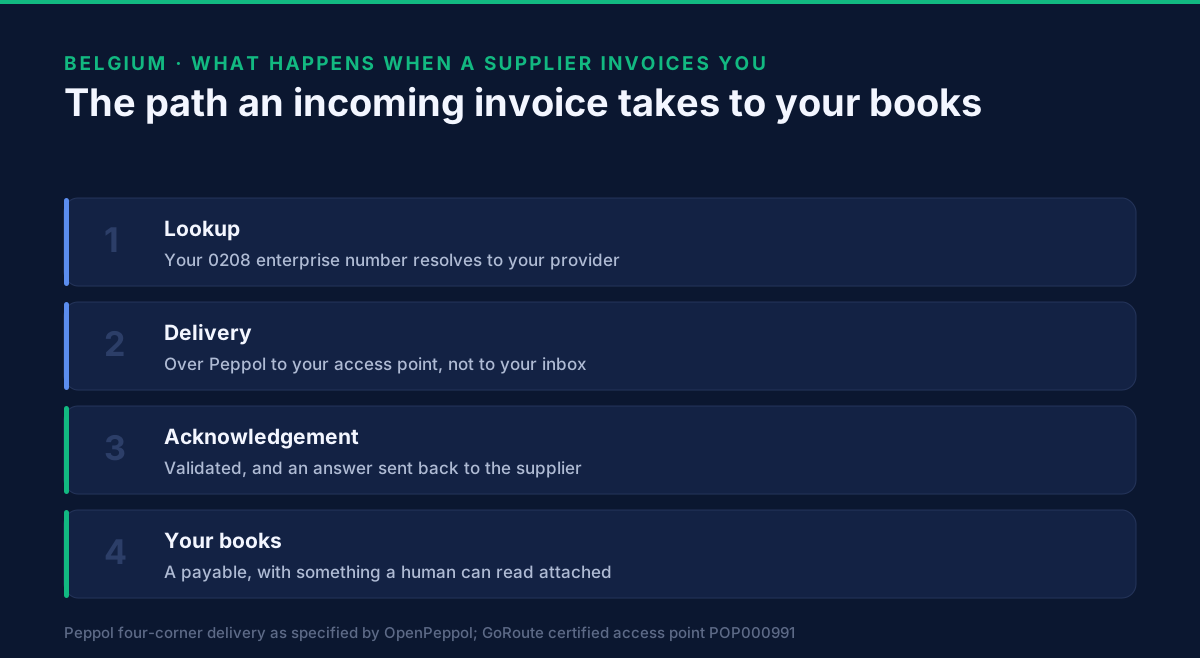
It means one record exists, in one place, saying that documents for your enterprise number go to your provider.
Peppol delivers on a four-corner model: your supplier's access point has to discover where to send before it can send. That discovery is a lookup of your participant identifier in a service metadata publisher — an SMP, the network's address book. If your company has a record there, the lookup resolves and the document is delivered. If it does not, the send fails at the first step, and the supplier sees an error rather than you seeing an invoice.
Two specifics decide whether that lookup works.
The identifier is your enterprise number, under scheme 0208. Not the VAT number, and not a
company name. Registering a Belgian participant under the wrong scheme is a breach of the Belgian
rule rather than a matter of taste, and
why scheme 0208 is not optional covers the check
digit and what the failure looks like at lookup.
Nothing registers you by default any more. Until the end of 2025 Belgian companies were reachable more or less automatically, because BOSA pre-registered them. That stopped: Hermes was decommissioned on 31 December 2025, so a Belgian company with no service provider is now genuinely unreachable. This is the single most common reason a Belgian business believes it is receiving e-invoices and is not.
Who registers my shop, and do I already have it?
Check before you buy anything, because you may already be done.
If you run one of our storefront apps, you are registered. Setting up the WooCommerce plugin or the Wix app registers your store as a Peppol participant as part of set-up — the same registration serves sending and receiving, because they are two capabilities on one participant record rather than two separate arrangements. Both apps are free for the first fifty e-invoices a month. If your shop is on either platform, the receiving half of the Belgian rule is already handled, and the useful next step is to confirm your enterprise number is the one on the record.
If you do not run a storefront app, registration is the product you want on its own. A business can be reachable on Peppol without having any shop software at all — that is GoRoute's Peppol registration service, at $29 a month, which publishes your company in our SMP and gives you a live check proving the lookup resolves. It is the right answer for a wholesaler, a service business or a company whose selling happens somewhere other than a website.
It is the wrong answer if you are already installing the WooCommerce or Wix app, and we would rather say so here than sell you the same capability twice. Who registers you on Peppol sets out the general division of labour between you, your provider and the Peppol authority, in whatever country you are in.
What arrives, and what do I do with it?
A structured XML document — Peppol BIS Billing 3.0, which is UBL 2.1 aligned to the European semantic standard EN 16931.
This is where the second job starts, and where a shop that ticked the registration box can still end up stuck. The arriving file is built to be read by software. Opening it in a browser is technically possible and practically useless, and a business that receives forty of them a month with no handling arrangement has swapped a manageable pile of PDFs for an unmanageable pile of XML.
So what you want from your access point is both halves at once:
- The structured document, delivered wherever your accounting system can consume it, so the invoice becomes a payable without anybody retyping it. Retyping a structured invoice by hand is the one outcome that makes the whole regime a cost rather than a saving.
- A human-readable rendering of the same document, for whoever approves the payment. The legal invoice is the structured file; the rendering is a view of it, and it is what your purchasing manager should actually be looking at.
- A validation result you can see. A document that fails the Belgian rules should be visible as a failure with a reason, not a silence.
- The document kept. Retention is the received file, not a printout of it.
GoRoute is itself the certified Peppol access point — POP000991 — so the lookup record, the delivery, the validation and the acknowledgement are one service with one place to ask when a document has not turned up. That matters more inbound than outbound: when your own invoice fails you find out from your own system, but when a supplier's invoice fails you often find out from a reminder letter.
Who answers my supplier, and what do they hear?
Your access point answers, automatically, and it answers a narrower question than people assume.
Peppol acknowledgement is technical. When the document reaches your provider and validates, the sender's provider is told it arrived. Nobody in your business has to do anything for that to happen, which is the design working correctly — the network is telling the supplier that delivery succeeded.
What that answer does not say is that you accept the invoice. Approval, query and dispute remain ordinary commercial conversations conducted the way they always were. A delivered invoice you disagree with is a delivered invoice you disagree with, and the correction travels as a credit note from the supplier rather than as a rejection from you.
What if my supplier is the one who is not ready?
That is now the likelier problem, and it is a conversation rather than a technical task.
Your side is a lookup record, done once. Your suppliers' side is their own software, their own provider and their own timetable, and a supplier who has not started will not be fixed by anything you configure. What you can do is remove every excuse on your own side: be reachable, publish your enterprise number on your purchase orders and remittance details, and tell suppliers who email PDFs that you can receive properly and that Belgium does not accept the PDF.
How a supplier sets up their own sending is outside this page deliberately. It depends on their platform, and pointing them at the sending-side guide or Belgium's country page is more useful than anything we could generalise here.
What this page does not cover
Penalty amounts. What non-compliance costs in Belgium has its own page, and the figures are not restated here, because a number quoted second-hand in the wrong place is how a wrong number spreads.
Any country but Belgium. The receiving position differs elsewhere — Germany's obligation to receive arrived on a different date and accepts a different set of formats. Do not read the Belgian answer across.
How your supplier's own software is set up. Their platform, their provider, their decision.
Related Belgian guides
- Does your Belgian online shop have to send e-invoices? — the sending half of this rule: checkout, unreachable buyers and refunds. Read with this one.
- Belgium B2B e-invoicing 2026: what changed — the mandate itself: scope, exemptions and the five-corner roadmap.
- Why Peppol scheme 0208 is not optional — the enterprise number, the check digit, and what breaks at lookup.
- Hermes is gone: what changes when a Belgian party is not on Peppol — why nothing registers a Belgian company by default any more.
- What non-compliance actually costs in Belgium — the fines and the tolerance period.
- Who registers you on Peppol? — you, your provider or the authority: the general division of labour.
What to do next
Look up your own enterprise number before a supplier does it for you. Either it resolves or it does not, and that single check tells you whether the receiving side of the Belgian rule is already handled or has never been started.
If your shop is on WooCommerce or Wix, install the app and the registration comes with it: the WordPress.org plugin listing and the Wix App Market listing. If you want to be reachable without a storefront app, that is Peppol registration at $29 a month. Recorded walkthroughs are on tutorials, the document types, statuses and identifier formats are in the developer documentation, and the Belgian regime in full is on our Belgium page. To walk your own purchase-to-pay flow against these rules with our team, book a session.
Sources: Belgium's business-to-business e-invoicing obligation in force since 1 January 2026,
under the framework set by FPS Finance; the
OpenPeppol BIS Billing 3.0 specification for the
format and the 0208 identifier scheme; the OpenPeppol directory
for participant reachability and the Hermes decommissioning of 31 December 2025. Product behaviour
— registration as part of storefront app set-up, the standalone registration service, the
validation result and the human-readable rendering — is GoRoute's own, described on
the WooCommerce plugin page,
the Wix page and the registration page. GoRoute operates
certified Peppol Access Point POP000991.
Frequently asked questions
- Does my Belgian business have to be able to receive e-invoices?
- In practice, yes. E-invoicing has been mandatory between businesses in Belgium since 1 January 2026, and that obligation is symmetrical: the rule that makes you send structured invoices to your business customers makes your suppliers send structured invoices to you. A supplier who cannot reach you has a compliance problem they will hand straight back to you, because Belgium does not accept a PDF by email as a business-to-business invoice.
- How do my suppliers find my shop on the Peppol network?
- By your enterprise number, published under Peppol identifier scheme 0208. Your access point puts that record in a service metadata publisher, and the supplier's access point looks it up before sending. If there is no record, the lookup fails and nothing arrives — which is now a real outcome in Belgium, because Hermes was decommissioned on 31 December 2025 and Belgian companies are no longer pre-registered by default.
- Do I need to register separately if I already run the WooCommerce or Wix app?
- No, and this is worth checking before you pay for anything. Registering your store as a Peppol participant is part of setting up either storefront app, so a shop that has installed one is already reachable. Standalone registration exists for a business that wants to be reachable without running a storefront app at all.
- What does it cost to be registered to receive?
- If you run one of the storefront apps, nothing beyond the app, which is free for the first fifty e-invoices a month. If you want registration on its own, GoRoute's Peppol registration service is $29 a month. Current plan ladders live on the product pages rather than here, because a price written into an article goes stale quietly.
- What actually arrives when a supplier sends me an e-invoice?
- A structured XML document in Peppol BIS Billing 3.0, which is UBL 2.1 aligned to the European semantic standard EN 16931. It is machine-readable by design and not meant to be read directly by a person, so what you want from your provider is both the file for your accounting system and a human-readable rendering for whoever approves the payment.
- A supplier emailed me a PDF invoice. Is that valid in Belgium?
- Not as a business-to-business invoice. A PDF by email does not satisfy the Belgian rule, so the supplier has not met their obligation, and accepting it quietly does not fix that. The practical answer is to tell them you are reachable on Peppol, give them your enterprise number, and ask them to send it properly.
- Who sends the acknowledgement back to my supplier?
- Your access point, not you. Delivery on Peppol is answered technically at the network level, so a supplier learns that the document arrived without anybody in your business doing something. What that answer does not tell them is whether you agree with the invoice — approval and dispute stay ordinary commercial conversations.
- Does receiving change anything about how I send?
- No. Sending and receiving are separate capabilities on the same registration, and being set up for one does not imply the other. Our storefront apps register the store for both at set-up, which is why the sending side and the receiving side of the Belgian rule are one install rather than two projects.
About Dr. Syed Raza
Dr. Syed Raza is an IT Enterprise Architect at ClayDesk LLC and leads the GoRoute platform. He works across Peppol Access Point and SMP infrastructure, PINT jurisdictions (Oman, AU/NZ, EU, JP, MY, SG), and national CTC regimes, translating regulatory detail into production-grade e-invoicing systems.
Building on Peppol?
GoRoute is a certified Peppol Access Point & SMP. Book a demo or read the docs to get started.