
Belgium's 120% Tax Deduction for E-Invoicing Software
Belgian SMEs and the self-employed can deduct e-invoicing subscription and advice costs at 120% for tax years 2024 to 2027. What counts and what to ask.

The short answer
Belgium offers a tax break for the cost of getting ready for e-invoicing. According to the federal e-invoicing site, for taxable periods 2024 to 2027, SMEs and the self-employed who pay through subscriptions can apply an increased deduction of 120% to e-invoicing packs and to the consulting costs of meeting the new obligations. The extra cost of e-invoicing inside an existing software subscription also qualifies, provided that extra cost is shown separately on the invoice.
That is what the government says. It is a summary, not a tax ruling. Whether it applies to your company, and how it goes into your return, is a question for your accountant. We are a software provider, not a tax adviser, and nothing here says that any particular GoRoute invoice qualifies.
What does the federal site actually say?
The page is titled "Tax incentives for adopting e-invoicing" and sits on the federal e-invoicing site, which FPS BOSA runs. It is dated 10 October 2024. It gives two measures for the self-employed and SMEs, offered as compensation for the technical adjustments they may have to pay for:
- From 1 January 2025, the digital investment deduction rises to 20%.
- For taxable periods 2024 to 2027, an increased cost deduction of 120% for invoicing packs and consulting costs incurred to meet the new obligations, for SMEs and self-employed people who use subscription formulas.
The second is the one most small businesses will meet, because most buy e-invoicing as a monthly fee, not as an asset.
Which costs count?
The page is specific, and the limits matter as much as the headline.
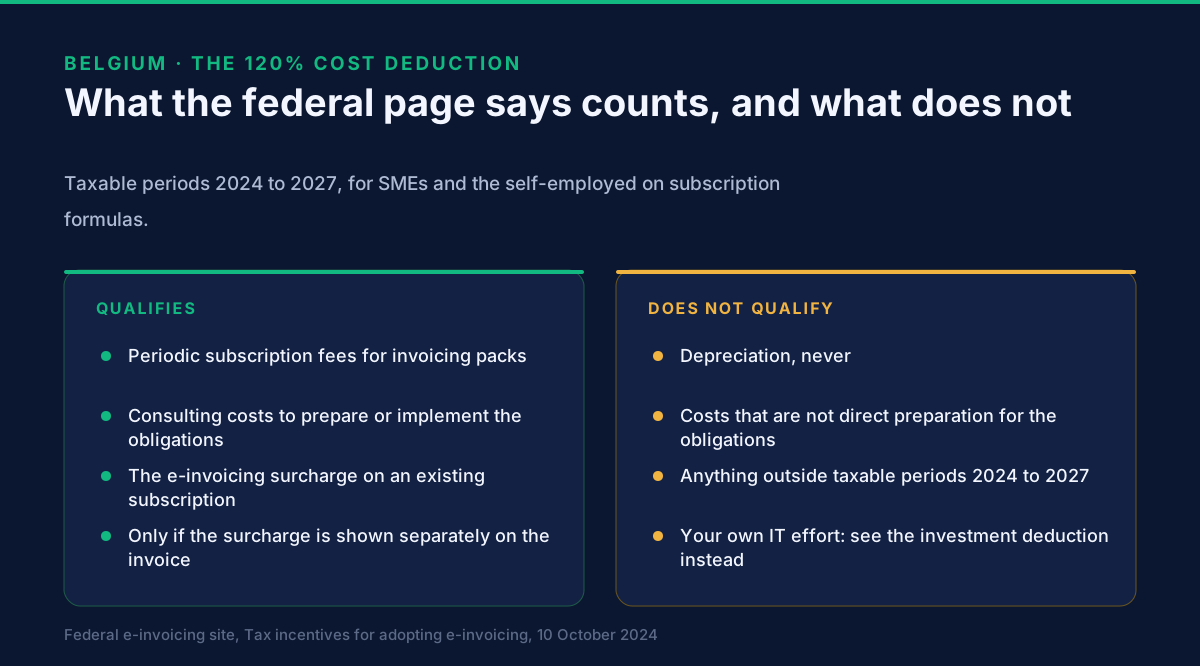
What qualifies:
- Periodic subscription fees for invoicing packs.
- Consulting costs incurred specifically to prepare for or implement the e-invoicing obligations.
- The additional cost of e-invoicing (issuing, sending and receiving structured invoices) on a software subscription you already had, if that extra cost is shown separately on the invoice.
What does not:
- Depreciation is never eligible for this cost deduction.
- Only direct costs of preparing for the invoicing obligations count, and the page says this deduction concerns costs the business chooses not to capitalise (book as an asset), or which do not qualify for capitalisation.
The reason for the 120% figure is stated plainly: it is meant to give equal tax treatment to these expenses whether the business pays for them as an investment or as an ordinary running cost.
What does 120% mean in euros?
The page calls it an "increased deduction of 120%". Our reading is that the cost is deducted at 120% of what you paid, so EUR 300 of qualifying subscription fees in a tax year would count as EUR 360 of deductible expense. The saving is then your corporate or personal tax rate applied to the extra amount, so it depends on your own position. Treat the figure as an illustration of the mechanism, not a forecast of a refund. The page does not give a worked example, and your accountant will confirm the arithmetic.
What about software I own or build?
The page separates this case. Your own IT effort may be considered under the existing increased investment deduction for digital fixed assets, or under the new basic increased investment deduction for digital investments from 1 January 2025. To qualify, the asset must fall into one of the categories listed in article 49/1 of the royal decree implementing the income tax code, and the other conditions of the investment deduction must be met. If you are weighing a build-versus-subscribe decision for your invoicing, this is a question to put to your accountant before you choose, because the two routes get different tax treatment.
Who is an "SME" here?
The page includes a definition of a small company, taken from the Belgian Code of Companies and Associations: a company that, at the balance-sheet date of the last closed financial year, does not exceed more than one of these limits: turnover EUR 11,250,000, balance sheet total EUR 6,000,000, or 50 employees. The page does not spell out how that definition connects to each measure, so do not assume the 120% deduction stops at the thresholds or extends beyond them. Ask your accountant how your company is classified.
Sole traders and the self-employed are named directly in the text. If you are one, our guide to small businesses and the Belgian e-invoicing mandate explains what the mandate itself asks of you.
What to ask your supplier
The one condition you can influence is the itemisation. If you already pay for accounting or invoicing software and the supplier adds e-invoicing to it, ask three things:
- Is the e-invoicing part a separate line on the invoice? The federal page requires the surcharge to be shown separately for the existing-subscription case.
- Does the invoice describe the line clearly? "Peppol e-invoicing, sending and receiving" is easier to defend than "platform fee".
- Is any consulting or set-up work billed as its own line? The page treats consulting costs as a separate category.
Keep the invoices. The page says nothing about forms or box numbers, so your accountant will decide where the figure goes in the return.
What the page does not tell you
Stating the gaps matters. The federal page does not say how the deduction appears on the tax return, whether it can be combined with other incentives for the same cost, or what happens for tax years after 2027. We have not found a statement on any of these in the sources we read, and we are not going to fill the gap with guesses. The measure is described for taxable periods 2024 to 2027, so plan on that window unless the government publishes more.
What to do next
- Tell your accountant about the measure and ask whether your company qualifies.
- Ask your software supplier to itemise the e-invoicing cost on your invoices.
- Do not wait for the tax return to decide how you will send and receive: the mandate has applied since 1 January 2026. The penalties article shows what non-compliance costs, and the Belgium overview sets out scope, format and identifiers.
If you also sell to public bodies, read how to invoice the Belgian government through Mercurius. If you issue invoices on behalf of your suppliers, read self-billing in Belgium.
To see how GoRoute sends and receives Peppol invoices and itemises your account, book a session. Recorded walkthroughs are on tutorials, and the technical reference is in the developer documentation. If you run a shop, the Belgium WooCommerce plugin page describes the shop route.
Sources: Tax incentives for adopting e-invoicing (French; 10 October 2024) and Who is concerned by the B2B obligation, both on the federal e-invoicing site run by FPS BOSA; software list published by FPS Finance. This page summarises government guidance and is not tax advice. Confirm your own position with your accountant.
Frequently asked questions
- Is there a tax deduction for e-invoicing costs in Belgium?
- Yes. The federal e-invoicing site says that for taxable periods 2024 to 2027, SMEs and the self-employed who use subscription formulas can apply an increased deduction of 120% to invoicing packs and to consulting costs incurred to meet the new obligations.
- Which e-invoicing costs qualify for the 120% deduction?
- Periodic subscription fees for invoicing packs, and consulting costs incurred specifically to prepare or implement the obligations. The extra cost of e-invoicing on an existing software subscription qualifies if it is shown separately on the invoice. Depreciation never qualifies.
- Does the deduction cover software I buy outright?
- Not under the 120% cost deduction, which targets subscription and advice costs. The same page says your own IT effort may fit the increased investment deduction for digital assets, if the asset falls in a listed category and the other conditions are met. Ask your accountant.
- Does GoRoute qualify for the deduction?
- We cannot say. Whether a given invoice line qualifies depends on your company, your tax year and how the cost is itemised, and that is a question for your accountant. We do not give tax advice.
About Dr. Syed Raza
Dr. Syed Raza is an IT Enterprise Architect at ClayDesk LLC and leads the GoRoute platform. He works across Peppol Access Point and SMP infrastructure, PINT jurisdictions (Oman, AU/NZ, EU, JP, MY, SG), and national CTC regimes, translating regulatory detail into production-grade e-invoicing systems.
Building on Peppol?
GoRoute is a certified Peppol Access Point & SMP. Book a demo or read the docs to get started.