
How to Invoice the Belgian Government Through Mercurius
For public contracts published after 1 March 2024, Belgian buyers need a Peppol e-invoice. How Mercurius routes it, what to put on it, and why invoices bounce.

The short answer
To invoice a Belgian public body, send a structured electronic invoice in the Peppol BIS Billing 3.0 format to the buyer over the Peppol network. A PDF by email is not enough. For public contracts published after 1 March 2024 this is compulsory, and it generally applies from contracts of EUR 3,000 excluding VAT. Mercurius is the federal "electronic mail room" that receives your invoice and passes it to the public entity. Your own access point is what sends it.
The rest of this page covers which buyers require it and from when, what the invoice must carry, why invoices bounce, and what to do if you have no invoicing software yet. It is written for the finance lead of a supplier, not for the tender team.
Which public buyers require an e-invoice, and from when?
All of them, but the dates differ by level of government. The rules were built up over several years, so a supplier with an old contract may have been invoicing electronically for longer than the 2024 date suggests.
| Level | Rule | Source |
|---|---|---|
| Federal | Public bodies must be able to receive EN 16931 e-invoices (federal law of 7 April 2019). Suppliers must send them for contracts published after 1 March 2024 (Royal Decree of 9 March 2022). | European Commission, einvoice.belgium.be |
| Flanders | E-invoices mandatory for suppliers of all regional entities from 1 January 2017. | European Commission |
| Brussels-Capital Region | Only e-invoices accepted for public contracts of the region's administrations from 1 November 2020. | European Commission, einvoice.belgium.be |
| Wallonia | E-invoices preferred from 1 January 2022. PDF and Word invoices no longer accepted, but invoices outside the legal obligation can still go by post. | European Commission |
Two details catch suppliers out.
The threshold is a default, not a ceiling. The federal guidance says the obligation generally applies to contracts of EUR 3,000 or more excluding VAT, that contracting authorities may be stricter in their contract documents, and that federal authorities have imposed e-invoicing below EUR 3,000 as well since 1 March 2024. Read the invoicing clause of your own contract.
The date is the publication date of the contract. A contract published before 1 March 2024 may still be invoiced the old way, unless the buyer's own rules say otherwise. If you hold both old and new contracts with the same authority, expect to run two invoicing routes for a while.
What does Mercurius actually do?
Mercurius receives invoices sent to Belgian public entities and forwards them to the right recipient. The federal site compares it to a mail room: you choose any Peppol operator you like, and Mercurius makes sure the invoice reaches the public entity.
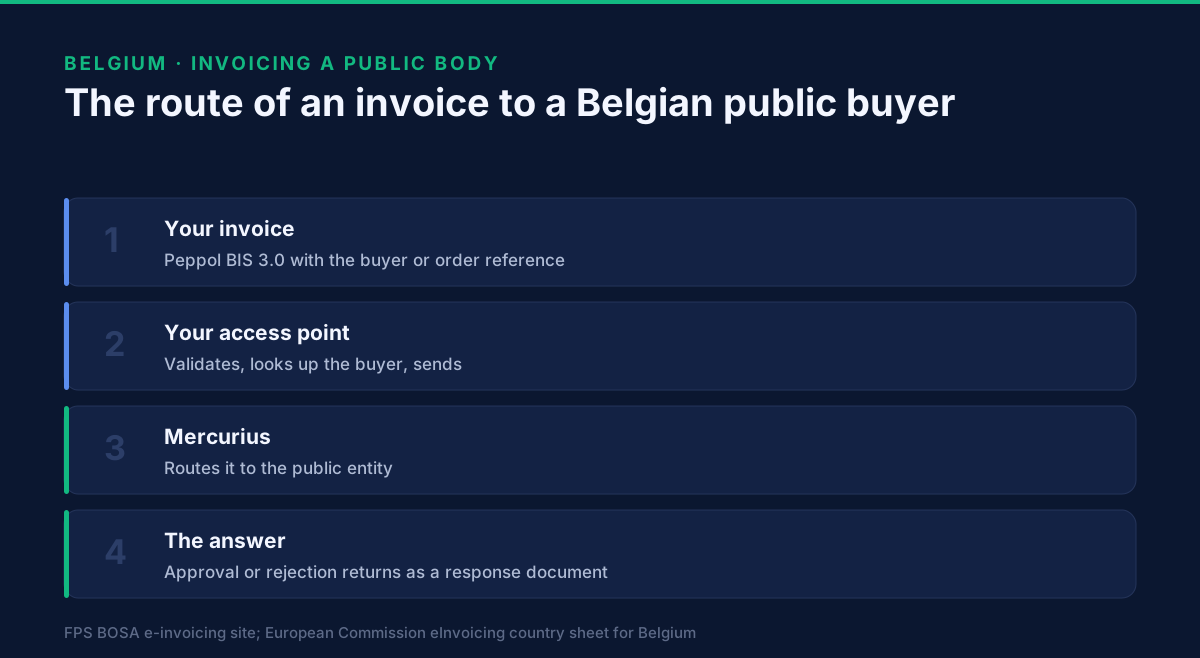
It does more than one direction. According to the same page:
- Approvals and rejections from the public entity come back as response documents, which Mercurius routes to the supplier.
- Public bodies can send their own invoices to companies through it.
- Purchase orders in structured form can be routed through it as well.
- A web portal lets suppliers, public entities and IT operators follow how an invoice is routed and processed.
So Mercurius is a routing and tracking layer. It does not create your invoice, and it does not replace your Peppol connection. If your software already sends Peppol invoices, the federal guidance says you can send to public entities today.
What must the invoice carry?
An invoice that validates against Peppol BIS Billing 3.0 is the starting point. Belgium publishes no national variant, so the plain Peppol specification is the whole technical requirement (European Commission). Three things matter more with a public buyer than with a private one.
A reference the buyer can match. The Peppol rule PEPPOL-EN16931-R003 says a buyer reference or a purchase order reference must be provided. In the UBL file these are cbc:BuyerReference and cac:OrderReference/cbc:ID. Public buyers match invoices against an order or a contract, so copy the reference exactly as the authority wrote it. The Commission's country page also lists the invoice reference, VAT number and bank account among the key details an invoice must include.
The right buyer identifier. Your invoice is addressed to the buyer's Peppol identifier, and your access point looks it up before sending. Belgian organisations are identified by their enterprise number under Peppol scheme 0208, and the number has a check digit; a malformed one is rejected outright. Our guide to the Belgian enterprise number and scheme 0208 shows how to test it. Take the number from the contracting authority's own instructions in the tender or contract, and check it in the Peppol Directory before you send.
Attachments inside the invoice. If you must send a timesheet or a delivery note, the federal FAQ says attachments must travel through the same channel as the invoice, not by separate email. A UBL invoice can carry them directly. Sending them separately delays processing and, in the FAQ's words, conflicts with the law, because attachments that supplement an invoice are part of it.
Corrections follow the same rule: a credit note is a structured document, type code 381, not an emailed PDF.
Why do invoices to public buyers bounce?
Most failures fall into one of five groups.
- The invoice is not structured. A PDF, a Word file or a PDF with an XML file beside it is not a structured invoice. Brussels and Wallonia both state that such formats are no longer accepted for in-scope contracts.
- The buyer cannot be found. The identifier is wrong, or the entity is not registered under the number you used. The send fails at lookup, before any invoice is delivered.
- The invoice fails validation. A missing buyer or order reference breaks rule R003. A malformed enterprise number breaks
PEPPOL-COMMON-R043. Our list of validation errors you can prevent covers the common ones. - The reference does not match. The invoice is delivered but the authority cannot link it to an order, so it is rejected or parked. The rejection comes back as a response document, which is why you should watch the response status and not only the send status.
- The wrong channel was used for part of it. An attachment emailed separately, or an invoice sent outside Peppol without the buyer's agreement.
The first three fail before the buyer sees anything. Groups four and five are the ones that cost you weeks, because the invoice looks sent.
What if you have no invoicing software yet?
The Mercurius portal lets you key an invoice or credit note by hand to a public authority. The federal guidance describes this as a stop-gap for suppliers who do not yet have a tool, and says the portal function will matter less as more suppliers equip themselves. It strongly encourages buying an e-invoicing tool or upgrading the one you use.
For a supplier with more than a handful of public invoices a month, hand entry is slow and it is where reference typos creep in. The better path is to post invoices from your accounting system to an access point and let it build, validate and send the Peppol file. GoRoute operates certified Peppol access point POP000991; the e-invoice sending page shows the flow, the API integration guide covers ERP connections, and the test bed guide shows how to try a document before you send a real one.
Is Mercurius going away?
Possibly in its current form. The European Commission's Belgium country page, last updated on 16 October 2026, describes the Mercurius platform as running "until December 2026" and mentions a transition to a new platform for contracting authorities. We did not find the new platform's name or start date in the Belgian federal sources we read, and we will not guess it.
What this means for a supplier is our reading, not an announcement: you address the invoice to the buyer's Peppol identifier through your access point, so a change of platform on the buyer's side should not change how you send. Ask each contracting authority which receiving route it will use from January 2027 and update your records when it answers.
What to do this week
- List your Belgian public customers and the date each contract was published.
- For each, find the buyer's enterprise number and the reference it requires on invoices.
- Test one invoice per authority in a sandbox, including a credit note.
- Check your send logs for response documents, not just delivery confirmations.
Private-sector customers follow a different rule set, covered in the Belgium overview and in Belgium B2B e-invoicing in 2026. If you sell to public bodies and also self-bill, small-business, or tax-relief questions apply to you, the rest of this series answers them: self-billing in Belgium, small businesses and the mandate and the 120% tax deduction for e-invoicing costs. If a late invoice has already drawn attention, read Belgian e-invoicing penalties.
To walk a real public-sector invoice flow through our access point with the team, book a session. The recorded walkthroughs are on tutorials and the technical reference is in the developer documentation.
Sources: FPS BOSA e-invoicing site (E-invoicing to the government; Mercurius: the electronic mail room; E-invoicing within Belgian public authorities); European Commission, eInvoicing in Belgium, updated 16 October 2026; Peppol BIS Billing 3.0, rule PEPPOL-EN16931-R003. This is not legal advice; confirm the rules of your own contract with the contracting authority.
Frequently asked questions
- Is e-invoicing mandatory for Belgian government contracts?
- Yes. The federal e-invoicing site says electronic invoicing is compulsory for public contracts published after 1 March 2024. It generally applies to contracts worth 3,000 euro or more excluding VAT, and federal contracting authorities also require it below that value. A contracting authority can be stricter in its contract documents.
- What is Mercurius?
- Mercurius is the federal platform that receives electronic invoices sent to Belgian public entities and passes them on to the entity concerned. It has a web portal where suppliers can follow how an invoice is routed and processed, and where they can issue an invoice or credit note by hand if they have no invoicing software.
- Do I need a Peppol access point to invoice a Belgian public body?
- In practice yes, unless you use the Mercurius portal to key invoices by hand. Invoices to public buyers travel over the Peppol network in the Peppol BIS Billing 3.0 format, so you need software connected to Peppol, which means an access point such as GoRoute.
- What reference does a Belgian public buyer need on the invoice?
- The Peppol BIS Billing 3.0 rules require a buyer reference or a purchase order reference on every invoice (rule PEPPOL-EN16931-R003). Use the reference the contracting authority gave you in the order or contract, because that is what lets the buyer match the invoice.
- Will Mercurius still exist in 2027?
- The European Commission's Belgium country page, updated on 16 October 2026, lists the Mercurius platform as running until December 2026, followed by a transition to a new platform for contracting authorities. The sources we read do not yet name the replacement or its start date.
About Dr. Syed Raza
Dr. Syed Raza is an IT Enterprise Architect at ClayDesk LLC and leads the GoRoute platform. He works across Peppol Access Point and SMP infrastructure, PINT jurisdictions (Oman, AU/NZ, EU, JP, MY, SG), and national CTC regimes, translating regulatory detail into production-grade e-invoicing systems.
Building on Peppol?
GoRoute is a certified Peppol Access Point & SMP. Book a demo or read the docs to get started.