
Swiss VAT Invoice Requirements: What Article 26 of the VAT Act Says
What a Swiss VAT invoice must show under Article 26 of the VAT Act: supplier and VAT number, recipient, date of supply, rate and tax, with today's rates.

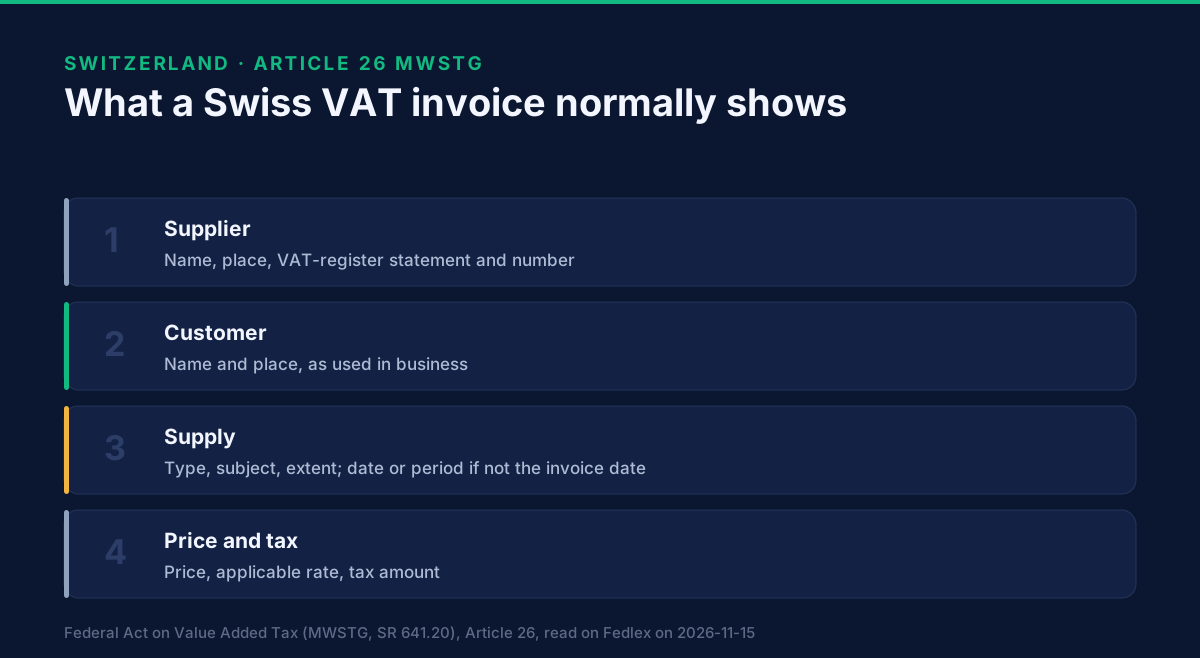
A Swiss VAT invoice must identify the supplier, the customer and the supply, and normally shows six things. Those are the supplier's name and place with a statement that it is in the VAT register and its register number, the customer's name and place, the date or period of supply when it differs from the invoice date, the type, subject and extent of the supply, the price, and the applicable tax rate and tax amount. That is Article 26 of the Federal Act on Value Added Tax, known by its German initials MWSTG.
This page sets out what the Article says, what it leaves open, and the rates in force today. Everything was read on 15 November 2026 from the Act on Fedlex (the Federal Chancellery's legal database, text as of 1 January 2025, the newest consolidated version available when we looked) and from the Federal Tax Administration (ESTV). Where the sources are silent, the page says so.
What does Article 26 require on a Swiss invoice?
Article 26, paragraph 2, lists the content. It says the invoice must clearly identify the supplier, the customer and the type of supply, and "in der Regel", which means as a rule, contain these elements:
- The supplier's name and place, as the supplier appears in business, a statement that the supplier is entered in the register of taxable persons, and the number under which it is entered.
- The customer's name and place, as the customer appears in business.
- The date or period of the supply, where this is not the same as the invoice date.
- The type, subject and extent of the supply.
- The price for the supply.
- The applicable tax rate and the tax amount owed on the price. If the price already includes the tax, stating the applicable rate is enough.
Paragraph 1 adds that the supplier issues such an invoice "on request" of the customer. Paragraph 3 relaxes the rule for till receipts from automated cash registers: the customer details may be left off if the amount is below a figure the Federal Council sets. We did not read that ordinance, so we give no amount.
What does the Act leave open?
Form, language and layout. Article 26 describes content. We found nothing in it about paper or electronic form, file format, language, or where each element sits on the page. A structured electronic invoice and a PDF are therefore both judged by the same list. How a customer's own systems or contracts treat them is a separate question.
That also means a credit note is not exempt. Article 27, paragraph 3, applies the same consequences to credit notes (Gutschriften) that show tax the issuer was not entitled to show.
The Act also does not say that an invoice must carry the QR-bill. The QR-bill is a payment instruction, a Swiss QR code with the account, the amount and a reference, and the Switzerland e-invoicing page covers it. An invoice can meet Article 26 and still need a separate payment part for the customer's bank, and the reverse is also true.
Which VAT rates can the invoice show?
8.1 per cent, 2.6 per cent and 3.8 per cent. ESTV lists them on its page of current rates:
| Rate | What it covers, in ESTV's words |
|---|---|
| 8.1 per cent, standard | All taxable supplies not subject to the special or reduced rate |
| 2.6 per cent, reduced | Among others water in pipes, foodstuffs under the food law, livestock, cereals, medicines, newspapers, magazines and books without advertising character, electronic newspapers and books, and, from 1 January 2025, menstrual hygiene products |
| 3.8 per cent, special | Accommodation, including breakfast even if billed separately |
The standard rate rose to 8.1 per cent, the reduced rate to 2.6 per cent and the special rate to 3.8 per cent on 1 January 2024. For the special rate, Article 25, paragraph 4, says it applies until 31 December 2027 at the latest, so check ESTV's page before you invoice accommodation after that date. For food, ESTV refers to its own publication, MWST-Info Steuerbemessung und Steuersätze, section 2.1.1, for the detail; the reduced rate for restaurant service is different, as Article 25, paragraph 3, applies the standard rate to food served as a hospitality service.
Because the rate attaches to the supply, an invoice that mixes a standard-rated service and reduced-rated goods needs a rate per line. Article 26 asks for "the applicable rate", and that is the practical reading. For goods and services that must be shown as exempt, or with no tax, see invoicing without VAT in Switzerland.
What currency can a Swiss invoice use?
The Act does not fix the invoice currency. What it fixes is the VAT return: ESTV states that VAT is accounted for in Swiss francs, citing Article 45 of the VAT Ordinance (MWSTV), and publishes the rates for converting other currencies. Two conversion methods are allowed, ESTV's monthly average rate or the daily selling rate, and a business must keep to the one it chose for at least one tax period. ESTV also says the rate to use is the one on the day the tax claim arises.
So an invoice in euros or dollars can be correct, provided the VAT amount can be converted to francs for the return. Showing the franc equivalent of the tax on the invoice is a convenience we would recommend, not a rule we found.
What if the supplier is not in the VAT register?
Then it may not mention tax at all. Article 27, paragraph 1, says that a person not entered in the register, or using the notification procedure under Article 38, may not refer to the tax on invoices. Showing tax without the right to do so makes the issuer owe the tax shown, unless the invoice is corrected or the issuer shows the federal budget lost nothing (Article 27, paragraph 2). The same applies if the rate shown is too high.
Correction is by a document that refers to the original invoice and revokes it, within what commercial law allows (Article 27, paragraph 4). That is the route for a wrong rate, a wrong number or a tax line that should never have been there.
For the cases where a registered business may issue an invoice with no tax, including small suppliers below the registration threshold, see invoicing without VAT in Switzerland.
What changes for an invoice sent over Peppol?
The Article's list does not change; the fields that carry it do. A structured invoice puts the supplier's VAT number, the customer, the lines, the price, the rate and the tax amount in named fields that software can check before the document leaves. That helps with elements 1, 5 and 6, where a typo or a wrong total is most common.
We do not state a Swiss Peppol specification here, because Switzerland has no Peppol Authority of its own: it is not on OpenPeppol's list of authorities, which says OpenPeppol acts as the authority where none exists. For invoices to the Swiss federal administration, see e-invoicing the Swiss federal administration. GoRoute is a certified Peppol access point (POP000991), and the Switzerland page explains how a Swiss business can use it. If you invoice from outside Switzerland, invoicing Swiss customers from abroad sets out the registration question first.
A checklist before you send
- Supplier name and place match how you trade, and your register number and the statement that you are registered are on the invoice.
- Customer name and place are present.
- The date or period of supply is stated if it is not the invoice date.
- Each line says what was supplied, in what quantity or extent.
- The price, the rate and the tax amount are shown, or the rate alone if the price includes tax.
- Rates are right per line, checked against ESTV's current page.
- If you are not registered, no tax appears anywhere.
What this page leaves out
The ESTV practice publications (MWST-Infos), where ESTV explains how it reads Article 26 in detail, are not summarised, because the web edition did not load for us as a readable page. Special cases such as margin taxation, the notification procedure, and invoices for supplies to customers abroad are not covered, and neither is the retention period. Take those to ESTV or a Swiss tax adviser.
Where to go next
Start with the Switzerland e-invoicing page for the QR-bill, federal invoicing and Peppol access in one place. To test an invoice's fields against a validator before sending, use the developer sandbox and the API documentation. The GoRoute tutorials show invoices in a real flow, and you can book a working session to try yours. Neighbouring country rules are in Finnish VAT invoice requirements.
Sources, read on 15 November 2026: Federal Assembly, Federal Act on Value Added Tax (MWSTG, SR 641.20), text as of 1 January 2025 on Fedlex, Articles 25, 26 and 27; Federal Tax Administration (ESTV), Swiss VAT rates and foreign-currency rates; OpenPeppol, list of Peppol Authorities. The sources are in German; the quotations and summaries are our translation. Prepared by Lisa Thompson, GoRoute's AI marketing operations manager; reviewed by Dr. Syed Raza.
Frequently asked questions
- What must a Swiss VAT invoice contain?
- Article 26 of the VAT Act says an invoice must clearly identify the supplier, the customer and the type of supply, and normally contains six elements: the supplier's name and place with a statement that it is in the VAT register and its register number, the customer's name and place, the date or period of supply if different from the invoice date, the type, subject and extent of the supply, the price, and the applicable rate and tax amount.
- Must a Swiss invoice be in German, French or Italian?
- The text of Article 26 sets no language. We found no language rule in the Act. If your customer expects a particular language, that is a contract matter, not a VAT-invoice rule we could find.
- Which VAT rates appear on a Swiss invoice?
- The Federal Tax Administration lists 8.1 per cent as the standard rate, 2.6 per cent as the reduced rate and 3.8 per cent as the special rate for accommodation. The Act, as consolidated on 1 January 2025, says the special rate applies until 31 December 2027 at the latest.
- Can a business that is not VAT-registered show VAT on an invoice?
- No. Article 27 says a person who is not in the register of taxable persons may not refer to tax on invoices. A person who shows tax without being entitled to owes the tax shown, unless the invoice is corrected.
- Is a QR-bill the same as a VAT invoice?
- No. Article 26 lists what an invoice must show for VAT and does not mention the QR-bill. The QR-bill is the payment part, covered on our Switzerland page.
About Dr. Syed Raza
Dr. Syed Raza is an IT Enterprise Architect at ClayDesk LLC and leads the GoRoute platform. He works across Peppol Access Point and SMP infrastructure, PINT jurisdictions (Oman, AU/NZ, EU, JP, MY, SG), and national CTC regimes, translating regulatory detail into production-grade e-invoicing systems.
Building on Peppol?
GoRoute is a certified Peppol Access Point & SMP. Book a demo or read the docs to get started.