
Invoicing Without VAT in Switzerland: When It Is Allowed
When a Swiss invoice carries no VAT: below the CHF 100,000 registration limit, exempt supplies, exports and services abroad, and what each invoice may say.

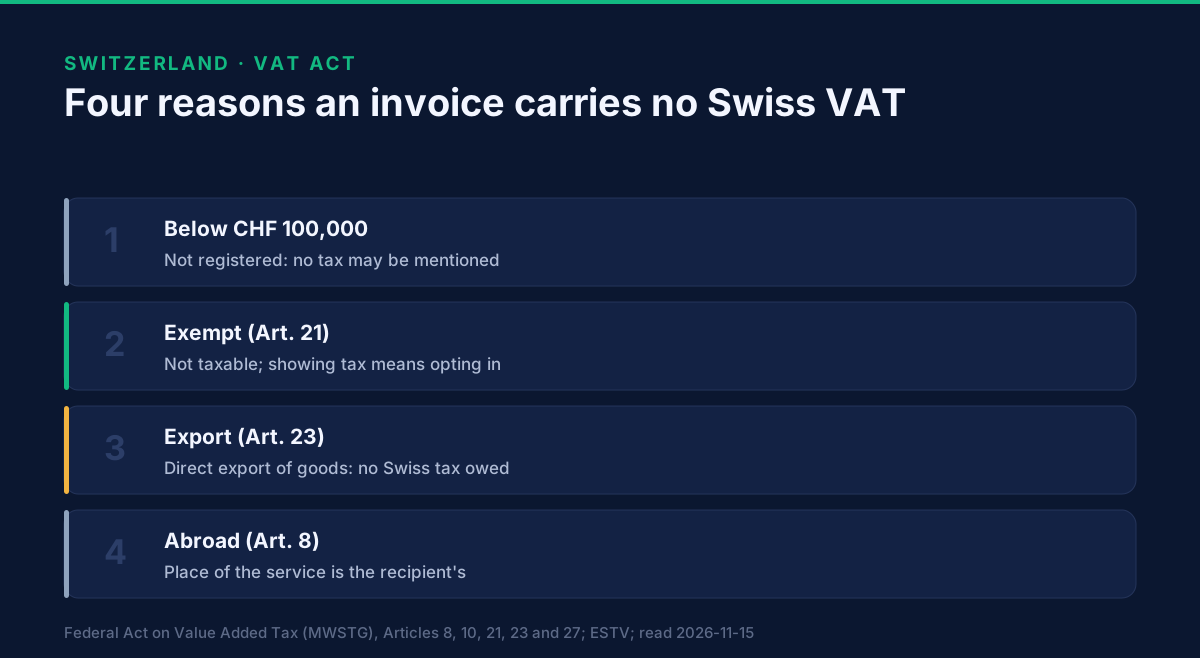
A Swiss invoice carries no VAT for one of four reasons, and they are not interchangeable. The supplier may be below the registration limit of CHF 100,000 and not registered; the supply may be exempt under Article 21 of the VAT Act; it may be a direct export of goods, exempt under Article 23; or the place of a service may be abroad. Which one applies decides what the supplier may say on the invoice and what it owes.
This page sets out each case. Everything was read on 15 November 2026 from the Act on Fedlex (the Swiss federal legal database, text as of 1 January 2025) and from the Federal Tax Administration (ESTV). It does not give tax advice, and it says where the sources are silent. For what a normal invoice must show, see Swiss VAT invoice requirements.
When is a Swiss business below the VAT limit?
When its yearly turnover from non-exempt supplies is under CHF 100,000. Article 10, paragraph 2, exempts from liability a business that earns less than CHF 100,000 a year, in Switzerland and abroad, from supplies that are not exempt under Article 21. Turnover is worked out on the agreed prices without the tax (paragraph 2bis).
ESTV says which supplies count towards the limit:
- Taxable supplies in Switzerland.
- Supplies abroad, if they would be taxable had they been made in Switzerland.
- Domestic supplies that are exempt under Article 23 ("von der Steuer befreit"), such as direct exports.
It says these do not count: supplies exempt under Article 21 in Switzerland, abroad supplies that would have been exempt, receipts that are not payment for a supply such as donations and subsidies, and income outside business activity. Sports and culture clubs run on a voluntary, non-profit basis, and charities, have a limit of CHF 250,000.
Below the limit, a business may still register voluntarily, at the earliest from the start of a running tax period. ESTV advises anyone who exceeds a limit to complete its registration questionnaire to find out whether liability applies.
What does an unregistered supplier put on its invoice?
No tax, and no reference to tax. Article 27, paragraph 1, says a person who is not in the register of taxable persons may not refer to the tax on invoices. A person who shows tax without being entitled to owes the tax shown, unless the invoice is corrected by a document referring to the original and revoking it, or unless the issuer shows that the federal budget lost nothing (Article 27, paragraphs 2 and 4).
We found no prescribed notice text, in Article 26 or 27, for an invoice without tax. If you add a line explaining why no tax is shown, keep it neutral and avoid anything that reads as a tax rate, and have a Swiss adviser confirm the wording. That is our practice suggestion, not a rule.
What is an exempt supply, and what does the invoice show?
A supply listed in Article 21, paragraph 2, is not taxable. The list includes hospital and medical treatment by licensed practitioners, nursing care, child care, education and training of certain kinds, and several financial supplies. Article 21, paragraph 1, says a supply that is exempt and not opted for "is not taxable".
Two consequences follow for the invoice:
- No tax is shown. The supplier charges the price without VAT.
- Input tax on the supplier's own costs is a separate question. We did not read the input-tax rules, so we say nothing about it here. ESTV or an adviser will.
ESTV adds an important detail: exempt supplies can be opted into tax, and the option is exercised simply by showing the tax openly on an invoice or declaring it in the return. An invoice for an exempt supply that shows tax is therefore not a mistake; it is a decision, with consequences. ESTV lists supplies that cannot be opted, including certain insurance supplies, various money and capital transactions, gambling, residential property and a business using flat-rate or balance tax rates.
Is an export invoice zero-rated in Switzerland?
No. The Act has no zero rate. Article 25 lists a standard rate of 8.1 per cent, a reduced rate of 2.6 per cent and a special rate of 3.8 per cent for accommodation, and no rate of nought. A direct export of goods is something else: Article 23, paragraph 2, number 1, makes the supply of goods that are transported or sent directly abroad "von der Steuer befreit", which means exempt from tax. Article 23, paragraph 1, says that for such a supply no domestic tax is owed. The Act uses a different word, "ausgenommen", for the Article 21 supplies above, and the difference matters for the turnover limit.
Paragraph 3 defines a direct export as one where the goods leave Switzerland, or enter an open customs warehouse or duty-free warehouse, without being used in Switzerland first. For chains of supplies the direct export covers all the suppliers in the chain. Goods may be processed before export by agents of a customer that is not taxable.
Two practical points. The turnover from exports counts towards the CHF 100,000 limit, as ESTV lists domestic supplies exempt under Article 23 among those that count. And the evidence for an export, usually the customs export declaration, is a matter for customs rules that we did not read, so keep it and ask your forwarder or adviser what proof is needed.
What about services for customers abroad?
They usually fall outside Swiss VAT, because of where the service is made. Article 8, paragraph 1, says the place of a service is, as the general rule, where the recipient has its seat of business activity or a permanent establishment for which the service is provided. A Swiss supplier of consulting or software services to a company in another country therefore normally does not charge Swiss VAT. Paragraph 2 lists exceptions, for example services given in person to individuals and services on the ground at an event, where the place follows the supplier or the location.
What the invoice then shows is not prescribed in the text we read. Show the customer's full name and place, which are required in any case, and the nature of the service, because those facts carry the place of supply. A Swiss customer's side is the mirror image: a Swiss business that buys such a service from abroad may owe acquisition tax, explained in invoicing Swiss customers from abroad.
How does a structured invoice carry "no VAT"?
In an electronic invoice the reason for no tax is a field, not a sentence. An invoicing system that tags each line with a tax category and a reason can check that the exempt lines, the export lines and the taxed lines are separate, and that totals add up. That matters most for mixed invoices. The Peppol and EN 16931 standards have categories and reason fields of this kind; how a Swiss customer's system reads them is for the parties to agree, as the Switzerland page explains. Switzerland has no Peppol Authority of its own, so there is no Swiss-specific profile for us to quote here.
What this page leaves out
The VAT return, input-tax deduction, the proof needed for an export, the flat-rate methods and the notification procedure (a way to move assets without tax) are not covered, because we did not read those texts. The practice publications that ESTV maintains (MWST-Infos) did not load for us as readable pages. Foreign suppliers face a different question, answered in invoicing Swiss customers from abroad. The federal buyer's rules are in e-invoicing the Swiss federal administration.
Where to go next
The Switzerland e-invoicing page brings the VAT, QR-bill and Peppol subjects together. To test an invoice with exempt and taxed lines, use the developer sandbox and the API documentation. The GoRoute tutorials show a full send, and you can book a working session to try your own.
Sources, read on 15 November 2026: Federal Assembly, Federal Act on Value Added Tax (MWSTG, SR 641.20), text as of 1 January 2025 on Fedlex, Articles 8, 10, 21, 23, 25 and 27; Federal Tax Administration (ESTV), VAT liability. The sources are in German; the quotations and summaries are our translation. Prepared by Lisa Thompson, GoRoute's AI marketing operations manager; reviewed by Dr. Syed Raza.
Frequently asked questions
- When can a Swiss business invoice without VAT?
- When it is below the registration limit and not registered, when the supply is exempt under Article 21 of the VAT Act, when it is a direct export of goods under Article 23, or when the place of a service is abroad. Each case has a different VAT consequence, so the cause matters as much as the result.
- What is the Swiss VAT registration threshold?
- CHF 100,000 of turnover a year from supplies that are not exempt under Article 21, in Switzerland and abroad, according to Article 10 of the VAT Act and ESTV. Sports and culture clubs run on a voluntary basis and non-profit organisations have a limit of CHF 250,000.
- What must an invoice say if no VAT is charged?
- We found no prescribed wording. Article 27 only says that a person who is not registered may not refer to the tax. If you add a note, make it neutral, such as the reason for no tax, and have a Swiss adviser confirm it.
- Is an export in Switzerland zero-rated?
- The Act's list of rates in Article 25 has no zero rate. Direct exports of goods are exempt under Article 23, which says no domestic tax is owed on them. That is different from an exempt supply under Article 21.
- Can I show VAT on an exempt supply?
- Yes, for most of them. ESTV says that showing the tax openly on an invoice means the supplier has opted to tax an exempt supply. Some supplies cannot be opted, including certain insurance and finance supplies and residential property.
About Dr. Syed Raza
Dr. Syed Raza is an IT Enterprise Architect at ClayDesk LLC and leads the GoRoute platform. He works across Peppol Access Point and SMP infrastructure, PINT jurisdictions (Oman, AU/NZ, EU, JP, MY, SG), and national CTC regimes, translating regulatory detail into production-grade e-invoicing systems.
Building on Peppol?
GoRoute is a certified Peppol Access Point & SMP. Book a demo or read the docs to get started.