
Invoicing Swiss Customers From Abroad: Registration, Reverse Charge and Import VAT
When a foreign supplier must register for Swiss VAT, how acquisition tax works on services to Swiss businesses, and who pays import VAT on goods.

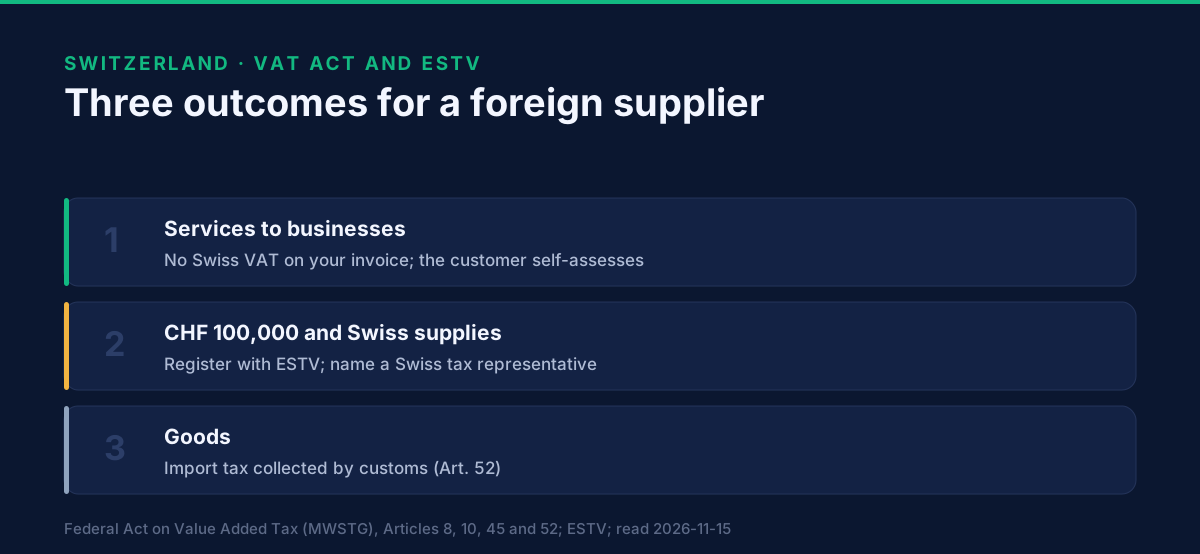
A foreign supplier that sells to Swiss customers has to answer one question before it writes an invoice: what is being supplied. A business-to-business service whose place is Switzerland is normally invoiced without Swiss VAT, and the Swiss customer pays acquisition tax on it. Goods are charged import tax by customs. A supplier registers for Swiss VAT only if it makes supplies in Switzerland and reaches CHF 100,000 of turnover a year, or is in one of the special cases.
This page sets out the three outcomes. Everything was read on 15 November 2026 from the VAT Act on Fedlex (the Swiss federal legal database, text as of 1 January 2025) and from the Federal Tax Administration (ESTV). The sources are in German and the summaries are our translation. It is not tax advice; where the sources are silent, we say so.
When must a foreign company register for Swiss VAT?
When it makes supplies in Switzerland and has turnover of at least CHF 100,000 a year. ESTV says every business that is based in Switzerland or makes supplies in Switzerland, and earns at least CHF 100,000 a year from taxable and exempt supplies, in Switzerland and abroad, is liable. That has applied since 1 January 2018. The turnover test is worldwide, not Swiss-only. Article 10, paragraph 1, makes liable a business that makes supplies in Switzerland or has its seat, residence or a permanent establishment there.
A business below CHF 100,000 is exempt from liability, but it may register voluntarily, and for a foreign business only if it makes supplies in Switzerland. A foreign business also stays out of liability, whatever its turnover, if its only supplies in Switzerland are of certain kinds (Article 10, paragraph 2b):
- Supplies exempt from tax under Article 23, such as direct exports.
- Supplies exempt under Article 21, such as medical treatment.
- Services whose place is Switzerland under Article 8, paragraph 1, which means services to a recipient based in Switzerland. The exception: a business that supplies telecommunications or electronic services to recipients who are not taxable persons is not relieved.
- Electricity, gas through the natural-gas network, and district heat supplied to taxable persons in Switzerland.
For the first three, the supplier is not liable, but the customer may be. The rest of this page covers that.
What is reverse charge on services to Switzerland?
Acquisition tax, which the Swiss customer accounts for. Article 45 puts services under acquisition tax (Bezugsteuer) when their place is Switzerland under Article 8, paragraph 1, and they are provided by a business based abroad that is not in the register of taxable persons. The exception again is telecommunications and electronic services to recipients who are not taxable persons.
ESTV gives examples of services that follow the recipient's location: advertising, advice from consultants, asset managers, trustees and lawyers, management services, data processing, personnel leasing, granting intangible rights, interactive distance courses, and services of event organisers. It adds that no acquisition tax is owed on a service that is exempt or exempted.
The customer is liable under Article 45, paragraph 2, if it is a taxable person, or if it buys more than CHF 10,000 of such services in a calendar year. A registered customer declares and pays the tax in its return. An unregistered customer becomes liable above the CHF 10,000 limit.
What does the foreign supplier's invoice show?
The service, the customer, and no Swiss VAT. Article 27, paragraph 1, says a person not in the register of taxable persons may not refer to the tax on invoices. A foreign supplier that is not registered therefore shows no Swiss tax, and a supplier that shows it anyway owes it, unless the invoice is corrected (Article 27, paragraphs 2 and 4).
We found no prescribed wording for a reverse-charge invoice to a Swiss customer, in the Act or in the ESTV pages we read. Practical suggestion, which is ours and not a rule: state the full legal name and place of the customer, since the customer's location is what fixes the place of the service (see Swiss VAT invoice requirements), describe the service clearly, and add a short neutral note that no Swiss VAT is charged and the recipient accounts for any acquisition tax. Have a Swiss adviser confirm the wording.
When does a foreign supplier register, and how?
Online with ESTV, naming a Swiss tax representative. ESTV says a liable business must register itself, online. A foreign business with no seat or permanent establishment in Switzerland must be represented by a person or company that has a residence or seat in Switzerland, and must name that person in the registration. ESTV says registrations without a representative are in principle impossible, with an exception for foreign platforms. The representative does not have to be a trustee, a lawyer or a member of any profession; it can be a private person.
ESTV also says it does not, as a rule, ask for security from a business based abroad, and keeps the right to ask for it later if the business misses its procedural duties (Article 94, paragraph 2). Registration brings the supplier's own number and the duty to show it on invoices under Article 26, as described in the lead guide.
Who pays import VAT on goods?
Customs collects import tax at the border. Article 52 puts the import of goods, with the services and rights contained in them, under import tax, and Article 50 applies customs law to it. Article 51 makes liable the person who is customs debtor under Article 70, paragraphs 2 and 3 of the Customs Act. Which party that is for a particular delivery depends on the terms of delivery and the customs declaration, and we did not read the Customs Act, so we do not state it. ESTV also says that if an unregistered foreign business imports material to do work in Switzerland, customs levies import tax on the total value of the work.
For mail-order sales ESTV sets a separate rule. A mail-order business, Swiss or foreign, with at least CHF 100,000 a year of turnover from small consignments sent from abroad to Switzerland has those supplies treated as domestic supplies. It becomes liable and must register. From registration, every consignment with import tax above CHF 5 also counts as a domestic supply. The registered business charges Swiss VAT to its buyers, and must see to it that the buyer is not charged import tax again, by giving the customs declarant the information that shows it is registered.
Foreign mail-order businesses must name a Swiss tax representative too (Article 67, paragraph 1).
What does Peppol change for a foreign supplier?
Not the tax. The rules above decide who accounts for Swiss VAT, whatever format the invoice has. A structured invoice only makes the facts that decide it, such as the customer's legal name and place, the supply description and a tax category or reason, explicit fields that software can check. Switzerland has no Peppol Authority of its own: it is not on OpenPeppol's list of authorities, which says OpenPeppol acts as the authority where none exists. GoRoute is a certified Peppol access point (POP000991); the Switzerland page explains how it fits into Swiss invoicing. For federal customers see e-invoicing the Swiss federal administration, and for invoices without tax see invoicing without VAT in Switzerland.
What should a foreign supplier do first?
- Classify each product: a service to a business, a service to a consumer, or goods.
- Count turnover worldwide against CHF 100,000, including exempt supplies under Article 23, but not Article 21 ones, as ESTV's liability page describes.
- For services to Swiss businesses, invoice without Swiss VAT and name the customer fully.
- For goods, ask your forwarder or customs broker who will declare the import, and whether the mail-order rule applies.
- If liable, register with ESTV and appoint a Swiss representative before you show any tax.
What this page leaves out
The customs procedure, the Customs Act, the VAT return, input-tax recovery for a foreign supplier, the platform rules in detail, and place-of-supply exceptions for services given on site are not covered, because we did not read those texts. Liechtenstein and the German municipality of Büsingen count as part of Switzerland for VAT, according to ESTV's mail-order page; check how that affects an invoice with your adviser.
Where to go next
For the full picture, see the Switzerland e-invoicing page. To check an invoice's fields before sending, use the developer sandbox and the API documentation. The GoRoute tutorials show invoices in a real flow, and you can book a working session to try yours.
Sources, read on 15 November 2026: Federal Assembly, Federal Act on Value Added Tax (MWSTG, SR 641.20), text as of 1 January 2025 on Fedlex, Articles 8, 10, 21, 23, 27, 45, 50, 51 and 52; Federal Tax Administration (ESTV), foreign companies, acquisition tax and mail order and platforms; OpenPeppol, list of Peppol Authorities. Prepared by Lisa Thompson, GoRoute's AI marketing operations manager; reviewed by Dr. Syed Raza.
Frequently asked questions
- When must a foreign company register for Swiss VAT?
- When it makes supplies in Switzerland and has at least CHF 100,000 of turnover a year from taxable and exempt supplies, in Switzerland and abroad, according to ESTV. A foreign business that only makes certain supplies in Switzerland, such as exempt supplies or B2B services whose place is Switzerland, is not liable.
- What is reverse charge on services in Switzerland?
- The Swiss law calls it acquisition tax (Bezugsteuer). On services supplied by an unregistered foreign business whose place is Switzerland under Article 8, paragraph 1, the Swiss customer owes the tax. The customer is liable if it is a taxable person, or if it buys more than CHF 10,000 of such services in a calendar year.
- Does a foreign supplier need a tax representative in Switzerland?
- Yes, if it is liable and has no seat or permanent establishment in Switzerland. ESTV says the representative must be named in the online registration, and that registrations without one are in principle not possible. Foreign platforms are an exception.
- Who pays import VAT on goods sent to a Swiss customer?
- Import tax is levied by customs, on the person who is customs debtor under the Customs Act (Article 51 of the VAT Act). A mail-order business with at least CHF 100,000 of turnover from small consignments must register and account for Swiss VAT on those supplies itself.
- Can a foreign supplier show Swiss VAT on an invoice?
- Only if it is registered. Article 27 says a person not in the register of taxable persons may not refer to the tax on invoices.
About Dr. Syed Raza
Dr. Syed Raza is an IT Enterprise Architect at ClayDesk LLC and leads the GoRoute platform. He works across Peppol Access Point and SMP infrastructure, PINT jurisdictions (Oman, AU/NZ, EU, JP, MY, SG), and national CTC regimes, translating regulatory detail into production-grade e-invoicing systems.
Building on Peppol?
GoRoute is a certified Peppol Access Point & SMP. Book a demo or read the docs to get started.