
E-Invoicing the Swiss Federal Administration: Who Must Send and How
How suppliers invoice the Swiss federal administration: electronic submission, PDF by email or structured data via PostFinance or Swisscom, small buys exempt.

Suppliers to the Swiss federal administration must submit their invoices electronically, according to the Federal Finance Administration (EFV), and small procurements are exempt from that duty. A supplier can send a PDF by email to the receiving unit, or send a structured data record through a service provider such as PostFinance or Swisscom. The EFV pages we read do not name Peppol as a channel.
This page sets out who is covered, the three channels, and what the EFV asks you to put on the invoice. Everything was read on 15 November 2026 from the EFV's own pages for suppliers. They are in German, and the summaries are our translation. Where the pages give no detail, such as the value of a "small procurement", this page says so.
Who must invoice the federal administration electronically?
Every supplier except for small procurements. The EFV's summary page says invoices to the Confederation (the Bund) must be submitted electronically and that "Kleinbeschaffungen sind von der Pflicht ausgenommen", small procurements are exempt from the duty. We did not find a franc amount for a small procurement on those pages, so we do not give one. If your order is small, ask the unit that ordered it whether the duty applies.
The EFV says that more than 90 per cent of invoices already arrive electronically: about 687,000 of roughly 750,000 invoices a year. It says the duty does not apply to all invoices, because of the small-procurement exemption.
The same pages cover the federal administration only. Cantonal and municipal buyers have their own rules, which we did not read. For the VAT content of any Swiss invoice, see Swiss VAT invoice requirements.
How can a supplier send an e-invoice to the federal administration?
By structured data through a service provider, by PDF over email, or by typing the invoice into a provider's portal. The EFV describes each.
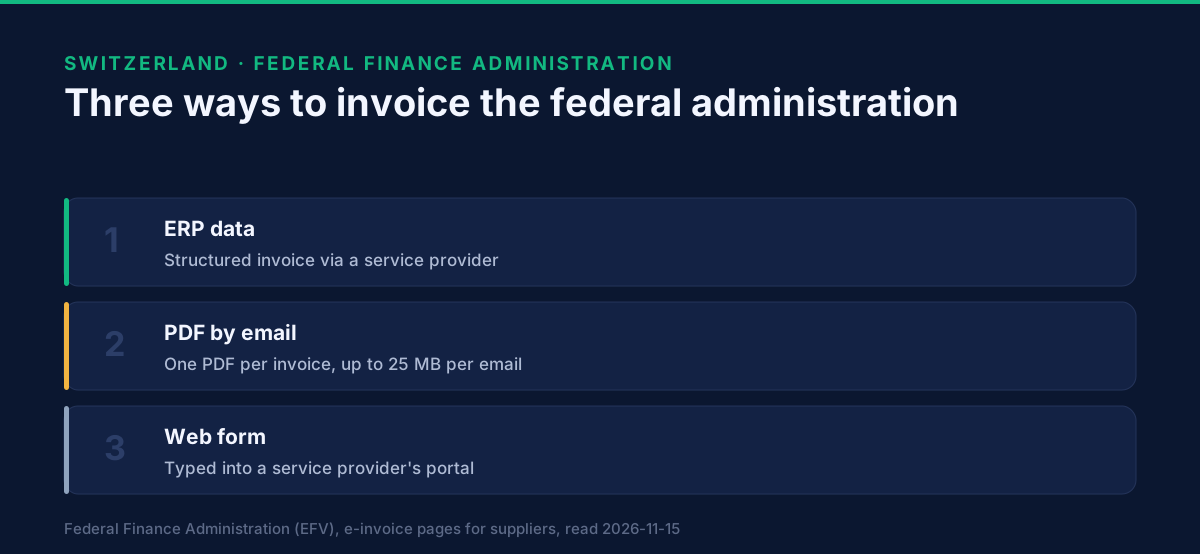
1. Structured invoice from your ERP system. Your system produces the invoice data and passes it to a service provider. The provider creates the legally compliant e-invoice, including the signature, and delivers it. The EFV says the data goes by the participant number in your customer master data, the "electronic invoice address". The federal administration names two providers it uses, PostFinance and Swisscom, and says you can also use other providers that have an interconnect with them. It lists ABACUS, io-market, PENTAG and StepCom among them. It asks you to test with the recipient and to state the invoice reference in every invoice.
2. PDF by email. Make one PDF per invoice, including any payment slip and attachments. Existing digital signatures are kept and stay valid. Several PDFs can go in one email, up to 25 MB. State the order reference in the PDF and send it to the address the EFV lists for the receiving unit. This channel is free of charge for invoices to the federal administration.
3. Online form. You type the invoice data into a form at the provider, which creates the signed e-invoice and delivers it. The EFV suggests this if you send the federal administration only a few invoices. It names PostFinance and Swisscom for this channel.
One change matters if you used to upload PDFs through a provider's portal. The EFV says that from 30 June 2023 the federal administration no longer takes PDF invoices through service providers. PDFs go by email only.
What does the EFV ask you to put on the invoice?
An order or invoice reference. All three channels carry the same instruction: always state the reference, so the administration can process the invoice efficiently. In the PDF it is the order reference, in a structured invoice or the online form it is the invoice reference field. The EFV does not set out the VAT content of the invoice on these pages; that comes from Article 26 of the VAT Act, covered in the VAT invoice requirements.
For a question about a particular invoice, the EFV gives the Financial Services Centre (DLZ FI) and its email address, e-rechnung@efv.admin.ch.
How are federal e-invoices paid?
The EFV says payment follows the recipient's approval and goes through the recipient's financial institution. The administration also lists the units that can receive e-invoices, and the e-invoicing participant directory eDirectory.ch lists Swiss-based companies and organisations that exchange structured invoices.
Is Peppol a federal channel?
Not according to the EFV pages we read. Nothing on them mentions Peppol. Switzerland also has no Peppol Authority of its own: it is not on OpenPeppol's list of national authorities, which says OpenPeppol acts as the authority where none exists. A Swiss or foreign supplier can use the Peppol network through an access point, and GoRoute is a certified one (POP000991). That is a statement about the network, not about the federal administration.
So we cannot say that a Peppol invoice from GoRoute or any other access point reaches the federal administration. If you want to try, ask the receiving unit in writing which format and address it accepts, and keep the answer. Until the EFV names it, use one of the three channels above for the federal administration, and use Peppol for the customers that accept it. The Switzerland page sets out how the two fit together.
What should a supplier do first?
- Find the receiving unit in the EFV's list of administrative units, and note its invoice address.
- Check whether the order is a small procurement, and ask the unit if the duty applies.
- Choose a channel. The EFV suggests the online form for a supplier with only a few invoices, and says many ERP systems can already produce the structured data for the provider.
- Carry the reference. Put the order reference on every invoice and build it into the template.
- Test one invoice with the receiving unit before the first live one.
What this page leaves out
The value that makes a procurement small, the file format the providers use inside their networks, cantonal and municipal buyers, and the VAT return are not covered, because the EFV pages do not state them and we did not find them elsewhere.
Where to go next
For the whole Swiss picture, see the Switzerland e-invoicing page. To check the structure of an invoice before it goes anywhere, use the developer sandbox and the API documentation. The GoRoute tutorials show an invoice from creation to delivery, and you can book a working session to test yours. Two companion pages cover invoicing without VAT in Switzerland and invoicing Swiss customers from abroad.
Sources, read on 15 November 2026: Federal Finance Administration (EFV), E-invoices in brief and Delivering an e-invoice to the Confederation; OpenPeppol, list of Peppol Authorities. The sources are in German; the summaries are our translation. Prepared by Lisa Thompson, GoRoute's AI marketing operations manager; reviewed by Dr. Syed Raza.
Frequently asked questions
- Must suppliers invoice the Swiss federal administration electronically?
- Yes. The Federal Finance Administration (EFV) says invoices to the Confederation must be submitted electronically, and that small procurements are exempt. Its page does not give a franc amount for small procurements.
- Can I send a PDF to the federal administration?
- Yes, by email. The EFV says a PDF with all invoice details, one PDF per invoice, goes to the address of the receiving unit, and several PDFs can share one email up to 25 MB. Since 30 June 2023 a PDF can no longer be submitted through a service provider.
- Does the Swiss federal administration accept Peppol invoices?
- The EFV pages we read do not mention Peppol. They name PostFinance and Swisscom as service providers and list others that connect to them. We cannot say that a Peppol invoice reaches the federal administration; ask the receiving unit.
- Which reference must the invoice carry?
- The EFV asks suppliers to always state the order reference in the PDF, or the invoice reference in the structured invoice, so the administration can process it efficiently.
- Does this cover cantonal or municipal buyers?
- No. The EFV pages concern the federal administration only. We did not read any cantonal or municipal rules.
About Dr. Syed Raza
Dr. Syed Raza is an IT Enterprise Architect at ClayDesk LLC and leads the GoRoute platform. He works across Peppol Access Point and SMP infrastructure, PINT jurisdictions (Oman, AU/NZ, EU, JP, MY, SG), and national CTC regimes, translating regulatory detail into production-grade e-invoicing systems.
Building on Peppol?
GoRoute is a certified Peppol Access Point & SMP. Book a demo or read the docs to get started.