
Stamp Duty on Italian E-Invoices: When the €2 Bollo Is Due
When an Italian e-invoice owes the €2 stamp duty, how the file declares it, and how the Agency's quarterly lists, dates and payment work (June 2026 guide).

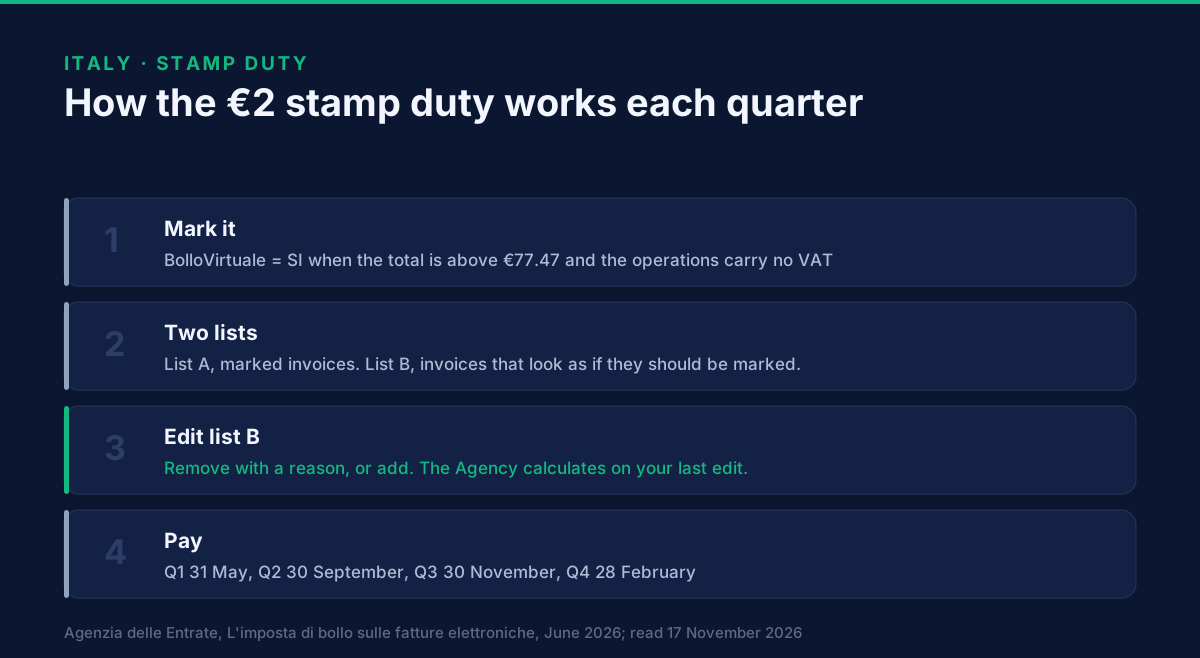
An Italian e-invoice owes €2 of stamp duty (imposta di bollo) when the total of its operations is above €77.47 and the operations carry no VAT: outside its scope, not taxable or exempt. The supplier declares it by setting the BolloVirtuale element of the file to SI. Each quarter the Agency then lists the invoices that carry the mark and the ones that look as if they should, and the supplier confirms or corrects the second list and pays by a fixed date. This page sets out those rules as the Agency's guide of June 2026 gives them.
It is for the accountant who has to get the duty right on a first Italian invoice for an exempt or non-VAT sale. It does not cover stamp duty on paper documents, and it gives no tax advice beyond what the Agency publishes. The element sits in the body of the file described in FatturaPA XML format, which names the field and nothing more.
When does an invoice owe the €2?
When it meets all three conditions the Agency lists for its proposed list of invoices.
- The sum of the amounts is above €77.47. The Agency counts the total-price field of each line in an ordinary invoice, and the amount field of a simplified invoice.
- The VAT nature field (
Natura) holds one of:N2.1orN2.2(operations not subject to VAT),N3.5orN3.6(not taxable), orN4(exempt). - The invoice does not carry one of the codes that signal that duty does not apply to this operation. They are set in the "other management data" block of an ordinary invoice, in the data type field:
NB1for an insurance document whose duty is absorbed in insurance tax,NB2for a document issued by a third-sector body, andNB3for a bank document where the duty is absorbed by the account statement duty.
Some invoices are excluded outright. The Agency lists document types TD16, TD17, TD18 and TD19 (the buyer's own integration and self-invoice documents) and TD28 (purchases from San Marino with VAT, on paper). It also excludes invoices whose fiscal regime field is RF05 to RF11, which the guide ties to the special VAT regimes of article 74 of the VAT act: salt and tobacco, matches, publishing, public telephony, transport and parking documents, entertainment, and travel agencies. It excludes documents issued in the ordinary layout to report cross-border transactions, which carry the recipient code XXXXXXX, a case explained in the SDI code page.
Because the NB codes sit in a block that only exists in the ordinary invoice, the Agency adds a consequence: a supplier who needs to say that duty does not apply must use an ordinary invoice, at least for those operations.
How does the file declare the duty?
With BolloVirtuale set to SI, in the stamp-duty block. The block has two elements in the schema: BolloVirtuale, required, and ImportoBollo, the amount, optional. The Agency's guide gives the field numbers 2.1.1.6.1 for the ordinary invoice and 2.1.1.5 for the simplified one.
One detail changes how you fill the amount. The Agency states that the content of ImportoBollo is not relevant. For every invoice marked with the duty, it determines an amount due of €2, whatever you put there.
The name causes a mix-up. The Agency's guide warns that this route must not be confused with the "virtual stamp" of article 15 of Presidential Decree 642/1972 for paper documents. That route needs an authorisation from the Agency, a virtual-stamp indication on the paper document, an annual declaration to settle the duty, and payment on form F24. The e-invoice route has none of these. The field has a similar name and a different procedure.
What does the Agency do each quarter?
It reads every invoice sent to SdI and processed without rejection, and builds two lists for the supplier. The Agency's guide describes them.
- List A, not editable. Invoices and the documents in the ordinary layout for cross-border data that carry
SI. Self-invoices of typeTD20that carry the duty, andTD16documents that carry it, go here too, for the buyer. - List B, editable. Invoices that meet the conditions above but carry no mark.
The lists are in the supplier's reserved area of the Fatture e Corrispettivi portal, and a delegated intermediary can see them too, if it holds the delegation for the consultation service. They are available by the 15th of the month after each quarter.
Which quarter an invoice falls in depends on the delivery date. For invoices to private recipients it is the date in the delivery receipt, or the availability date in the receipt of impossibility of delivery, if before the end of the quarter. For invoices to public bodies the Agency counts those delivered and accepted, delivered and lapsed (the lapse date does not count), and not delivered. The guide's example: an invoice dated and sent on 30 March, with a delivery date of 31 March, belongs to the first quarter. If the delivery date is 1 April, it belongs to the second. The messages are explained in SdI notifications.
What can you change in list B?
You can remove an invoice that does not owe the duty, and add one that does but is on neither list. Every removal needs a reason, which the Agency may verify. An added invoice must have been transmitted to SdI and processed without rejection, issued by you as seller (or, for a TD20 self-invoice, as buyer), and belong to the quarter in question and not to the one before or after.
Changes are made one by one on the portal, or in bulk by downloading the list as XML, editing it and uploading it. The Agency returns the result and any invoices it rejected, with reasons. List B can be changed more than once before the deadline, and the Agency calculates on the last version. If you pay before the deadline for changes, you can no longer change it. If you make no changes, the list the Agency proposed stands as confirmed.
When is the duty paid, and how?
By the date in the Agency's table, and by debit from a bank account or on form F24. The Agency calculates the duty and shows the amount by the 15th of the second month after the quarter, and the second quarter is shifted to 20 September.
| Quarter | Lists available | Last day to change list B | Amount shown | Payment due |
|---|---|---|---|---|
| 1st | 15 April | 30 April | 15 May | 31 May (see below) |
| 2nd | 15 July | 10 September | 20 September | 30 September |
| 3rd | 15 October | 31 October | 15 November | 30 November |
| 4th | 15 January | 31 January | 15 February | 28 February (29 in a leap year) |
Two allowances. If the first quarter's duty is not more than €5,000, it can be paid by 30 September. If the first and second quarters together are not more than €5,000, they can be paid by 30 November. When a date falls on a holiday it moves to the next working day.
To pay, enter on the portal the IBAN of an account in your name, and the amount is debited. Or pay on form F24, filed online, with these tax codes: 2521, 2522, 2523 and 2524 for the four quarters, 2525 for penalties and 2526 for interest. When a quarter's payment has been postponed to 30 September or 30 November, use the code of the quarter the duty is for, 2521 or 2522.
What if payment is late or missing?
The Agency writes to you, and you have 30 days to answer. For a late payment the portal calculates the penalty and interest for the voluntary-correction procedure. For a missed, partial or late one, the Agency sends a message to the certified-email address in the national register of PEC addresses (INI-PEC), stating the duty, the penalty under article 13(1) of Legislative Decree 471/1997 reduced to one third, and interest. Within 30 days of receiving it, you or your delegated intermediary can give clarifications to have the amounts recalculated. Help is by the online service CIVIS, or by appointment at an Agency office.
What is still open?
Three things, as of 17 November 2026.
- Who bears the duty between supplier and customer. The Agency's guide describes the supplier's obligation to the Agency. It does not say how the cost is shared with the buyer, and neither does this page.
- The legal text behind the guide. It cites article 6 of the Decree of 17 June 2014 and article 12-novies of Decree-Law 34/2019. We read article 6 as published in the Gazzetta Ufficiale of 26 June 2014. Its second paragraph there states a payment term (120 days from year end) that differs from the guide's quarterly table. We follow the guide, which is dated June 2026, and have not traced the amendment.
- The consolidated VAT text from 2027. The Agency's guide predates it, and we did not check whether it changes the duty.
What to do next
- Check the VAT nature of every invoice line. Only
N2.1,N2.2,N3.5,N3.6andN4operations above €77.47 are in scope. - Set
BolloVirtualetoSIon an invoice that is in scope and not excluded. - Diarise the four list dates and the four payment dates, and read list B each quarter, not only the payment screen.
- Keep the invoice after it is processed. How is in keeping Italian e-invoices.
- Public customers: read invoicing the Italian public administration for the codes and the refusal grounds.
- To talk through duties and dates for invoices in several countries, book a demo. The developer documentation, the tutorials and the GoRoute API show how documents are sent on the Peppol network, where GoRoute is a certified access point (POP000991).
Related reading
- E-invoicing in Italy, the country page.
- FatturaPA XML Format: Structure, File Name and Signature
- FatturaPA Document Types: The TD Codes
- SdI Notifications Explained: Every Message After You Send
Sources, all read on 17 November 2026: Agenzia delle Entrate, "L'imposta di bollo sulle fatture elettroniche" (guide dated June 2026) and the page of the same name on agenziaentrate.gov.it; Ministry of Economy and Finance Decree of 17 June 2014, article 6, in the Gazzetta Ufficiale n. 146 of 26 June 2014; the FatturaPA schema version 1.2.3. Translations from the Italian are ours.
Frequently asked questions
- When does an Italian e-invoice owe the €2 stamp duty?
- When the total of the operations is above €77.47 and the invoice carries a VAT nature code for operations outside the scope of VAT (N2.1, N2.2), not taxable (N3.5, N3.6) or exempt (N4), unless an exclusion applies. The Agency's guide gives these conditions for the list of invoices it proposes to the supplier.
- How does the invoice declare the stamp duty?
- By setting the element BolloVirtuale in the stamp-duty block of the file to SI. The Agency notes that the amount element is not relevant: for every invoice marked, it calculates €2 due.
- What if I forget to mark an invoice that owes the duty?
- The Agency finds it. For each calendar quarter it publishes two lists on the Fatture e Corrispettivi portal: list A of marked invoices, and list B of invoices that appear to owe the duty but were not marked. You can edit list B before the deadline, and the Agency calculates the duty on your last edit.
- When is the stamp duty paid?
- Quarterly. The first-quarter duty is due by 31 May, the second by 30 September, the third by 30 November and the fourth by 28 February (29 in a leap year). Smaller amounts can wait: first-quarter duty of up to €5,000 can be paid by 30 September, and first- and second-quarter duty of up to €5,000 together by 30 November.
- Is this the same as bollo virtuale on paper documents?
- No. The Agency warns against confusing them. The paper-document route needs an authorisation, an indication on the document, an annual declaration and payment on form F24. The e-invoice route is the quarterly lists on the portal.
About Dr. Syed Raza
Dr. Syed Raza is an IT Enterprise Architect at ClayDesk LLC and leads the GoRoute platform. He works across Peppol Access Point and SMP infrastructure, PINT jurisdictions (Oman, AU/NZ, EU, JP, MY, SG), and national CTC regimes, translating regulatory detail into production-grade e-invoicing systems.
Building on Peppol?
GoRoute is a certified Peppol Access Point & SMP. Book a demo or read the docs to get started.