
Invoicing the Italian Public Administration
What an Italian public body accepts: the six-character office code from IPA, CIG and CUP, split payment, the five legal grounds for refusal, and NSO orders.

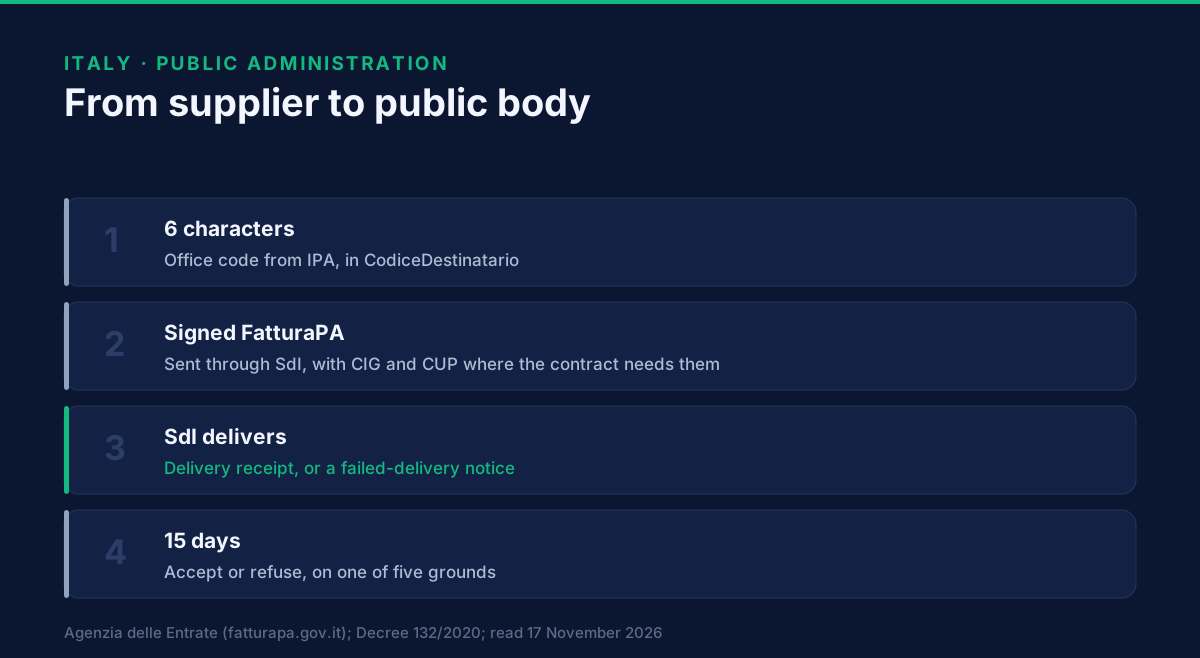
To invoice an Italian public body, send a signed FatturaPA file through SdI, the Sistema di Interscambio (Italy's national invoice exchange system), addressed to the six-character office code that the body's office holds in the public index, IPA. The Agency says FatturaPA is the only type of invoice accepted by the public bodies required to use SdI. A paper invoice cannot be accepted, and cannot be paid. Everything else on this page is the detail that decides whether the file is delivered and whether it is kept.
This page is for the finance lead at a supplier who has won an Italian public customer and needs to know what the file must carry. It reads the Agency's pages on fatturapa.gov.it, the SdI technical specification version 1.8.4, Decree 132/2020 and the public bodies' side of the process on 17 November 2026. It does not cover procurement rules beyond invoicing, and it gives no tax advice beyond what the Agency publishes. The wider picture is on the Italy country page.
What is the Codice Univoco Ufficio, and where is it found?
It is the six-character code of the office that receives the invoice, and it is the CodiceDestinatario of the file. A public body must first register each of its central and local offices that may receive invoices in IPA (Indice delle Pubbliche Amministrazioni, the public index of administrations). When the registration ends, IPA gives the body an alphanumeric office code of six characters. The Agency's page for public bodies says it is what operators need to send them invoices, and that it corresponds to CodiceDestinatario in the file.
You find it on indicepa.gov.it, under the electronic invoicing office codes. The Agency's FAQ points to the index's public-area guide for the search. Two points follow from how the code works.
- The code belongs to an office, not to the body. A ministry or a municipality can have several. Ask the buyer which office is to receive the invoice, and use that office's code.
- A six-character code goes with the public-administration format. The format code
FPA12takes six characters, and a private recipient'sFPR12takes seven, as the companion page on the SDI code explains.
If SdI cannot place the body in IPA, or the receiving channel fails for a technical reason that is not yours, it sends an attestation of transmission with impossibility of delivery (attestazione di avvenuta trasmissione con impossibilità di recapito). It is the same message that follows a delivery that fails for ten days, described in SdI notifications explained.
The Agency's FAQ adds one trap for the buyer, and it explains some failures you cannot see. A body that updates its certified-email address on the office but not on the electronic invoicing service of that office keeps receiving invoices at the old address. IPA changes reach SdI within 24 hours.
What are the CIG and CUP, and where do they go in the file?
The CIG is the tender identification code and the CUP the single project code, and a wrong or missing one can get an invoice refused. Decree 132/2020 names them in its list of refusal grounds, by reference to article 25(2) of Decree-Law 66/2014. The same ground carries an exception: it does not apply to the exclusion cases in letter a) of that paragraph. We read the decree's text, not the paragraph it points to, and do not describe those cases.
In the file, the schema has two elements, CodiceCUP and CodiceCIG, each up to 15 characters. They sit in the block for a document related to the invoice, the same block that holds the reference to an order, a contract or an agreement. An invoice for a tender carries both where the contract calls for both. Take the codes from the contract or the purchase order. Do not copy them from an earlier invoice.
What is split payment, and how does the file show it?
Split payment means the public body pays the VAT itself, and the file declares it with the value S in EsigibilitaIVA. Article 17-ter of the VAT act (Presidential Decree 633/1972) provides that for supplies to public administrations whose buyer is not the VAT debtor under the VAT rules, the tax is paid by the buyer, in the way and by the dates a ministerial decree sets. Paragraph 1-bis extends it to listed public economic bodies, foundations and companies that public bodies control or hold at least 70 per cent of. Paragraph 1-ter says the article applies until the EU derogation measure expires.
The element has three values in the schema: I for immediate VAT, D for deferred, and S for scissione dei pagamenti, payment splitting.
Two things to know about the date. Normattiva shows article 17-ter in the text in force from 2 August 2025 to 31 December 2026. The text in force from 1 January 2027 shows the article abrogated by Legislative Decree 10/2026, which approved a consolidated VAT text. We did not read where split payment sits in that text, so this page does not say what happens to it in 2027. Whether split payment applies to a given sale is a VAT question for the supplier's adviser.
What does the public body send back?
It may send an outcome, accepting or refusing the invoice, within 15 days, and the file's channel is the one it must use. The message is the notifica di esito committente. SdI's specification calls it optional: the body chooses whether to send it, and an invoice is not treated as accepted just because nobody refused it. If the body sends a valid outcome, SdI forwards it to you as a notifica di esito. If the outcome is malformed, or refers to an invoice SdI does not know or that already has an outcome, SdI returns a scarto esito committente to the body, not to you.
For a file that carries a batch of invoices, the body can give one outcome for the whole batch or one for a single invoice.
If 15 days pass from the date of the delivery receipt with no outcome, SdI sends both sides a notifica di decorrenza termini, the notice that the time limit has run. After it, SdI rejects a resubmission of the same invoice. The Agency's FAQ says the notice has no bearing on the body's checks or later handling, which stay between supplier and customer. Do not read a lapse notice as acceptance, and do not read it as a refusal.
On what grounds can a public body refuse an invoice?
Five, and no others. Decree 132/2020, in force from 6 November 2020, inserted article 2-bis into the 2013 regulation. Public bodies may not refuse an electronic invoice outside these cases:
- The invoice refers to an operation not carried out for the body that received it.
- The CIG or CUP is missing or wrong, subject to the exclusions already noted.
- The repertory code for medical devices is missing or wrong, where the law requires it.
- The marketing authorisation code (AIC) and the quantity are missing or wrong, for medicines, where the law requires them.
- For invoices to Regions and local authorities, the number and date of the management decision committing the expenditure are missing or wrong.
A sixth rule limits all five. A body cannot refuse an invoice where the missing or wrong data can be put right through the variation procedure in article 26 of the VAT act. When it does refuse, the body must give the ground in the description field of its outcome notice. The Agency's note to the decree says the point is to prevent improper rejections and speed payment.
A refusal is a commercial-process message, not an SdI error. The file was delivered. An SdI rejection, with its own error codes, is a different event, and the codes are in FatturaPA XML format.
What is NSO, and who does it apply to?
NSO is the Nodo di Smistamento degli Ordini, the node through which purchase orders are routed, and it is compulsory for the health service entities. The Ragioneria Generale dello Stato says the 2018 budget law provides that all purchase orders of public administrations are to be electronic and routed through NSO from dates set by ministerial decree. For entities of the national health service, it says the obligation runs from 1 February 2020, under ministerial decrees of 7 December 2018 and 27 December 2019. We read the page, not the decrees.
It matters to an invoicing supplier because the order, not only the invoice, then arrives in a prescribed form. The technical rules, version 5.0 of October 2025, name three ways to exchange messages that will remain: certified email, SdI's interoperability services (SdICoop or SdIFtp) and the Peppol transport infrastructure. A fourth, the Sicoge Enti web portal, is being withdrawn from 1 January 2027. The rules include a Peppol BIS compliance check, and from 30 June 2026 they require the sender field to carry the valid unique code enabled for NSO on IPA.
What an order supplier has to do in practice is in the NSO guidelines and technical rules. We have not summarised them here.
What is still open?
Four things, as of 17 November 2026.
- Which exclusion cases article 25(2) of Decree-Law 66/2014 carries. We read the decree that points to them, not the paragraph.
- Split payment from 2027. The article is shown abrogated in the text from 1 January 2027 and we did not read its successor.
- How a Peppol invoice reaches an Italian public body. The Agency's pages describe SdI delivery. They do not describe a Peppol route for invoices, and this page does not describe one.
- What an NSO order requires of a supplier. We read the node's page and its dates, not its rules.
What to do next
- Get the office code from the buyer, confirm it on indicepa.gov.it, and keep it in the customer record next to the VAT identifiers.
- Take the CIG and CUP from the contract and put them in the related-document block of every invoice.
- Ask your adviser whether split payment applies and set
EsigibilitaIVAto match. - Watch for an outcome for 15 days and treat a refusal as a correction task: match its ground to the five above.
- Read the file structure in FatturaPA XML format, the document codes in the TD codes and the duty that some invoices carry in stamp duty on Italian e-invoices. How long to keep the invoice is in archiving.
- To talk through invoicing across several countries, book a demo. The developer documentation, the tutorials and the GoRoute API show how documents are sent on the Peppol network, where GoRoute is a certified access point (POP000991).
Related reading
- E-invoicing in Italy, the country page.
- What Is an SDI Code? The Codice Destinatario Explained
- SdI Notifications Explained: Every Message After You Send
- Stamp Duty on Italian E-Invoices
- Keeping Italian E-Invoices: Conservazione
Sources, all read on 17 November 2026: Agenzia delle Entrate, fatturapa.gov.it, pages "Cos'è la FatturaPA", "Censire gli uffici destinatari", "Esplicitare l'esito per la FatturaPA", the FAQ for public administrations and the normative index; Sistema di Interscambio technical specification version 1.8.4 (31 March 2026), section 4.5; the FatturaPA schema version 1.2.3 for public administrations; Ministry of Economy and Finance Decree 24 August 2020, n. 132, on Normattiva; Presidential Decree 633/1972, article 17-ter, on Normattiva; Ragioneria Generale dello Stato, page on the NSO, at rgs.mef.gov.it. Translations from the Italian are ours.
Frequently asked questions
- How do I invoice an Italian public body?
- Send a FatturaPA file, signed, through SdI, the national exchange system. The Agency says it is the only invoice type a public body bound to use SdI accepts, and that transmission depends on the unique code of the receiving office in the public index, IPA. Paper invoices cannot be accepted or paid.
- What is the Codice Univoco Ufficio and where do I find it?
- It is a six-character alphanumeric code that IPA, the Index of Public Administrations, gives to each office when the body registers it to receive invoices. It goes in the CodiceDestinatario field of the file. You look it up on indicepa.gov.it, on the public side of the index.
- Do I need a CIG and a CUP?
- A missing or wrong CIG (tender code) or CUP (project code) is one of five grounds on which a public body may refuse an invoice, unless the exclusion cases in article 25(2) of Decree-Law 66/2014 apply. Which codes your contract needs is a question for the contract, and for the buyer.
- Can an Italian public body refuse my invoice?
- Only on five grounds, listed in Decree 132/2020: the operation was not for that body, a wrong or missing CIG or CUP, a wrong or missing repertory code for medical devices, a wrong or missing AIC code and quantity for medicines, or a missing expenditure decision number for Regions and local authorities. Anything fixable by a credit note under article 26 of the VAT act cannot be refused.
- What happens if the public body does nothing?
- After 15 days without an outcome, SdI sends both sides a notice that the time limit has run. The notice closes SdI's handling. It does not mean the invoice was accepted, and it says nothing about payment.
About Dr. Syed Raza
Dr. Syed Raza is an IT Enterprise Architect at ClayDesk LLC and leads the GoRoute platform. He works across Peppol Access Point and SMP infrastructure, PINT jurisdictions (Oman, AU/NZ, EU, JP, MY, SG), and national CTC regimes, translating regulatory detail into production-grade e-invoicing systems.
Building on Peppol?
GoRoute is a certified Peppol Access Point & SMP. Book a demo or read the docs to get started.